Multiple port dual diameter pumps
US20050135952A1
2005-06-23
10/965,287
2004-10-14
✅ Patent granted
US 7,207,780 B2
2007-04-24
-
-
Ehud Gartenberg | Vikansha Dwivedi
2025-06-12
Abstract:
A multiple port, dual diameter piston fluid dispensing pump which includes multiple input and output ports accessed by rotating at least one of the pistons and a dual or multiple diameter piston or set of pistons that cooperate so that they follow each other. The dispensing piston is of smaller diameter than the pushing piston. This diameter difference permits a longer, controllable stroke to dispense micro-liters of fluid accurately.
Assignee:
- Scientific Products and Systems 1 🇺🇸 Baltimore, MD, United States
Interested in similar patents?
Get notified when new applications in this technology area are published.
Classification:
F04B43/12 IPC
Machines, pumps, or pumping installations having flexible working members having peristaltic action
F04B7/045 » CPC main
Piston machines or pumps characterised by having positively-driven valving in which the valving is performed by pistons and cylinders coacting to open and close intake or outlet ports Two pistons coacting within one cylinder
B01L3/0217 » CPC further
Containers or dishes for laboratory use, e.g. laboratory glassware ; Droppers; Burettes; Pipettes; Pipettes, i.e. with only one conduit for withdrawing and redistributing liquids of the plunger pump type
F04B13/00 » CPC further
Pumps specially modified to deliver fixed or variable measured quantities
G01F11/024 » CPC further
Apparatus requiring external operation adapted at each repeated and identical operation to measure and separate a predetermined volume of fluid or fluent solid material from a supply or container, without regard to weight, and to deliver it with measuring chambers which expand or contract during measurement of the piston type the pistons reciprocating in rotatable cylinders
B01L2400/0622 » CPC further
Moving or stopping fluids; Valves, specific forms thereof distribution valves, valves having multiple inlets and/or outlets, e.g. metering valves, multi-way valves
B01L2400/0644 » CPC further
Moving or stopping fluids; Valves, specific forms thereof with moving parts rotary valves
G01N35/1016 » CPC further
Automatic analysis not limited to methods or materials provided for in any single one of groups - ; Handling materials therefor; Devices for transferring samples to, in, or from, the analysis apparatus, e.g. suction devices, injection devices; Characterised by arrangements for controlling the aspiration or dispense of liquids Control of the volume dispensed or introduced
G01N2035/1034 » CPC further
Automatic analysis not limited to methods or materials provided for in any single one of groups - ; Handling materials therefor; Devices for transferring samples to, in, or from, the analysis apparatus, e.g. suction devices, injection devices; General features of the devices Transferring microquantities of liquid
Description
This application is related to and claims priority from U.S. provisional patent application No. 60/511,566 filed Oct. 15, 2003. Application No. 60/511,566 is hereby incorporated by reference.
BACKGROUND1. Field of the Invention
The present invention relates generally to fluid pumps and more particularly to multiple port, dual diameter fluid pumps.
2. Description of the Prior Art
Multiple port linear pumps have been used in the biosciences as a means to dispense different fluids from the same pump. Multiple ports also provide the capability to rinse the pump between dispensing strokes. For example, U.S. Pat. No. 6,666,666 shows such a pump. Prior art pumps however have single pistons of fixed diameter. To dispense micro-liter quantities of fluid, they require extremely tiny strokes. This leads to inaccuracy.
What is badly needed is a multiple port, dual or multiple diameter pump for the dispensing of fluids where micro-liters can be dispensed with a reasonably controllable length stroke.
SUMMARY OF THE INVENTIONThe present invention relates to a multiple-port, dual-diameter piston pump that has a top piston having a first diameter and a second bottom piston having a second diameter smaller than the first diameter. The first and second pistons cooperate with each other to load and dispense fluid. This cooperation can be achieved by having a spring or magnet hold the pistons together on the up-stroke with a direct contact push on the down-stroke. Any other method of cooperation or coupling between the pistons is within the scope of the present invention. The pump can have several input ports, the input ports being selected by rotation of at least one of the pistons. The pump also can have several output ports, the output ports also being selected by rotation of at least one pistons. Usually the pistons rotate together; however, this is not a requirement. The first and second pistons operate to cause fluid to be drawn into one of the input ports and dispensed from one of the output ports. The pump can have the pistons coupled with a spring, with magnets or otherwise. The lower or smaller piston can be partially contained in the upper or larger piston.
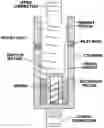
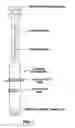
DESCRIPTION OF THE FIGURESFIG. 1 shows a two diameter piston pump.
FIG. 2 shows a rotary positive displacement pump with two diameters with piston spring coupling. Here one piston is partially within the other.
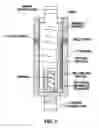
FIG. 3 shows a different embodiment of a two diameter pump with spring coupling.
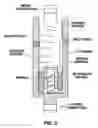
FIG. 4 shows an embodiment with magnet coupling.
Various figures and illustrations have been presented to better explain the present invention. The scope of the present invention is not limited to the figures.
DESCRIPTION OF THE INVENTION
Multiple port positive displacement pumps offer the biosciences the capability of having multiple pump capability in one pump. The use of as many as nine or more ports in one pump allows a single pump to be connected to an eight channel pipettor where each of the eight channel volumes can be individually adjusted. At least one of the multiple port pump ports can be an inlet port. The inlet port can be attached to a buffer solution used for washing any of the output channels. When a multiple port pump is designed, it is necessary to provide adequate distance between each of the pump ports in order to make an effective seal. The distance between ports is related to the fluid properties being pumped and that of the fluid internal pressure developed as the pump is used. A typical pump could have around 7 mm spacing between ports with port apertures of around 2.3 mm diameter. The piston diameter for such a pump could be around 30 mm. For this particular example, the effective surface area for the piston is around 706.5 square mm. Different ports can be accessed by simply rotating the piston.
When a pump with a piston of around 30 mm is used, a piston movement of around 1 mm can result. This would result in around 706 micro-liters of fluid being dispensed. The dispensing of small micro-liter volumes could require a linear piston motion of around 7 microns. It is very hard to control such a small linear motion.
The present invention solves this problem by using a dual or multi diameter piston and chamber on a multiple inlet/outlet pump. This greatly diminishes the piston effective area. For example, if the primary piston is around 30 mm in diameter, the face surface area is around 706.5 square mm. If the second diameter of the dual diameter piston is only around 28 mm, the surface area is around 615.1 square mm. This results in the dispensing of only around 91.1 micro-liters of fluid for each 1 mm of piston travel. The motion for a 5 micro-liter dispense would thus be around 55 microns. The difference between the two piston diameters can be further reduced to enhance small volume multiple port dispensing. Piston arrangements with more than two diameters are within the scope of the present invention.
FIG. 1 shows a pump with two piston diameters configured in one piston as a single piece. This pump has multiple input and output ports. A piston groove on the larger and smaller pistons is used to keep them aligned.
FIG. 2 shows a cross-section of a pump with two piston diameters configured in a piston-in-a-piston approach where the internal piston can be spring loaded. Here the spring is used to keep the pistons together on the up-stroke, and direct contact is used to push them together on the down-stroke.
FIG. 3 shows a cross-section of a pump where one of the pistons is located in line with the primary piston and is also spring loaded. This embodiment functions in a manner similar to the embodiment of FIG. 2.
FIG. 4 shows a cross-section of a pump where one of the pistons is located in line with the primary piston and is magnetically coupled to it. Here, the two pistons cooperate with each other by being held together with the two magnets. In this arrangement, it is easy to separate the two pistons for cleaning.
The various pump configurations shown in FIGS. 1-4 can be fabricated out of various materials such as stainless steel, ceramic, glass or plastic. Any rigid material can be used to construct such a pump and is within the scope of the present invention. It is preferred that the material used be immune to corrosion or chemical reaction with the fluid being dispensed.
The secondary piston can follow the primary piston making the pump's entire stroke volume equal to the area difference between the two diameters times the stroke length. However, it is not necessary that the secondary piston follow the primary piston throughout the entire stroke. The defined movement of the secondary piston can be anywhere from very small to that of the entire stroke. Optionally, the secondary piston can have a convex curvature where it meets the primary piston thus minimizing the amount of contact area.
Various descriptions and illustrations have been presented to better aid in understanding the present invention. One skilled in the art will understand that many changes and variations are possible. All such changes and variations are within the scope of the present invention.
Claims
1. A multiple-port, dual-diameter piston pump comprising:
a first piston having a first diameter;
a second piston having a second diameter smaller that said first diameter;
a plurality of input ports, said input ports being selected by rotation of at least one of said first and second piston;
a plurality of output ports, said output ports being selected by rotation of at least one of said first and second piston;
said first and second piston cooperating to cause fluid to be drawn in one of said input ports and dispensed from one of said output ports.
2. The pump of claim 1 wherein said pistons are coupled with a spring.
3. The pump of claim 1 wherein said pistons are coupled by magnets.
4. The pump of claim 1 wherein said second piston is partially contained within said first piston.
5. The pump of claim 1 wherein said pistons are stainless steel.
6. The pump of claim 1 wherein said pistons are plastic.
7. A method of dispensing micro-liters of fluid comprising;
providing a pump with multiple input and output ports and at least two pistons of different diameters, said pistons cooperating to move linearly to dispense fluid, one of said pistons being a lower piston of smaller diameter than the other of said pistons;
rotating at least one of said pistons to an input port location;
moving said pistons linearly in a direction to load fluid into said pump from said input port;
rotating at least one of said pistons to an output port location;
moving said pistons linearly in a direction to dispense fluid from said output port.
8. The method of claim 7 wherein said pistons are stainless steel.
9. The method of claim 7 wherein said pistons are plastic.
10. The method of claim 7 wherein said pistons are spring-coupled.
11. The method of claim 7 wherein said pistons are magnetically coupled.
Images & Drawings included:

Sources:
- United States Patent and Trademark Office - verify current appl. status at the USPTO↗
Recent applications in this class:
- » 20150275869 2015-10-01
Pumping system with plunger having a shaped edge and coating