Hanging overhead crevice simulator
US20050164834A1
2005-07-28
10/757,662
2004-01-14
Abstract:
A portable simulated overhead crevice apparatus for rock climbing practice designed to be easily suspended from fixed points. The invention comprises a structure with an internal sub-frame (1) with a rough covering (4) to simulate the look and feel of natural rock. Along the underside length is a pronounced concave longitudinal furrow. There is a plurality of apertures along the upper-side (3) and a plurality of apertures situated about the apparatus (5) through which a flexible elongated support member (7) and a flexible elongated stabilization member (6) may be removably coupled to suspended and stabilize the apparatus at various elevations and orientations from fixed points about the apparatus, such as rafters, trees, and other structures specifically constructed for the purpose of suspending the invention. There exists at least one member (2) of the sub-frame which spans the furrow and to which a safety line may be removably coupled. The apparatus is useful as a teaching medium to allow students to practice climbing simulated overhead crevices in rocks in a safe and accessible manner, as well as vertical and other orientations, and is suitable for sporting activities in commercial establishments as well as private settings.
Interested in similar patents?
Get notified when new applications in this technology area are published.
Classification:
A63B69/0048 » CPC main
Training appliances or apparatus for special sports for mountaineering, e.g. climbing-walls, grip elements for climbing-walls
A63B2208/0285 » CPC further
Characteristics or parameters related to the user or player posture Hanging
Description
CROSS-REFERENCE TO RELATED APPLICATIONSNot Applicable.
BACKGROUND OF THE INVENTION1. Background of the Invention—Field of Invention
The invention concerns the field of physical and sporting activities, and relates to an artificial training apparatus for rock climbing, in particular to simulate overhead crevices.
2. Background of the Invention—Description of Prior Art
Rock climbing is an activity that is enjoyed by many, and can be enjoyed on natural rock formations or on conventional climbing walls. Rock climbing provides exceptional cardiovascular exercise, working both upper and lower body muscle groups. Climbing on natural rock formations presents hazards due to inclement weather, high elevations, loose rocks, critters, and other hazards, which may pose harm or cause intimidation to many people.
Rock climbing walls present an alternative to climbing on natural formations. Rock climbing walls are known, generally consisting of a structure about a vertical plane on which simulated rock is found, or upon which blocks to simulate handholds and footholds found on rocks are found. Conventional climbing walls are typically constructed on site, and require a level of skill and cost not readily available to most climbing enthusiasts. There are essentially two types of climbing walls used to simulate rock climbing activities. The first type of climbing wall includes a vertical or substantially vertical wall which includes a rough, rock-like surface (see e.g., U.S. Pat. No. 5,254,058). With this type of wall shape, or texture, of the climbing wall determines the level of difficulty associated with maneuvering around on the wall. The second type of climbing wall includes rock-like hand/foot holds which are attached to a more or less planar wall (see e.g., U.S. Pat. No. 5,125,877). With this second type of wall, the shape and placement of the hand/foot hold determines the level of difficulty associate with maneuvering about the wall. There are also climbing apparatuses that are specifically designed for climbing activity by children (see, e.g., U.S. Pat. Nos. 5,816,980, 5,634,687, 5,177,926 and D374,902).
Practicing climbing overhead crevices is desirable to climbing enthusiasts; however, conventional climbing walls are vertical or near vertical and do not simulate overhead crevices. There are devices which attempt to simulate climbing the climbing of overhangs, surfaces which are more or less coplanar with the surface of the Earth, by including elements of these two types of climbing walls (see e.g., U.S. Pat. No. 5,092,587). Finally, as practicing climbing overhead crevices involves losing grip at times and falling, there is no practical way to practice using conventional climbing walls without safety measures such as harnesses.
A need exists for an inexpensive apparatus which simulates a crevice whether vertical or overhead, is easily moved, can be installed in various settings; is modular so that short and long crevices can be simulated; can be made to simulate various depths, widths, and types of crevices; and can be raised and lowered independently at either end to allow the user to adjust the height to a level which is safe given the skill level of the user and to simulate rock crevices at varying angles.
BRIEF SUMMARY OF THE INVENTIONIn accordance with the present invention a portable simulated overhead crevice apparatus for rock climbing practice designed to be easily suspended from fixed points
Brief Summary of the Invention—Objects and Advantages
It is an object of the present invention to provide a device for simulating an overhead crevice apparatus.
It is another object to provide a device for simulating an overhead crevice apparatus which can be conveniently installed in various settings such as from ceilings, trees, and other structures, including structures designed for the purpose.
It is a further object to provide a device for simulating an overhead crevice apparatus which can be used modularly to simulate short and long crevices by connecting together modular components.
It is further still an object to provide a device for simulating an overhead crevice apparatus which can be used and transported in and to different locations by the user.
It is also an object to provide a device for simulating an overhead crevice apparatus which simulates the look and texture of natural rock.
It is yet another to provide a device for simulating an overhead crevice apparatus while allowing users to grasp all surfaces of the apparatus.
It is still further an object to provide a device for simulating an overhead crevice apparatus of which the elevation can be adjusted independently at each end by the user so that the user can simulate crevices at various angles relative to the surface of the earth.
It is still further an object to provide a device for simulating an overhead crevice apparatus of which the elevation can be adjusted independently at each end by the user so that the user can simulate crevices at various heights above the ground, providing a range of safety and accessibility options.
It is still yet anther object to provide a device for simulating an overhead crevice apparatus which can be used in various settings, including indoors to avoid inclement weather, and outdoors, to simulate climbing in inclement weather.
Further objects, features, and advantages of the invention will be apparent from the following detailed description when taken in conjunction with the accompanying drawings.
For purpose of illustration of this invention a preferred embodiment is shown and described hereinbelow in the accompanying drawing. It is to be understood that this is for the purpose of example only and that the invention is not limited thereto.
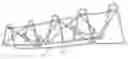
BRIEF DESCRIPTION OF THE SEVERAL VIEWS OF THE DRAWINGFIG. 1 is a perspective view of the invention.
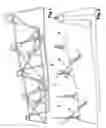
FIG. 2 is a cross sectional view similar to FIG. 1 with parts broken away showing the internal structure of the preferred embodiment.
BRIEF DESCRIPTION OF THE SEVERAL VIEWS OF THE INVENTION—REFERENCE NUMERALS IN DRAWINGS
- 1. Internal sub-frame of the apparatus.
- 2. Support brace for purposes of attaching a safety line.
- 3. Apertures for purposes of suspending the apparatus.
- 4. Outer rock-like covering of the apparatus.
- 5. Apertures for purposes of stabilizing the apparatus.
- 6. Flexible elongated stabilization member which may be removably coupled to the apparatus for purposes of suspension and stabilization.
- 7. Flexible elongated support member which may be removably coupled to the apparatus for purposes of suspension and stabilization.
The present invention provides for a portable simulated overhead crevice apparatus for rock climbing practice designed to be easily suspended from fixed points. The apparatus comprises a structure with a rough covering to simulate the look and feel of natural rock, with a pronounced concave longitudinal furrow along the underside length of the apparatus, and with a plurality of apertures situated about the apparatus through which flexible elongated members may be removably coupled to suspended and stabilize the apparatus at various elevations and orientations from fixed points about the apparatus, such as rafters, trees, and other structures specifically constructed for the purpose of suspending the invention. The apparatus is useful as a teaching medium to allow students to practice climbing overhead crevices in rocks in a safe and accessible manner, as well as vertical and other orientations, and is suitable for sporting activities in commercial establishments as well as private settings.
Detailed Description of the Invention—FIGS. 1 and 2
Turning now descriptively to the drawings, as shown in FIG. 2, the simulated rock surface of the apparatus is a three dimensional structure with the cross-section resembling a rounded, inverted “V” so that in its most usual orientation there is a pronounced concave longitudinal furrow on the underside. There is a plurality of apertures situated on the upper-side of the apparatus through which an flexible elongated support member may be removably coupled and attached to stationary points above the apparatus such that the apparatus can be suspended at varying heights and orientations. There is also a plurality closed loop members situated on the outer-sides of the apparatus through which an flexible elongated stabilization member may be removable coupled and attached to stationary points about the apparatus for the purpose of stabilizing the apparatus at various angles and for purposes of minimizing movement during usage.
The apparatus as shown in FIG. 1 has integrated stiff structural internal sub-frame which comprise a rigid sub-frame (1) upon which and to which the simulated rock surface (4) is affixed. The preferred embodiment of the apparatus is of a steel sub-frame (1) and concrete cover (4), but other materials such as plastic and epoxy and resin may be used. Certain members of the sub-frame extend further above the sub-frame than others and describe an aperture (3) on the upper-side of the apparatus to which a flexible elongated support member (7) may be removably coupled to suspend the apparatus from stationary points above the apparatus for purposes of suspending the unit therefrom. Other members of the sub-frame extend from the sides of the apparatus and describe an aperture (5) to which a flexible elongated stabilization member (6) may be removably coupled to suspend the apparatus at various angles and to minimize movement of the apparatus during usage. There exists at least one member (2) of the sub-frame which spans the furrow and to which a safety line may be removably coupled.
Detailed Description of the Invention—Conclusion, Ramifications, and Scope
From the description above, it is evident that the hanging overhead crevice simulator has the advantages that:
-
- a) The invention can be conveniently installed in various settings such as from ceilings, trees, and other structures, including structures designed for the purpose.
- b) The invention can be used modularly to simulate short and long crevices by connecting together modular components.
- c) The invention can be used and transported in and to different locations by the user.
- d) The invention simulates the look and texture of natural rock.
- e) The invention allows users to grasp all surfaces of the apparatus.
- f) The invention can be adjusted independently at each end by the user so that the user can simulate crevices at various angles relative to the surface of the earth.
- g) The invention can be adjusted independently at each end by the user so that the user can simulate crevices at various heights above the ground, providing a range of safety and accessibility options.
- h) The invention can be in various settings, including indoors to avoid inclement weather, and outdoors, to simulate climbing in inclement weather.
Although the description above contains much specificity, this should not be construed as limiting the scope of the invention but as merely providing illustrations of some of the presently preferred embodiments of this invention. For example, the materials presented above are steel and concrete, but other materials such as epoxy and resin may be used to effect the functional shape of the invention. Thus, the scope of the invention should be determined by the appended claims and their legal equivalents, rather than by the examples given above.
Claims
1. A hanging overhead crevice simulator apparatus comprising a structure of rigid material with a cross-section resembling a rounded, inverted “V” with a pronounced concave longitudinal furrow on the underside length and a plurality of apertures through which an flexible elongated member may be removably coupled to suspend and stabilize the same from fixed points about the apparatus.
2. The apparatus as recited in claim 1, further comprising a plurality of closed loop members extending from the apparatus wherein a flexible elongated member may be removably coupled to suspend and stabilize the apparatus from fixed points about the apparatus.
3. The apparatus as recited in claim 1, further comprising at least one support brace spanning the furrow to which a support line may be removably coupled.
4. The apparatus as recited in claim 1, further comprising a plurality of the apparatuses in claim 1 contiguous with one another thereby extending the longitudinal furrow in a multitude of orientations and configurations.
Images & Drawings included:
Sources:
- United States Patent and Trademark Office - verify current appl. status at the USPTO↗
Recent applications in this class:
- » 20250090923 2025-03-20
SYSTEMS AND METHODS FOR PROVIDING AN ADJUSTABLE CLIMBING WALL - » 20250065207 2025-02-27
ADJUSTABLE-INCLINE CLIMBING WALL - » 20250050185 2025-02-13
ADJUSTABLE, VARIABLE STEP CAMPUS BOARD - » 20240390758 2024-11-28
INTERFACE APPARATUS AND CLIMBING EXPERIENCE SYSTEM - » 20240382816 2024-11-21
RECYCLABLE REMOVABLE CLIMBING GRIP FOR AN ARTIFICIAL CLIMBING STRUCTURE AND ARTIFICIAL STRUCTURE COMPRISING SAID GRIP - » 20240278100 2024-08-22
FAST-ROPE TRAINING APPARATUS - » 20240261654 2024-08-08
Climbing training device - » 20240245967 2024-07-25
ROTATING CLIMBING WALL - » 20240157212 2024-05-16
Climbing Wall - » 20240091617 2024-03-21
MULTI-PURPOSE ADJUSTABLE-INCLINE CLIMBING WALL