Fencing panels
US20050167643A1
2005-08-04
10/770,962
2004-02-03
Abstract:
A translucent fencing panel (10) allows light to pass through whilst maintaining privacy. The fencing panel is made up of a frame (11) within which is situated a sheet of translucent material (19). The sheet of translucent material (19) rests within a longitudinal groove (31) formed within the frame (11). Slats (20) can be arranged over the sheet of material to provide different visual effects. In some embodiments a gravelboard (63) is included. The fencing panels (10) are provided with brackets (18) so that they can be secured to existing fence posts (17).
Interested in similar patents?
Get notified when new applications in this technology area are published.
Classification:
E04H17/16 » CPC main
Fencing, e.g. fences, enclosures, corrals; Fences constructed of rigid elements, e.g. with additional wire fillings or with posts using prefabricated panel-like elements, e.g. wired frames
Description
FIELD OF THE INVENTIONThe present invention relates to fencing panels, in particular panels that are at least partially translucent.
BACKGROUND OF THE INVENTIONMany people with gardens use fences to mark the boundary of their property and to provide privacy from their neighbors. Fences are either opaque and cast a shadow when the sun is out, or they have gaps to allow light through. Therefore people, especially those with small gardens, are often forced to choose between privacy and light. This can be a particular problem where the fencing needs to be situated on the south or west sides of gardens (in the Northern hemisphere at least).
The shade caused by fences can inhibit the growth of certain plants, and create shadows in areas of the garden where people would rather enjoy the sunlight.
SUMMARY OF THE INVENTIONThe invention, which is defined by the claims set forth at the end of this document, is directed to methods and apparata which at least partially alleviate the aforementioned problems. A basic understanding of some of the preferred features of the invention can be attained from a review of the following brief summary of the invention, with more details being provided elsewhere in this document. Reference is also made to the corresponding UK Patent Application GB 2380209A, which is incorporated herein by reference.
An object of the present invention is to provide a fencing panel that is at least partially translucent thereby enabling light to pass through.
According to a first aspect of the present invention, there is provided a fencing panel, wherein the fencing panel is securable to at least one fence post and wherein the fencing panel is at least partially translucent. The translucent fencing panel allows light to penetrate a fence. It also enables colors and shadows to be seen through it, but not in so much detail that privacy is compromised.
Preferably, the parts of the panel that are not translucent are opaque. This ensures maintenance of privacy.
Preferably, the fencing panel includes: a frame; and at least one sheet of material located within the frame; wherein at least one sheet of material is at least partially translucent.
In a preferred embodiment, the fencing panel further includes more than one internal frame, within each of which is accommodated at least one sheet of material. Such an arrangement allows different effects to be provided by the different sheets of material provided within each internal frame.
Preferably three internal frames are provided, each internal frame accommodating a sheet of material. This arrangement allows simple manufacture of the basic unit, which can then be modified according to different designs.
In a preferred embodiment, the frame includes a groove or rebate and bead along the internal edges thereof, the edges of the sheet of material being located within said groove. This provides support for the sheet of material.
In a further preferred embodiment, at least one slat arranged across the surface of the sheet of material. This allows different designs to be easily produced to meet different users' tastes.
Preferably the slats are secured by attachment to the frame. This provides extra support to the sheet of material. Alternatively the slats may be attached to the sheet of material.
In a preferred embodiment, a slat on one side of the sheet of material is attached to a slat on the other side of a sheet of material. This arrangement helps to prevent warping.
Preferably, the fencing panel further includes a gravelboard panel located below the frame.
The fencing panel preferably further includes at least one planter, light or water feature.
Preferably the fencing panel includes more than one sheet of material and at least one substantially vertical slat of differing material with strips of plastic between each sheet of material.
Preferably the fencing panel includes at least one substantially vertical slat of differing material where a single sheet of plastic sheet material is woven alternately between the vertical slats.
Preferably the fencing panel includes at least one substantially vertical slat of differing material where strips of plastic sheet material are woven alternately between the vertical slats.
According to a second aspect of the present invention, there is provided a gate panel, wherein the gate panel is securable to at least one gate post and wherein the gate panel is at least partially translucent.
Preferably the gate panel includes: a frame; at least one sheet of material located within the frame; wherein at least one sheet of material is at least partially translucent.
According to a third aspect of the present invention, there is provided an outdoor structure including a panel, wherein the panel is at least partially translucent.
Preferably the panel of the outdoor structure includes: a frame; at least one sheet of material located within the frame; wherein at least one sheet of material is at least partially translucent.
According to a fourth aspect of the present invention, there is provided a kit of parts for a fence including: an at least partially translucent fencing panel, securable to at least one fence post; and at least one fence post.
Advantageously, the kit further includes brackets and fixings for assembly of the fence.
Further advantages, features, and objects of the invention will be apparent from the following detailed description of the invention in conjunction with the associated drawings.
BRIEF DESCRIPTION OF THE DRAWINGSExemplary versions of the present invention are described below, by way of example only, with reference to the accompanying drawings, in which:
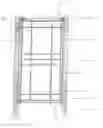
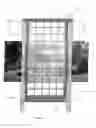
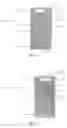
FIG. 1 is a front view of an embodiment of a fencing panel;
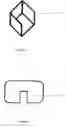
FIG. 2 is a perspective view of a bracket used in the construction of the fencing panel of FIG. 1;
FIG. 3 is a typical cross section of the frame of the fencing panel of FIG. 1;
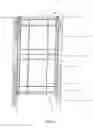
FIG. 4 is a front view of an alternative embodiment of a fencing panel;
FIG. 5 is a front view of a further alternative embodiment of a fencing panel;
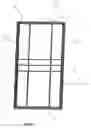
FIG. 6 is a front view of another embodiment of a fencing panel;
FIG. 7 is a front view of another embodiment of a fencing panel;
FIG. 8 is a front view of another embodiment of a fencing panel;
FIG. 9 is a front view of another embodiment of a fencing panel;
FIG. 10 is a front view of another embodiment of a fencing panel;
FIG. 11 is a front view of another embodiment of a fencing panel;
FIG. 12 is a front view of another embodiment of a fencing panel;
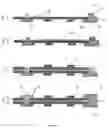
FIG. 13 is a series of partial plan sectional views of a further embodiment of a fencing panel;
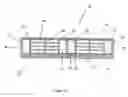
FIG. 14 is a front view of a modification of the fencing panel of FIGS. 6 to 12; and
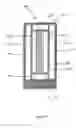
FIG. 15 is a front view of a further embodiment of a fencing panel.
DETAILED DESCRIPTION OF PREFERRED EMBODIMENTS OF THE INVENTIONFIG. 1 shows a translucent fencing panel 10. The panel 10 comprises a rectangular wooden frame 11, made up of two side portions 12, 13, each 1200 mm in length, an upper portion 14 and a lower portion 15, each 900 mm in length. The upper and lower portions 14, 15 are fixed to the side portions by pins 16.
A cross section of the frame 11 is shown in FIG. 3. In this embodiment, the frame 11 is formed with a longitudinal groove 31 or rebate and bead. Longitudinal groove 31 receives a sheet of translucent ultraviolet-tolerant polypropylene twin-wall sheeting 19, which fills frame 11.
Wooden slats 20 are glued to each side of the polypropylene sheeting 19. In this embodiment, five horizontal slats and two vertical slats are provided.
The upper and lower portions 14, 15 of frame 11 are also fixed to the long edge of wooden fence posts 17 by brackets 18. Wooden posts 17 are arranged parallel to the side portions 12, 13 of frame 11.
In use, fence posts 17 are fixed into the ground to support fencing panel 10. Further fencing panels 10 are then situated adjacent to that already in place, with fence posts 17 between each panel, to form a fence of the desired length.
There are various advantages of the above-described arrangement.
Use of a wooden frame and posts allows the fencing panel to provide a boundary marker that would be easily integrated into a person's garden.
The panels are resistant to rain, heat and cold and also act as a wind-break.
There are various modifications that can be made to the above-described arrangement.
The panel need not be securable to fence posts by means of brackets. FIG. 5 illustrates an alternative method of securing the panel 10 to fence posts 17. Upper portion 14 of frame 11 extends beyond the position of side portions 12, 13 creating an overhang on each side of the frame 11. The underside of each overhang is provided with a pin 51, 52, each of which engages with the top end of a fence post 17. The lower end of each side portion 12, 13 of frame 11 is provided with a laterally extending pin 53, 54, each of which engages with one side of each fence post 17. Other suitable means of securing the panel to fence posts may be envisaged, such as use of metal plates, metal brackets, or plastic fixing devices.
The slats need not be glued directly to the translucent sheet. They may instead be attached to the frame. This can be effected by use of pins, screws, mortice and tenon joints. FIG. 4 shows a fencing panel 10 with an alternative arrangement of slats 20. The slats 20 are fixed to frame 11 rather than to translucent sheet 19. The slats 20 thus provide extra support to the sheet.
A second embodiment of the present invention is illustrated in FIG. 6. Fencing panel 10 is comprised of a frame 11. In addition to the upper, lower, and side portions 14, 15, 12 13, the frame comprises internal portions 61, 62, arranged to form three internal frames. Each internal frame houses a sheet of translucent ultraviolet-tolerant polypropylene twin-wall sheeting 19. In other words, in this embodiment, three sheets of translucent material extending the full height of the frame (a left border panel, a right border panel, and a center section panel) are provided.
This embodiment also further includes a 200 mm wide gravelboard 63.
In this embodiment twelve slats 20 are arranged horizontally across the central internal frame, and one slat 20 is arranged vertically across the central internal frame. In other embodiments, different numbers of slats, arranged vertically, horizontally, or even diagonally may be provided.
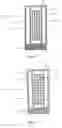
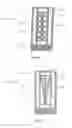
FIGS. 7 to 12 show modifications of this embodiment. It can be seen from FIGS. 6 to 12, that all the panels 10 have the same basic frame structure comprising in this embodiment three internal frames formed by an upper portion 14, lower portion 15, two side portions 12, 13 and two internal portions 61, 62 of frame 11. Such a frame structure allows easy manufacture of a basic unit, which can be individualized by use of slats 20.
Construction of the fencing panels of a further embodiment of a fencing panel is shown in FIG. 13. Upper portion 14, to which is glued two vertical slats 20, is attached by pins 16 within a recess 131 of side portion 12 and internal portion 61 of frame 11 (A). The sheet of polypropylene 19 is laid upon the structure (B), then glued to a second portion of frame 11 (C). The structure is stabilized by further pins 16. Finally, a securing portion of side and internal portions 12, 61 of frame 11 is pinned to the structure to hold the sheet of polypropylene in place within recess 131.
In the embodiments of FIGS. 6 to 13, some of the translucent sheets may be replaced by sheets providing different effects. For example, some sheets may have a reflective surface. The translucent sheeting may be used in combination with sheeting including mirrors or clear materials for example. FIG. 11 shows the use of metal or plastic meshed sheeting 111. In FIG. 12 it can be seen that some of the sheets may even be replaced by opaque sheets 121.
The gravelboard 63 could be a different size. In some embodiments, it is 500 mm wide instead of 200 mm wide.
There are various modifications that can be made to the above-described embodiments.
The frame does not have to be made of wood. It could be made from any suitable material for holding the transparent sheet in place. In particular, it could be made from plastic, or metals such as aluminum or steel. Preferably the metal would be resistant to rusting. It could be made from metal tubing.
The upper and lower portions of the frame could be joined to the side portions by any suitable means, for example, by screws, by glue or by mortice and tenon.
The frame could be of any size suitable for the desired application. For instance, a version having a frame with shorter side portions could be used on top of a wall (see FIG. 14). Extra wide panels could be the size of two “regular” panels, thereby reducing the number of panels required for a particular fence (for example, see FIG. 14).
The translucent sheeting could be made from any suitable translucent material. It could be made from polycarbonate, such as ultraviolet light-protected LEXAN (lightweight twin-walled polycarbonate sheeting), polypropylene, polythene, such as ultraviolet light-protected CORREX (lightweight polythene twin-wall sheeting) fibreglass or glass. The sheeting may be multi-walled or laminated to incorporate a metal or plastic strengthening mesh, perforated sheet or web-linked laminate. These materials are all available in various thicknesses, textures and degrees of translucency.
Different degrees of translucency may be utilized to provide different effects. The translucency of the sheeting may be formed by use of etching, sand blasting, paint-spraying or printing. The translucent effect may include motifs, for example of birds or plants. Different colors of translucent sheeting may be employed to provide different effects. The sheeting can be pre-folded and formed to provide pleats or curves 151 to provide different effects. An example of this is shown in FIG. 15.
The slats may be attached to the panel by any suitable means. Glue, pins, screws or mortice and tenon joints could be used, to fix the slats to the translucent sheet, to the frame, or to one or more of the internal frames.
Preferably, the slats on one side of the sheet are screwed to the slats on the other side of the sheet through holes drilled in the sheet. A spacer, typically 2 mm, is provided to prevent the screws from squeezing the sheet. Attachment of the slats on one side of the sheet to the slats on the other helps to prevent the slats from warping.
The slats can be used to create different visual effects. The slats may be arranged differently on each side of the fence panel, or may be present on only one side of the sheeting fence panel. The frame can incorporate designs such as classic French-style trellising or Japanese Shoji screens. FIG. 5 shows an example of how a fencing panel can be used to evoke a Japanese Shoji screen.
The panels need not form part of a fence. They may be free-standing. Free-standing panels may be arranged in different ways to create ornamental effects. The panels can also be used in the construction of garden buildings such as pergolas, sheds, arbors, outbuildings, car ports, play areas, or for dividing a space into sections. The panels can also be adapted for use as gates, doorways or external shutters for properties, courtyards, gardens, balconies and railings. The panels may slide one over another to form an opening.
The panels may be adapted to incorporate functional or decorative features such as plant containers, seating, water features, or artificial lighting. The panels may include more than one translucent sheet arranged in parallel, with an internal space between each sheet. Features such as water features or lighting could be situated between two sheets.
The features of the various described embodiments may be interchanged and/or combined as appropriate.
The invention is not intended to be limited to the preferred versions of the invention described above, but rather is intended to be limited only by the claims set out below. Thus, the invention encompasses all different versions that fall literally or equivalently within the scope of these claims.
Claims
1. A fencing panel, wherein the fencing panel is securable to at least one fence post and wherein the fencing panel is at least partially translucent.
2. The fencing panel of claim 1 in combination with at least one fence post, wherein the fencing panel and fence post are provided as a disassembled kit of parts.
3. The fencing panel of claim 1 wherein the parts of the panel that are not translucent are opaque.
4. The fencing panel of claim 1, wherein the panel includes:
a. a frame; and
b. at least one sheet of material located within the frame;
wherein at least one sheet of material is at least partially translucent.
5. The fencing panel of claim 4, further including more than one frame, each of which has at least one sheet of material located therein.
6. The fencing panel of claim 5, wherein three frames are provided, each frame accommodating a sheet of material.
7. The fencing panel of claim 4, wherein the frame includes a groove along the internal edges thereof, the edges of the sheet of material being located within said groove.
8. The fencing panel of claim 4, further including a gravelboard panel located below the frame.
9. The fencing panel of claim 4, further including at least one planter, light or water feature.
10. The fencing panel of claim 4, further including at least one slat arranged across the surface of the sheet of material.
11. The fencing panel of claim 10, wherein the slat or slats are secured by attachment to at least one of:
a. the frame, and
b. the sheet of material.
12. The fencing panel of claim 10 wherein a slat on one side of the sheet of material is attached to a slat on the other side of the sheet of material.
13. The fencing panel of claim 10, including more than one sheet of material and at least one substantially vertical slat of differing material with strips of plastic between each sheet of material.
14. The fencing panel of claim 10 including at least one substantially vertical slat of differing material where a single sheet of plastic sheet material is woven alternately between the vertical slats.
15. The fencing panel of claim 10, including at least one substantially vertical slat of differing material where strips of plastic sheet material are woven alternately between the vertical slats.
16. A gate panel, wherein:
a. the gate panel is securable to at least one gate post, and
b. the gate panel is at least partially translucent.
17. The gate panel of claim 16 wherein the parts of the panel that are not translucent are opaque.
18. The gate panel of claim 16, wherein the panel includes:
a. a frame; and
b. at least one sheet of material located within the frame;
wherein at least one sheet of material is at least partially translucent.
19. An outdoor structure including a panel, wherein the panel is at least partially translucent.
20. The outdoor structure of claim 19, wherein the parts of the panel that are not translucent are opaque.
21. The outdoor structure of claim 19, wherein the panel includes:
a. a frame; and
b. at least one sheet of material located within the frame;
wherein at least one sheet of material is at least partially translucent.
Images & Drawings included:
Sources:
- United States Patent and Trademark Office - verify current appl. status at the USPTO↗
Similar patent applications:
- » 20210165922
DESIGN AND CONSTRUCTION OF FENCE PANELS AND FENCE PANEL COMPONENTS - » 20210019454
Construction of fence panels and fence panel components - » 20240386151
DESIGN AND CONSTRUCTION OF FENCE PANELS AND FENCE PANEL COMPONENTS - » 20220374557
Construction of fence panels and fence panel components - » 20150315809
Security fence panel and security fence - » 20150048290
Fence clipping system having flexible arm and double-locking-head arm for hanging fence panels on one side of fence posts - » 20060196147
Fence Panel with interlock - » 20060169965
Pre-fabricated fencing panels - » 20080237560
Method of batch assembly of temporary fence panels and anchor blocks - » 20070090334
Molded decorative fence panel
Recent applications in this class:
- » 20240254801 2024-08-01
FENCE SYSTEM - » 20240191540 2024-06-13
Fence Gap Closer Device - » 20240141684 2024-05-02
DECORATIVE TOPPER SYSTEM AND METHOD - » 20240011320 2024-01-11
FENCE COVER AND FENCE COVER KIT - » 20220136279 2022-05-05
OUTDOOR PRIVACY ENCLOSURE - » 20220056727 2022-02-24
THE PRIVACY SCREEN - » 20210238881 2021-08-05
FENCE - » 20210040768 2021-02-11
Nonconductive, modular barrier assemblies and related methods - » 20200232250 2020-07-23
PREFABRICATED FENCING SYSTEM AND METHOD - » 20190218817 2019-07-18
FENCE SLAT AND FENCE SLAT LOCKING SYSTEM