Shock absorber for height adjustment
US20060196741A1
2006-09-07
10/547,754
2004-03-23
Abstract:
A shock absorber for controlling the height of vehicles that has a cylinder, a shock absorber piston including a piston rod. The piston rod is slidably mounted in the cylinder and has an end opposite to the piston extending sealingly through a first end of the cylinder, a second end of which is closed, and a shock absorber spring. The shock absorber spring is arranged between the shock absorber piston and a separating piston located at an end of the cylinder. The separating piston is sealingly slidable in relation to the cylinder wall and, together with the end of the cylinder, form a closed control chamber. A gas spring is connected to the control chamber via a shut-off valve.
Interested in similar patents?
Get notified when new applications in this technology area are published.
Classification:
F16F9/065 » CPC main
Springs, vibration-dampers, shock-absorbers, or similarly-constructed movement-dampers using a fluid or the equivalent as damping medium using both gas and liquid; Units characterised by the location or shape of the expansion chamber Expansion chamber provided on the upper or lower end of a damper, separately there from or laterally on the damper
B60G15/061 » CPC further
Resilient suspensions characterised by arrangement, location or type of combined spring and vibration damper, e.g. telescopic type having mechanical spring and fluid damper with a coil spring being mounted inside the damper
B60G17/08 » CPC further
Resilient suspensions having means for adjusting the spring or vibration-damper characteristics, for regulating the distance between a supporting surface and a sprung part of vehicle or for locking suspension during use to meet varying vehicular or surface conditions, e.g. due to speed or load; Characteristics of dampers, e.g. mechanical dampers Characteristics of fluid dampers
B62K25/04 » CPC further
Axle suspensions for mounting axles resiliently on cycle frame or fork
F16F9/44 » CPC further
Springs, vibration-dampers, shock-absorbers, or similarly-constructed movement-dampers using a fluid or the equivalent as damping medium; Details Means on or in the damper for manual or non-automatic adjustment; such means combined with temperature correction
B60G2202/30 » CPC further
Indexing codes relating to the type of spring, damper or actuator Spring/Damper and/or actuator Units
B60G2202/322 » CPC further
Indexing codes relating to the type of spring, damper or actuator; Spring/Damper and/or actuator Units; The spring being in series with the damper and/or actuator the damper being controllable
B62K2025/045 » CPC further
Axle suspensions for mounting axles resiliently on cycle frame or fork Suspensions with ride-height adjustment
B62K2025/048 » CPC further
Axle suspensions for mounting axles resiliently on cycle frame or fork with suspension manual adjustment details
F16F9/00 IPC
Springs, vibration-dampers, shock-absorbers, or similarly-constructed movement-dampers using a fluid or the equivalent as damping medium
Description
The present invention is concerned with a shock absorber according to the preamble of claim 1.
In many cases there is a need for enabling in a very easy manner the adjustment of the height of the vehicle over the ground—the road clearance—particularly for motorcycles. The following explanation of the invention is therefore concerned with the height adjustment of a motorcycle.
It is known to adjust or control the height above the ground of motorcycles. The height control is accomplished in such a way that oil or gas is respectively pumped into and allowed to flow back from a cylinder of a shock absorber by means of a pump provided on the motorcycle. Thereby, the shock absorber piston rod will glide to rise or lower the frame of the motorcycle via a suitable link connection to the rear wheel. The medium pumped in is acting ‘behind’ the shock absorber piston resulting in a direct influence on the characteristics of the spring of the shock absorber.
Another way to control the height is simply by screwing on a piston rod arranged for that purpose on the shock absorber. These both systems are laborious and require time-consuming effort that cannot be made instantaneously.
By the present invention, as defined in the characterizing part of claim 1, there is obtained a shock absorber having a height controlling function that allows an automated and instantaneous adjustment of the height position of the motorcycle only by means of the load of the motorcycle, i.e. the weight of the driver, and without influencing the spring characteristics of the shock absorber spring.
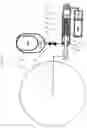
Exemplary embodiments of the invention will be closer described with reference to the drawing, wherein
FIG. 1 diagrammatically shows the invention in section and operating with a pulled shock absorber piston; and
FIG. 2 shows the invention correspondingly but having a pushed shock absorber piston.
In a known manner, the shock absorber piston generally comprises a cylinder 1 and a piston 2 having a piston rod 3. In a conventional manner, the shock absorber piston 2 is designed to have the ability to shock-absorbingly move back and forth in the oil-filled cylinder 1.
According to the invention, a separating piston 4 is arranged ir embodiment shown in FIG. 1, the separating piston 4 is sealing slidably against the cylinder wall and against the piston rod 3 that runs through the separating piston. In FIG. 1, a control chamber 6 is formed between the left end portion 5 of the cylinder 1, which end portion 5 is also sealed against the piston rod 3, and the separating piston 4. Through a line 7, control chamber 6 is in communication with a gas spring 8 which is known per se and is operating by oil or other incompressible medium. Line 7 is provided with a shut-off valve 9. Further, a compression spring 10 is arranged acting, on the one hand, against shock absorber piston 2 and, on the other hand, against separating piston 4. Numeral 13 designates an accumulator which is present at shock absorbers for the purpose of their normal function and will therefore not be further described herein.
The pressure in the gas spring 8 is so controlled that when the motorcycle is unloaded and the valve 9 is open, the pressure is sufficiently large for pushing the separating piston 4 to the right In FIG. 1, pushing piston 2 and piston rod 3 via spring 10 likewise to the right in FIG. 1. The motorcycle thereby acquires its highest ground clearance. If the driver when sitting on the motorcycle wishes to lower the clearance, the valve 9 is opened. Due to the increasing load from the driver on the motorcycle, piston 2 and rod 3 will be moved to the left in FIG. 1. Spring 10 now exerts a pressure on separating piston 4 to the left in FIG. 1. The situation is now that the pressure of gas spring 8 is so controlled that the increasing pressure in control chamber 6 due to the pressure of spring 10 on separating piston 4 is sufficiently large to overcome the action from the gas spring in the control chamber 6, resulting that piston 2 and rod 3 can be displaced to the left in FIG. 1. This position of the piston rod implies that the motorcycle acquires the lowest ground clearance. If the valve 9 is closed in this position, the motorcycle will maintain this ground clearance.
As soon as the motorcycle is unloaded and valve 9 is open, for example by the driver putting his/her feet on the ground and raising, the motorcycle will follow after, i.e. rise to its previous highest ground clearance. Different height positions can be set by closing valve 9 at the acquired height position. In FIG. 1, numeral 11 indicates an angled link arm to be connected to the wheel suspension, and numeral 12 indicates an articulated joint to the motorcycle frame. 11 and 12 constitute expedient measures obvious for the skilled person outside the scope of the invention.
It is to be pointed out that the movements of the separating piston 4 are here relatively small in order to obtain the desired function. It is of course also understood that the spring and shock dampening functions all the time works for different settings of the height positions of the motorcycle, i.e. the positions of the separating piston 4.
FIG. 2 shows a section corresponding to that of FIG. 1 but differing by the piston and rod, instead for being pulled against the action of spring 10 according to FIG. 1, are pushed against the spring that accordingly acts between the shock ab separating piston 4, which is now located to the right in FIG. 2 and which defines the control chamber 6 together with the other end of the cylinder. Thereby the requirement that the piston rod should run through the separating piston 4 is eliminated. Otherwise, also this embodiment functions as that already described in connection with FIG. 1.
It is to be understood that of course also other types of vehicles than motorcycles can make use of the principle described above according to the invention.
Claims
1. A shock absorber for controlling the height of vehicles, comprising:
a cylinder (1), a shock absorber piston(2) including a piston rod (C) slidably mounted in the cylinder and having an end opposite to the piston extending sealingly through a first end (5) of the cylinder, a second end of which is closed,
a shock absorber spring (10) being arranged between the shock absorber piston (2) and a separating piston (4) located at an end of the cylinder (1), the separating piston (4) being sealingly slidable in relation to the cylinder wall and, together with the end of the cylinder, forming a closed control chamber (6),
a gas spring (8) being connected to the control chamber (6) via 4 a shut-off valve (9), when a certain load is acting on the piston rod (3) and when the shut-off valve (9) is open, the pressure from the gas spring (8) acting on the separating piston (4) is higher than the pressure from the spring (10) on the separating piston (4), and when a larger load is acting on the piston (3) and thereby on the spring (1C) acting against the separating piston (4}, the pressure in the control chamber (6) is higher than the pressure in the gas spring (8).
2. The shock absorber according to claim 1 wherein the separating piston (4) is located at the first end of the cylinder and is sealingly slidable in relation to the piston rod (3) running sealingly through the separating piston (4).
3. The shock absorber according to claim 1 wherein the separating piston (4) is located at the second end of the cylinder.
4. The shock absorber according to claim 1 wherein the shock absorber is mounted on a motorcycle.
Images & Drawings included:


Sources:
- United States Patent and Trademark Office - verify current appl. status at the USPTO↗
Similar patent applications:
- » 20070169784
Piston load of vehicle height adjusting shock absorber and method of machining the same - » 20070170027
PISTON LOAD OF VEHICLE HEIGHT ADJUSTING SHOCK ABSORBER AND METHOD OF MACHINING THE SAME - » 20090008847
Height Adjustable Shock Absorber - » 20240116323
HEIGHT ADJUSTABLE SHOCK ABSORBER TOP MOUNT - » 20170267208
Shock absorbing height adjusters for restraint systems and associated systems and methods - » 20200130775
Shock absorbing and height adjusting structure - » 20220071833
Shock absorber under arm adjustable height walking crutch - » 20220379677
SHOCK ABSORBER ASSEMBLY WITH ADJUSTABLE HEIGHT - » 20240227488
Shock absorber with vehicle height adjustment function - » 20150061243
Air shock absorber with smart suspension system with height adjustment without losing comfort and safety
Recent applications in this class:
- » 20240376950 2024-11-14
GAS SPRING WITH HYDRAULIC ACCUMULATOR - » 20240369122 2024-11-07
DAMPING SYSTEM COMPRISING A FLUID DAMPER AND A FLUID RESERVOIR - » 20240093748 2024-03-21
SINGLE PIECE SHOCK BODY - » 20230112874 2023-04-13
HYDROPNEUMATIC SUSPENSION COMPONENT - » 20220325772 2022-10-13
UNIVERSAL TUBE ADAPTOR AND SHOCK ABSORBER INCLUDING THE SAME - » 20220049753 2022-02-17
Damper assembly - » 20210372499 2021-12-02
Telescopic damper assembly - » 20210164532 2021-06-03
Rotary damper, particularly for vehicle suspension - » 20200318705 2020-10-08
APPARATUS AND METHODS FOR A VEHICLE SHOCK ABSORBER - » 20190346006 2019-11-14
Multi-stage shock absorber and method for using the same