Add-on hook and rod assembly
US20060231516A1
2006-10-19
11/108,166
2005-04-18
Abstract:
This invention uses two small parts to make an easily assembled clothes hanger add-on attachment to be used in conjunction with wire shelves so as to allow uninterupted slidability of clothes hangers while retaining strength durability, low cost and ease of manufacture. The add-on hook and rod assembly is usable for both wide web and narrow web wire shelving. No fasteners are required. The existing hung garments do not have to be removed to install this system. Individual garments may be transferred after a completion.
Interested in similar patents?
Get notified when new applications in this technology area are published.
Classification:
A47B61/003 » CPC main
Wardrobes Details of garment-holders
A47B96/06 » CPC further
Details of cabinets, racks or shelf units not covered by a single one of groups - ; General details of furniture Brackets or similar supporting means for cabinets, racks or shelves
A47F5/0068 » CPC further
Show stands, hangers, or shelves characterised by their constructional features; Show shelves Shelf extensions, e.g. fixed on price rail
A47G25/0692 » CPC further
Household implements used in connection with wearing apparel; Dress, hat or umbrella holders; Dress holders; Dress suspending devices; Clothes-hanger assemblies; Clothing lifters; Clothes hooks; Clothes racks; Garment-supporting stands with swingable or extending arms Details of rods for suspending clothes-hangers
A47F7/00 IPC
Show stands, hangers, or shelves, adapted for particular articles or materials
Description
BACKGROUNDIn the past, closets were equiped with garment hanger rods made from wood dowels or galvanized pipe. A high percentage of todays shelving is wire—form welded aluminum which provides a longitudinal lower rod for hanging garments using a variety of hanger designs. There are two types of shelving: those where the transverse rods are bent at the front downward vertically and welded to a lower longitudinal rod. The spacing of the trans-verse rods vary by fabricators. Some are one inch and others are 12 inches in their spacing. The one inch space allows no slidability and the 12 inch improves that factor. This invention provides the maximum slidability by simply hanging the add-on hook with the small radius bend on the upper front longitudinal shelf rod every 12 inches. The wooden add-on-rod, with the slotted bottom, is pressed onto upward facing bend of the lower add-on hook. One-quarter inch of the add-on hook should be exposed at each end of the rod. By adding additional hooks and rods, a continuous slidable rod is created.
SUMMARY OF INVENTIONThis invention has two (2) small, individualy removable parts. The homeowner will find them easy to handle and install. The hook is “S” shaped with a small bend at the top, facing backward and downward; a stem extending downward vertically; a large foward-bend at the bottom ending upward to the tangent point; extending upward ¼ inch parallel to the stem. The rod is 12 inches long is rounded on top and slotted the entire length of the rod on the bottom. To assemble, two hooks are hung on the upper front transverse rod of the shelf spaced 12″ apart; a rod is pressed onto the upward facing end of the hook, leaving ¼″ exposed at both ends; going in either direction, one rod and hook are added to provide any length without the use of fasteners. Garments do not have to be removed from their current placement until the installation is completed.
DESCRIPTION OF INVENTIONThe add-on hook is cut, to a length of 6.75 inches, from ⅛″×½″ cold rolled flat steel: the hook top is bent into half circle with a ⅜″ dia. facing backward and downward; the stem goes vertically downward; the lower hook is bent forward and upward with a 1¼″ dia. to a half circle tangent point; extending upward ¼″ parallel to the stem of the hook; the add-on rod is made of maplewood; it is ½″ wide, by ⅝″ high by 12″ long; has a rounded top; a slot ¼″ high by ⅛″ wide that runs the entire length of the rod on the bottom; to assemble, two hooks are placed 12″ aprart and a rod pressed onto the upward facing end of the hook, leaving a ¼″ exposed at each end; only one hook and one rod are required to go in either direction to make any length of continuous hanger rod.
FIELD OF SEARCH; 248/220.2., 222.2, 251,304,305.317,339,340, 211/90,94,105.1,106.123, 162,181.
REFERENCES CITEDU.S. Patent Documents
-
- U.S. Pat. No. D349,000 Rogers et al Jul. 26,1994
- U.S. Pat. No. D352,195 Rogers et al Nov. 8, 1994
- U.S. Pat. No. 5,050,750 Mason September 1991
- U.S. Pat. No. 5,350,072 Rogers et al September 1994
- U.S. Pat. No. 5,405,026 Lee et al Apr. 11, 1995
- U.S. Pat. No. 5,351,416 Remmers Jul. 2, 1996
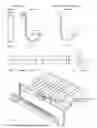
Views of add-on hook and rod assembly;
FIG. 1 Hanger hook; front view of upper bend, stem and lower bend
FIG. 2 Hanger hook; side view
FIG. 3. Hanger hook; side view of hanger hook and rod assembled
FIG. 4. Hanger rod; side view showing continuous slot
FIG. 5 Hanger rod; end view
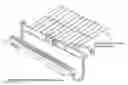
FIG. 6 Hanger hook and rod assembly in perspective (shelving not a part of this invention)
Claims
What I claim is my invention is;1. An add-on hanger hook and rod assembly for independent attachment to the top front transverse wire of a wire shelf, the wire shelf having a plurality of horizontally spaced lateral wires attached to and traversed by the transverse wire, the assembly compriising:
an “S” shaped support hook;
the support comprised of an upper hook having a half circle bend facing backward and downward ;a stem vertically downward; a lower hook having a half ciircle bend facing forward and upward to the tangent point; extending a ¼″ parallel to the stem; the upper hook being removably positioned between adjacent lateral wires on the upper transverse rod of the wire shelf; two support hooks required to be placed for the first rod segment; one thereafter.
a maplewood rod:
the rod of only 12″ in length; rounded on top; slotted on the bottom; removably attached to the support hooks when pressed onto the upward facing end of the hooks.
2. Assembly of add-on system may be accomplished without removing the garments from their current hanging position.
3. Garments may, in most cases, be moved from the original rod to the add-on rod; most hangers today are flexible plastic or have swivel hooks.
Images & Drawings included:
Sources:
- United States Patent and Trademark Office - verify current appl. status at the USPTO↗
Recent applications in this class:
- » 20250127296 2025-04-24
STORAGE SYSTEMS INCLUDING BACK CHANNELS AND WALLS MOUNTABLE ALONG THE BACK CHANNELS - » 20240180326 2024-06-06
Storage systems including back channels and walls mountable along the back channels - » 20230104539 2023-04-06
Wardrobe lift - » 20220338625 2022-10-27
J-HOOK ROD HOLDER - » 20220279924 2022-09-08
Closet organizer - » 20220160125 2022-05-26
Method and System for Home Clothing and Footwear Products Arrangement - » 20220061523 2022-03-03
Storage systems including back channels and walls mountable along the back channels - » 20210177139 2021-06-17
BRA RESCUE CLOSET - » 20210093082 2021-04-01
MODULAR STORAGE SYSTEM - » 20200359788 2020-11-19
Storage systems including back channels and walls mountable along the back channels