Model for robot circulatory system for movement and dexterity
US20070124023A1
2007-05-31
11/245,780
2005-11-30
Abstract:
This application is for a unique system for robotic movement and dexterity using the concept of utilizing pressurized compressed air to contract and/or retract limbs, joints, fingers or any attached device, attachment and/or extremity, such as used for gripping or releasing, movement, ambulation, dexterity or fine motor skills. The system relies upon an on-board computer/central processing device or system which would use relays or solenoids to direct pressurize air or create a closed-loop pressurization within the robot. A “lung” or storage container to house pressurized air would be located on board the robot. Tubing, valves, solenoids, switches, relays or anything to carry or distribute the pressurized air to extremities or other areas of the robot for movement, ambulation, dexterity, gripping or release, fine motor skills, power regeneration, or any other use by the robot. A small battery powered air compressor utilizing a piston in a cylinder to pressurize air or a gas, possibly within a Teflon coated or similar cylinder to reduce friction and heat or coated with other friction and/or heat reducing coating. Wires or fiber optics on board the robot will carry or relay commands and/or data from the on-board CPU computer or logic gate array and/or remotely controlled device or system such as a computer or other electronic device. Said CPU's being capable of being programmed with a set of condition or conditions, commands, decisions or self- automated and regulated, preferably with decision making capabilities.
Interested in similar patents?
Get notified when new applications in this technology area are published.
Classification:
G06N3/008 » CPC main
Computing arrangements based on biological models; Artificial life, i.e. computers simulating life based on physical entities controlled by simulated intelligence so as to replicate intelligent life forms, e.g. robots replicating pets or humans in their appearance or behavior
Description
cl Paragraph 1-Theory
This application is for a unique system for robotic movement and dexterity using the concept of utilizing pressurized compressed air to contract and/or retract limbs, joints, fingers or any attached device, attachment and/or extremity, such as used for gripping or releasing, movement, ambulation, dexterity or fine motor skills. The system relies upon an on-board computer/central processing device or system which would use relays or solenoids to direct pressurize air or create a closed-loop pressurization within the robot.
A “lung” or storage container to house pressurized air would be located on board the robot. Tubing, valves, solenoids, switches, relays or anything to carry or distribute the pressurized air to extremities or other areas of the robot for movement, ambulation, dexterity, gripping or release, fine motor skills, power regeneration, or any other use by the robot. A small battery powered air compressor utilizing a piston in a cylinder to pressurize air or a gas, possibly within a Teflon coated or similar cylinder to reduce friction and heat or coated with other friction and/or heat reducing coating. Wires or fiber optics on board the robot will carry or relay commands and/or data from the on-board CPU computer or logic gate array and/or remotely controlled device or system such as a computer or other electronic device. Said CPU's being capable of being programmed with a set of condition or conditions, commands, decisions or self-automated and regulated, preferably with decision making capabilities.
Paragraph 02-Construction
This application is for a unique system for robotic movement and dexterity using the concept of utilizing pressurized compressed air to contract and/or retract limbs, joints, fingers or any attached device, attachment and/or extremity, such as used for gripping or releasing, movement, ambulation, dexterity or fine motor skills. The system relies upon an on-board computer/central processing device or system which would use relays or solenoids to direct pressurize air or create a closed-loop pressurization within the robot.
A “lung” or storage container to house pressurized air would be located on board the robot. Tubing, valves, solenoids, switches, relays or anything to carry or distribute the pressurized air to extremities or other areas of the robot for movement, ambulation, dexterity, gripping or release, fine motor skills, power regeneration, or any other use by the robot. A small battery powered air compressor utilizing a piston in a cylinder to pressurize air or a gas, possibly within a Teflon coated or similar cylinder to reduce friction and heat or coated with other friction and/or heat reducing coating.
Wires or fiber optics on board the robot will carry or relay commands and/or data from the on-board CPU computer or logic gate array and/or remotely controlled device or system such as a computer or other electronic device. Said CPU's being capable of being programmed with a set of condition or conditions, commands, decisions or self-automated and regulated, preferably with decision making capabilities.
Paragraph 03-Field of the Invention
This device and this technology relate to robotics technology.
CROSS REFERENCE TO RELATED APPLICATIONSI am uncertain if anything like this has been patented in the United States.
STATEMENT REGARDING FEDERALLY SPONSORED RESEARCH AND DEVELOPMENTUnknown at this time.
REFERENCE TO SEQUENCE LISTING, A TABLE OR A COMPUTER PROGRAM LISTING COMPACT DISK APPENDIXNot applicable.
BACKGROUND OF THE INVENTION AND DESCRIPTION OF PRIOR ARTThis is just an idea I had and took a chance that it is not already patented in the United States. It deals with robots.
BRIEF SUMMARY OF THE INVENTIONThis application is for a unique system for robotic movement and dexterity using the concept of utilizing pressurized compressed air to contract and/or retract limbs, joints, fingers or any attached device, attachment and/or extremity, such as used for gripping or releasing, movement, ambulation, dexterity or fine motor skills. The system relies upon an on-board computer/central processing device or system which would use relays or solenoids to direct pressurize air or create a closed-loop pressurization within the robot.
A “lung” or storage container to house pressurized air would be located on board the robot. Tubing, valves, solenoids, switches, relays or anything to carry or distribute the pressurized air to extremities or other areas of the robot for movement, ambulation, dexterity, gripping or release, fine motor skills, power regeneration, or any other use by the robot. A small battery powered air compressor utilizing a piston in a cylinder to pressurize air or a gas, possibly within a Teflon coated or similar cylinder to reduce friction and heat or coated with other friction and/or heat reducing coating. Wires or fiber optics on board the robot will carry or relay commands and/or data from the on-board CPU computer or logic gate array and/or remotely controlled device or system such as a computer or other electronic device. Said CPU's being capable of being programmed with a set of condition or conditions, commands, decisions or self-automated and regulated, preferably with decision making capabilities.
DESCRIPTION OF PREFERRED EMBODIMENTSystem would be installed into robots.
DETAILED DESCRIPTION OF THE INVENTIONThis application is for a unique system for robotic movement and dexterity using the concept of utilizing pressurized compressed air to contract and/or retract limbs, joints, fingers or any attached device, attachment and/or extremity, such as used for gripping or releasing, movement, ambulation, dexterity or fine motor skills. The system relies upon an on-board computer/central processing device or system which would use relays or solenoids to direct pressurize air or create a closed-loop pressurization within the robot.
A “lung” or storage container to house pressurized air would be located on board the robot. Tubing, valves, solenoids, switches, relays or anything to carry or distribute the pressurized air to extremities or other areas of the robot for movement, ambulation, dexterity, gripping or release, fine motor skills, power regeneration, or any other use by the robot. A small battery powered air compressor utilizing a piston in a cylinder to pressurize air or a gas, possibly within a Teflon coated or similar cylinder to reduce friction and heat or coated with other friction and/or heat reducing coating. Wires or fiber optics on board the robot will carry or relay commands and/or data from the on-board CPU computer or logic gate array and/or remotely controlled device or system such as a computer or other electronic device. Said CPU's being capable of being programmed with a set of condition or conditions, commands, decisions or self-automated and regulated, preferably with decision making capabilities.
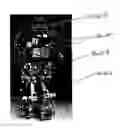
DRAWING/MARKED UP COPY DESCRIPTION OF FIGURESFIG. A—Head containing Computer CPU “brain”
FIG. B—Buttock area containing batteries, one in each to keep weight evenly distributed with redundancy or backup, one battery being located within each “buttock” area.
FIG. C—“lungs” or sealed chamber's, one sealed chamber (“Lung”) located in each half of the chest cavity. Two being required for backup and keep weight evenly distributed and allow one to be used at a time or both for redundancy in which to house the compressed air or fluid which is used and controlled by the CPU to effectuate dexterity, movement and strength via controlled pressurization.
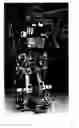
FIG. D—Depicts one of many examples of the finished robotic system wherein movement dexterity and strength would occur via installed relays, switches or solenoids each connected to the “brain” computer/CPU via fiberoptic lightweight tubing or electrical wires or wireless relays, each installed for example at each of the joints just as in a human being:
-
- To control arms, legs, knees, elbo's, fingers, toes, ankles, neck/head movement waist movement, wrist movement, arm movement, leg movement, foot movement, eye movement, mouth/jaw, movement, etc.
Claims
1) The concept of utilizing pressurized compressed air to contract and/or retract limbs, joins, fingers or any attached device, attachment and/or extremity, such as used for gripping or releasing, movement, ambulation, dexterity or fine motor skills.
2) The concept of utilizing an on-board device or system which would pressurize air or create a pressurization within the robot.
3) The concept of using a “lung” or storage container to house pressurized air on board the robot.
4) The concept of using tubing, valves, solenoids, switches, relays or anything to carry or distribute said pressurized air to extremities or other areas of the robot for movement, ambulation, dexterity, gripping or release, fine motor skills, power regeneration, or any other use by the robot.
5) The concept of utilizing a piston in a cylinder to pressurize air or a gas, said piston and/or cylinder possibly Teflon coated or coated with other friction and/or heat reducing coating.
6) The concept of using wires or fiber optics on board the robot which will carry or relay commands and/or data from oh board and/or remotely located device or system such as a computer or other electronic device.
7) The concept of an on-board computer or CPU for the robot.
8) The concept of an on-board CPU, computer or other electronic device(s) being capable of being programmed with a set of condition or conditions, commands, decisions.
Images & Drawings included:
Sources:
- United States Patent and Trademark Office - verify current appl. status at the USPTO↗
Recent applications in this class:
- » 20250139405 2025-05-01
GENERATING AND/OR USING TRAINING INSTANCES THAT INCLUDE PREVIOUSLY CAPTURED ROBOT VISION DATA AND DRIVABILITY LABELS - » 20250061302 2025-02-20
UPDATE OF LOCAL FEATURES MODEL BASED ON CORRECTION TO ROBOT ACTION - » 20240249109 2024-07-25
CONTROLLING A ROBOT BASED ON FREE-FORM NATURAL LANGUAGE INPUT - » 20230401419 2023-12-14
Generating and/or using training instances that include previously captured robot vision data and drivability labels - » 20230316038 2023-10-05
MULTIFUNCTIONAL SOFT DIODE FOR ARTIFICIAL SYSTEMS - » 20230281422 2023-09-07
Update of local features model based on correction to robot action - » 20230196059 2023-06-22
ATTENTION-BASED BRAIN EMULATION NEURAL NETWORKS - » 20230148120 2023-05-11
TELEOPERATION FOR TRAINING OF ROBOTS USING MACHINE LEARNING - » 20230133511 2023-05-04
ARTISAN LEARNING SYSTEM - » 20230083349 2023-03-16
TELEOPERATION FOR TRAINING OF ROBOTS USING MACHINE LEARNING