Multi-composite acoustic panel
US20070137927A1
2007-06-21
10/544,319
2004-01-28
✅ Patent granted
US 7,467,688 B2
2008-12-23
WO; PCT/CA2004/000112; 20040128
WO; WO2004/067870; 20040812
Edgardo San Martin
2025-02-24
Abstract:
The invention relates to a multi-composite acoustic panel for application to walls or ceilings. The panel is made from 15 to 65% of particles of sawdust with a granulometry of 4 to 60 mesh, 25 to 75% of rubber crumb or other petroleum derivatives or recycled rubber with a granulometry of 4 to 30 mesh and 3 to 20% of a polyurethane elastomer binder, the percentages being expressed by weight with relation to the total weight of the panel. In use the rubber acts as an anti-vibration element and the sawdust acts as an acoustic energy absorber as this type of fibre is hollow-centered which permits an absorption role which the rubber particle does not have. Said particle has the ability to reduce an impact.
Assignee:
- Royal Mat Inc. 1 🇨🇦 Quebec, Canada
Interested in similar patents?
Get notified when new applications in this technology area are published.
Classification:
E04B1/84 IPC
Constructions in general; Structures which are not restricted either to walls, e.g. partitions, or floors or ceilings or roofs; Insulation or other protection; Elements or use of specified material therefor; Heat, sound or noise insulation, absorption, or reflection . Other building methods affording favourable thermal or acoustical conditions, e.g. accumulating of heat within walls specifically with respect to sound only Sound-absorbing elements
E04F15/181 » CPC main
Flooring; Separately-laid insulating layers; Other additional insulating measures; Floating floors Insulating layers integrally formed with the flooring or the flooring elements
E04B1/86 » CPC further
Constructions in general; Structures which are not restricted either to walls, e.g. partitions, or floors or ceilings or roofs; Insulation or other protection; Elements or use of specified material therefor; Heat, sound or noise insulation, absorption, or reflection . Other building methods affording favourable thermal or acoustical conditions, e.g. accumulating of heat within walls specifically with respect to sound only; Sound-absorbing elements slab-shaped
E04F13/08 » CPC further
Coverings or linings, e.g. for walls or ceilings composed of covering or lining elements; Sub-structures therefor; Fastening means therefor composed of a plurality of similar covering or lining elements
E04F13/0867 » CPC further
Coverings or linings, e.g. for walls or ceilings composed of covering or lining elements; Sub-structures therefor; Fastening means therefor composed of a plurality of similar covering or lining elements having acoustic absorption means on the visible surface
E04F15/02 » CPC further
Flooring Flooring or floor layers composed of a number of similar elements
E04F15/20 » CPC further
Flooring; Separately-laid insulating layers; Other additional insulating measures; Floating floors for sound insulation
E04B2001/746 » CPC further
Constructions in general; Structures which are not restricted either to walls, e.g. partitions, or floors or ceilings or roofs; Insulation or other protection; Elements or use of specified material therefor; Heat, sound or noise insulation, absorption, or reflection . Other building methods affording favourable thermal or acoustical conditions, e.g. accumulating of heat within walls; Use of special materials; Materials having special structures or shape Recycled materials, e.g. made of used tires, bumpers or newspapers
E04F2290/043 » CPC further
Specially adapted covering, lining or flooring elements not otherwise provided for for insulation or surface protection, e.g. against noise, impact or fire against noise with a bottom layer for sound insulation
Y10T428/249925 » CPC further
Stock material or miscellaneous articles; Web or sheet containing structurally defined element or component; Noninterengaged fiber-containing paper-free web or sheet which is not of specified porosity Fiber-containing wood product [e.g., hardboard, lumber, or wood board, etc.]
Y10T428/253 » CPC further
Stock material or miscellaneous articles; Web or sheet containing structurally defined element or component and including a second component containing structurally defined particles Cellulosic [e.g., wood, paper, cork, rayon, etc.]
E04B1/82 IPC
Constructions in general; Structures which are not restricted either to walls, e.g. partitions, or floors or ceilings or roofs; Insulation or other protection; Elements or use of specified material therefor; Heat, sound or noise insulation, absorption, or reflection . Other building methods affording favourable thermal or acoustical conditions, e.g. accumulating of heat within walls specifically with respect to sound only
B32B21/02 IPC
Layered products comprising a layer of wood, e.g. wood board, veneer, wood particle board of fibres, chips, or particles
B32B5/16 IPC
Layered products characterised by the non- homogeneity or physical structure, i.e. comprising a fibrous, filamentary, particulate or foam layer; Layered products characterised by having a layer differing constitutionally or physically in different parts characterised by features of a layer formed of particles, e.g. chips, powder or granules
E04B1/74 IPC
Constructions in general; Structures which are not restricted either to walls, e.g. partitions, or floors or ceilings or roofs; Insulation or other protection; Elements or use of specified material therefor Heat, sound or noise insulation, absorption, or reflection . Other building methods affording favourable thermal or acoustical conditions, e.g. accumulating of heat within walls
E04B1/62 IPC
Constructions in general; Structures which are not restricted either to walls, e.g. partitions, or floors or ceilings or roofs Insulation or other protection; Elements or use of specified material therefor
Description
The invention relates to a multi-composite acoustic panel for use as a support in a floor or a wall, which panel is made of:
-
- (a) particles of wood fibers from sawdust,
- (b) rubber crumb and/or other derivatives of petroleum or recycled rubber of a different granulometries, and
- (c) a polyurethane or elastomer based binder.
The present invention is thus directed to an acoustic panel of the above-mentioned type, characterized in that it comprises more specifically:
-
- 15 to 65% of particles of sawdust with a granulometry of 4 to 60 mesh;
- 25 to 75% of rubber crumb or other petroleum derivatives or recycled rubber with a granulometry of 4 to 30 mesh; and
- 3 to 20% of a polyurethane or elastomer based binder such as the polyurethane binder G.N. 405 type G.T. or the binder S.L. 336 type G.T. from Polyval®, made of either isocyanate and alcohol or of polyvinyl acetate.
If need be, one may also incorporate into the composition of the panel between 3 and 8% of natural or synthetic fibers (polyethylene, polypropylene, polymer, polyurethane, fiberglass, mineral fibers, cellulose fibers, cork). One may also incorporate 3 to 20% of particles of metal such as bronze, copper or aluminum so as to give it radiant capacity. One can also add to it anti-fungal, water-repellent or anti-ant products or a fire-retardant product such as graphite. One can furthermore apply onto the panel an elastomeric membrane (neoprene, rubber and its derivatives).
It is worth noting that all the percentages given in the present specification are expressed by weight with respect to the total weight of the panel.
It is also worth noting that the granulometry of the particles of sawdust (a), crumb (b) and other elements eventually present can vary according to its need.
Thus, preferably, the percentages of base products used for the manufacturing of the panel can be as follows:
-
- 45 to 65% of particles of sawdust;
- 25 to 45% of rubber crumb; and
- 5 to 15% of a urethane based binder.
It will again be understood that these percentages can vary depending on the use of the acoustic product. Thus, depending on the floor finish that will be used on the product, a different hardness may be necessary. A semi-soft floor finish, such as vinyl tile or wood, will absorb the impacts much more than a hard finish such as ceramic or marble.
One will therefore note that the range of percentages given above can be more narrow in order to optimize the acoustic and mechanical performance of the panel.
The panel can be of varying dimensions 2′×2′ (60 cm×60 cm); 4′×4′ (120 cm×120 cm); 4′×6′ (120 cm×180 cm), etc. and can be adapted to any kind of construction. Its thickness varies from ¼″ to 1″ (approximately 0.5 cm to 2.5 cm).
The multi-composite acoustic panel according to the invention is advantageously manufactured in a press by method of thermo-baking at a low temperature ranging between 100 and 350° F. (approximately 35° C. and 180° C.) under a low pressure ranging between 200 and 2000 PSI (approximately 1400 kN/m2 and 14 000 kN/m2), depending on the desired densification.
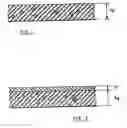
The panel can be manufactured in a single layer made of a homogeneous mixture of particles of sawdust, rubber crumb, rubber or other derivatives of petroleum, and binder (see FIG. 1 of the annexed drawings). Alternatively, it can be manufactured in several layers including a layer made strictly from sawdust interrelated to at least one other layer to form a panel. The latter is then made of different layers (see FIG. 2 of the drawings).
The panel that is so manufactured can be nailed, screwed, glued to the ground and can receive various floor finishes made of wood, ceramic, linoleum or stone.
It can also be laminated to other existing panels such as plywood panels, composite panels such as medium density fiberboards (MDF) or high density fiberboards (HDF), gypsum or cellulose boards.
Its two faces can be flat or one of its faces can have grooves of different configurations, as described by example in U.S. Pat. No. 6,213,252 issued on Apr. 10, 2001 in the name of the Applicant.
In fact, the invention essentially lies in incorporating different percentages of rubber crumb, other petroleum derivatives or recycled rubber to particles of sawdust and binding conjointly the particles of rubber and the sawdust with a binder chosen for acoustical optimization regarding impact noise and aerial noise.
In practice, the rubber acts as an anti-vibration element and the sawdust acts like an acoustical-energy absorbent element because this type of fiber is hollow in the center thereby giving it an absorptive role, which the particle of rubber does not have. This type of fiber therefore has the capacity of reducing impacts.
The invention will be better understood upon reading of the following examples made with reference to the accompanying drawings in which:
FIG. 1 is a partial cross-section view of a portion of a panel made of a single layer;
FIG. 2 is a partial cross-section view of a panel made of two layers; and
FIG. 3 is a graph giving the result of acoustical tests conducted on the multi-composite acoustic panel according to the invention as illustrated in FIG. 1.
The single-layer multi-composite acoustic panel illustrated in FIG. 1 was prepared from a composition containing
-
- 28% of particles of sawdust;
- 68% of particles of rubber; and
- 4% of a polyurethane G.N. 405 type G.T. binder.
The panel was prepared at a temperature of about 100° F. (35° C.) under a pressure of about 500 PSI. Its thickness was ⅜ inch (approximately 0.95 cm).
The panel illustrated in FIG. 2 was manufactured from two laminar layers. The main layer was composed of:
-
- 28% of particles of sawdust;
- 68% of particles of rubber; and
- 4% of a binder (this composition is similar to that of the layer illustrated in FIG. 1).
The thickness of this layer was also the same, that is, ⅜ inch (approximately 0.95 cm).
The second layer laminated onto the first one was manufactured from:
-
- 96% particles of sawdust; and
- 4% of a binder.
The thickness of this second layer was ⅛ inch (approximately 0.3 cm).
Acoustic trials in a building site were conducted on the sample panel illustrated in FIG. 1. The results obtained have proved to be twice those that could have been expected, such coming from the application of two physical advantages including mass principle due to the rubber and spring principle due to the sawdust. Such has thus resulted in a high-level acoustical performance.
The invention is therefore particularly advantageous insofar as it provides multi-composite acoustic panels that are both extremely effective while being less expensive and more ecological since they are obtained from recycling of tires and sawdust. These panels are easy to install and satisfy environmental standards.
It is obvious that numerous modifications could be made to the invention as it has been described while remaining within the scope of the present invention as defined hereinafter in the annexed claims.
Claims
1. A multi-composite acoustic panel comprising:
a) particles of sawdust;
b) crumb or other petroleum derivatives or recycled rubber; and
c) an elastomer or polyurethane based binder, wherein:
the particles of sawdust have a granulometry of 4 to 60 mesh and are present in an amount ranging from 15 to 65% by weight with respect to the total weight of the panel;
the crumb or other petroleum derivatives or recycled rubber have a granulometry of 4 to 30 mesh and are present in an amount ranging from 25 to 75% by weight with respect to the total weight of the panel; and
the binder is present in an amount ranging from 3 to 20% by weight with respect to the total weight of the panel.
2. The panel according to claim 1, which comprises:
a) 45 to 65% of particles of sawdust;
b) 25 to 45% of rubber crumb or other petroleum derivatives or recycled rubber; and
c) 5 to 15% of a polyethane or elastomer based binder.
3. The panel according to claim 1, further comprising:
d) 3 to 8% natural or synthetic fibers, said percentage being expressed by weight with respect to the total weight of the panel.
4. The panel according to claim 3, wherein the natural or synthetic fibers are selected from the group consisting of fibers of polyethylene, polypropylene, polymer, polyurethane, fiberglass, mineral fibers, cellulose fibers, and cork.
5. The panel according to claim 1 which further comprises:
e) 3 to 20% of metal particles in such a way as to give it a radiant capacity, said percentage being expressed by weight with respect to the total weight of the panel.
6. The panel according to claim 5, wherein the metal particles are selected from the group consisting of bronze, copper and aluminum.
7. The panel according to claim 1 which further comprises:
f) particles of at least one additional product selected from the group consisting of -anti fungal, water-repellent, fire-retardant and anti-ant products.
8. The panel according to claim 7, wherein the additional product is a fire-retardant product and said product consists of particles of graphite.
9. The panel according to claim 1 wherein the panel is made of a single layer.
10. The panel according to claim 1, wherein said panel is made of at least two layers made of different compositions.
11. (canceled)
12. (canceled)
13. The panel according to claim 1, which further comprises:
d) 3 to 8% natural or synthetic fibers, said percentage being expressed by weight with respect to the total weight of the panel, said material and synthetic fibers being selected from the group consisting of fibers of polyethylene, polypropylene, polymer, polyurethane, fiberglass, mineral fibers, cellulose fibers and cork; and
e) 3 to 20% of metal particles in such a way as to give it a radiant capacity; said percentage being expressed by weight with respect to the total weight of the panel, said metal particles being selected from the group consisting of bronze, cooper and aluminum.
14. The panel according to claim 13, which further comprises:
f) particles of at least one additional product selected amongst anti-fungal, water-repellent, fire-retardant and anti-ant products
15. The panel according to claim 1 wherein said panel is manufactured in a press by a method of thermo-baking at a low temperature ranging between 35° C. and 180° C. under a pressure ranging between 1,400 kN/m2 and 14,000 kN /m2.
16. The panel according to claim 4, wherein said panel is manufactured in a press by a method of thermo-baking at a low temperature ranging between 35° C. and 180° C. under a pressure ranging between 1400 kN/m2 and 14,000 kN/m2.
17. The panel according to claim 6, wherein said panel is manufactured in a press by a method of thermo-baking at a low temperature ranging between 35° C. and 180° C. under a pressure ranging between 1,400 kN/m2 and 14,000 kN/m2.
18. The panel according to claim 13 wherein said panel is manufactured in a press by a method of thermo-baking at a low temperature ranging between 35° C. and 180° C. under a pressure ranging between 1,400 kN/m2 and 14,000 kN/m2.
19. The panel according to claim 4, which comprises
a) 45 to 65% of particles of sawdust;
b) 25 to 45% of rubber crumb or other petroleum derivatives or recycled rubber; and
c) 5 to 15% of a polyethane or elastomer based binder.
20. The panel according to claim 6, which comprises:
a) 45 to 65% of particles of sawdust;
b) 25 to 45% of rubber crumb or other petroleum derivatives or recycled rubber; and
c) 5 to 15% of a polyethane or elastomer based binder.
21. The panel according to claim 13, which comprises:
a) 45 to 65% of particles of sawdust;
b) 25 to 45% of rubber crumb or other petroleum derivatives or recycled rubber; and
c) 5 to 15% of a polyethane or elastomer based binder.
Images & Drawings included:

Sources:
- United States Patent and Trademark Office - verify current appl. status at the USPTO↗
Recent applications in this class:
- » 20250137266 2025-05-01
Insulated Floor System for Grade or Basement Floors - » 20210102387 2021-04-08
Rubber flooring and method for producing rubber flooring for heavy animal maintenance and care facilities - » 20200332533 2020-10-22
UNDERLAY MAT FOR FLOOR COVERINGS - » 20180080233 2018-03-22
Floor underlayment having self-sealing vapor barrier - » 20160348380 2016-12-01
Floor underlayment having self-sealing vapor barrier - » 20160222675 2016-08-04
Insulating floor underlayment - » 20160040440 2016-02-11
Method for pre-applied waterproofing - » 20150184400 2015-07-02
Methods of producing foam structures from recycled metallized polyolefin material - » 20140318061 2014-10-30
Floorboard and method for manufacturing thereof - » 20140178638 2014-06-26
FLOOR LINING INSULATION UNDERLAY WITH A SLIP-INHIBITING SURFACE CONFIGURATION