Method of making imidazole-2-ones and 2-thiones
US20070197795A1
2007-08-23
11/467,292
2006-08-25
✅ Patent granted
US 7,579,481 B2
2009-08-25
-
-
Rei-Tsang Shiao | Janet L Coppins
2027-09-20
Abstract:
A method of 4-substituted imidazole-2-ones and thiones which comprises reacting a methylene urea or methylene thiourea wherein said methylene is substituted with the 4-subsituent and a cyano or alkycarboxylate group to provide said 4-substituted imidazole 2-one or thione.
Inventors:
- Michael E. Garst 179 🇺🇸 Newport Beach, CA, United States
- Shervin Esfandiari 11 🇺🇸 Eugene, OR, United States
- Lloyd J. Dolby 5 🇺🇸 Eugene, OR, United States
- Lloyd Dolby 1 🇺🇸 Eugene, OR, United States
Assignee:
- Allergan, Inc. 2,273 🇺🇸 Irvine, CA, United States
Interested in similar patents?
Get notified when new applications in this technology area are published.
Classification:
C07D233/84 » CPC main
Heterocyclic compounds containing 1,3-diazole or hydrogenated 1,3-diazole rings, not condensed with other rings having two double bonds between ring members or between ring members and non-ring members with hetero atoms or with carbon atoms having three bonds to hetero atoms with at the most one bond to halogen, e.g. ester or nitrile radicals, directly attached to ring carbon atoms Sulfur atoms
C07D233/70 » CPC further
Heterocyclic compounds containing 1,3-diazole or hydrogenated 1,3-diazole rings, not condensed with other rings having two double bonds between ring members or between ring members and non-ring members with hetero atoms or with carbon atoms having three bonds to hetero atoms with at the most one bond to halogen, e.g. ester or nitrile radicals, directly attached to ring carbon atoms One oxygen atom
C07D233/22 IPC
Heterocyclic compounds containing 1,3-diazole or hydrogenated 1,3-diazole rings, not condensed with other rings having one double bond between ring members or between a ring member and a non-ring member with substituted hydrocarbon radicals, directly attached to ring carbon atoms Radicals substituted by oxygen atoms
A61K31/4166 IPC
Medicinal preparations containing organic active ingredients; Heterocyclic compounds having nitrogen as a ring hetero atom, e.g. guanethidine or rifamycins having five-membered rings with two or more ring hetero atoms, at least one of which being nitrogen, e.g. tetrazole 1,3-Diazoles having oxo groups directly attached to the heterocyclic ring, e.g. phenytoin
C07D233/32 IPC
Heterocyclic compounds containing 1,3-diazole or hydrogenated 1,3-diazole rings, not condensed with other rings having one double bond between ring members or between a ring member and a non-ring member with hetero atoms or with carbon atoms having three bonds to hetero atoms with at the most one bond to halogen, e.g. ester or nitrile radicals, directly attached to ring carbon atoms; Oxygen or sulfur atoms One oxygen atom
Description
CROSS REFERENCE TO RELATED APPLICATIONSThis application is based on, and claims the benefit of, U.S. Provisional Application No. 60/711,877, filed Aug. 26, 2005, and which is incorporated herein by reference.
BACKGROUND OF THE INVENTION1. Field of the Invention
A method of making 4-substituted imidazole-2-ones or thiones which comprises reacting a methylene urea or methylene thiourea wherein said methylene is substituted with the 3-subsituent and a cyano or alkycarboxylate group to provide said 3-substituted imidazole 2-one or thione.
2. Description of the Related Art
Compounds such as imidazole-2-ones and imidazole-2-thiones are useful as pharmaceutical compounds or as intermediates for preparing pharmaceutical compounds. Therefore, new and improved methods for making such compounds are continuously being developed.
BRIEF SUMMARY OF THE INVENTIONThe present invention provides a method of preparing 4-substituted imidazole-2-ones and thiones which comprises reacting a methylene urea or methylene thiourea wherein said methylene is substituted with the 4-subsituent and a cyano or alkycarboxylate group to provide said 4-substituted imidazole 2-one or thione.
The above method may be carried out by reducing said methylene urea or methylene thiourea to said 4-substituted imidazole-2-one or thione.
Preferably, said methylene urea or methylene thiourea is reduced in the presence of a dialkyl aluminum hydride, e.g. diisobutylaluminum hydride (DIBAL-H).
Said methylene urea or methylene thiourea may be provided by reacting the corresponding 1-cyano, 1-amino, 1-substituted methane with a cyanate or a thiocyanate, e.g. potassium cyanate or potassium thiocyanate.
The reaction may be carried out in the liquid phase in the presence of an inert solvent at a temperature of less than 0° C. For example, said reaction may be carried out in a dichloromethane solvent.
Preferably, said 4-substituent is selected form the group consisting of alkyl, aryl and alkylaryl radicals which have from 1 to 50 carbon atoms which radicals may be substituted with halogen, nitrogen, oxygen, sulfur and phosphorus substituents.
More preferably said 4-substituent is benzyl.
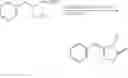
DETAILED DESCRIPTION OF THE INVENTIONThe method of the present invention may be carried out in accordance with the schemes below.
In the above schemes, R is selected from the group consisting of alkyl, aryl and alkyl aryl radicals having from 1 to 50 carbon atoms which radicals may be substituted with halogen, nitrogen, oxygen, sulfur and phosphorus substituents, R′ is a lower alkyl having from 1 to 6 carbon atoms, and X is O or S.
The invention is further illustrated by the following examples which are illustrative of a specific mode of practicing the invention and are not intended as limiting the scope of the claims.
EXAMPLE 1Methyl 2-(aminocarbonylamino)-3-phenylpropanoate, 2
A 500 mL 3-necked flask equipped with a mechanical stirrer was charged with L-phenylalanine methyl ester hydrochloride 1 (24.8 g, 0.115 mol) in water (100 mL). Potassium cyanate (9.5 g, 0.117 mol) was added. After stirring for 1 hr at room temperature, the white solid was collected and air dried to give 19.5 g (76%) of methyl 2-(aminocarbonylamino)-3-phenylpropanoate (2). HPLC analysis showed a purity of 99%. 1H NMR (CDCl3) δ 7.5 (s, 5 h), 6.5 (d, 1 H), 5.3 (s, 2 H), 4.8 (dd, 1 H), 3.75(s, 3 H), 3.1 (d, 2 H).
EXAMPLE 24-Benzylimidazolin-2-one, 3
A 250 mL 3-necked flask equipped with a dropping funnel, a thermometer and a stir-bar, was charged with urea methyl ester 2 (6.66 g, 0.03 mol) in dichloromethane (30 mL) under argon. The resulting solution cooled to −40° C. A solution of diisobutylaluminum hydride (0.066 mol, 66 mL of 1 M solution in dichloromethane) was slowly added over a period of 45 min. During this addition the internal temperature rose to −30° C. and then fell to −40° C. After 15 min, HPLC analysis of an aliquot worked up in 3 M hydrochloric acid showed complete consumption of starting material. The reaction mixture was transferred by a cannula into a vigorously stirring mixture of conc. HCl (25 mL) and crushed ice (75 g). The product slowly precipitated while stirring the resultant mixture at room temperature for 5 hr. The white solid was collected and air dried to give 2.2 g (42%) of 4-benzylimidazolin-2-one (3). HPLC analysis showed a purity of >97%. 1H NMR (warm d6-DMSO) 67 10.0 (br s,1 H), 9.7 (br s,1 H), 7.3 (s, 5 H), 6.0 (s,1 H), 3.6 (s, water peak), 3.5 (s, 2 H).
HPLC analysis: column: Alltech Alltima, C18, 5μ, 250×4.6 mm, flow 1 mL/min, at 40° C.; wavelength 210 nm. Condition: H2O/A1/CH3OH (25/10/65). The retention time for 1 was 2.7 min, for 2 3.7 min and for 3, 3.9 min. A1 is made of 700 mL water, 300 mL methanol, 3 mL triethylamine and enough phosphoric acid to give a pH of 3.4.
While particular embodiments of the invention have been described it will be understood of course that the invention is not limited thereto since many obvious modifications can be made and it is intended to include within this invention any such modifications as will fall within the scope of the appended claims.
Claims
1. A method of 4-substituted imidazole-2-ones and thiones which comprises reacting a methylene urea or methylene thiourea wherein said methylene is substituted with the 3-subsituent and a cyano or alkycarboxylate group to provide said 3-substituted imidazole 2-one or thione.
2. The method of claim 1 wherein said 4-substituted imidazole-2-one or thione is provided by reducing said methylene urea or methylene thiourea.
3. The method of claim 2 wherein said methylene urea or methylene thiourea is reduced in the presence of a dialkyl aluminum hydride.
4. The method of claim 3 wherein said dialkyl aluminum hydride is diisobutyl aluminum hydride.
5. The method of claim 4 wherein said methylene urea or methylene thiourea is provided by reacting the corresponding 1-cyano, 1-amino, 1-substituted methane with a cyanate or a thiocyanate.
6. The method of claim 5 wherein said cyanate is potassium cyanate and said thiocyanate is potassium thiocyanate.
7. The method of claim 1 wherein said reaction is carried out in the liquid phase at a temperature of less than 0° C.
8. The method of claim 7 wherein said reaction is carried out in a dichloromethane solvent.
9. The method of claim 1 wherein said 4-substituent is selected form the group consisting of alkyl, aryl and alkylaryl radicals which have from 1 to 50 carbon atoms which radicals may be substituted with halogen, nitrogen, oxygen, sulfur and phosphorus substituents.
10. The method of claim 9 wherein said 4-substituent is benzyl.
Images & Drawings included:


Sources:
- United States Patent and Trademark Office - verify current appl. status at the USPTO↗
Recent applications in this class:
- » 20250042860 2025-02-06
Process for Chemical Synthesis of Ergothioneine and Methods of Use - » 20220281822 2022-09-08
PLANT GROWTH REGULATOR AND METHOD FOR PROMOTING PLANT GROWTH - » 20220089548 2022-03-24
Non-aqueous electrolyte solution additive, and non-aqueous electrolyte solution for lithium secondary battery and lithium secondary battery which include the same - » 20210122716 2021-04-29
Sulfonylureas and sulfonylthioureas as NLRP3 inhibitors - » 20170305865 2017-10-26
Process for synthesizing ergothioneine and related compounds - » 20170050933 2017-02-23
N, N, N-trialkyl histidine derivatives useful for the preparation of ergothioneine compounds - » 20160264530 2016-09-15
N, N, N-trialkyl histidine derivatives useful for the preparation of ergothioneine compounds - » 20140094436 2014-04-03
Imidazole compounds that modulate HSP90 activity - » 20130289047 2013-10-31
HETEROARYLTHIO DERIVATIVES AND ANALOGUES - » 20120330029 2012-12-27
Method for the synthesis of 2-thiohistidine and the like
Recent applications for this Assignee:
- » 20250121169 2025-04-17
DISSOLVABLE MICRONEEDLES FOR SKIN TEATMENT - » 20240252604 2024-08-01
NON-PROTEIN CLOSTRIDIAL TOXIN COMPOSITIONS - » 20240050726 2024-02-15
MICRONEEDLE ARRAY WITH ACTIVE INGREDIENT - » 20240033492 2024-02-01
DISSOLVABLE MICRONEEDLES FOR SKIN TREATMENT - » 20230355724 2023-11-09
Non-protein Clostridial toxin compositions - » 20230355723 2023-11-09
Non-protein clostridial toxin compositions - » 20230321420 2023-10-12
MICRONEEDLE ARRAY WITH ACTIVE INGREDIENT - » 20230029327 2023-01-26
Process and system for obtaining botulinum neurotoxin - » 20220331429 2022-10-20
Animal protein-free pharmaceutical compositions - » 20220298496 2022-09-22
Process and system for obtaining botulinum neurotoxin