Garments comprising a flexible high thermal performance outer shell fabric of polybenzimidazole and polypyridobisimidazole fibers
US20090282601A1
2009-11-19
12/084,508
2006-12-13
✅ Patent granted
US 7,820,572 B2
2010-10-26
WO; PCT/US2006/061963; 20061213
WO; WO2007/076259; 20070705
Ula C Ruddock
2027-04-24
Abstract:
This invention concerns a flame-resistant garment having an outer shell fabric comprising 5 to 50 parts by weight of a polypyridobisimidazole fiber having an inherent viscosity of greater than 20 dl/g and 50 to 95 parts by weight of polybenzimidazole fiber.
Inventors:
- Reiyao Zhu 17 🇺🇸 Midlothian, VA, United States
- Richard Young 7 🇺🇸 Richmond, VA, United States
Assignee:
- E. I. DU PONT DE NEMOURS AND COMPANY 4,854 🇺🇸 Wilmington, DE, United States
Interested in similar patents?
Get notified when new applications in this technology area are published.
Classification:
B32B5/08 » CPC main
Layered products characterised by the non- homogeneity or physical structure, i.e. comprising a fibrous, filamentary, particulate or foam layer; Layered products characterised by having a layer differing constitutionally or physically in different parts characterised by structural features of a layer the fibres or filaments of a layer being of different substances, e.g. conjugate fibres, mixture of different fibres
A41D31/08 » CPC further
Materials specially adapted for outerwear characterised by special function or use Heat resistant; Fire retardant
A41D31/085 » CPC further
Materials specially adapted for outerwear characterised by special function or use; Heat resistant; Fire retardant using layered materials
A62B17/003 » CPC further
Protective clothing affording protection against heat or harmful chemical agents or for use at high altitudes Fire-resistant or fire-fighters' clothes
B32B5/024 » CPC further
Layered products characterised by the non- homogeneity or physical structure, i.e. comprising a fibrous, filamentary, particulate or foam layer; Layered products characterised by having a layer differing constitutionally or physically in different parts characterised by structural features of a layer Woven fabric
B32B5/26 » CPC further
Layered products characterised by the non- homogeneity or physical structure, i.e. comprising a fibrous, filamentary, particulate or foam layer; Layered products characterised by having a layer differing constitutionally or physically in different parts characterised by the presence of two or more layers which are next to each other and are fibrous, filamentary, formed of particles or foamed one layer being a fibrous or filamentary layer another layer also being fibrous or filamentary
D01F6/74 » CPC further
Monocomponent artificial filaments or the like of synthetic polymers; Manufacture thereof from homopolycondensation products from polycondensates of cyclic compounds, e.g. polyimides, polybenzimidazoles
D01F6/94 » CPC further
Monocomponent artificial filaments or the like of synthetic polymers; Manufacture thereof from mixtures of polycondensation products as major constituent with other polymers or low-molecular-weight compounds of other polycondensation products
D02G3/443 » CPC further
Yarns or threads, e.g. fancy yarns; Processes or apparatus for the production thereof, not otherwise provided for; Yarns or threads characterised by the purpose for which they are designed Heat-resistant, fireproof or flame-retardant yarns or threads
D03D15/513 » CPC further
Woven fabrics characterised by the material, structure or properties of the fibres, filaments, yarns, threads or other warp or weft elements used characterised by the properties of the yarns or threads heat-resistant or fireproof
D04H1/42 » CPC further
Non-woven fabrics formed wholly or mainly of staple fibres or like relatively short fibres from fleeces or layers composed of fibres without existing or potential cohesive properties characterised by the use of certain kinds of fibres insofar as this use has no preponderant influence on the consolidation of the fleece
B32B2262/02 » CPC further
Composition or structural features of fibres which form a fibrous or filamentary layer or are present as additives Synthetic macromolecular fibres
B32B2262/14 » CPC further
Composition or structural features of fibres which form a fibrous or filamentary layer or are present as additives Mixture of at least two fibres made of different materials
B32B2307/3065 » CPC further
Properties of the layers or laminate having particular thermal properties; Resistant to heat Flame resistant or retardant, fire resistant or retardant
B32B2307/7265 » CPC further
Properties of the layers or laminate; Other properties; Permeability to liquids, absorption Non-permeable
B32B2437/00 » CPC further
Clothing
B32B2571/00 » CPC further
Protective equipment
D10B2331/14 » CPC further
Fibres made from polymers obtained otherwise than by reactions only involving carbon-to-carbon unsaturated bonds, e.g. polycondensation products polycondensates of cyclic compounds, e.g. polyimides, polybenzimidazoles
Y10S428/92 » CPC further
Stock material or miscellaneous articles Fire or heat protection feature
Y10S428/921 » CPC further
Stock material or miscellaneous articles; Fire or heat protection feature Fire or flameproofing
Y10T428/2904 » CPC further
Stock material or miscellaneous articles; Coated or structually defined flake, particle, cell, strand, strand portion, rod, filament, macroscopic fiber or mass thereof Staple length fiber
Y10T428/2913 » CPC further
Stock material or miscellaneous articles; Coated or structually defined flake, particle, cell, strand, strand portion, rod, filament, macroscopic fiber or mass thereof Rod, strand, filament or fiber
Y10T442/3976 » CPC further
Fabric [woven, knitted, or nonwoven textile or cloth, etc.]; Woven fabric [i.e., woven strand or strip material] Including strand which is stated to have specific attributes [e.g., heat or fire resistance, chemical or solvent resistance, high absorption for aqueous composition, water solubility, heat shrinkability, etc.]
Y10T442/463 » CPC further
Fabric [woven, knitted, or nonwoven textile or cloth, etc.]; Knit fabric [i.e., knit strand or strip material]; Knit fabric is characterized by a particular or differential knit pattern other than open knit fabric or a fabric in which the strand denier is specified; Including additional strand inserted within knit fabric Warp knit insert strand
A62B17/00 IPC
Protective clothing affording protection against heat or harmful chemical agents or for use at high altitudes
C09K21/14 IPC
Fireproofing materials Macromolecular materials
A41D13/00 IPC
Professional, industrial or sporting protective garments, e.g. surgeons' gowns or garments protecting against blows or punches
A41D27/02 IPC
Details of garments or of their making Linings
D03D15/00 IPC
Woven fabrics characterised by the material, structure or properties of the fibres, filaments, yarns, threads or other warp or weft elements used
Description
FIELD OF THE INVENTION
The invention concerns a flame-resistant garment having an outer shell fabric comprising polypyridobisimidazole fiber and polybenzimidazole fiber.
BACKGROUND OF THE INVENTION
Polypyridobisimidazole polymer is a rigid rod polymer. Fiber made from this polymer, one polymer composition of which is referred to as PIPD and known as the polymer used to make M5® fiber, is known to be useful in both cut and flame resistant protective apparel. See, for example, PCT Application WO199902169 and WO2005002376. Fibers made from rigid-rod polymers having strong hydrogen bonds between polymer chains, e.g., polypyridobisimidazoles, have been described in U.S. Pat. No. 5,674,969 to Sikkema et al. An example of a polypyridobisimidazole includes poly(1,4-(2,5-dihydroxy)phenylene-2,6-pyrido[2,3-d:5,6-d′]bisimidazole), which can be prepared by the condensation polymerization of tetraaminopyridine and 2,5-dihydroxyterephthalic acid in polyphosphoric acid. Sikkema describes that in making one- or two-dimensional objects, such as fibers, films, tapes, and the like, it is desired that polypyridobisimidazoles have a high molecular weight corresponding to a relative viscosity (“Vrel” or “ηrel”) of at least about 3.5, preferably at least about 5, and more particularly equal to or higher than about 10, when measured at a polymer concentration of 0.25 g/dl in methane sulfonic acid at 25° C. Sikkema also discloses that good fiber spinning results are obtained with poly[pyridobisimidazole-2,6-diyl(2,5-dihydroxy-p-phenylene)] having relative viscosities greater than about 12, and that relative viscosities of over 50 (corresponding to inherent viscosities greater than about 15.6 dl/g) can be achieved.
Published U.S. Patent Applications US20030228812 and US20040216215 and U.S. Pat. No. 6,624,096 disclose protective fabrics & garments made from blends of Kevlar(r) and polybenzimidazole (PBI). U.S. Patent Application No. 2003/0228812 discloses the use of polybenzimidazole (PBI) and PBO fibers in protective apparel. PCT Patent Application No. WO2004023909 discloses the use of polybenzimidazole and poly(paraphephenylene benzobisaxazole) fibers and filaments in fabrics.
The aforementioned polybenzimidazoles are polybibenzimidazole compositions, which are not rigid rod polymers. Therefore the fiber made from that polymer has low fiber strength.
Thermal and flame retardant protective apparel has been used by firefighters, emergency response personnel, members of the military and racing personnel to save lives and reduce injury due to fires and other thermal events. Polypyridobisimidazole fiber has excellent fire resistant properties, superior in many respects to most other fibers, and because of the rigid rod nature of the polymer, fibers made from polypyridobisimidazoles have exceptionally high strength. There is, however, a desire to incorporate the superior fire resistance of polypyridobisimidazole fibers into outer shell fabrics for protective garments to take advantage of their superior flame resistant properties. One concern with using such fibers is that they have a high tensile modulus and may create fabrics that are relatively stiff and uncomfortable to wear. Thus, there is a need for a garment having an outer shell fabric containing polypyridobisimidazole that is both flexible and relatively comfortable and still provides good fire protection properties.
SUMMARY OF THE INVENTION
In some embodiments, the invention concerns flame-resistant garment having an outer layer comprising polypyridobisimidazole fiber and polybenzimidazole fiber. In certain embodiments, the invention concerns a flame-resistant garment comprising 5 to 50 parts by weight of a polypyridobisimidazole fiber having an inherent viscosity of greater than 20 dl/g and 50 to 95 parts by weight of polybenzimidazole fiber.
In some embodiments, the polypyridobisimidazole fiber has an inherent viscosity of greater than 25 dl/g. In other embodiments, the polypyridobisimidazole fiber has an inherent viscosity of greater than 28 dl/g
Some flame-resistant garments of this invention comprise 35 to 50 parts by weight of a polypyridobisimidazole fiber, and 50 to 65 parts by weight of polybenzimidazole fiber.
In some embodiments, the polypyridobisimidazole and polybenzimidazole fibers are present as staple fibers. In certain embodiments, the polypyridobisimidazole and polybenzimidazole fibers are present as continuous filaments.
One preferred polypyridimidazole polymer is poly[2,6-diimidazo[4,5-b:4,5-e]-pyridinylene-1,4(2,5-dihydroxy)phenylene).
In some embodiments, the polybenzimidazole fiber comprises polybibenzimidazole polymer. In certain embodiments, the polybibenzimidazole polymer is poly(2,2′-(m-phenylene)-5,5′-bibenzimidazole) polymer.
In some embodiments, the polypyridobisimidazole and polybibenzimidazole fibers are in the outer shell of the garment.
In another aspect, the invention concerns a flame-resistant garment comprising, in order, (a) an inner thermal lining, (b) a liquid barrier, and (c) an outer shell fabric, the outer shell fabric (c) comprising 5 to 50 parts by weight of a polypyridobisimidazole fiber and
50 to 95 parts by weight of an polybenzimidazole fiber; the polypyridobisimidazole fiber having an inherent viscosity of greater than 20 dl/g.
Additional embodiments of the invention concern method of producing a flame-resistant garment having an inner thermal lining, a liquid barrier, and an outer shell fabric by incorporating into the garment an outer shell fabric comprising 5 to 50 parts by weight of a polypyridobisimidazole fiber and 50 to 95 parts by weight of an polybnezimidazole fiber; the polypyridobisimidazole fiber having an inherent viscosity of greater than 20 dl/g.
DETAILED DESCRIPTION OF ILLUSTRATIVE EMBODIMENTS
The present invention can be understood more readily by reference to the following detailed description of illustrative and preferred embodiments that form a part of this disclosure. It is to be understood that the scope of the claims is not limited to the specific devices, methods, conditions or parameters described and/or shown herein, and that the terminology used herein is for the purpose of describing particular embodiments by way of example only and is not intended to be limiting of the claimed invention. Also, as used in the specification including the appended claims, the singular forms “a,” “an,” and “the” include the plural, and reference to a particular numerical value includes at least that particular value, unless the context clearly dictates otherwise. When a range of values is expressed, another embodiment includes from the one particular value and/or to the other particular value. Similarly, when values are expressed as approximations, by use of the antecedent “about,” it will be understood that the particular value forms another embodiment. All ranges are inclusive and combinable.
In one embodiment, the invention relates flame-resistant garment having an outer shell fabric comprising 5 to 50 parts by weight of a polypyridobisimidazole fiber having an inherent viscosity of greater than 20 dl/g and 50 to 95 parts by weight of polybenzimidazole fiber. This invention also relates to a flame-resistant garment comprising, in order, an inner thermal lining, a liquid barrier, and an outer shell fabric; the outer shell fabric comprising 5 to 50 parts by weight of a polypyridobisimidazole fiber having an inherent viscosity of greater than 20 dl/g and 50 to 95 parts by weight of polybenzimidazole fiber.
In some embodiments, the polypyridobisimidazole fiber has an inherent viscosity of greater than 25 dl/g. In other embodiments, the polypyridobisimidazole fiber has an inherent viscosity of greater than 28 dl/g
Some flame-resistant garments of this invention comprise 35 to 50 parts by weight of a polypyridobisimidazole fiber, and 50 to 65 parts by weight of polybenzimidazole fiber.
In some embodiments, the polypyridobisimidazole and polybenzimidazole fibers are present as staple fibers. In certain embodiments, the polypyridobisimidazole and polybenzimidazole fibers are present as continuous filaments.
One preferred polypyridimidazole polymer is poly[2,6-diimidazo[4,5-b:4,5-e]-pyridinylene-1,4(2,5-dihydroxy)phenylene).
In some embodiments, the polybenzimidazole fiber comprises polybibenzimidazole polymer. In certain embodiments, the polybibenzimidazole polymer is poly(2,2′-(m-phenylene)-5,5′-bibenzimidazole) polymer.
In another aspect, the invention concerns a flame-resistant garment comprising, in order, (a) an inner thermal lining, (b) a liquid barrier, and (c) an outer shell fabric, the outer shell fabric (c) comprising 5 to 50 parts by weight of a polypyridobisimidazole fiber and
50 to 95 parts by weight of an polybenzimidazole fiber; the polypyridobisimidazole fiber having an inherent viscosity of greater than 20 dl/g.
Additional embodiments of the invention concern method of producing a flame-resistant garment having an inner thermal lining, a liquid barrier, and an outer shell fabric by incorporating into the garment an outer shell fabric comprising 5 to 50 parts by weight of a polypyridobisimidazole fiber and 50 to 95 parts by weight of an polybenzimidazole fiber; the polypyridobisimidazole fiber having an inherent viscosity of greater than 20 dl/g.
For purposes herein, the term “fiber” is defined as a relatively flexible, macroscopically homogeneous body having a high ratio of length to width across its cross-sectional area perpendicular to its length. The fiber cross section can be any shape, but is typically round. Herein, the term “filament” or “continuous filament” is used interchangeably with the term “fiber.”
As used herein, the term “staple fibers” refers to fibers that are cut to a desired length or are stretch broken, or fibers that occur naturally with or naturally have a low ratio of length to width across its cross-sectional area perpendicular to its length when compared with filaments. Length can vary from about 0.1 inch to several feet. In some embodiments, the length is from 0.1 inch to about 8 inches. Man made staple fibers are cut to a length suitable for processing on cotton, woolen, or worsted yarn spinning equipment.
The staple fibers can have (a) substantially uniform length, (b) variable or random length, or (c) subsets of the staple fibers have substantially uniform length and the staple fibers in the other subsets have different lengths, with the staple fibers in the subsets mixed together forming a substantially uniform distribution.
In some embodiments, suitable staple fibers have a length of 1 to 30 centimeters. Staple fibers made by short staple processes result in a fiber length of 1 to 6 centimeters.
The staple fibers can be made by any process. The staple fibers can formed by stretch breaking continuous fibers resulting in staple fibers with deformed sections that act as crimps. The staple fibers can be cut from continuous straight fibers using a rotary cutter or a guillotine cutter resulting in straight (i.e., non crimped) staple fiber, or additionally cut from crimped continuous fibers having a saw tooth shaped crimp along the length of the staple fiber, with a crimp (or repeating bend) frequency of no more than 8 crimps per centimeter.
Stretch broken staple fibers can be made by breaking a tow or a bundle of continuous filaments during a stretch break operation having one or more break zones that are a prescribed distance creating a random variable mass of fibers having an average cut length controlled by break zone adjustment.
Staple fibers of this invention can be converted into yarns using traditional long and short staple ring spinning processes which are well known in the art. For short staple, cotton system spinning fiber lengths from ¾ inch to 2¼ inch (i.e., 1.9to 5.7 cm.) are typically used. For long staple, worsted or woolen system spinning, fibers up to 6½ inches (i.e., 16.5 cm.) are typically used. However, this is not intended to be limiting to ring spinning because the yarns may also be spun using air jet spinning, open end spinning, and many other types of spinning which converts staple fiber into useable yarns.
The stretch broken staple fibers typically have length of up to 7 inches (i.e., 17.8 cm.) long and can be made using traditional stretch-broken tow to top staple processes. Staple fibers having maximum lengths of up to around 20 inches (i.e., 51 cm) are possible through processes as described for example in PCT Patent Application No. WO 0077283. Yarns can be made by consolidating fibers into spun yarn using filament entanglement with air jets having a tenacity in the range of 3 to 7 grams per decitex. These yarns may have secondary twist, that is, they may be twisted after formation to impart more tenacity to the yarn, in which case the tenacity can be in the 10 to 18 grams per denier (i.e., 9 to 17 grams per dtex) range. Stretch broken staple fibers normally do not require crimp because the stretch-breaking process imparts a degree of crimp into the fiber.
The term continuous filament refers to a flexible fiber having relatively small-diameter and whose length is longer than those indicated for staple fibers. Continuous filament fibers and multifilament yarns of continuous filaments can be made by processes well known to those skilled in the art.
Fabrics of this invention can take on numerous configurations, including, but not limited to, knitted or woven fabrics or non-woven structures. Such fabric configurations are well known to those skilled in the art.
By “non-woven” fabric is meant a network of fibers, including unidirectional (if contained within a matrix resin), felt, fiber batts, and the like.
By “woven” fabric is meant a fabric woven using any fabric weave, such as plain weave, crowfoot weave, basket weave, satin weave, twill weave, and the like. Plain and twill weaves are believed to be the most common weaves used in the trade.
The instant invention utilizes polypyridobisimidazole fiber. This fiber is
a rigid rod polymer that is of high strength. The polypyridobisimidazole fiber has an
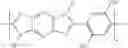
inherent viscosity of at least 20 dl/g or at least 25 dl/g or at least 28 dl/g. Such fibers include PIPD fiber (also known as M5® fiber and fiber made from poly[2,6-diimidazo[4,5-b:4,5-e]- pyridinylene-1,4(2,5-dihydroxy)phenylene). PIPD fiber is based on the structure:
Polypyridobisimidazole fiber can be distinguished from the well known commercially available PBI fiber or polybenzimidazole fiber in that that polybenzimidazole fiber is a polybibenzimidazole. Polybibenzimidazole fiber is not a rigid rod polymer and has low fiber strength and low tensile modulus when compared to polypyridobisimidazoles.
PIPD fibers have been reported to have the potential to have an average modulus of about 310 GPa (2100 grams/denier) and an average tenacities of up to about 5.8 Gpa (39.6 grams/denier). These fibers have been described by Brew, et al., Composites Science and Technology 1999, 59, 1109; Van der Jagt and Beukers, Polymer 1999, 40, 1035; Sikkema, Polymer 1998, 39, 5981; Klop and Lammers, Polymer, 1998, 39, 5987; Hageman, et al., Polymer 1999, 40, 1313.
One method of making rigid rod polypyridoimidazole polymer is disclosed in detail in U.S. Pat. No. 5,674,969 to Sikkema et al. Polypyridoimidazole polymer may be made by reacting a mix of dry ingredients with a polyphosphoric acid (PPA) solution. The dry ingredients may comprise pyridobisimidazole-forming monomers and metal powders. The polypyridobisimidazole polymer used to make the rigid rod fibers used in the fabrics of this invention should have at least 25 and preferably at least 100 repetitive units.
For the purposes of this invention, the relative molecular weights of the polypyridoimidazole polymers are suitably characterized by diluting the polymer products with a suitable solvent, such as methane sulfonic acid, to a polymer concentration of 0.05 g/dl, and measuring one or more dilute solution viscosity values at 30° C. Molecular weight development of polypyridoimidazole polymers of the present invention is suitably monitored by, and correlated to, one or more dilute solution viscosity measurements. Accordingly, dilute solution measurements of the relative viscosity (“Vrel” or “ηrel” or “nrel”) and inherent viscosity (“Vinh” or “ηinh” or “ninh”) are typically used for monitoring polymer molecular weight. The relative and inherent viscosities of dilute polymer solutions are related according to the expression
Vinh=ln(Vrel)/C,
where ln is the natural logarithm function and C is the concentration of the polymer solution. Vrel is a unitless ratio of die polymer solution viscosity to that of the solvent free of polymer, thus Vinh is expressed in units of inverse concentration, typically as deciliters per gram (“dl/g”). Accordingly, in certain aspects of the present invention the polypyridoimidazole polymers are produced that are characterized as providing a polymer solution having an inherent viscosity of at least about 20 dl/g at 30° C. at a polymer concentration of 0.05 g/dl in methane sulfonic acid. Because the higher molecular weight polymers that result from the invention disclosed herein give rise to viscous polymer solutions, a concentration of about 0.05 g/dl polymer in methane sulfonic acid is useful for measuring inherent viscosities in a reasonable amount of time.
Exemplary pyridobisimidazole-forming monomers useful in this invention include 2,3,5,6-tetraaminopyridine and a variety of acids, including terephthalic acid, bis-(4-benzoic acid), oxy-bis-(4-benzoic acid), 2,5-dihydroxyterephthalic acid, isophthalic acid, 2,5-pyridodicarboxylic acid, 2,6-napthalenedicarboxylic acid, 2,6-quinolinedicarboxylic acid, or any combination thereof. Preferably, the pyridobisimidazole forming monomers include 2,3,5,6-tetraaminopyridine and 2,5-dihydroxyterephthalic acid. In certain embodiments, it is preferred that that the pyridoimidazole-forming monomers are phosphorylated. Preferably, phosphorylated pyridoimidazole-forming monomers are polymerized in the presence of polyphosphoric acid and a metal catalyst.
Metal powders can be employed to help build the molecular weight of the final polymer. The metal powders typically include iron powder, tin powder, vanadium powder, chromium powder, and any combination thereof.
The pyridobisimidazole-forming monomers and metal powders are mixed and then the mixture is reacted with polyphosphoric acid to form a polypyridoimidazole polymer solution. Additional polyphosphoric acid can be added to the polymer solution if desired. The polymer solution is typically extruded or spun through a die or spinneret to prepare or spin the filament.
Polybibenzimidazole polymer useful for making the PBI fiber used in this invention can be made by the processes disclosed in U.S. Pat. No. 2,895,948 and U.S. Reissue 26,065. Polybibenzimidazole fibers can be made by known processes such as those disclosed in U.S. Pat. No. 3,441,640 and U.S. Pat. No. 4,263,245.
In some embodiments, the polybenzimidazole (PBI) fiber comprises polybibenzimidazole polymer. One useful polybibenzimidazole polymer is poly(2,2′-(m-phenylene)-5,5′-bibenzimidazole) polymer. One commercial PBI polymer is prepared from tetra-aminobiphenyl and diphenyl isophthalate and the fiber formed by a dry spinning process using dimethyl acetamide as the solvent.
As illustration of some particularly useful embodiments of this invention, the flame-resistant garment can have essentially one layer, which is the outer shell fabric, for such things as jumpsuits for fire fighters or for military personnel. Such suits are typically used over the firefighters clothing and can be used to parachute into an area to fight a forest fire.
In other embodiments of this invention the flame-resistant garment is as multilayer garment having a general construction such as disclosed in U.S. Pat. No. 5,468,537, which is incorporated herein by reference. Such garments generally have three layers or three types of fabric constructions, each layer or fabric construction performing a distinct function. There is an outer shell fabric that provides flame protection and serves as a primary defense from flames for the fire fighter. Adjacent the outer shell is a moisture barrier that is typically a liquid barrier but can be selected such that it allows moisture vapor to past through the barrier. Laminates of Gore-Tex® PTFE membrane or Neoprene® membranes on a fibrous nonwoven or woven meta-aramid scrim fabric are moisture barriers typically used in such constructions. Adjacent the moisture barrier is a thermal liner, which generally includes a batt of heat resistant fiber attached to an internal face cloth. The moisture barrier keeps the thermal liner dry and thermal liner protects the wearer from heat stress from the fire or heat threat being addressed by the wearer.
The outer shell fabric of the garments of this invention have 5 to 50 parts by weight of a polypyridobisimidazole fiber and 50 to 95 parts by weight of an polybenzimidazole fiber, based on 100 parts by weight of the two fibers. This compositional range is believed to provide the best combination of properties from both fibers In some preferred embodiments, the compositional range of the outer shell fabric of the garments of this invention have 35 to 50 parts by weight of a polypyridobisimidazole fiber and 50 to 65 parts by weight of polybenzimidazole fiber, based on 100 parts by weight of the two fibers.
The garments of this invention have improved outer fabrics for situations where a protective garment having an outer shell having high flexibility and high fire retardancy is desired. These are situations wherein a fabric made from a high strength rigid rod fiber such as a polypyridobisimidazole would be desired. However, rigid rod polypyridobisimidazole yarns typically have a very high tensile modulus, which is generally about 600 to 2300 grams per denier. In some preferred embodiments for apparel, the tensile modulus is 1000 to 1800 grams per denier. A yarn having a high tensile modulus translates, in many cases, to a stiffer fabric; so a fabric made totally from high modulus polypyridobisimidazole yarns would reflect the high tensile modulus of the fiber, and it is believed the fabric would be so stiff as to make the garment objectionable in many instances.
On the other hand, polybenzimidazole fiber, while being fire retardant, is a very weak fiber, and fibers of this type generally have a much lower tensile modulus of about 30 to 60 grams per denier. It is believed that the addition of even small amounts of the higher strength and higher modulus polypyridobisimidazole fiber (about 5 percent by weight) can contribute to increase the fabric strength and in some embodiments amounts greater than about 35 percent but no greater than 50 percent by weight can provide an preferred fabric for use in protective garments. Such a fabric would have lower stiffness than therefore more flexible than a fabric made totally from higher amounts of the high modulus polypyridobisimidazole fiber.
Both the polypyridobisimidazole and polybenzimidazole fibers have high flame retardancy, therefore, the combination of a majority of lower strength but highly flexible
polybenzimidazole fiber with a minority of high strength and high modulus polypyridobisimidazole fiber will ensure the resulting flame-retardant fabric gives a garment a flexible outer shell for environments where fire retardancy and comfort are required.
In a preferred embodiment of this invention the outer shell fabric is woven. The fibers can be incorporated into the outer shell fabric using staple fibers yarns of an intimate blend of fibers. By “intimate blend” it is meant the various staple fibers in the blend form a relatively uniform mixture of the fibers. If desired, other staple fibers can be combined in this relatively uniform mixture of staple fibers. The blending can be achieved by any number of ways known in the art, including processes that creel a number of bobbins of continuous filaments and concurrently cut the two or more types of filaments to form a blend of cut staple fibers; or processes that involve opening bales of different staple fibers and then opening and blending the various fibers in openers, blenders, and cards; or processes that form slivers of various staple fibers which are then further processed to form a mixture, such as in a card to form a sliver of a mixture of fibers. Other processes of making an intimate fiber blend are possible as long as the various types of different fibers are relatively uniformly distributed throughout the blend. If yarns are formed from the blend, the yarns have a relatively uniform mixture of the staple fibers also. Generally, in most preferred embodiments the individual staple fibers are opened or separated to a degree that is normal in fiber processing to make a useful fabric, such that fiber knots or slubs and other major defects due to poor opening of the staple fibers are not present in an amount that detract from the final fabric quality.
Alternatively, some woven fabrics of this invention can be made by weaving individual ends of polypyridobisimidazole fiber staple yarns with individual ends of polybenzimidazole fiber staple yarns. This can be achieved in any number of ways, such as plying the two different staple yarns together or by weaving a portion of one type of staple fiber in the warp and another type of staple fiber in the fill.
Alternatively, some woven fabrics of this invention can be made from multifilament continuous yarns which are either a mixture of different filaments, or as indicated above for different staple yarns, are woven from individual ends of different multifilament yarns.
This invention also relates to a method of producing a flame-resistant garment having an inner thermal lining, a liquid barrier, and an outer shell fabric by incorporating into the garment an outer shell fabric comprising 5 to 50 parts by weight of a polypyridobisimidazole fiber and 50 to 95 parts by weight of an polybenzimidazole fiber; the polypyridobisimidazole fiber having an inherent viscosity of greater than 20 dl/g. In some preferred embodiments, the polypyridobisimidazole fiber comprises poly[2,6-diimidazo[4,5-b:4,5-e]-pyridinylene-1,4(2,5-dihydroxy)phenylene).
EXAMPLES
The invention is illustrated by, but is not intended to be limited by the following examples.
Example 1
A thermally protective and durable fabric is prepared having in both the warp and fill ring spun yarns of intimate blends of polybenzimidazole fiber, polypyridobisimidazole staple fiber, and antistatic staple fiber. The polybenzimidazole staple fiber is made from poly(2,2′-(m-phenylene)-5,5,-bibenzimidazole) polymer and is known under the common designation of PBI fiber (available from PBI Performance Products of Charlotte, N.C.): the polypyridobisimidazole staple fiber is made from PIPD polymer and is marketed by Magellan Systems International under the trademark M5® fiber; and the antistatic staple fiber has a nylon sheath and carbon core and is known as P-140 nylon fiber (available from Invista).
A picker blend sliver of 40 wt. % of polypyridobisimidazole fiber, 58% of polybenzimidazole fiber, and 2 wt. % of antistatic fiber is prepared and processed by the conventional cotton system equipment and is then spun into a spun staple yarn having twist multiplier 4.0 and a single yarn size of about 21 tex (28 cotton count) using a ring spinning frame. Two single yarns arc then plied on a plying machine to make a two-ply yarn. Using a similar process and the same twist and blend ratio, a 24 tex (24 cotton count) yarn is made for use as a fill yarn. As before, two of these single yarns are plied to form a two-ply yarn.
The polybenzimidazole/polypyridobisimidazole/antistatic blend yarns arc then used as the warp and fill yarns and are woven into a fabric on a shuttle loom, making a greige fabric having a 2×1 twill weave and a construction of 26 ends×17 picks per cm (72 ends×52 picks per inch), and a basis weight of about 215 g/m2 (6.5 oz/yd2). The greige twill fabric is then scoured in hot water and is dried under low tension. The scoured fabric is then jet dyed using basic dye. The finished fabric has a basis weight of about 231 g/m2 (7 oz/yd2).
The finished fabric is then used as an outershell fabric for a three-layer composite fabric that also includes a moisture barrier and a thermal liner. The moisture barrier is Goretex (0.5-0.8oz/yd2) with a nonwoven MPD-1/PPD-T fiber substrate (2.7 oz/yd2) and thermal liner was three spunlaced 1.5 oz/yd2 sheets quilted to a 3.2 oz/yd2 MPD-I staple fiber scrim. Protective garments such as fireman turnout coats are then made from the composite fabric.
Example 2
Alternatively, the finished fabric of Example 1 is made into protective articles, including garments, by cutting the fabric into fabric shapes per a pattern and sewing the shapes together to form a protective coverall for use as protective apparel in industry. Likewise, the fabric is cut into fabric shapes and the shapes sewn together to form a protective apparel combination comprising a protective shirt and a pair of protective pants. If desired, the fabric is cut and sewn to form other protective apparel components such as hoods, sleeves, and aprons.
Claims
What is claimed:1. A flame-resistant garment having an outer shell fabric comprising:
5 to 50 parts by weight of a polypyridobisimidazole fiber having an inherent viscosity of greater than 20 dl/g and
50 to 95 parts by weight of polybenzimidazole fiber.
2. The flame-resistant garment of claim 1 where the polypyridobisimidazole fiber has an inherent viscosity of greater than 25 dl/g.
3. The flame-resistant garment of claim 1 where the polypyridobisimidazole fiber has an inherent viscosity of greater than 28 dl/g.
4. The flame-resistant garment of claim 1 comprising
35 to 50 parts by weight of a polypyridobisimidazole fiber, and
50 to 65 parts by weight of polybenzimidazole fiber.
5. The flame-resistant garment of claim 1 where the polypyridobisimidazole and polybenzimidazole fibers are present as staple fibers.
6. The flame-resistant garment of claim 5 where the polypyridimidazole polymer is poly[2,6-diimidazo[4,5-b:4,5-e]- pyridinylene-1,4(2,5-dihydroxy)phenylene).
7. The blend of fibers of claim 1 where the polybenzimidazole fiber comprises polybibenzimidazole polymer.
8. The blend of fibers of claim 9 where the polybibenzimidazole polymer is poly(2,2′-(m-phenylene)-5,5′-bibenzimidazole) polymer.
9. The flame-resistant garment of claim 1 where the polypyridobisimidazole and polybenzimidazole fibers are present as continuous filaments.
10. A flame-resistant garment comprising in order
a) an inner thermal lining,
b) a liquid barrier, and
c) an outer shell fabric,
the outer shell fabric comprising:
5 to 50 parts by weight of a polypyridobisimidazole fiber having an inherent viscosity of greater than 20 dl/g and
50 to 95 parts by weight of polybenzimidazole fiber.
11. The flame-resistant garment of claim 10 where the polypyridobisimidazole fiber has an inherent viscosity of greater than 25 dl/g.
12. The flame-resistant garment of claim 10 where the polypyridobisimidazole fiber has an inherent viscosity of greater than 28 dl/g.
13. The flame-resistant garment of claim 10 where the outer shell fabric comprises:
35 to 50 parts by weight of a polypyridobisimidazole fiber, and
50 to 65 parts by weight of polybenzimidazole fiber.
14. The flame-resistant garment of claim 10 where the polypyridobisimidazole and polybenzimidazole fibers are present as staple fibers.
15. The flame-resistant garment of claim 14 where the polypyridimidazole polymer is poly[2,6-diimidazo[4,5-b:4,5-c]- pyridinylene-1,4(2,5-dihydroxy)phenylene).
16. The blend of fibers of claim 10 where the polyberizimidazole fiber comprises polybiberizimidazole polymer.
17. The blend of fibers of claim 16 where the polybibenzimidazole polymer is poly(2,2′-(m-phenylene)-5,5′-bibenzimidazole) polymer.
18. The flame-resistant garment of claim 10 where the polypyridobisimidazole and polybenzimidazole fibers are present as continuous filaments.
19. A method of producing a flame-resistant garment having an inner thermal lining, a liquid barrier, and an outer shell fabric, by incorporating into the garment an outer shell fabric comprising
5 to 50 parts by weight of a polypyridobisimidazole fiber having an inherent viscosity of greater than 20 dl/g and
50 to 95 parts by weight of polybenzimidazole fiber.
20. The method of claim 19 where the polypyridobisimidazole fiber comprises poly[2,6-diimidazo[4,5-b:4,5-e]- pyridinylene-1,4(2,5-dihydroxy)phenylene).
Images & Drawings included:
Sources:
- United States Patent and Trademark Office - verify current appl. status at the USPTO↗
Recent applications in this class:
- » 20250100246 2025-03-27
STERILIZATION WRAP AND METHODS OF FABRICATION AND USE - » 20240051258 2024-02-15
FIRE-RESISTANT COMPOSITE SHEET - » 20230173786 2023-06-08
Absorbent Structure for Items of Clothing, Operating Method and Uses Thereof - » 20230092011 2023-03-23
ECO-FRIENDLY AUTOMOTIVE INTERIOR PART AND METHOD OF MANUFACTURING SAME - » 20230021854 2023-01-26
BASE MATERIAL FOR MOLDING - » 20210316527 2021-10-14
INTERLAYER AND ASSOCIATED REINFORCEMENT STRUCTURE, COMPOSITE, AND METHOD - » 20210221094 2021-07-22
MULTIAXIAL PRODUCT HAVING AT LEAST TWO 0° LAYERS - » 20210154968 2021-05-27
Gradually recruited fiber reinforced polymer (FRP) composite - » 20210107249 2021-04-15
Method for Manufacturing Recycled Plastic Composite - » 20210031485 2021-02-04
Preform and method of manufacturing fiber-reinforced resin composite material
Recent applications for this Assignee:
- » 20240002842 2024-01-04
COMPOSITIONS AND METHODS TO CONTROL INSECT PESTS - » 20230323374 2023-10-12
PLANT GENOME MODIFICATION USING GUIDE RNA/CAS ENDONUCLEASE SYSTEMS AND METHODS OF USE - » 20230279413 2023-09-07
PLANT GENOME MODIFICATION USING GUIDE RNA/CAS ENDONUCLEASE SYSTEMS AND METHODS OF USE - » 20230235345 2023-07-27
PLANT GENOME MODIFICATION USING GUIDE RNA/CAS ENDONUCLEASE SYSTEMS AND METHODS OF USE - » 20230235342 2023-07-27
METHODS FOR PRODUCING A COMPLEX TRANSGENIC TRAIT LOCUS - » 20230220407 2023-07-13
MAIZE EVENT DP-004114-3 AND METHODS FOR DETECTION THEREOF - » 20230212595 2023-07-06
Generation of site specific integration sites for complex trait loci in corn and soybean, and methods of use - » 20230203525 2023-06-29
COMPOSITIONS AND METHODS FOR ENHANCING RESISTANCE TO NORTHERN LEAF BLIGHT IN MAIZE - » 20230193304 2023-06-22
U6 polymerase III promoter and methods of use - » 20230056043 2023-02-23
Insecticidal proteins and methods for their use