Golf club head
US20100317455A1
2010-12-16
12/322,304
2009-06-15
Abstract:
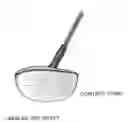
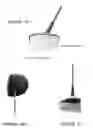
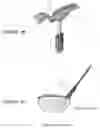
The idea relates to a golf club, metal driver (FIG. 01) or in some cases metal irons (FIG. 04) which differs from conventional golf clubs. In this idea the shaft is moved from the heal of the club head to the center of the club head to meet the contact point of the club head. This enables the axis of the shaft to be located at the contact point of the head where the club face meets the golf ball. This helps eliminate the club turning in the golfer's hands upon contact of the ball.
Interested in similar patents?
Get notified when new applications in this technology area are published.
Classification:
A63B53/0466 » CPC main
Golf clubs; Heads wood-type
A63B53/047 » CPC further
Golf clubs; Heads iron-type
A63B60/00 » CPC further
Details or accessories of golf clubs, bats, rackets or the like
A63B53/02 » CPC further
Golf clubs Joint structures between the head and the shaft
Description
(1) The golf club design came from the concept, that with a conventional golf club, the contact point of the ball is 2 or 3 inches from the shaft axis. This creates a torque action when hitting the ball. The torque action causes a loss of power when striking the ball. It also increases the tendency of twisting the club in the golfer's hands upon impact. The twist action impacts direct control of the ball causing poor hitting and scoring outcomes. To improve the problem of a conventional club, the basic design of this idea is to move the shaft toward the center of the club head to meet the contact point. This moves the contact point of the head of the club to meet the axis of the shaft. The contact point and axis of the club face intersect.
(2) By moving the contact point from the rear of the club face to the center of the club face the golfer will be able to be more successful in their game and improve their scores.
(3) The best mode of carrying out the invention is to change the head of the conventional golf club and move the contact point to the center of the club as shown in diagram 01.
Claims
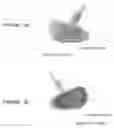
1. The claim of this new design is to reduce torque around the shaft of the club when hitting the golf ball. In the standard club design, the club head contact point may be more than 2 inches from the point where the shaft is connected (FIG. 07). Striking the ball 2 inches from the shaft axis can torque the club. A twist of the club, even so slightly, can send the ball in a completely different direction than intended. Striking the ball where the axis meets the contact point eliminates the torque and projects the ball in the desired direction. Another claim of this new design is to reduce the need to hold the club shaft so tightly in order to prevent twisting, aiding the golfer to concentrate on other aspects of the game.
Images & Drawings included:
Sources:
- United States Patent and Trademark Office - verify current appl. status at the USPTO↗
Similar patent applications:
- » 20230064898
GOLF CLUB HEAD ALLOY, GOLF CLUB HEAD, HEAT TREATMENT METHOD FOR THE GOLF CLUB HEAD ALLOY, AND METHOD FOR PRODUCING GOLF CLUB HEAD - » 20110152002
Method of manufacturing golf club head, golf club head, and head base body - » 20100048322
Golf club head, face of the golf club head, and method of manufacturing the golf club head - » 20200254314
Method for manufacturing iron golf club head, iron golf club head, and iron golf club - » 20190358503
Method for manufacturing iron golf club head, iron golf club head, and iron golf club - » 20150151171
Golf Club Head Alloy and Method for Producing a Sheet Material for a Striking Plate of a Golf Club Head and for the Golf Club Head by Using the Same - » 20090029797
Method of manufacturing golf club head and golf club head - » 20160008676
GOLF CLUB HEAD, GOLF CLUB, GOLF CLUB PERFORMANCE EVALUATION METHOD, AND GOLF CLUB AND GOLF BALL SET - » 20080076598
Colored, transparent coating layer for golf club head and golf club head members - » 20090082129
Method of Manufacturing Golf Club Head and Golf Club Head
Recent applications in this class:
- » 20250161767 2025-05-22
GOLF CLUB HEAD - » 20250153010 2025-05-15
Method of Manufacturing Golf Club Head Having Stress-Reducing Features - » 20250144483 2025-05-08
Multi-Material Iron-Type Golf Club Head - » 20250135300 2025-05-01
GOLF CLUB - » 20250121264 2025-04-17
GOLF CLUB HEADS WITH OPTIMIZED CHARACTERISTICS - » 20250121263 2025-04-17
MULTI-MATERIAL GOLF CLUB HEAD - » 20250121262 2025-04-17
GOLF CLUB HEAD WITH IMPROVED VARIABLE THICKNESS STRIKING FACE - » 20250121261 2025-04-17
GOLF CLUB HEAD - » 20250114672 2025-04-10
LOCALIZED MILLED GOLF CLUB FACE - » 20250114671 2025-04-10
GOLF CLUB HEADS WITH ENERGY STORAGE CHARACTERISTICS