CERAMIC MOLDED COMPONENT OF SANDWICH CONSTRUCTION
US20110045307A1
2011-02-24
12/989,955
2009-05-05
Abstract:
The molded component consists of one or more deck layer(s) and a supporting core. This core also consists of one or more layers. The deck layer(s), as well as the core, are coated and impregnated by a ceramic matrix. The deck layers, as part of the molded component in the sandwich construction, have to take the principal stress; therefore, they have a special importance in absorbing tension, pressure, shear, torsion and bending stress. The invented molded component, with its fiber orientation preferably of±45° , will be the most efficient use of material and the best features.
Interested in similar patents?
Get notified when new applications in this technology area are published.
Classification:
B32B18/00 » CPC main
Layered products essentially comprising ceramics, e.g. refractory products
B32B5/22 IPC
Layered products characterised by the non- homogeneity or physical structure, i.e. comprising a fibrous, filamentary, particulate or foam layer; Layered products characterised by having a layer differing constitutionally or physically in different parts characterised by the presence of two or more layers which are next to each other and are fibrous, filamentary, formed of particles or foamed
C04B35/80 » CPC further
Shaped ceramic products characterised by their composition ; Ceramics compositions ; Processing powders of inorganic compounds preparatory to the manufacturing of ceramic products; Ceramic products containing macroscopic reinforcing agents containing non-metallic materials Fibres, filaments, whiskers, platelets, or the like
C04B2235/5268 » CPC further
Aspects relating to ceramic starting mixtures or sintered ceramic products; Composition of constituents of the starting material or of secondary phases of the final product; Constituents or additives of the starting mixture chosen for their shape or used because of their shape or their physical appearance; Constituents or additives characterised by their shapes; Fibers Orientation of the fibers
C04B2237/341 » CPC further
Aspects relating to ceramic laminates or to joining of ceramic articles with other articles by heating; Composition of layers of ceramic laminates or of ceramic or metallic articles to be joined by heating, e.g. Si substrates; Ceramic; Oxidic Silica or silicates
C04B2237/38 » CPC further
Aspects relating to ceramic laminates or to joining of ceramic articles with other articles by heating; Composition of layers of ceramic laminates or of ceramic or metallic articles to be joined by heating, e.g. Si substrates; Ceramic Fiber or whisker reinforced
Description
DESCRIPTION
The invention is a Ceramic Molded Component consisting of a ceramic core with deck layer(s) made of tows in ceramic matrix with quasi-isotropic features. This sandwich construction has already proven its advantages in long term practice in many fields, especially in the construction industry. For instance, in a lightweight roof construction, the truss and wall panels are made by sandwich construction. In all cases, the goal is to produce a construction with minimum weight but maximum static and dynamic load, combined with fire resistance.
Sandwich parts in building construction and in civil and underground engineering are also applied to multi-layer pipes; for instance, in sewer systems or district heating. Also, there are already bridges made of molded components with fiberglass-reinforced plastics, but the parts are still heavy.
All of these conceptually excellent constructions described above have the unappreciated but irreversible disadvantages of too-high weight and/or too little bending-tension strength, combined with too much bending of the part.
Until now it was not possible to produce modern sandwich components for challenging projects, because until now construction methods used did not include the possibility of this invention; in this sense it is a real innovation. The invention described in this document can be produced today because the necessary components now exist.
The deck-layer fiber reinforcements until now are made from fabrics, stitch-bonded fabrics, or multidirectionals of different fibers. Compared with stitch-bonded fabrics or multidirectionals, the construction and production of usual fabrics causes much higher weight, combined with only a fraction of the strength.
The reinforcement is impregnated with a ceramic matrix. For practical use of the molded component, especially under tension in different directions, the prefabricated reinforcement layers have to have a different orientation. Preferably they are arranged at an angle of±45° . In this way, the molded component is quasi-isotropic. Together with the ceramic core, the deck layers comprise the molded component. Middle reinforcements in the same±45° orientation give additional very high strength and support to the ceramic core. If needed, such reinforcements can be oriented only in a crosswise direction, to strengthen the construction part. The use of other reinforcements with quasi-isotropic features like stitch-bonding reinforcements are possible. But even usual reinforcement fabrics are possible based on their lower costs (but also lower features).
Applications of the Ceramic Molded Component described here include not only panels or boards but also many other challenging applications. For example, in the field of building construction (especially fire-resistant construction). Two other examples are the field of bridge construction and for pipes in district heating, sewers, oil pipelines in polar regions etc.
Some other applications of this invention are:
-
- Basic materials for hanging, fire-resistant facades; double flooring; building material for entire houses
- Covers for cable tunnel
- Insulated pipes
- Tunnel lining
- Containers of all kinds
- Traffic management systems
- Insulated vehicles; for instance, railway cars, trucks, ships, and trailers
- Quick-build road bridges
- Pontoon bridges for military use
- Armored vehicles, bulletproof walls, etc.
These are but a few of the potential applications.
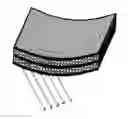
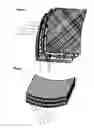
DESCRIPTION OF FIGS. 1 AND 2 (BELOW)
1. Upper top layer made of resin-impregnated layers with reinforcement fibers;
2. Middle layer to absorb the tension transverse to the long axis of the stress direction;
3. Lower top layer, the same as the upper top layer;
4. Upper core layer made of ceramic material; for instance, expanded clay, perlite, pumice or similar;
5. Lower core layer, the same as the upper core layer;
6. Upper and middle reinforcement bundles in place;
7. Lower reinforcement bundles in place.
Claims
1. A ceramic molded component of sandwich construction including a supporting core layer having at least one reinforcing outer layer, said layer having differing fiber orientations, characterized in that said core layer is formed of ceramic material and said outer layer comprises at least two single fiber layers soaked in a ceramic matrix.
2. A component as claimed in claim 1 formed of a sandwich construction comprising a top outer layer formed of resin impregnated fiber layers soaked in a resin matrix, said core layer, and a lower, outer layer formed the same as top outer layer.
3. A component as claimed in claim 2, further including a middle layer having a similar construction to the top outer layer and lower outer layer, and a further core layer formed the same as said core layer, the middle layer and further core layer being adjacent said core layer and lower, outer, layer respectively.
4. A component as claimed in claim 1 wherein the outer layers are made of one of glass, carbon, aramid, polyester, acrylic, basalt, ceramic fibers and similar materials.
5. A component as claimed in claim 3, wherein the top, middle and lower layers are made of one of glass, carbon, aramid, polyester, acrylic, basalt, ceramic fibers and similar materials.
6. A component as claimed in claim 1, wherein at least one of said core layer and further core layer are made of a ceramic-bonded granulate based on at least one of pumice, perlite, mica, cellular glass, expanded materials, expanded clay, gravel of any kind, and the like.
7. A component as claimed in claim 1 when used as a building material.
Images & Drawings included:
Sources:
- United States Patent and Trademark Office - verify current appl. status at the USPTO↗
Recent applications in this class:
- » 20250018690 2025-01-16
JOINED BODY - » 20240408855 2024-12-12
METHOD TO FABRICATE A MACHINABLE CERAMIC MATRIX COMPOSITE - » 20240359434 2024-10-31
Ceramic matrix composite (CMC) component resistant to edge cracks - » 20240300219 2024-09-12
Ceramic package for quantum computing and method for preparation - » 20240278543 2024-08-22
CERAMIC MATRIX COMPOSITES AND METHOD OF MAKING - » 20240262084 2024-08-08
SILICON CARBIDE SEED CRYSTAL - » 20240253333 2024-08-01
COMPOSITE PANELS AND METHODS FOR MANUFACTURING THE SAME - » 20240157683 2024-05-16
SUBSTRATE AND METHOD FOR PRODUCING THE SUBSTRATE - » 20240149565 2024-05-09
COMPOSITE BODY COMPRISING SILICON CARBIDE AND METHOD FOR PRODUCING SAME - » 20240140076 2024-05-02
Ceramic susceptor