Flexible maleimide polymer and method for preparing the same
US20130172518A1
2013-07-04
13/549,606
2012-07-16
✅ Patent granted
US 9,267,005 B2
2016-02-23
-
-
Rachel Kahn
Birch, Stewart, Kolasch & Birch, LLP.
2033-02-13
Abstract:
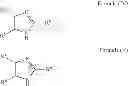
Disclosed is a flexible maleimide polymer. The flexible maleimide polymer includes a reaction product of reactants (a)-(c). The reactant (a) is maleimide, a compound with a structure represented by Formula (I), a compound with a structure represented by Formula (II), or combinations thereof
-
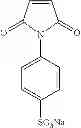
- wherein R1 is —(CH2)10—CO2H, and R2 is H, OH, SO3Na, NO2, CN or CO2H. The reactant (b) is a compound with a structure represented by formula (III)
-
- wherein A is
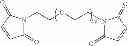
R3 is H or methyl group, x is between 1-12, R4 is H or methyl group, and y and z are both between 1-5. The reactant (c) is a compound with a structure represented by formula (IV), or a compound with a structure represented by formula (V)
-
- wherein R5 and R6 are independent H or C1-4 alkyl group.
Inventors:
- Li-Duan Tsai 78 🇹🇼 Hsinchu City, Taiwan
- Wei-Hsin Wu 5 🇹🇼 Kaohsiung City, Taiwan
- Li-Fu HUANG 1 🇹🇼 Taoyuan City, Taiwan
- Li-Duan Tsai 63 🇹🇼 Hsinchu, Taiwan
- Li Fu HUANG 2 🇹🇼 Taoyuan, Taiwan
- Wei-Hsin Wu 4 🇹🇼 Kaohsiung, Taiwan
Assignee:
- INDUSTRIAL TECHNOLOGY RESEARCH INSTITUTE 7,890 🇹🇼 HSINCHU, Taiwan
Applicant:
Interested in similar patents?
Get notified when new applications in this technology area are published.
Classification:
C08K5/3415 » CPC further
Use of organic ingredients; Nitrogen-containing compounds; Heterocyclic compounds having nitrogen in the ring having one nitrogen atom in the ring Five-membered rings
C08K5/3445 » CPC further
Use of organic ingredients; Nitrogen-containing compounds; Heterocyclic compounds having nitrogen in the ring having two nitrogen atoms in the ring Five-membered rings
C08G73/124 » CPC main
Macromolecular compounds obtained by reactions forming a linkage containing nitrogen with or without oxygen or carbon in the main chain of the macromolecule, not provided for in groups - ; Polycondensates having nitrogen-containing heterocyclic rings in the main chain of the macromolecule; Polyimides; Polyester-imides; Polyamide-imides; Polyamide acids or similar polyimide precursors; Unsaturated polyimide precursors the unsaturated precursors containing oxygen in the form of ether bonds in the main chain
C08G73/12 IPC
Macromolecular compounds obtained by reactions forming a linkage containing nitrogen with or without oxygen or carbon in the main chain of the macromolecule, not provided for in groups - ; Polycondensates having nitrogen-containing heterocyclic rings in the main chain of the macromolecule; Polyimides; Polyester-imides; Polyamide-imides; Polyamide acids or similar polyimide precursors Unsaturated polyimide precursors
C08L79/08 IPC
Compositions of macromolecular compounds obtained by reactions forming in the main chain of the macromolecule a linkage containing nitrogen with or without oxygen or carbon only, not provided for in groups - ; Polycondensates having nitrogen-containing heterocyclic rings in the main chain; Polyhydrazides; Polyamide acids or similar polyimide precursors Polyimides; Polyester-imides; Polyamide-imides; Polyamide acids or similar polyimide precursors
C08L79/085 » CPC further
Compositions of macromolecular compounds obtained by reactions forming in the main chain of the macromolecule a linkage containing nitrogen with or without oxygen or carbon only, not provided for in groups - ; Polycondensates having nitrogen-containing heterocyclic rings in the main chain; Polyhydrazides; Polyamide acids or similar polyimide precursors; Polyimides; Polyester-imides; Polyamide-imides; Polyamide acids or similar polyimide precursors Unsaturated polyimide precursors
C08G73/10 IPC
Macromolecular compounds obtained by reactions forming a linkage containing nitrogen with or without oxygen or carbon in the main chain of the macromolecule, not provided for in groups - ; Polycondensates having nitrogen-containing heterocyclic rings in the main chain of the macromolecule Polyimides; Polyester-imides; Polyamide-imides; Polyamide acids or similar polyimide precursors
Description
CROSS REFERENCE TO RELATED APPLICATIONS
This application is based upon and claims the benefit of priority from the prior Taiwan Patent Application No. 100149463, filed on Dec. 29, 2011, the entire contents of which are incorporated herein by reference.
TECHNICAL FIELD
The disclosure relates to a maleimide polymer, and in particular relates to a flexible maleimide polymer.
BACKGROUND
Due to its high thermal stability, mechanical strength, and resistance to chemical corrosion, maleimide polymer is applied in a variety of electrical devices. A coating made of the conventional maleimide polymer, however, exhibits inferior film extensibility due to the rigid aromatic linking chain of the conventional maleimide polymer. Further, the conventional maleimide polymer has a high dimensional change under high temperature or by water absorption due the poor dimensional stability of the conventional maleimide polymer.
Moreover, in order to improve the ionic electrical conductivity, a polymer with high ionic electrical conductivity has to be used to blend with the conventional maleimide polymer. Therefore, the application of the maleimide polymer is limited.
SUMMARY
One embodiment provides a flexible maleimide polymer which includes a reaction product of reactants (a)-(c). Particularly, the reactant (a) is maleimide, a compound with a structure represented by Formula (I), a compound with a structure represented by Formula (II), or combinations thereof
wherein R1 is —(CH2)10—CO2H, and R2 is H, OH, SO3Na, NO2, CN or CO2H. The reactant (b) is a compound with a structure represented by formula (II)
wherein A is
R3 is H or methyl group, x is between 1-12, R4 is H or methyl group, and y and z are both between 1-5. The reactant (c) is a compound with a structure represented by formula (IV), or a compound with a structure represented by formula (V)
wherein R5 and R6 are independent H or C1-4 alkyl group.
Another embodiment provides a method for preparing the aforementioned flexible maleimide polymer. The method includes reacting the reactant (a) with the reactant (b) in the presence of a reactant (c) undergoing a polymerization to obtain the flexible maleimide polymer.
A detailed description is given in the following embodiments with reference to the accompanying drawings.
DETAILED DESCRIPTION
Below, exemplary embodiments will be described in detail with reference to accompanying drawings so as to be easily realized by a person having ordinary knowledge in the art. The inventive concept may be embodied in various forms without being limited to the exemplary embodiments set forth herein. Descriptions of well-known parts are omitted for clarity, and like reference numerals refer to like elements throughout.
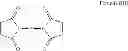
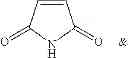
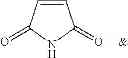
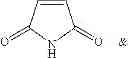
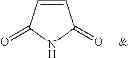
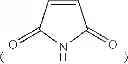
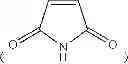
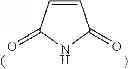
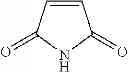
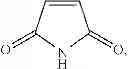
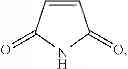
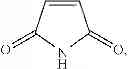
According to embodiments of the disclosure, a flexible maleimide polymer with high dimensional stability, mechanical strength, and water retaining capacity is provided. The flexible maleimide polymer includes a reaction product of reactants (a)-(c). Particularly, the reactant (a) is maleimide (having a structure represented by
a compound with a structure represented by Formula (I), a compound with a structure represented by Formula (II), or combinations thereof
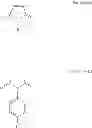
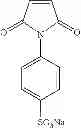
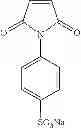
wherein R1 is —(CH2)10—CO2H, and R2 is H, OH, SO3Na, NO2, CN or CO2H. In order to improve the ionic electrical conductivity of the flexible maleimide polymer, the reactant (a) can include a compound represented by
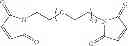
The reactant (b) is a compound with a structure represented by formula (III)
wherein A is
R3 is H or methyl group, x can be between 1-12 and can not be an integer. For example, x can be 3.5, 5.5, 6.1 or 7.5 (an average value measured by evaluating the molecular weight of reactant (b)). R4 is H or methyl group, and y and z are both between 1-5. Due to the flexible linking chain A, the maleimide polymer prepared from the reactant (b) has superior extensibility and elasticity.
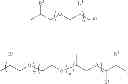
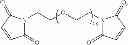
The reactant (b) can have long-chain polyethylene oxide (PEO) linking chain, such as
Further, the reactant (b) can have branched polyethylene oxide, such as
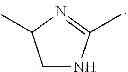
(y and z are from 1-5). The reactant (c) is a compound with a structure represented by formula (IV), or a compound with a structure represented by formula (V)
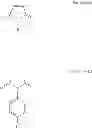
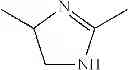
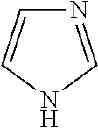
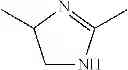
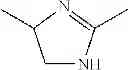
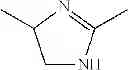
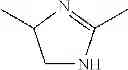
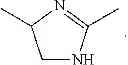
wherein R5 and R6 are independent H or C1-4 alkyl group. For example, the reactant (c) can be a nitrogen-containing heterocyclic compound, such as imidazole
or 2,4-dimethyl-4,5-dihydro-1H-imidazole
According to an embodiment of the disclosure, the reactant (a) can include maleimide
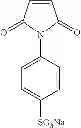
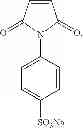
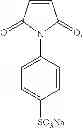
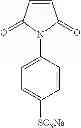
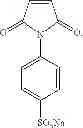
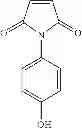
and the molar ratio between the maleimide and the reactant (c) can be from 5:0.05 to 1:1, or from 4:1 to 1:1. The molecular weight of the flexible maleimide polymer is in inverse ratio to the amount of the reactant (c), and the flexible maleimide polymer with high molecular weight is apt to form gel. Further, the reactant (a) can be, or further include, a maleimide with a functional group (such as
in order to modify the flexible maleimide polymer. The reactant (a) can include the compound with the structure represented by Formula (I) (and/or the compound with the structure represented by Formula (II)), and the molar ratio between the compound with the structure represented by Formula (I) (or Formula (II)) and the reactant (c) is from 4:0.05 to 1:1. Moreover, the molar ratio between the reactant (b) and the reactant (c) is from 2:0.05 to 1:1 or from 1:0.25 to 1:1.
In an embodiment of the disclosure, the method for preparing the flexible maleimide polymer includes the following steps. First, the reactants (a)-(c) are dissolved in an organic solvent (such as dimethyl acetamide (DMAC), or N-methylpyrrolidone (NMP), obtaining a mixture. Next, the mixture is heated and stirred to undergo a polymerization at a reaction temperature. After reacting for a period of time (such as 4-10 hrs), a solution including the flexible maleimide polymer is obtained. The reaction temperature can be from 25 to 180° C. For example, the mixture can be reacted at room temperature or below the boiling point of the organic solvent.
Preparation of Flexible Maleimide Polymer
Example 1
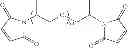
5.12 mmole of maleimide
(reactant (a)), 1.28 mmole of
(reactant (b)), 1.28 mmole of
(reactant (c)), and 30 mL of DMAC (serving as a solvent) were added to a reaction bottle, wherein the molar ratio between
was 4:1:1. Next, the mixture was stirred at 100° C. and continuously examined by gel permeation chromatography (GPC) to confirm the presence of reactants (a) and (b). After reacting for 6 hrs, a red transparent solution including a flexible maleimide polymer was obtained.
Example 2
5.12 mmole of maleimide
(reactant (a)), 1.28 mmole of
(reactant (b)), 1.28 mmole of
(reactant (c)), and 30 mL of DMAC (serving as a solvent) were added to a reaction bottle, wherein the molar ratio between
was 4:1:1. Next, the mixture was stirred at 100° C. and continuously examined by gel permeation chromatography (GPC) to confirm the presence of reactants (a) and (b). After reacting for 6 hrs, a wine-red solution including a flexible maleimide polymer was obtained.
Example 3
3.84 mmole of maleimide
(reactant (a)), 1.28 mmole of
(reactant (a)), 1.28 mmole of
(reactant (b)), 1.28 mmole of
(reactant (c)), and 30 mL of DMAC (serving as a solvent) were added to a reaction bottle, wherein the molar ratio between
was 3:1:1:1. Next, the mixture was stirred at 100° C. and continuously examined by gel permeation chromatography (GPC) to confirm the presence of reactants (a) and (b). After reacting for 6 hrs, a dark red solution including a flexible maleimide polymer was obtained.
Example 4
4.32 mmole of maleimide
(reactant (a)), 1.44 mmole of
(reactant (a)), 1.44 mmole of
(reactant (b)), 1.44 mmole of
(reactant (c)), and 30 mL of DMAC (serving as a solvent) were added to a reaction bottle, wherein the molar ratio between
was 3:1:1:1. Next, the mixture was stirred at 100° C. and continuously examined by gel permeation chromatography (GPC) to confirm the presence of reactants (a) and (b). After reacting for 6 hrs, a wine-red solution including a flexible maleimide polymer was obtained.
Example 5
4.32 mmole of maleimide
(reactant (a)), 1.44 mmole of
(reactant (a)), 1.44 mmole of
(reactant (b)), 1.44 mmole of
(reactant (c)), and 30 mL of DMAC (serving as a solvent) were added to a reaction bottle, wherein the molar ratio between
was 3:1:1:1. Next, the mixture was stirred at 100° C. and continuously examined by gel permeation chromatography (GPC) to confirm the presence of reactants (a) and (b). After reacting for 6 hrs, a red transparent solution including a flexible maleimide polymer was obtained.
Example 6
7.17 mmole of maleimide
(reactant (a)), 2.39 mmole of
(reactant (a)), 2.39 mmole of
(reactant (b)), 2.39 mmole of
(reactant (c)), and 30 mL of DMAC (serving as a solvent) were added to a reaction bottle, wherein the molar ratio between
was 3:1:1:1. Next, the mixture was stirred at 100° C. and continuously examined by gel permeation chromatography (GPC) to confirm the presence of reactants (a) and (b). After reacting for 6 hrs, a red transparent solution including a flexible maleimide polymer was obtained.
Example 7
3.60 mmole of maleimide
(reactant (a)), 1.20 mmole of
(reactant (a)), 1.20 mmole of
(reactant (b)), 1.20 mmole of
(reactant (c)), and 30 mL of DMAC (serving as a solvent) were added to a reaction bottle, wherein the molar ratio between
was 3:1:1:1. Next, the mixture was stirred at 100° C. and continuously examined by gel permeation chromatography (GPC) to confirm the presence of reactants (a) and (b). After reacting for 6 hrs, a red transparent solution including a flexible maleimide polymer was obtained.
Example 8
2.52 mmole of maleimide
(reactant (a)), 0.84 mmole of
(reactant (a)), 0.84 mmole of
(reactant (b)), 0.84 mmole of
(reactant (c)), and 30 mL of DMAC (serving as a solvent) were added to a reaction bottle, wherein the molar ratio between
was 3:1:1:1. Next, the mixture was stirred at 100° C. and continuously examined by gel permeation chromatography (GPC) to confirm the presence of reactants (a) and (b). After reacting for 6 hrs, a red transparent solution including a flexible maleimide polymer was obtained.
Example 9
Example 9 was performed as Example 6 except for substitution of 1.2 mmole of
for 2.39 mmole of
Particularly, the molar ratio between
was 3:1:1:0.5.
Example 10
Example 10 was performed as Example 6 except for substitution of 0.6 mmole of
for 2.39 mmole of
Particularly, the molar ratio between
was 3:1:1:0.25.
Example 11
Example 11 was performed as Example 6 except for substitution of 4.78 mmole of
for 7.17 mmole of
and substitution of 4.78 mmole of
for 2.39 mmole of
Particularly, the molar ratio between
was 2:2:1:1.
Example 12
Example 12 was performed as Example 6 except for substitution of 4.78 mmole of
for 7.17 mmole of
substitution of 4.78 mmole of
for 2.39 mmole of
and substitution of 1.2 mmole of
for 2.39 mmole of
Particularly, the molar ratio between
was 2:2:1:0.5.
Example 13
Example 13 was performed as Example 6 except for substitution of 2.39 mmole of
for 7.17 mmole of
Particularly, the molar ratio of
was 1:1:1:1.
Example 14
Example 14 was performed as Example 6 except for substitution of 11.95 mmole of
for 7.17 mmole of
Particularly, the molar ratio between
was 5:1:1:1.
Example 15
Example 15 was performed as Example 6 except for substitution of 11.95 mmole of
for 7.17 mmole of
substitution of 7.17 mmole of
for 2.39 mmole of
substitution of 4.78 mmole of
for 2.39 mmole of
and substitution of 0.12 mmole of
for 2.39 mmole of
Particularly, the molar ratio between
was 5:3:2:0.05.
Example 16
2.58 mmole of maleimide
(reactant (a)), 0.86 mmole of
(reactant (a)), 0.86 mmole of
(reactant (b)), 0.86 mmole of
(reactant (c)), and 30 mL of DMAC (serving as a solvent) were added to a reaction bottle, wherein the molar ratio between
was 3:1:1:1. Next, the mixture was stirred at 100° C. and continuously examined by gel permeation chromatography (GPC) to confirm the presence of reactants (a) and (b). After reacting for 6 hrs, an orange red transparent solution including a flexible maleimide polymer was obtained.
Example 17
2.55 mmole of maleimide
(reactant (a)), 0.85 mmole of
(reactant (a)), 0.85 mmole of
(reactant (b)), 0.85 mmole of
(reactant (c)), and 30 mL of DMAC (serving as a solvent) were added to a reaction bottle, wherein the molar ratio between
was 3:1:1:1. Next, the mixture was stirred at 100° C. and continuously examined by gel permeation chromatography (GPC) to confirm the presence of reactants (a) and (b). After reacting for 6 hrs, a red transparent solution including a flexible maleimide polymer was obtained.
Example 18
2.49 mmole of maleimide
(reactant (a)), 0.83 mmole of
(reactant (a)), 0.83 mmole of
(reactant (b)), 0.83 mmole of
(reactant (c)), and 30 mL of DMAC (serving as a solvent) were added to a reaction bottle, wherein the molar ratio between
was 3:1:1:1. Next, the mixture was stirred at 100° C. and continuously examined by gel permeation chromatography (GPC) to confirm the presence of reactants (a) and (b). After reacting for 6 hrs, a dark red transparent solution including a flexible maleimide polymer was obtained.
Example 19
2.52 mmole of maleimide
(reactant (a)), 0.84 mmole of
(reactant (a)), 0.84 mmole of
(reactant (b)), 0.84 mmole of
(reactant (c)), and 30 mL of DMAC (serving as a solvent) were added to a reaction bottle, wherein the molar ratio between
was 3:1:1:1. Next, the mixture was stirred at 100° C. and continuously examined by gel permeation chromatography (GPC) to confirm the presence of reactants (a) and (b). After reacting for 6 hrs, a wine-red transparent solution including a flexible maleimide polymer was obtained.
Example 20
2.49 mmole of maleimide
(reactant (a)), 0.83 mmole of
(reactant (a)), 0.83 mmole of
(reactant (b)), 0.83 mmole of
(reactant (c)), and 30 mL of DMAC (serving as a solvent) were added to a reaction bottle, wherein the molar ratio between
was 3:1:1:1. Next, the mixture was stirred at 100° C. and continuously examined by gel permeation chromatography (GPC) to confirm the presence of reactants (a) and (b). After reacting for 6 hrs, a wine-red transparent solution including a flexible maleimide polymer was obtained.
Example 21
2.37 mmole of maleimide
(reactant (a)), 0.79 mmole of
(reactant (a)), 0.79 mmole of
(reactant (b)), 0.79 mmole of
(reactant (c)), and 30 mL of DMAC (serving as a solvent) were added to a reaction bottle, wherein the molar ratio between
was 3:1:1:1. Next, the mixture was stirred at 100° C. and continuously examined by gel permeation chromatography (GPC) to confirm the presence of reactants (a) and (b). After reacting for 6 hrs, a wine-red transparent solution including a flexible maleimide polymer was obtained.
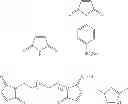
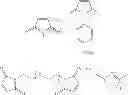
The reactants (a)-(c) and the phase of flexible maleimide polymers as disclosed in Examples 1-21 are shown in Table 1.
| TABLE 1 | |||||
| Molar | |||||
| ratio | |||||
| reactant | between | ||||
| reactant (a) | reactant (b) | (c) | reactants | phase | |
| Example 1 | 4:1:1 | liquid | |||
| Example 2 | 4:1:1 | liquid | |||
| Example 3 | 3:1:1:1 | liquid | |||
| Example 4 | 3:1:1:1 | liquid | |||
| Example 5 | 3:1:1:1 | liquid | |||
| Example 6 | 3:1:1:1 | liquid | |||
| Example 7 | 3:1:1:1 | liquid | |||
| Example 8 | 3:1:1:1 | liquid | |||
| Example 9 | 3:1:1:0.5 | liquid | |||
| Example 10 | 3:1:1:0.25 | liquid | |||
| Example 11 | 2:2:1:1 | liquid | |||
| Example 12 | 2:2:1:0.5 | liquid | |||
| Example 13 | 1:1:1:1 | liquid | |||
| Example 14 | 5:1:1:1 | liquid | |||
| Example 15 | 5:3:2:0.05 | gel | |||
| Example 16 | 3:1:1:1 | liquid | |||
| Example 17 | 3:1:1:1 | liquid | |||
| Example 18 | 3:1:1:1 | liquid | |||
| Example 19 | 3:1:1:1 | liquid | |||
| Example 20 | 3:1:1:1 | liquid | |||
| Example 21 | 3:1:1:1 | liquid | |||
Accordingly, since the flexible maleimide polymer of the disclosure is prepared by reacting a N-phenylmaleimide having a specific function group (such as sulfonic group) with bismaleimide having a flexible and water-retaining linking chain, the flexible maleimide polymer exhibits a high mechanical strength, and water retaining capacity.
It will be apparent to those skilled in the art that various modifications and variations can be made to the disclosed methods and materials. It is intended that the specification and examples be considered as exemplary only, with a true scope of the disclosure being indicated by the following claims and their equivalents.
Claims
What is claimed is:1. A flexible maleimide polymer, comprising a reaction product of a reactant (a), a reactant (b), and a reactant (c), wherein the reactant (a) is maleimide, a compound with a structure represented by Formula (I), a compound with a structure represented by Formula (II), or combinations thereof,
wherein R1 is —(CH2)10—CO2H, and R2 is H, OH, SO3Na, NO2, CN or CO2H;
the reactant (b) is a compound with a structure represented by formula (III)
wherein A is
R3 is H or methyl group, x is between 1-12, R4 is H or methyl group,
and y and z are both between 1-5; and
the reactant (c) is a compound with a structure represented by formula (IV), or
a compound with a structure represented by formula (V)
wherein R5 and R6 are independent H or C1-4 alkyl group.
2. The flexible maleimide polymer as claimed in claim 1, wherein the reactant (a) comprises maleimide, and the molar ratio between the maleimide and the reactant (c) is from 5:0.05 to 1:1.
3. The flexible maleimide polymer as claimed in claim 1, wherein the reactant (a) comprises the compound with the structure represented by Formula (I) or the compound with the structure represented by Formula (II), and the molar ratio between the compound with the structure represented by Formula (I) and the reactant (c) is from 4:0.05 to 1:1, or the molar ratio between the compound with the structure represented by Formula (II) and the reactant (c) is from 4:0.05 to 1:1.
4. The flexible maleimide polymer as claimed in claim 1, wherein the molar ratio between the reactant (b) and the reactant (c) is from 2:0.05 to 1:1.
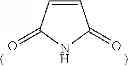
5. The flexible maleimide polymer as claimed in claim 1, wherein the maleimide is
6. A method for preparing flexible maleimide polymer, comprising:
reacting a reactant (a) with a reactant (b) in the presence of a reactant (c) undergoing a polymerization to obtain the flexible maleimide polymer, wherein the reactant (a) is maleimide, a compound with a structure represented by Formula (I), a compound with a structure represented by Formula (II), or combinations thereof,
wherein R1 is —(CH2)10—CO2H, and R2 is H, OH, SO3Na, NO2, CN or CO2H;
the reactant (b) is a compound with a structure represented by formula (III)
wherein A is
R3 is H or methyl group, x is between 1-12, R4 is H or methyl group,
and y and z are both between 1-5; and
the reactant (c) is a compound with a structure represented by formula (IV), or
a compound with a structure represented by formula (V)
wherein R5 and R6 are independent H or C1-4 alkyl group.
7. The method as claimed in claim 6, wherein the reactant (a) comprises maleimide, and the molar ratio between the maleimide and the reactant (c) is from 5:0.05 to 1:1.
8. The method as claimed in claim 6, wherein the reactant (a) comprises the compound with the structure represented by Formula (I) or the compound with the structure represented by Formula (II), and the molar ratio between the compound with the structure represented by Formula (I) and the reactant (c) is from 4:0.05 to 1:1, or the molar ratio between the compound with the structure represented by Formula (II) and the reactant (c) is from 4:0.05 to 1:1.
9. The method as claimed in claim 6, wherein the molar ratio between the reactant (b) and the reactant (c) is from 2:0.05 to 1:1.
10. The method as claimed in claim 6, wherein the maleimide is
Images & Drawings included:














































Sources:
- United States Patent and Trademark Office - verify current appl. status at the USPTO↗
Recent applications for this Assignee:
- » 20250289330 2025-09-18
MOBILE VEHICLE CHARGING PROTECTION DEVICE FOR ELECTRICAL SAFETY IN LIVESTOCK HOUSES - » 20250287224 2025-09-11
COMMUNICATION DEVICE AND COMMUNICATION METHOD - » 20250286593 2025-09-11
COMMUNICATION DEVICE AND METHOD OF BEAM MANAGEMENT - » 20250284336 2025-09-11
SYSTEM AND METHOD FOR ADJUSTING IMAGE BASED ON PHYSIOLOGICAL INFORMATION AND POSTURE - » 20250281908 2025-09-11
ELECTROCATALYST COMPOSITION AND PREPARATION METHOD THEREOF - » 20250273403 2025-08-28
CAPACITOR AND ELECTRONIC DEVICE - » 20250271759 2025-08-28
POLYMER, POSITIVE PHOTORESIST COMPOSITION, AND METHOD FOR FORMING PATTERNED PHOTORESIST LAYER - » 20250265803 2025-08-21
MULTI-SENSOR COORDINATION METHOD, PROCESSING DEVICE, AND INFORMATION DISPLAY SYSTEM - » 20250263659 2025-08-21
METHOD AND KIT FOR PREPARING AN IMMUNE CELL DIFFERENTIATED FROM A STEM CELL - » 20250252547 2025-08-07
CORROSION POSITIONING SYSTEM, CORROSION INSPECTION VEHICLE AND CORROSION POSITIONING METHOD USING THE SAME