Multilayer ceramic capacitor, dielectric ceramic, multilayer ceramic electronic component, and method for manufacturing multilayer ceramic capacitor
US20140016243A1
2014-01-16
14/031,198
2013-09-19
✅ Patent granted
US 9,202,626 B2
2015-12-01
-
-
Dion R Ferguson
Arent Fox LLP
2034-02-25
Abstract:
Provided in a dielectric ceramic having flat capacitance characteristics and a high dielectric constant, and a multilayer ceramic electronic component (such as a multilayer ceramic capacitor) in which the dielectric ceramic is used. A multilayer ceramic capacitor includes a multilayer body having a plurality of dielectric ceramic layers and a plurality of internal electrodes, and external electrodes formed on the multilayer body. The composition of the multilayer body includes any of a bismuth layered compound containing Sr, Bi and Ti, a bismuth layered compound containing Sr, Bi and Nb, and a bismuth layered compound containing Ca, Bi and Ti as a primary ingredient, Bi and at least one of Cu, Ba, Zn and Li, and satisfies the conditions that if the Ti content is 400 molar parts or the Nb content is 200 molar parts, then (Bi content-Ti content) or (Bi content-Nb content) is equal to or greater than 1 molar part and less than 7.5 molar parts and the total content of Cu, Ba, Zn and Li is equal to or greater than 1 molar part and less than 10 molar parts.
Inventors:
- Shoichiro Suzuki 36 🇯🇵 Nagaokakyo-shi, Japan
- Koichi Banno 19 🇯🇵 Nagaokakyo-shi, Japan
- Taisuke Kanzaki 25 🇯🇵 Nagaokakyo-shi, Japan
- Akihiro Shiota 18 🇯🇵 Nagaokakyo-shi, Japan
- Taisuke Kanzaki 24 🇯🇵 Nagaokakyo, Japan
- Shoichiro Suzuki 30 🇯🇵 Nagaokakyo, Japan
- Koichi Banno 17 🇯🇵 Nagaokakyo, Japan
- Akihiro Shiota 17 🇯🇵 Nagaokakyo, Japan
Assignee:
- Murata Manufacturing Co., Ltd. 2,311 🇯🇵 Nagaokakyo-shi, Japan
- MURATA MANUFACTURING CO., LTD. 942 🇯🇵 Nagaokakyo-shi, Kyoto-fu, Japan
Applicant:
Interested in similar patents?
Get notified when new applications in this technology area are published.
Classification:
H01G4/1209 » CPC main
Fixed capacitors; Processes of their manufacture; Details; Dielectrics; Solid dielectrics; Inorganic dielectrics; Ceramic dielectrics characterised by the ceramic dielectric material
C04B35/64 » CPC further
Shaped ceramic products characterised by their composition ; Ceramics compositions ; Processing powders of inorganic compounds preparatory to the manufacturing of ceramic products; Forming processes; Processing powders of inorganic compounds preparatory to the manufacturing of ceramic products Burning or sintering processes
H01G4/12 IPC
Fixed capacitors; Processes of their manufacture; Details; Dielectrics; Solid dielectrics; Inorganic dielectrics Ceramic dielectrics
C04B35/453 » CPC further
Shaped ceramic products characterised by their composition ; Ceramics compositions ; Processing powders of inorganic compounds preparatory to the manufacturing of ceramic products based on oxide ceramics based on zinc, tin, or bismuth oxides or solid solutions thereof with other oxides, e.g. zincates, stannates or bismuthates
C04B2235/3284 » CPC further
Aspects relating to ceramic starting mixtures or sintered ceramic products; Composition of constituents of the starting material or of secondary phases of the final product; Constituents and secondary phases not being of a fibrous nature; Metal oxides, mixed metal oxides, or oxide-forming salts thereof, e.g. carbonates, nitrates, (oxy)hydroxides, chlorides Zinc oxides, zincates, cadmium oxides, cadmiates, mercury oxides, mercurates or oxide forming salts thereof
C04B35/475 » CPC further
Shaped ceramic products characterised by their composition ; Ceramics compositions ; Processing powders of inorganic compounds preparatory to the manufacturing of ceramic products based on oxide ceramics based on titanium oxides or titanates based on titanates based on bismuth titanates
C04B2235/3203 » CPC further
Aspects relating to ceramic starting mixtures or sintered ceramic products; Composition of constituents of the starting material or of secondary phases of the final product; Constituents and secondary phases not being of a fibrous nature; Metal oxides, mixed metal oxides, or oxide-forming salts thereof, e.g. carbonates, nitrates, (oxy)hydroxides, chlorides; Alkali metal oxides or oxide-forming salts thereof Lithium oxide or oxide-forming salts thereof
C04B35/626 IPC
Shaped ceramic products characterised by their composition ; Ceramics compositions ; Processing powders of inorganic compounds preparatory to the manufacturing of ceramic products; Forming processes; Processing powders of inorganic compounds preparatory to the manufacturing of ceramic products Preparing or treating the powders individually or as batches ; preparing or treating macroscopic reinforcing agents for ceramic products, e.g. fibres; mechanical aspects section
C04B35/62685 » CPC further
Shaped ceramic products characterised by their composition ; Ceramics compositions ; Processing powders of inorganic compounds preparatory to the manufacturing of ceramic products; Forming processes; Processing powders of inorganic compounds preparatory to the manufacturing of ceramic products; Preparing or treating the powders individually or as batches ; preparing or treating macroscopic reinforcing agents for ceramic products, e.g. fibres; mechanical aspects section; Treating the starting powders individually or as mixtures characterised by the order of addition of constituents or additives
H01G4/30 » CPC further
Fixed capacitors; Processes of their manufacture Stacked capacitors
C04B2235/3208 » CPC further
Aspects relating to ceramic starting mixtures or sintered ceramic products; Composition of constituents of the starting material or of secondary phases of the final product; Constituents and secondary phases not being of a fibrous nature; Metal oxides, mixed metal oxides, or oxide-forming salts thereof, e.g. carbonates, nitrates, (oxy)hydroxides, chlorides; Alkaline earth oxides or oxide forming salts thereof, e.g. beryllium oxide Calcium oxide or oxide-forming salts thereof, e.g. lime
C04B2235/3213 » CPC further
Aspects relating to ceramic starting mixtures or sintered ceramic products; Composition of constituents of the starting material or of secondary phases of the final product; Constituents and secondary phases not being of a fibrous nature; Metal oxides, mixed metal oxides, or oxide-forming salts thereof, e.g. carbonates, nitrates, (oxy)hydroxides, chlorides; Alkaline earth oxides or oxide forming salts thereof, e.g. beryllium oxide Strontium oxides or oxide-forming salts thereof
C04B2235/3215 » CPC further
Aspects relating to ceramic starting mixtures or sintered ceramic products; Composition of constituents of the starting material or of secondary phases of the final product; Constituents and secondary phases not being of a fibrous nature; Metal oxides, mixed metal oxides, or oxide-forming salts thereof, e.g. carbonates, nitrates, (oxy)hydroxides, chlorides; Alkaline earth oxides or oxide forming salts thereof, e.g. beryllium oxide Barium oxides or oxide-forming salts thereof
C04B2235/3251 » CPC further
Aspects relating to ceramic starting mixtures or sintered ceramic products; Composition of constituents of the starting material or of secondary phases of the final product; Constituents and secondary phases not being of a fibrous nature; Metal oxides, mixed metal oxides, or oxide-forming salts thereof, e.g. carbonates, nitrates, (oxy)hydroxides, chlorides; Refractory metal oxides, their mixed metal oxides, or oxide-forming salts thereof Niobium oxides, niobates, tantalum oxides, tantalates, or oxide-forming salts thereof
C04B2235/3255 » CPC further
Aspects relating to ceramic starting mixtures or sintered ceramic products; Composition of constituents of the starting material or of secondary phases of the final product; Constituents and secondary phases not being of a fibrous nature; Metal oxides, mixed metal oxides, or oxide-forming salts thereof, e.g. carbonates, nitrates, (oxy)hydroxides, chlorides; Refractory metal oxides, their mixed metal oxides, or oxide-forming salts thereof; Niobium oxides, niobates, tantalum oxides, tantalates, or oxide-forming salts thereof Niobates or tantalates, e.g. silver niobate
C04B2235/3281 » CPC further
Aspects relating to ceramic starting mixtures or sintered ceramic products; Composition of constituents of the starting material or of secondary phases of the final product; Constituents and secondary phases not being of a fibrous nature; Metal oxides, mixed metal oxides, or oxide-forming salts thereof, e.g. carbonates, nitrates, (oxy)hydroxides, chlorides Copper oxides, cuprates or oxide-forming salts thereof, e.g. CuO or CuO
C04B2235/3298 » CPC further
Aspects relating to ceramic starting mixtures or sintered ceramic products; Composition of constituents of the starting material or of secondary phases of the final product; Constituents and secondary phases not being of a fibrous nature; Metal oxides, mixed metal oxides, or oxide-forming salts thereof, e.g. carbonates, nitrates, (oxy)hydroxides, chlorides Bismuth oxides, bismuthates or oxide forming salts thereof, e.g. zinc bismuthate
C04B2235/6025 » CPC further
Aspects relating to ceramic starting mixtures or sintered ceramic products; Aspects relating to the preparation, properties or mechanical treatment of green bodies or pre-forms; Making the green bodies or pre-forms by moulding Tape casting, e.g. with a doctor blade
C04B2235/6562 » CPC further
Aspects relating to ceramic starting mixtures or sintered ceramic products; Aspects relating to heat treatments of ceramic bodies such as green ceramics or pre-sintered ceramics, e.g. burning, sintering or melting processes characterised by specific heating conditions during heat treatment Heating rate
C04B2235/6567 » CPC further
Aspects relating to ceramic starting mixtures or sintered ceramic products; Aspects relating to heat treatments of ceramic bodies such as green ceramics or pre-sintered ceramics, e.g. burning, sintering or melting processes characterised by specific heating conditions during heat treatment Treatment time
H01G4/232 » CPC further
Fixed capacitors; Processes of their manufacture; Details; Terminals electrically connecting two or more layers of a stacked or rolled capacitor
C04B35/495 » CPC further
Shaped ceramic products characterised by their composition ; Ceramics compositions ; Processing powders of inorganic compounds preparatory to the manufacturing of ceramic products based on oxide ceramics based on vanadium, niobium, tantalum, molybdenum or tungsten oxides or solid solutions thereof with other oxides, e.g. vanadates, niobates, tantalates, molybdates or tungstates
Description
This is a continuation of application Serial No. PCT/JP2012/057266, filed Mar. 22, 2012, the entire contents of which are incorporated herein by reference.
TECHNICAL FIELD
The present invention relates to a multilayer ceramic capacitor, a dielectric ceramic used in the multilayer ceramic capacitor, a multilayer ceramic electronic component represented by the multilayer ceramic capacitor, and a method for manufacturing the multilayer ceramic capacitor.
BACKGROUND ART
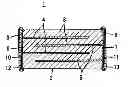
With reference to FIG. 1, a multilayer ceramic capacitor 1, a representative example of a multilayer ceramic electronic component according to the present invention, will be described first.
Multilayer ceramic capacitor 1 includes a multilayer body 2 which is formed from a plurality of laminated ceramic layers 3 and a plurality of internal electrodes 4 and 5 each formed along an interface between ceramic layers 3.
A first external electrode 8 and a second external electrode 9 are formed at mutually different positions on an outer surface of multilayer body 2. In the multilayer ceramic capacitor 1 illustrated in FIG. 1, first external electrode 8 and second external electrode 9 are formed respectively on opposing end surfaces 6 and 7 of multilayer body 2. Internal electrode 4 includes a plurality of first internal electrodes 4 which are electrically connected to first external electrode 8 and internal electrode 5 includes a plurality of second internal electrodes 5 which are electrically connected to second external electrode 9. First internal electrodes 4 and second internal electrodes 5 are disposed alternately in the lamination direction. If necessary, a surface of external electrode 8 is coated with a first plating layer 10 and a second plating layer 12, and a surface of external electrode 9 is coated with a first plating layer 11 and a second plating layer 13.
In recent years, a capacitor that has flat capacitance characteristics from a low temperature to a high temperature exceeding 150° C. has been required, especially in the field of automobiles.
Conventionally, a calcium titanate ceramic is known as such dielectric ceramic having the flat capacitance characteristics. For example, PTD 1 discloses a dielectric ceramic containing calcium titanate at 0 to 45%, Al2O3 and SiO2 at a total amount of 2 to 20%, at least one of MnO, Cr2O3, Fe2O3, CoO and NiO at a total amount of 0.1 to 1.0%, and the remainder being magnesium titanate at 50% or more.
CITATION LIST
Patent Document
PTD 1: Japanese Patent Laying-Open No. 2002-338345
SUMMARY OF INVENTION
Technical Problem
The dielectric ceramic disclosed in PTD 1 has the problem of a low dielectric constant, notwithstanding the flat capacitance characteristics,.
The present invention has been accomplished in view of the aforementioned problem, and it is therefore an object of the present invention to provide a dielectric ceramic having flat capacitance characteristics and a high dielectric constant, and a multilayer ceramic electronic component using the dielectric ceramic.
Solution to Problem
A multilayer ceramic capacitor of the present invention includes a multilayer body having a plurality of laminated dielectric ceramic layers and a plurality of internal electrodes each formed along an interface between the dielectric ceramic layers, and a plurality of external electrodes formed on an outer surface of the multilayer body and electrically connected with the internal electrodes. The composition of the multilayer body includes any bismuth layered compound containing Sr, Bi and Ti, a bismuth layered compound containing Sr, Bi and Nb, and a bismuth layered compound containing Ca, Bi and Ti as a primary ingredient, Bi and at least one of Cu, Ba, Zn and Li, and satisfies such the condition that if the Ti content is 400 molar parts or the Nb content is 200 molar parts, then (Bi content-Ti content) or (Bi content-Nb content) is equal to or greater than 1 molar part and less than 7.5 molar parts and the total content of Cu, Ba, Zn and Li is equal to or greater than 1 molar part and less than 10 molar parts.
A multilayer ceramic capacitor of the present invention includes a multilayer body having a plurality of laminated dielectric ceramic layers and a plurality of internal electrodes formed along an interface between the dielectric ceramic layers, and a plurality of external electrodes formed on an outer surface of the multilayer body and electrically connected with said internal electrodes. The composition of the multilayer body includes any bismuth layered compound containing Sr, Bi and Ti, a bismuth layered compound containing Sr, Bi and Nb, and a bismuth layered compound containing Ca, Bi and Ti as a primary ingredient, Bi and at least one of Cu, Ba, Zn and Li, and satisfies such the condition that if the Ti content is 400 molar parts or the Nb content is 200 molar parts when the multilayer body is dissolved in a solvent, then (Bi content-Ti content) or (Bi content-Nb content) is equal to or greater than 1 molar part and less than 7.5 molar parts and the total content of Cu, Ba, Zn and Li is equal to or greater than 1 molar part and less than 10 molar parts.
It is preferable that in the multilayer ceramic capacitor of the present invention, the primary ingredient of the internal electrode is Al.
A dielectric ceramic of the present invention includes any bismuth layered compound containing Sr, Bi and Ti, a bismuth layered compound containing Sr, Bi and Nb, and a bismuth layered compound containing Ca, Bi and Ti as a primary ingredient, Bi and at least one of Cu, Ba, Zn and Li; and satisfies such a condition that if the Ti content is 400 molar parts or the Nb content is 200 molar parts, then (Bi content-Ti content) or (Bi content-Nb content) is equal to or greater than 1 molar part and less than 7.5 molar parts and the total content of Cu, Ba, Zn and Li is equal to or greater than 1 molar part and less than 10 molar parts.
The dielectric ceramic of the present invention can be used in a multilayer ceramic electronic component.
It is preferable that in the dielectric ceramic electronic component of the present invention, the primary ingredient of the internal electrode is Al.
A method for manufacturing the multi layer ceramic capacitor of the present invention includes the steps of: preparing primary ingredient powder including any bismuth layered compound containing Sr, Bi and Ti, a bismuth layered compound containing Sr, Bi and Nb, and a bismuth layered compound containing Ca, Bi and Ti as a primary ingredient; preparing at least one of Cu compound, Ba compound, Zn compound and Li compound; preparing Bi compound; blending the primary ingredient power, at least one of the Cu compound, the Ba compound, the Zn compound and the Li compound, and the Bi compound to offer a ceramic slurry; obtaining a ceramic green sheet from the ceramic slurry; laminating the ceramic green sheet and an internal electrode layer to offer a non-sintered multilayer body; and sintering the non-sintered multilayer body to offer a multilayer body with an internal electrode formed between dielectric layers. The multilayer body satisfies the condition that if the Ti content is 400 molar parts or the Nb content is 200 molar parts, then (Bi content-Ti content) or (Bi content-Nb content) is equal to or greater than 1 molar part and less than 7.5 molar parts and the total content of Cu, Ba, Zn and Li is equal to or greater than 1 molar part and less than 10 molar parts.
Advantageous Effects of Invention
According to the present invention, it is possible to provide a dielectric ceramic having flat capacitance characteristics and a high dielectric constant, contributing greatly to making a multilayer ceramic electronic component smaller in size and higher in performance.
BRIEF DESCRIPTION OF DRAWINGS
FIG. 1 is a schematic view illustrating an example of a multilayer ceramic capacitor representing a multilayer ceramic electronic component of the present invention.
DESCRIPTION OF EMBODIMENTS
A dielectric ceramic of the present invention includes any one of a bismuth layered compound containing Sr, Bi and Ti, a bismuth layered compound containing Sr, Bi and Nb, and a bismuth layered compound containing Ca, Bi and Ti as the primary ingredient, Bi and at least one of Cu, Ba, Zn and Li. If the Ti content is 400 molar parts or the Nb content is 200 molar parts, then (Bi content-Ti content) or (Bi content-Nb content) is equal to or greater than 1 molar part and less than 7.5 molar parts and the total content of Cu, Ba, Zn and Li is equal to or greater than 1 molar part and less than 10 molar parts. Thereby, it is possible to sinter the dielectric ceramic having the above main components at a low temperature to offer a dielectric ceramic having a high dielectric constant and flat capacitance characteristics.
As long as it does not affect the object of the present invention, it is acceptable for the dielectric ceramic of the present invention to contain a rare earth element, Mg, Mn, V, Al, Ni, Co or the like.
An example of a method for manufacturing the dielectric ceramic of the present invention will now be described.
First, powders of Sr, Bi, Ti, Ca and Nb oxides or carbonates are prepared as a starting material for the primary ingredient. The starting material powders are weighed, blended and pulverized in a solution with the help of a mechanical medium. After drying, a heat treatment is performed on the obtained powder mixture to provide the power of a bismuth layered compound serving as the primary ingredient. This method is generally referred to as a solid-phase synthesis method; alternatively, it is acceptable to use a wet synthesis method such as a hydrothermal synthesis method, a hydrolysis method, or an oxalic acid method.
As a bismuth layered compound serving as the primary ingredient, SrBi4Ti4O15, SrBi2Nb2O9, CaBi4Ti4O15 or the like may be given as examples; however, a non-stoichiometric compound is also applicable.
Next, powders of Bi, Cu, Ba, Zn and Li oxides or carbonates are added into the primary ingredient powder at a predetermined amount. As long as it does not affect the object of the present invention, the powders are not be limited to oxide powders or carbonate powders. The powders are blended in a solution, and after drying, the ceramic raw material powder is obtained as the final raw material.
The subsequent procedures will be described by taking a multilayer ceramic capacitor representing a multilayer ceramic electronic component of the present invention as an example.
The abovementioned ceramic raw material powder is prepared. The ceramic raw material powder is blended, where necessary, with an organic binder component in a solvent to provide a ceramic slurry. Thereafter, a ceramic green sheet is obtained by forming the ceramic slurry into a sheet.
Next, a conductor film serving as an internal electrode is formed on the ceramic green sheet. It can be formed according to several methods, and among them, a simple one is screen printing method which screen-prints a paste containing metal particles and an organic carrier into a desired pattern. Alternatively, it is acceptable to form the conductor film according to a metal foil transfer-printing method, or to form the conductor film while masking it according to a vacuum thin-film deposition method.
In this way, the ceramic green sheet and the internal electrode layer are laminated in multiple layers, and after being pressed, a raw multilayer body prior to sintering is obtained.
The raw multilayer body is sintered in a sintering furnace under a predetermined atmosphere and temperature to offer a ceramic multilayer body containing a sintered ceramic body. Since the above ceramic raw material powder may be sintered at a low temperature, in the case where the primary ingredient of the conductor film is Al, it is possible that the Al may be sintered together with the ceramic. Even though Al is sintered together with the ceramic, since Bi in the ceramic is non-volatile and may be sintered, for example, under air atmosphere, advantageously it is not possible for the composition of the dielectric ceramic to be changed easily.
The multilayer ceramic capacitor is obtained by forming an external electrode at a location where the internal electrode is drawn out of the ceramic multilayer body. A method such as applying a paste containing glass frit and metal particles such as Cu, Ag and the like on the ceramic multilayer body and baking it thereafter may be given as a method for forming the external electrode. If necessary, a plating layer of Ni, Sn or the like may be formed on an outer surface of the external electrode.
The multilayer ceramic electronic component of the present invention is not limited to being applied to a multilayer ceramic capacitor, it is applicable to various electronic components such as a multilayer ceramic substrate and the like.
EXAMPLE
First, a powder was prepared according to the solid-phase synthesis method, and thereafter calcined to offer the primary ingredient powder of bismuth layered compounds as shown in Table 1.
Next, powders of Bi2O3, CuO, BaCO3, ZnO and Li2CO3 were prepared. The powders were weighed in such a way that the additional ingredients of Bi, Cu, Ba, Zn and Li in molar parts relative to 400 molar parts of Ti content or 200 molar parts of Nb content match the molar parts in Table 1, and blended with the primary ingredient. Subsequently, a polyvinyl butyral organic binder was added and blended, thereafter an organic solvent containing toluene was added and the mixture was wet-blended for 24 hours to offer a ceramic slurry. The ceramic slurry was formed into the sheet satisfying a condition that the thickness thereof after sintering was 5 μm form a to the ceramic green sheet.
The obtained ceramic green sheet was confirmed to have the ingredients substantially identical to those shown in Table 1 through ICP emission spectrochemical analysis.
Thereafter, a paste film containing Al powder was formed on the ceramic green sheet through printing. Five layers of the ceramic green sheets were laminated in such a way that the paste films are drawn out alternately. Thereafter, 100 pieces of the ceramic green sheets without having the paste film printed thereon were laminated on both sides of the above 5-layer ceramic green sheet.
The raw multilayer body was heated at 280° C. under an air atmosphere for 6 hours to remove the organic binder, and thereafter sintered in a continuous sintering furnace under an air atmosphere and at a maximum temperature of 850° C. raised at a velocity of 100° C./min to give a sintered body.
The dimensions of the sintered body were 2.0×1.2×1.0 mm, the thickness of the internal electrode was 2 μm, and the opposing area between the internal electrodes was 1.7×10⁻⁶ m2.
The sintered body was dissolved in a solvent, and through ICP emission spectrochemical analysis, the sintered body (except the ingredient Al of the internal electrode) was confirmed to have the ingredients substantially identical to those shown in Table 1.
The sintered body was confirmed to have a bismuth layered structure through an XRD structure analysis performed thereon.
A paste containing Ag and epoxy resin was applied to the end surfaces where the internal electrodes were drawn out of the sintered body, and cured at 180° C.
The dielectric constant at 150° C. was measured for the obtained specimens. First, the capacitance thereof was measured for each of 20 specimens in a range of −55° C. to 180° C. by using an automatic bridge-type detector under the a conditions of 1 kHz and 1.0 Vrms, and thereafter, the dielectric constant at 150° C. was calculated.
A high-temperature load test was performed on 10 specimens under the conditions of 190° C. and 50V. A mean time to failure (MTTF) for each specimen was calculated from the down time thereof.
The results of dielectric constant and mean time to failure for each specimen under the respective conditions are listed in Table 1.
| TABLE 1 | ||
| Relative to 400 molar parts | ||
| of Ti content or | ||
| 200 molar parts of Nb | ||
| content (in molar parts) |
| (Bi content-Ti | ||||
| Additional | content) or | Total | ||
| Ingredients | (Bi | content of |
| Specimen | Primary | (in molar parts) | content-Nb | Cu, Ba, Zn | Dielectric |
| No. | Ingredient | Bi | Cu | Ba | Zn | Li | content) | and Li | constant | MTTF |
| 1* | SrBi4Ti4O15 | 0.5 | 1 | 0.5 | 1 | Not Sintered |
| 2 | SrBi4Ti4O15 | 1 | 2 | 1 | 2 | 180 | 123 | |
| 3 | SrBi4Ti4O15 | 2.5 | 2 | 2.5 | 2 | 166 | 182 | |
| 4 | SrBi4Ti4O15 | 5 | 2 | 5 | 2 | 132 | 166 | |
| 5* | SrBi4Ti4O15 | 7.5 | 2 | 7.5 | 2 | 110 | 1 |
| 6* | SrBi4Ti4O15 | 2.5 | 0.5 | 2.5 | 0.5 | Not Sintered |
| 7 | SrBi4Ti4O15 | 2.5 | 1 | 2.5 | 1 | 171 | 130 | |||
| 8 | SrBi4Ti4O15 | 2.5 | 5 | 2.5 | 5 | 156 | 192 | |||
| 9* | SrBi4Ti4O15 | 2.5 | 10 | 2.5 | 10 | 122 | 0 | |||
| 10 | SrBi4Ti4O15 | 2.5 | 5 | 2.5 | 5 | 161 | 171 | |||
| 11 | SrBi4Ti4O15 | 2.5 | 5 | 2.5 | 5 | 132 | 181 | |||
| 12 | SrBi4Ti4O15 | 2.5 | 5 | 2.5 | 5 | 148 | 121 |
| 13* | SrBi2Nb2O9 | 0.5 | 1 | 0.5 | 1 | Not Sintered | |
| 14* | SrBi2Nb2O9 | 2.5 | 0.5 | 2.5 | 0.5 | Not Sintered |
| 15 | SrBi2Nb2O9 | 2.5 | 5 | 2.5 | 5 | 212 | 251 | |||
| 16 | SrBi2Nb2O9 | 2.5 | 5 | 2.5 | 5 | 201 | 162 | |||
| 17 | SrBi2Nb2O9 | 2.5 | 5 | 2.5 | 5 | 211 | 181 | |||
| 18 | SrBi2Nb2O9 | 2.5 | 5 | 2.5 | 5 | 196 | 182 |
| 19* | CaBi4Ti4O15 | 0.5 | 1 | 0.5 | 1 | Not Sintered | |
| 20* | CaBi4Ti4O15 | 2.5 | 0.5 | 2.5 | 0.5 | Not Sintered |
| 21 | CaBi4Ti4O15 | 2.5 | 5 | 2.5 | 5 | 132 | 105 | |||
| 22 | CaBi4Ti4O15 | 2.5 | 5 | 2.5 | 5 | 122 | 113 | |||
| 23 | CaBi4Ti4O15 | 2.5 | 5 | 2.5 | 5 | 125 | 121 | |||
| 24 | CaBi4Ti4O15 | 2.5 | 5 | 2.5 | 5 | 111 | 101 | |||
The specimens of No. 1 to 12 had SrBi4Ti4O15 as the primary ingredient, and the contents of Bi, Cu, Ba, Zn and Li were changed so as to observe the effects thereof.
The specimens of No. 13 to 18 had SrBi2Nb2O9 as the primary ingredient, and the contents of Bi, Cu, Ba, Zn and Li were changed so as to observe the effects thereof.
The specimens of No. 19 to 24 had CaBi4Ti4O15 as the primary ingredient, and the contents of Bi, Cu, Ba, Zn and Li were changed so as to observe the effects thereof.
According to the results in Table 1, the dielectric ceramic, which contains any one of a bismuth layered compound containing Sr, Bi and Ti, a bismuth layered compound containing Sr, Bi and Nb, and a bismuth layered compound containing Ca, Bi and Ti as the primary ingredient, Bi and at least one of Cu, Ba, Zn and Li, and satisfies the a conditions that if the Ti content is 400 molar parts or the Nb content is 200 molar parts, then (Bi content-Ti content) or (Bi content-Nb content) is equal to or greater than 1 molar part and less than 7.5 molar parts and the total content of Cu, Ba, Zn and Li is equal to or greater than 1 molar part and less than 10 molar parts, has a high dielectric constant at 150° C. and a MTTF of 100 hours or more.
INDUSTRIAL APPLICABILITY
The dielectric ceramic of the present invention is applicable to a multilayer ceramic electronic component, especially a multilayer ceramic capacitor, a multilayer ceramic substrate and the like, contributing to making these electronic components smaller in size and higher in performance.
REFERENCE SIGNS LIST
1: multilayer ceramic capacitor; 2: multilayer body; 3: ceramic layer; 4, 5: internal electrode; 6, 7: end surface; 8, 9: external electrode; 10, 11: first plating layer; 12, 13: second plating layer
Claims
1. A multilayer ceramic component comprising:
a multilayer body having a plurality of laminated dielectric ceramic layers and a plurality of internal electrodes each disposed at an interface between said dielectric ceramic layers; and
an external electrode disposed on an outer surface of said multilayer body and electrically connected to an internal electrode,
wherein the composition of said dielectric ceramic layer comprises one of a bismuth layered compound containing Sr, Bi, and Ti or Nb, and a bismuth layered compound containing Ca, Bi and Ti as a primary ingredient, Bi and at least one member of the group consisting of Cu, Ba, Zn and Li, and
wherein if the Ti content is 400 molar parts or the Nb content is 200 molar parts, then (Bi content-Ti content) or (Bi content-Nb content) is equal to or greater than 1 molar part and less than 7.5 molar parts and the total content of Cu, Ba, Zn and Li is equal to or greater than 1 molar part and less than 10 molar parts.
2. The multilayer ceramic component according to claim 1, wherein said contents of Ti or Nb, and total contents Cu, Ba, Zn and Li are when said dielectric ceramic layer is dissolved in a solvent.
3. The multilayer ceramic component according to claim 2, wherein said internal electrode comprises Al.
4. The multilayer ceramic component according to claim 1, wherein said internal electrode comprises Al.
5. The multilayer ceramic component according to claim 4, wherein said bismuth layered compound contains Sr, Bi and Ti as a primary ingredient.
6. The multilayer ceramic component according to claim 5, wherein said dielectric ceramic contains Cu.
7. The multilayer ceramic component according to claim 4, wherein said bismuth layered compound contains Sr, Bi and Nb as a primary ingredient.
8. The multilayer ceramic component according to claim 7, wherein said dielectric ceramic contains Cu.
9. The multilayer ceramic component according to claim 4, wherein said bismuth layered compound contains Ca, Bi and Nb as a primary ingredient.
10. The multilayer ceramic component according to claim 9, wherein said dielectric ceramic contains Cu.
11. The multilayer ceramic component according to claim 2, wherein said dielectric ceramic contains Cu.
12. The multilayer ceramic component according to claim 1, wherein said dielectric ceramic contains Cu.
13. The multilayer ceramic component according to claim 1, which is a capacitor and contains a pair of external electrodes disposed on the external surface of said multilayer body, each of which is electrically connected to a different internal electrode.
14. The multilayer ceramic component according to claim 13, wherein said internal electrodes comprise Al.
15. The multilayer ceramic component according to claim 14, wherein said dielectric ceramic contains Cu.
16. The multilayer ceramic component according to claim 13, wherein said dielectric ceramic contains Cu.
17. A dielectric ceramic comprising
one of a bismuth layered compound containing Sr, Bi and Ti, a bismuth layered compound containing Sr, Bi and Nb, and a bismuth layered compound containing Ca, Bi and Ti as the primary ingredient, Bi and at least one member selected from the group consisting of Cu, Ba, Zn and Li,
wherein if the Ti content is 400 molar parts or the Nb content is 200 molar parts, then (Bi content-Ti content) or (Bi content-Nb content) is equal to or greater than 1 molar part and less than 7.5 molar parts and the total content of Cu, Ba, Zn and Li is equal to or greater than 1 molar part and less than 10 molar parts.
18. The dielectric ceramic according to claim 17, wherein said dielectric ceramic contains Cu.
19. A method for manufacturing a multilayer ceramic capacitor, comprising:
providing a ceramic slurry comprising a primary ingredient powder comprising one of a bismuth layered compound containing Sr, Bi and Ti, a bismuth layered compound containing Sr, Bi and Nb, and a bismuth layered compound containing Ca, Bi and Ti, and an auxiliary ingredient comprising a Bi compound and at least one member of the group consisting of Cu compound, Ba compound, Zn compound and Li compound;
obtaining ceramic green sheets from said ceramic slurry;
laminating a plurality of said ceramic green sheets and a pair of internal electrode layers disposed on different interfaces between adjacent green sheets to for a non-sintered multilayer body; and
sintering said non-sintered multilayer body to form a multilayer body with a pair of internal electrodes disposed between different dielectric layers,
wherein the multilayer body satisfies the conditions that if the Ti content is 400 molar parts or the Nb content is 200 molar parts, then (Bi content-Ti content) or (Bi content-Nb content) is equal to or greater than 1 molar part and less than 7.5 molar parts and the total content of Cu, Ba, Zn and Li is equal to or greater than 1 molar part and less than 10 molar parts.
20. The method for manufacturing a multilayer ceramic capacitor according to claim 19, wherein said internal electrodes comprise Al.
Images & Drawings included:
Sources:
- United States Patent and Trademark Office - verify current appl. status at the USPTO↗
Similar patent applications:
- » 20130342958
Multilayer ceramic capacitor, dielectric ceramic, multilayer ceramic electronic component, and method for manufacturing multilayer ceramic capacitor - » 20070109720
DIELECTRIC PASTE, CAPACITOR-EMBEDDED GLASS-CERAMIC MULTILAYER SUBSTRATE, ELECTRONIC COMPONENT AND METHOD OF MANUFACTURING CAPACITOR-EMBEDDED GLASS-CERAMIC MULTILAYER SUBSTRATE
Recent applications in this class:
- » 20250285807 2025-09-11
ELECTRICAL DEVICE COMPRISING A CAPACITOR WITH AN IMPROVED DIELECTRIC STRUCTURE - » 20250218674 2025-07-03
MULTILAYERED CAPACITOR - » 20250166905 2025-05-22
MULTILAYERED CAPACITOR - » 20250069809 2025-02-27
MULTILAYERED CAPACITOR - » 20250062074 2025-02-20
CERAMIC ELECTRONIC CHIP COMPONENT AND METHOD FOR MANUFACTURING THE SAME - » 20240355544 2024-10-24
MULTILAYER ELECTRONIC COMPONENT - » 20240258031 2024-08-01
Multilayer electronic component - » 20240203648 2024-06-20
MULTILAYER ELECTRONIC COMPONENT - » 20240170213 2024-05-23
MULTILAYER ELECTRONIC COMPONENT - » 20240047136 2024-02-08
MULTILAYER ELECTRONIC DEVICE
Recent applications for this Assignee:
- » 20250294678 2025-09-18
MULTILAYER RESIN SUBSTRATE AND ELECTRONIC DEVICE - » 20250294677 2025-09-18
RESIN MULTILAYER SUBSTRATE AND ELECTRONIC DEVICE - » 20250294676 2025-09-18
MULTILAYER BOARD AND ELECTRONIC DEVICE - » 20250294672 2025-09-18
MULTILAYER SUBSTRATE, MODULE SUBSTRATE, AND ELECTRONIC APPARATUS - » 20250293661 2025-09-18
ACOUSTIC WAVE FILTER AND RADIO FREQUENCY MODULE - » 20250293659 2025-09-18
ACOUSTIC WAVE FILTER AND RADIO FREQUENCY MODULE - » 20250293131 2025-09-18
MODULE SUBSTRATE AND ELECTRONIC DEVICE - » 20250280491 2025-09-04
RADIO FREQUENCY MODULE AND COMMUNICATION DEVICE - » 20250266854 2025-08-21
RADIO-FREQUENCY CIRCUIT - » 20250266852 2025-08-21
RADIO FREQUENCY CIRCUIT