Components and method of use of a home lipstick lead test kit
US20150233886A1
2015-08-20
14/184,652
2014-02-19
✅ Patent granted
US 9,404,907 B2
2016-08-02
-
-
Jennifer Wecker
2034-11-05
Abstract:
Lipsticks are tested by a lead indicator solution. A lipstick is swiped across a sheet of wax paper, forming a lipstick sample. The test solution is applied, in droplet form, to the sample of lipstick, and allowed to sit for a period of time so a chemical change can occur in the solution, if there is lead present in the lipstick. A cotton swab is used to absorb the solution, and the tip of the swab picks up a bit of the lipstick sample. A color change is observed in the solution on the swab if lead is present in the lipstick. The amount of lead is determined by what color the solution changes to.
Applicant:
Interested in similar patents?
Get notified when new applications in this technology area are published.
Classification:
G01N33/20 » CPC main
Investigating or analysing materials by specific methods not covered by groups - Metals
G01N21/78 » CPC further
Investigating or analysing materials by the use of optical means, i.e. using sub-millimetre waves, infrared, visible or ultraviolet light; Systems in which material is subjected to a chemical reaction, the progress or the result of the reaction being investigated by observing the effect on a chemical indicator producing a change of colour
G01N33/52 » CPC further
Investigating or analysing materials by specific methods not covered by groups -; Biological material, e.g. blood, urine ; Haemocytometers; Chemical analysis of biological material, e.g. blood, urine; Testing involving biospecific ligand binding methods; Immunological testing Use of compounds or compositions for colorimetric, spectrophotometric or fluorometric investigation, e.g. use of reagent paper and including single- and multilayer analytical elements
G01N2021/7706 » CPC further
Investigating or analysing materials by the use of optical means, i.e. using sub-millimetre waves, infrared, visible or ultraviolet light; Systems in which material is subjected to a chemical reaction, the progress or the result of the reaction being investigated by observing the effect on a chemical indicator using reagent-clad optical fibres or optical waveguides Reagent provision
G01N21/84 » CPC further
Investigating or analysing materials by the use of optical means, i.e. using sub-millimetre waves, infrared, visible or ultraviolet light Systems specially adapted for particular applications
G01N2021/7759 » CPC further
Investigating or analysing materials by the use of optical means, i.e. using sub-millimetre waves, infrared, visible or ultraviolet light; Systems in which material is subjected to a chemical reaction, the progress or the result of the reaction being investigated by observing the effect on a chemical indicator; Sensor type Dipstick; Test strip
G01N21/77 » CPC further
Investigating or analysing materials by the use of optical means, i.e. using sub-millimetre waves, infrared, visible or ultraviolet light; Systems in which material is subjected to a chemical reaction, the progress or the result of the reaction being investigated by observing the effect on a chemical indicator
Description
CROSS-REFERENCE TO RELATED APPLICATIONS
N/A
TECHNICAL FIELD
The invention of this Home Lipstick Lead Test Kit uses simple techniques to test lipstick samples for lead content by the application of a test solution to a lipstick sample, allowing the solution to set for a period of time, absorbing the solution with a cotton swab, and observing a chemical change in the solution.
BACKGROUND OF THE INVENTION
Researchers and corporations have proven that lipsticks contain levels of lead through many different analytical techniques. The FDA has conducted their own research by: Hepp, N. M., “Determination of Total Lead in 400 Lipsticks on the U.S. Market Using a Validated Microwave-Assisted Digestion, Inductively Coupled Plasma—Mass Spectrometric Method,” Journal of Cosmetic Science, accepted for publication in May/June, 2012, issue. Their research showed lipsticks could contain up to 7.19 ppm lead. To compare, tolerance levels for lead in water and candy are zero and 0.1 ppm, making the levels in lipstick concerning. This home test kit was developed so that consumers can determine if their lipsticks are safe to use.
There are other home lead test kits available on the market, but the techniques and/or indicators these tests use do not work on lipsticks. Either the solution is applied in a manner that the lipstick color interferes with indication (rubbing the solution indicator on the lipstick), or the lead indicator itself changes to a color similar to that of the lipstick. This lipstick lead test kit was designed specifically to work on lipsticks and give accurate results.
BRIEF SUMMARY OF THE INVENTION
This Home Lipstick Lead Test Kit is specifically designed to give accurate and safe results for the testing of lipsticks for lead. The concentration of the testing solution has been made to be as safe as possible, and the method of testing is designed specifically for lipsticks; unlike other tests, this method avoids the contamination of the lipstick with the solution, and allows for accurate color change to be observed, whereas other tests allow the color of the lipstick color to interfere with lead indication. Other tests apply their solution with an absorbent swab to the substance being tested. Such tests don't work on lipsticks due to the transferable lipstick color.
This invention, by applying the solution first, allowing the solution to sit, and then absorbing the solution without mixing it with the lipstick, allows for a color change to be observed without interference of the lipstick. The purpose of this invention is to help lipstick users know if the product they're using is potentially toxic; a large majority of lipsticks have been proven to have testable levels of lead.
BRIEF DESCRIPTION OF THE SEVERAL VIEWS OF THE DRAWING
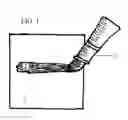
FIG. 1 illustrates the application of the lipstick being tested to a sheet of wax paper.
FIG. 2A-2B illustrates the application of the test solution in droplet form by an eyedropper bottle.
FIG. 3A-3B illustrates the absorption of the solution by a cotton swab.
FIG. 4 illustrates the final view of the cotton swab with solution and lipstick on it.
DETAILED DESCRIPTION OF THE INVENTION
Development: 2.5 g of sodium sulfide (lead indicator) were measured by weight on a scale. The 2.5 g of sodium sulfide were mixed by inversion with 50 mL of distilled water in a volumetric flask. This formed the sodium sulfide test solution with a concentration of 1:20. The solution is clear in the absence of lead, but when the solution comes in contact with lead, it forms a lead nitrate that ranges in color from light yellow to black/brown; black/brown indicates high lead content, and light yellow indicates low lead content. The solution was transferred from the flask to a sealed eyedropper bottle (bottle shown in FIG. 2A-2B, reference #4).
Method of Testing Lipsticks for Lead: (FIG. 1) Swipe the lipstick being tested (3) across a sheet of wax paper (1) so that there is a thin streak (2) of lipstick on the paper (1). This streak (2) will be referred to as the lipstick sample.
(FIG. 2A-2B) Apply a drop (5) of the sodium sulfide test solution contained in an eyedropper bottle (4) to the lipstick sample (2). Let the drop of solution (5) sit on the lipstick sample (2) for one minute.
(FIG. 3A-3B) Use a solid stemmed, absorbent ended, cotton swab (6) to absorb the drop of solution (5). Allow the tip of the cotton swab (6) to pick up an extremely small of the lipstick sample (2) while absorbing the solution (5). The lipstick is picked up due to the fact that it has been exposed to the solution for a long time, and will help in indication. However, only an extremely small amount should be allowed on the swab, otherwise the lipstick color would interfere with lead indication.
FIG. 4 depicts what the cotton swab (6) should look like after absorbing the solution (5) and picking up a bit of lipstick (2). A color change (formation of a lead nitrate) can be observed in the solution (5) surrounding the lipstick (2) on the cotton swab (6). It is important that very little lipstick is on the swab.
In some cases, extremely bright lipstick color can leach into the solution droplet. If this occurs, retest the lipstick using the same method, but reduce the time that the solution droplet sits on the lipstick sample to twenty seconds. This method works, but it is preferable to let the solution sit for one minute for ultimate accuracy.
Claims
1. The method of testing lipsticks for lead content by: swiping a lipstick across a sheet of wax paper;
applying the test solution, in droplet form, on the sample swipe of lipstick by use of a sealed eyedropper bottle;
allowing the solution to set on the lipstick swipe for one minute;
absorbing the solution with a solid stemmed, absorbent ended, cotton swab;
allowing the tip of the cotton swab to pick up an extremely small amount of the lipstick exposed to the solution;
and determining lead presence by observing a change in the color of the solution on the cotton swab.
2. The method described in Claim I., except the solution is absorbed twenty seconds after application instead of a minute.
3. The sodium sulfide test solution with the concentration ratio of 1:20, or one part sodium sulfide to twenty parts distilled water.
Images & Drawings included:


Sources:
- United States Patent and Trademark Office - verify current appl. status at the USPTO↗
Recent applications in this class:
- » 20230393113 2023-12-07
CONSTRUCTION METHOD OF ABNORMALITY DIAGNOSIS MODEL, ABNORMALITY DIAGNOSIS METHOD, CONSTRUCTION DEVICE OF ABNORMALITY DIAGNOSIS MODEL, AND ABNORMALITY DIAGNOSIS DEVICE - » 20210041413 2021-02-11
Measuring device for process metrology - » 20200158710 2020-05-21
System and method for detecting the concentration of metal particles - » 20200064326 2020-02-27
Slag volume evaluation method for molten metal surface - » 20190391124 2019-12-26
Methods of isolating and detecting metal ions from proteins - » 20190271677 2019-09-05
Methods and kits for detecting non-luminescent or weakly luminescent metals - » 20190242865 2019-08-08
PROCESS EQUIVALENT POWDER REUSE CAPSULE FOR ADDITIVE MANUFACTURING - » 20190137471 2019-05-09
Method for determining quality level of iron and steel product - » 20190137470 2019-05-09
Methods of measuring metal pollutants on skin - » 20190128863 2019-05-02
Reactive diffusive gradient in thin-film sampler and mercury speciation by use of same