Fastening device for fastening a structural part consisting of a carbon-fiber-reinforced plastic to a component, in particular a chassis component of a vehicle
US20150285290A1
2015-10-08
14/743,275
2015-06-18
✅ Patent granted
US 10,082,170 B2
2018-09-25
-
-
Flemming Saether
Crowell & Moring LLP
2035-11-04
Abstract:
A fastening device is provided for fastening a structural part consisting of a carbon-fiber reinforced plastic, in particular a cell of a vehicle, to a component, in particular a chassis component of a vehicle. In order to provide a fastening device which ensures a secure fastening of structural parts consisting of a carbon fiber-reinforced plastic to other vehicle components, a first connecting element is mounted on the structural part, on which first connecting element a second connecting element can be mounted. The first connecting element is connected to the structural part by an adhesive layer and has a protruding bush which passes through a bore in the structural part and which projects with its free end beyond the structural part.
Inventors:
- Sabine ROEHRL 2 🇩🇪 Germering, Germany
- Thomas WEISS 4 🇩🇪 Feldafing, Germany
- Ferdinand DIRSCHMID 3 🇩🇪 Ottobrunn, Germany
- Johann KETTENBERGER 4 🇩🇪 Winhoering, Germany
- Anton GRUBER 1 🇩🇪 Puchheim, Germany
Assignee:
- Bayerische Motoren Werke Aktiengesellschaft 743 🇩🇪 Muenchen, Germany
- BAYERISCHE MOTOREN WERKE AKTIENGESELLSCHAFT 3,338 🇩🇪 Munich, Germany
Applicant:
Interested in similar patents?
Get notified when new applications in this technology area are published.
Classification:
F16B35/005 » CPC main
Screw-bolts; Stay-bolts; Screw-threaded studs; Screws; Set screws Set screws; Locking means therefor
F16B25/0015 » CPC further
Screws that cut thread in the body into which they are screwed, e.g. wood screws characterised by the material of the body into which the screw is screwed the material being a soft organic material, e.g. wood or plastic
F16B35/00 IPC
Screw-bolts; Stay-bolts; Screw-threaded studs; Screws; Set screws
F16B25/00 IPC
Screws that cut thread in the body into which they are screwed, e.g. wood screws
B62D27/026 » CPC further
Connections between superstructure sub-units rigid Connections by glue bonding
F16B11/006 » CPC further
Connecting constructional elements or machine parts by sticking or pressing them together, e.g. cold pressure welding by gluing
B62D27/065 » CPC further
Connections between superstructure sub-units readily releasable using screwthread
B62D29/048 » CPC further
Superstructures, characterised by the material thereof predominantly of synthetic material Connections therefor, e.g. joints
B62D27/02 IPC
Connections between superstructure sub-units rigid
B62D27/06 IPC
Connections between superstructure sub-units readily releasable
B62D29/04 IPC
Superstructures, characterised by the material thereof predominantly of synthetic material
F16B11/00 IPC
Connecting constructional elements or machine parts by sticking or pressing them together, e.g. cold pressure welding
F15B11/00 IPC
Servomotor systems without provision for follow-up action; Circuits therefor
F16B5/02 » CPC further
Joining sheets or plates, e.g. panels, to one another or to strips or bars parallel to them by means of fastening members using screw-thread
Description
CROSS REFERENCE TO RELATED APPLICATIONS
This application is a continuation of PCT International Application No. PCT/EP2013/075968, filed Dec. 9, 2013, which claims priority under 35 U.S.C. §119 from German Patent Application No. 10 2012 223 863.8, filed Dec. 19, 2012, the entire disclosures of which are herein expressly incorporated by reference.
BACKGROUND AND SUMMARY OF THE INVENTION
The present invention relates to a fastening device for a structural part made of a carbon fiber-reinforced plastic to a component, in particular a chassis component of a vehicle.
In vehicle construction, structural parts made of carbon fiber-reinforced plastic are increasingly used when high weight-specific strengths and stiffnesses are required. Sometimes even entire vehicle components, such as the cell of a vehicle, for example, are made partially or entirely of carbon fiber-reinforced plastic. However, connecting these structural parts or components made of carbon fiber-reinforced plastic to other components, in particular a chassis component of a vehicle, is problematic because under pressure, carbon fiber-reinforced plastic exhibits a settlement behavior that negatively influences a safe connection to other components.
Therefore, the object of the present invention is to provide a fastening device that guarantees a safe and high-strength fastening of structural parts made of a carbon fiber-reinforced plastic to other vehicle components. The structural part may, in particular, also be a vehicle component, so that the object of the invention is in particular to provide a fastening device that guarantees a safe and high-strength connection of two vehicle components, with at least one vehicle component being made of a carbon fiber-reinforced plastic.
With a device for fastening a structural part consisting of a carbon fiber-reinforced plastic, in particular a vehicle cell or a load-bearing structural vehicle body part, to a component, in particular a chassis component of a vehicle or a motor vehicle, this object is achieved according to the invention in that a first connecting element is affixed at the structural part, to which a second connecting element can be affixed. The first connecting element is connected to the structural part by an adhesive layer and has a protruding bush that reaches through a bore in the structural part and protrudes with one free end beyond the structural part.
Alternately, with a fastening device for a structural part consisting of a carbon fiber-reinforced plastic, in particular a vehicle cell or a load-bearing structural vehicle body part, to a component, in particular a chassis component of a vehicle or a motor vehicle, the object of the invention is achieved in accordance with the invention in that a first connecting element is affixed at the structural part, to which a second connecting element can be affixed. The first connecting element is connected to the structural part by an adhesive layer. Furthermore, a third connecting element bears against the component and the structural part is positioned between the first connecting element and the third connecting element. The third connecting element has a protruding bush that reaches through a bore in the structural part and protrudes with its free end beyond the structural part.
Because of this design in accordance with the invention, a fastening device is provided where the structural part made of carbon fiber-reinforced plastic is not clamped since the structural part is held at the first connecting element merely by the adhesive layer. This prevents any settlement behavior. Furthermore, high-strength and detachable screw connections can be realized, which are cost efficient and can be produced in high piece numbers.
According to a preferred further development, the first connecting element has an internal thread and the second connecting element has a setscrew.
According to a first embodiment, the bush bears against the component, and the structural part is positioned between the component and the first connecting element. This embodiment guarantees the transmission of relatively tensile forces at a relatively easy setup.
According to a preferred further development, not only is the first connecting element connected to the structural part by an adhesive layer, but rather, the structural part can be advantageously also glued to the component by an adhesive. This results in a particularly firm and safe connection between the structural part and the component, which can also transmit high lateral and/or pressure forces.
Preferably, the third connecting element bears against the free end of the bush. Alternately, the third connecting element preferably comprises a tube that reaches through the opening of the structural part and bears against the first connecting element.
Furthermore, according to an advantageous further development, the structural part can also be glued to the third connecting element by an adhesive.
Advantageously, the third connecting element has the same shape as the first connecting element, with the third connecting element not being able to be coupled mechanically to the second connecting element, in particular therefore not comprising an internal thread.
With this embodiment, high lateral forces (across large adhesive surfaces) as well as high tensile and pressure forces can be transmitted. Furthermore, in this embodiment, the connection between structural part and component is easy to detach.
Other objects, advantages and novel features of the present invention will become apparent from the following detailed description of one or more preferred embodiments when considered in conjunction with the accompanying drawings.
BRIEF DESCRIPTION OF THE DRAWINGS
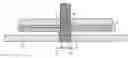
FIG. 1 illustrates a first embodiment of a fastening device according to the invention;
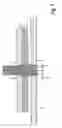
FIG. 2 illustrates a second embodiment of a fastening device according to the invention; and
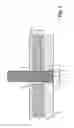
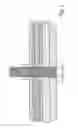
FIG. 3 illustrates a third embodiment of a fastening device according to the invention.
DETAILED DESCRIPTION OF THE DRAWINGS
The figures show only the parts of the fastening device that are of interest here. All other parts have been omitted for the sake of clarity.
FIG. 1 shows a first embodiment of the fastening device according to the invention; it has a simple structure and can transmit high tensile forces.
A structural part 1 (CFK structural part) consisting of a carbon fiber-reinforced plastic, such as a CFK cell or a load-bearing body part of a vehicle, for example, is glued to a first connecting element 3 via an adhesive layer 2. The first connecting element 3 has a protruding bush 4, which can be formed in a single (one) piece with the first connecting element 3. When viewed in cross-section, the connecting element 3 and the bush 4 form the form of a “T”, with the connecting element 3 forming the horizontal and the bush 4 forming the vertical leg of the “T”.
The bush 4 of the first connecting element 3 extends through a bore 5 in the structural part 1 and protrudes with its free end beyond the structural part 1 on the side facing away from the first connecting element 3.
To connect the structural part 3 to a component 6, which for example may be a chassis component of the vehicle, a second connecting element 7 is provided. The second connecting element 7 extends through a bore 8 in the component 6 and can be connected to the first connecting element 3. In this condition, the component 6 is supported at the bush 4. Because the bush 4 protrudes beyond the structural part 1, no clamping forces can be transmitted to the structural part 1, which is connected to the fastening device according to the invention exclusively via the adhesive layer 2.
For example, the first connecting element 3 can be a screw nut with an interior screw thread, and the second connecting element 7 can be a setscrew that can be screwed into the screw nut, in particular a screw.
FIG. 2 shows a second embodiment of the fastening device according to the invention, which can transmit high lateral forces as well as high tensile and pressure forces.
This embodiment is different from the first embodiment in that the structural part 1 is additionally connected to the component 6 via an adhesive 9, which makes it possible to transmit high lateral forces because of the relatively large adhesive surfaces 2 and 9. The structural part 1 is therefore glued on one side to the first connecting element 3 and on the other side to the component 6.
FIG. 3 shows a third embodiment of the fastening device according to the invention, which can transmit high lateral forces as well as high tensile and pressure forces.
In this embodiment as well, the structural part 1, which consists of a carbon fiber-reinforced plastic (CFK structural part), is glued to the first connecting element 3 via the adhesive layer 2. The first connecting element 3 has the same shape as the first embodiment shown in FIG. 1. However, here the bush 4 protrudes away from the structural component 1.
The second connecting element 7 is also used in this embodiment to connect the structural part 3 to the component 6. The second connecting element 7 extends through the bore 8 in the component 6 and can be connected to the first connecting element 3. Unlike in the first embodiment, where the component 6 is supported at the bush 4, in the present embodiment of FIG. 3, the component 6 is supported at a third connecting element 10. Because of this arrangement, a tube 11 is located at the side of the third connecting element 10 that faces away from the component 6 and extends through and protrudes beyond the structural part 1 there. The first connecting element 3 bears against said protruding tube 11. The tube 11 can be, in particular, formed in a single (one) piece with the third connecting element 10.
In cross-section, the third connecting element 10 has the same shape as the first connecting element 3 and is also connected to the structural part 1 by an adhesive 9. Consequently, the structural part 1 is glued to the first connecting element 3 on one side, and to the third connecting element 10 on the other side. Unlike the first connecting element 3, the third connecting element 10 is merely a spacing element and not a fastening element. Therefore, the third connecting element 10 in particular does not have an internal thread.
Instead of the way it was described and is shown in the figures, the bush 4 can also be arranged at the component 6 instead of at the first connecting element 3, or it can be developed as a separate structural part. Likewise, the tube 11 can also be provided as a separate structural part instead of at the third connecting element 10.
The fastening device according to the invention facilities a high-strength connection, in particular of a CFK structural part to a component, and it can be realized in a cost-efficient and space-saving manner.
The description above of the present invention is merely for illustrative purposes and not for the purpose of limiting the invention. In the scope of the invention, various changes and modifications are possible without leaving the scope of the invention as well as its equivalents.
LIST OF REFERENCE SYMBOLS
- 1 Structural part
- 2 Adhesive layer
- 3 First connecting element
- 4 Bush
- 5 Bore
- 6 Component
- 7 Second connecting element
- 8 Bore
- 9 Adhesive
- 10 Third connecting element
- 11 Tube
The foregoing disclosure has been set forth merely to illustrate the invention and is not intended to be limiting. Since modifications of the disclosed embodiments incorporating the spirit and substance of the invention may occur to persons skilled in the art, the invention should be construed to include everything within the scope of the appended claims and equivalents thereof.
Claims
What is claimed is:1. A fastening device for a carbon fiber-reinforced plastic structural part to be fastened to another component, comprising:
a first connecting element;
a second connecting element;
an adhesive layer affixing the first connecting element to the carbon fiber-reinforced plastic structural part, wherein
the first connecting element includes a protruding bush that extends through a bore in the carbon fiber-reinforced plastic structural part with a free end extending beyond the carbon fiber-reinforced plastic structural part, and
the second connecting element is fixed to the first connecting element.
2. The fastening device according to claim 1, wherein the carbon fiber-reinforced plastic structural part is a cell of a motor vehicle and the component to which the cell of the motor vehicle is fastened is a vehicle chassis.
3. The fastening device according to claim 1, wherein the carbon fiber-reinforced plastic structural part is a load-bearing vehicle body part and the component to which the load-bearing vehicle body part is fastened is a vehicle chassis.
4. The fastening device according to claim 1, wherein the first connecting element includes an internal thread and the second connecting element is a setscrew.
5. The fastening device according to claim 1, wherein the bush is arranged to bear against the other component and the first connecting element.
6. The fastening device according to claim 1, further comprising:
an adhesive that glues the carbon fiber-reinforced plastic structural part to the other component.
7. A fastening device for a carbon fiber-reinforced plastic structural part to be fastened to another component, comprising:
a first connecting element;
a second connecting element;
a third connecting element; and
an adhesive layer affixing the first connecting element to the carbon fiber-reinforced plastic structural part, wherein
the second connecting element is affixed to the first connecting element,
the third connecting element bears against the carbon fiber-reinforced plastic structural part and has a protruding sleeve that extends through a bore in the carbon fiber-reinforced plastic structural part with a free end extending beyond the carbon fiber-reinforced plastic structural part, and
the carbon fiber-reinforced plastic structural part is arranged between the first connecting element and the third connecting element.
8. The fastening device according to claim 7, wherein the carbon fiber-reinforced plastic structural part is a cell of a motor vehicle and the component to which the cell of the motor vehicle is fastened is a vehicle chassis.
9. The fastening device according to claim 7, wherein the carbon fiber-reinforced plastic structural part is a load-bearing vehicle body part and the component to which the load-bearing vehicle body part is fastened is a vehicle chassis.
10. The fastening device according to claim 7, wherein the first connecting element includes an internal thread and the second connecting element is a setscrew.
11. The fastening device according to claim 7, wherein the bush is arranged to bear against the other component and the first connecting element.
12. The fastening device according to claim 7, further comprising:
an adhesive that glues the carbon fiber-reinforced plastic structural part to the other component.
13. The fastening device according to claim 7, wherein the first connecting element bears against the free end of the protruding sleeve.
14. The fastening element according to claim 7, wherein the carbon fiber-reinforced plastic structural part is glued to the third connecting element by an adhesive.
15. The fastening device according to claim 7, wherein the third connecting element has a same shape as the first connecting element.
16. The fastening device according to claim 14, wherein the third connecting element has a same shape as the first connecting element.
Images & Drawings included:
Sources:
- United States Patent and Trademark Office - verify current appl. status at the USPTO↗
Recent applications in this class:
- » 20230108878 2023-04-06
Lockable adjustable standoff - » 20200182282 2020-06-11
Captive screw device - » 20180298936 2018-10-18
System made up of an attachment part and a retaining element - » 20180058490 2018-03-01
Modular locking pin - » 20170268558 2017-09-21
Captive screw device - » 20170175793 2017-06-22
Fixture connection device - » 20170146047 2017-05-25
Slotted set screw structure - » 20170122358 2017-05-04
Set screw, fixing structure, fixing method and sealing structure - » 20160298671 2016-10-13
Housing of active element and manufacturing method thereof - » 20150330433 2015-11-19
Bolt, and rock drill with bolt
Recent applications for this Assignee:
- » 20250236179 2025-07-24
METHOD FOR OPERATING A BRAKE CONTROL SYSTEM, BRAKE CONTROL SYSTEM, COMPUTER PROGRAM, AND COMPUTER-READABLE STORAGE MEDIUM - » 20250109792 2025-04-03
Mounting assembly for a coupler mechanism of a motor vehicle - » 20250077042 2025-03-06
Method for increasing safety during the operation of a device - » 20250042351 2025-02-06
Arrangement for Holding a Sidewall Element on a Bodyshell Part of a Vehicle, Bracket and Vehicle - » 20250026428 2025-01-23
Handlebar Assembly for a Motor Vehicle, and Motor Vehicle Having a Handlebar Assembly of This Kind - » 20250020305 2025-01-16
Decorative element for a motor vehicle, and production method for a decorative element - » 20250001843 2025-01-02
Motor Vehicle With a Side Door - » 20240426445 2024-12-26
Motor Vehicle Lighting Module - » 20240383554 2024-11-21
Leaning vehicle - » 20240383416 2024-11-21
Motor vehicle having a plurality of control devices which provide different vehicle functions in the motor vehicle and method for configuring the control devices and control device