Machine component composed of metal and rubber and manufacturing method of the same
US20170089394A1
2017-03-30
14/789,047
2015-07-01
✅ Patent granted
US 10,294,994 B2
2019-05-21
-
-
Maria V Ewald | Ethan A. Utt
Kratz, Quintos & Hanson, LLP
2036-02-27
Abstract:
The present invention is intended to provide a machine component composed of metal and rubber that results in no increase of material costs for an adhesive or increase of manufacturing costs for metal molding, causes no contamination of the metal mold or generates no foreign matter on the metal mold due to adhesion of the adhesive at the time of molding, causes no failure by separation of the adhesive from a fitting portion at the time of fitting the metal component, and is clean and favorable in appearance. A machine component 1 composed of metal and rubber is formed by applying a thermoset resin adhesive A to a surface of a metal component 2 of a predetermined shape, and vulcanizing and adhering a rubber 3 of a predetermined shape to part of the surface of the metal component 2 by metal molding.
Assignee:
- Nakanishi Metal Works Co., Ltd. 43 🇯🇵 Osaka-shi, Japan
Applicant:
Interested in similar patents?
Get notified when new applications in this technology area are published.
Classification:
F16C33/723 » CPC main
Parts of bearings; Special methods for making bearings or parts thereof; Sealings Shaft end sealing means, e.g. cup-shaped caps or covers
B60B7/0013 » CPC further
Wheel cover discs, rings, or the like, for ornamenting, protecting or obscuring, wholly or in part, the wheel body, rim, hub, or tyre sidewall Hub caps
C08J3/247 » CPC further
Processes of treating or compounding macromolecular substances; Crosslinking, e.g. vulcanising, of macromolecules Heating methods
C09K3/1006 » CPC further
Materials not provided for elsewhere for sealing or packing joints or covers Materials in mouldable or extrudable form characterised by the chemical nature of one of its constituents
F16C33/7833 » CPC further
Parts of bearings; Special methods for making bearings or parts thereof; Sealings of ball or roller bearings with a diaphragm, disc, or ring, with or without resilient members; Details of the sealing or parts thereof, e.g. geometry, material Special methods of manufacture
B32B2250/02 » CPC further
Layers arrangement 2 layers
B32B2255/06 » CPC further
Coating on the layer surface on metal layer
B32B2255/26 » CPC further
Coating on the layer surface Polymeric coating
B32B2581/00 » CPC further
Seals; Sealing equipment; Gaskets
B60B27/00 » CPC further
Hubs
B32B15/06 » CPC further
Layered products comprising a layer of metal comprising metal as the main or only constituent of a layer, next to another layer of a of natural rubber or synthetic rubber
B32B7/12 » CPC further
Layered products characterised by the relation between layers; Layered products characterised by the relative orientation of features between layers, or by the relative values of a measurable parameter between layers, i.e. products comprising layers having different physical, chemical or physicochemical properties; Layered products characterised by the interconnection of layers; Interconnection of layers using interposed adhesives or interposed materials with bonding properties
B32B15/18 » CPC further
Layered products comprising a layer of metal comprising iron or steel
C09K3/10 » CPC further
Materials not provided for elsewhere for sealing or packing joints or covers Materials in mouldable or extrudable form
C09J5/06 » CPC further
Adhesive processes in general; Adhesive processes not provided for elsewhere, e.g. relating to primers involving heating of the applied adhesive
C09J171/08 » CPC further
Adhesives based on polyethers obtained by reactions forming an ether link in the main chain ; Adhesives based on derivatives of such polymers Polyethers derived from hydroxy compounds or from their metallic derivatives
C09J183/00 » CPC further
Adhesives based on macromolecular compounds obtained by reactions forming in the main chain of the macromolecule a linkage containing silicon, with or without sulfur, nitrogen, oxygen, or carbon only; Adhesives based on derivatives of such polymers
B60B2310/204 » CPC further
Manufacturing methods; Shaping by moulding, e.g. injection moulding, i.e. casting of plastics material
B60B2310/318 » CPC further
Manufacturing methods joining by adhesive bonding, e.g. glueing
B60B2360/348 » CPC further
Materials; Physical forms thereof; Synthetic materials; Reinforced plastics Resins
B60B2360/50 » CPC further
Materials; Physical forms thereof Rubbers
C08J2319/00 » CPC further
Characterised by the use of rubbers not provided for in groups -
C09J2415/008 » CPC further
Presence of rubber derivatives in the pretreated surface to be joined
C09K2003/1068 » CPC further
Materials not provided for elsewhere for sealing or packing joints or covers Materials in mouldable or extrudable form; Materials or components characterised by specific properties Crosslinkable materials
C09K2200/0607 » CPC further
Chemical nature of materials in mouldable or extrudable form for sealing or packing joints or covers; Macromolecular organic compounds, e.g. prepolymers Rubber or rubber derivatives
F16C2326/02 » CPC further
Articles relating to transporting; Parts of vehicles in general Wheel hubs or castors
F16C33/72 IPC
Parts of bearings; Special methods for making bearings or parts thereof Sealings
F16C33/78 IPC
Parts of bearings; Special methods for making bearings or parts thereof; Sealings of ball or roller bearings with a diaphragm, disc, or ring, with or without resilient members
B60B7/00 IPC
Wheel cover discs, rings, or the like, for ornamenting, protecting or obscuring, wholly or in part, the wheel body, rim, hub, or tyre sidewall
C08J3/24 IPC
Processes of treating or compounding macromolecular substances Crosslinking, e.g. vulcanising, of macromolecules
F16C19/18 IPC
Bearings with rolling contact, for exclusively rotary movement with bearing balls essentially of the same size in one or more circular rows for both radial and axial load with two or more rows of balls
Description
TECHNICAL FIELD
The present invention relates to a machine component that is formed by vulcanizing and adhering rubber to part of a surface of a metal component by metal molding.
BACKGROUND ART
There is a cup-shaped protective cover provided with hermeticity by a vulcanized and adhered rubber seal (seal member or elastic member) that is pushed into an outer ring of a bearing to cover an axial magnetic encoder and intervene between the magnetic encoder and a sensor, as a machine component composed of metal and rubber formed by applying a thermoset resin adhesive to the surface of a metal component of a predetermined shape and vulcanizing and adhering a rubber of a predetermined shape to part of the surface of the metal component by metal molding (for example, refer to Patent Documents 1 and 2).
In such a protective cover, the metal component as a main body is formed by pressing a non-magnetic, highly corrosion-resistant stainless steel plate material, for example.
The application of the adhesive to the surface of the main body after pressing into the cup shape is generally performed by immersing the main body into the liquid-state adhesive retained in a bath.
CITATION LIST
Patent Literatures
Patent Document 1: JP-A No. 2011-84265
Patent Document 2: Japanese Patent No. 5355987
SUMMARY OF INVENTION
Technical Problem
When the application of the adhesive is performed by such an immerse process, a large number of metal components can be processed simultaneously. However, the adhesive is applied to the entire surface of the metal component including unnecessary portions. In addition, such an immerse process increases the wastage rate of the adhesive because the adhesive needs to be shaken off or replaced, which results in a large amount of waste adhesive and cost increase of adhesive material.
In addition, since the adhesive is applied to the entire surface of the metal component, when the rubber of a predetermined shape is vulcanized and adhered to the surface of the metal component by metal molding, there arises a problem that the rubber material is likely to be vulcanized and adhered beyond a predetermined range of rubber adhesion. To keep the vulcanization and adhesion of the rubber within the predetermined range, the metal mold structure needs to be complicated and raised in accuracy with increase of manufacturing costs.
Further, at the time of metal molding, the adhesive may stick to the metal mold to contaminate the metal mold and generate foreign matter on the metal mold.
Furthermore, when the metal component is pushed into the outer ring of the bearing, the adhesive may separate from the fitting portion and bite into the rubber seal to deteriorate airtightness or may remain as foreign matter in the bearing.
Moreover, the adhesive is adhered to the entire surface of the metal component and the appearance is not clear or favorable.
In view of the foregoing circumstances, an object of the present invention is to provide a machine component composed of metal and rubber that results in no increase of material costs for the adhesive or increase of manufacturing costs for metal molding, causes no contamination of the metal mold or generates no foreign matter on the metal mold due to adhesion of the adhesive at the time of molding, causes no failure by separation of the adhesive from a fitting portion at the time of fitting the metal component, and is clean and favorable in appearance, and a manufacturing method of the machine component.
Solution to Problem
To solve the foregoing problems, the machine component composed of metal and rubber according to the present invention is a machine component composed of metal and rubber that is formed by applying a thermoset resin adhesive to a surface of a metal component of a predetermined shape, and vulcanizing and adhering a rubber of a predetermined shape to part of the surface of the metal component by metal molding, wherein the range of the adhesive applied to the surface of the metal component before the metal molding covers only a joint surface relative to the rubber.
According to this configuration, the range of the adhesive applied to the surface of the metal component covers only the joint surface relative to the rubber, that is, the adhesive is not applied to portions other than a predetermined range of the rubber to be adhered. This results in a very small amount of waste adhesive without increase of material costs for the adhesive.
In addition, since the range of the adhesive applied to the surface of the metal component covers only the joint surface relative to the rubber, there occurs no failure that the rubber material is vulcanized and adhered beyond the predetermined range of the rubber to be adhered. This eliminates the need for a complicated and high-accuracy metal mold structure, which suppresses increase of manufacturing costs at metal molding. In addition, this configuration can be used for all of vulcanizing production systems with a high degree of flexibility in manufacture.
Further, since the range of the adhesive applied to the surface of the metal component covers only the joint surface relative to the rubber, the adhesive does not stick to the metal mold to contaminate the metal mold or generate foreign matter on the metal mold at the time of metal molding.
Moreover, since the range of the adhesive applied to the surface of the metal component covers only the joint surface relative to the rubber, the adhesive does not exist on the surface of the metal component to be visually checked. Accordingly, the finished product is clear and favorable in appearance and is improved in commodity value.
It is preferred that the machine component composed of metal and rubber is a protective cover for a bearing device, and a seal as the rubber is vulcanized and adhered to the outer peripheral surface of a cup-shaped stainless-steel main body as the metal component.
According to this configuration, the foregoing operations and advantages can be produced at the protective cover for bearing device. In addition, when the main body is pushed into the outer ring of the bearing, there occurs no situation in which the adhesive separates from the fitting portion and bites into the rubber seal to cause airtightness failure or the separated adhesive remains as foreign matter in the bearing.
To solve the foregoing problems, the manufacturing method of a machine component composed of metal and rubber according to the present invention is a manufacturing method of a machine component composed of metal and rubber including: an adhesive application step of applying a thermoset resin adhesive to a surface of a metal component of a predetermined shape; and a metal molding step of vulcanizing and adhering a rubber of a predetermined shape to part of the surface of the metal component, wherein, at the adhesive application step, the adhesive is applied to only a joint surface of the metal component relative to the rubber.
According to this manufacturing method, the range of the adhesive applied to the surface of the metal component at the adhesive application step covers only the joint surface relative to the rubber, that is, the adhesive is not applied to portions other than a predetermined range of the rubber to be adhered. This results in a very small amount of waste adhesive without increase of material costs for the adhesive.
In addition, since the range of the adhesive applied to the surface of the metal component covers only the joint surface relative to the rubber, there occurs no failure that the rubber material is vulcanized and adhered beyond the predetermined range of the rubber to be adhered. This eliminates the need for a complicated and high-accuracy metal mold structure, which suppresses increase of manufacturing costs at metal molding.
Further, since the range of the adhesive applied to the surface of the metal component covers only the joint surface relative to the rubber, the adhesive does not stick to the metal mold to contaminate the metal mold or generate foreign matter on the metal mold at the time of metal molding.
Moreover, in the machine component composed of metal and rubber manufactured by this manufacturing method, since the range of the adhesive applied to the surface of the metal component covers only the joint surface relative to the rubber, the adhesive does not exist on the surface of the metal component to be visually checked. Accordingly, the finished product is clear and favorable in appearance and is improved in commodity value.
It is preferred that the application of the adhesive to the metal component at the adhesive application step is performed by a pad printing process in which the adhesive is transferred to the metal component by pressing a pad as a transfer body with the adhesive in a predetermined region against the metal component, a screen printing process in which the adhesive on a screen plate with pores in a predetermined region is transferred to the metal component by extruding the adhesive through the pores, a brushing process, or a masking and spraying process.
According to this manufacturing method, it is possible to perform stably and reliably the application of the adhesive at the adhesive application step such that the adhesive is applied only to the joint surface of the metal component relative to the rubber and no adhesive is applied to the portions other than the joint surface.
Advantageous Effects of Invention
According to the machine component composed of metal and rubber and the manufacturing method of the same in the present invention as described above, the following significant advantages can be produced:
(A) According to this configuration, the range of the adhesive applied to the surface of the metal component covers only the joint surface relative to the rubber, that is, the adhesive is not applied to portions other than the predetermined range of the rubber to be adhered. This results in a very small amount of waste adhesive without increase of material costs for the adhesive.
(B) Since the range of the adhesive applied to the surface of the metal component covers only the joint surface relative to the rubber, there occurs no failure that the rubber material is vulcanized and adhered beyond the predetermined range of the rubber to be adhered. This eliminates the need for a complicated and high-accuracy metal mold structure, which suppresses increase of manufacturing costs at metal molding. In addition, this configuration can be used for all of vulcanizing production systems with a high degree of flexibility in manufacture.
(C) Since the range of the adhesive applied to the surface of the metal component covers only the joint surface relative to the rubber, the adhesive does not stick to the metal mold to contaminate the metal mold or generate foreign matter on the metal mold at the time of metal molding.
(D) Since the range of the adhesive applied to the surface of the metal component covers only the joint surface relative to the rubber, when the metal component is fitted, there occurs no failure resulting from the separation of the adhesive from the fitting portion; and
(E) Since the range of the adhesive applied to the surface of the metal component covers only the joint surface relative to the rubber, the adhesive does not exist on the surface of the metal component to be visually checked. Accordingly, the finished product is clear and favorable in appearance and is improved in commodity value.
BRIEF DESCRIPTION OF DRAWINGS
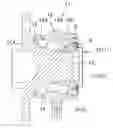
FIG. 1 is a vertical cross-sectional view of a bearing device with a protective cover as a machine component composed of metal and rubber according to a first embodiment of the present invention;
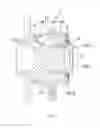
FIG. 2 is an enlarged vertical cross-sectional view of main parts of the same;
FIG. 3 is a vertical cross-sectional view of the protective cover as a machine component composed of metal and rubber according to the first embodiment of the present invention;
FIG. 4(a) and FIG. 4(b) are enlarged vertical cross-sectional views of main parts: FIG. 4(a) illustrates a stainless-steel main body to which an adhesive is applied; and FIG. 4(b) illustrates a protective cover manufacturing by vulcanizing and adhering a rubber seal to the stainless-steel main body by metal molding;
FIG. 5 is a vertical cross-sectional view illustrating an example of metal molding in the case of direct-pressure molding (compression (vulcanizing) molding);
FIG. 6 is a vertical cross-sectional view illustrating an example of metal molding in the case of injection (vulcanizing) molding;
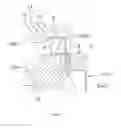
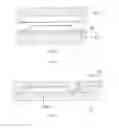
FIG. 7 is a vertical cross-sectional view of a damper component as a machine component composed of metal and rubber according to a second embodiment of the present invention; and
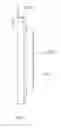
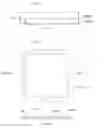
FIG. 8(a) and FIG. 8(b) illustrate a rubber packing-equipped plate as a machine component composed of metal and rubber according to a third embodiment of the present invention: FIG. 8(a) is a plane view and FIG. 8(b) is a vertical cross-sectional view.
DESCRIPTION OF EMBODIMENTS
First Embodiment
As illustrated in the vertical cross-sectional view of FIG. 1 and the enlarged vertical cross-sectional view of main parts of FIG. 2, a bearing device 11 with a protective cover 1A as a machine component 1 composed of metal and rubber according to a first embodiment of the present invention, includes: a bearing having an inner ring 12 with an inner ring track surface 12A on an outer peripheral surface, an outer ring 13 with an outer ring track surface 13A on an inner peripheral surface, and rolling elements 14, 14, . . . rolling between the inner ring track surface 12A and the outer ring track surface 13A; a magnetic encoder 8 that is positioned at one axial end portion of the bearing and fixed to the inner ring 12 by a fixing member 9; a sensor 10 that is fixed to the outer ring 13 and opposed to a magnetic pole of the magnetic encoder 8 to detect rotation of the magnetic encoder 8; and a seal member 15 that is arranged at the other axial end portion of the bearing, and the like.
As illustrated in the enlarged vertical cross-sectional view of main parts of FIG. 2 and the vertical cross-sectional view of FIG. 3, in the protective cover 1A, a first cylindrical part 4 and a second cylindrical part 5 smaller in diameter than the first cylindrical part 4 and connected to an end edge of the first cylindrical part 4 are provided at a maximum outer diameter part of a main body 2A as a machine component 2, and a seal 3A as a rubber 3 is vulcanized and adhered to the outer peripheral surface of the second cylindrical part 5.
In the protective cover 1A, a fitting portion C as the outer peripheral surface of the first cylindrical part 4 is pushed into the outer ring 13 to cover the magnetic encoder 8 and intervene between the magnetic encoder 8 and the sensor 10.
Accordingly, the inside of the bearing is sealed by the protective cover 1 having the seal 3A and the seal member 15 at the axial both end portions of the bearing. The magnetic encoder 8 is accommodated in the inner space of the bearing to protect the magnetic encoder 8 and the interior of the bearing from foreign matter and the like.
The main body 2A of the protective cover 1A is formed by pressing a stainless steel plate material such as SUS304 into a cup shape to include the first cylindrical part 4, the second cylindrical part 5, and the like.
The seal 3A as the rubber 3 may be one of oil-resistant rubber materials such as nitrile rubber (NBR), hydrogenated nitrile rubber (HNBR), acrylic rubber (ACM), ethylene-acrylic rubber (AEM), fluorine rubber (FKM, FPM), and silicon rubber (VQM), or a blend of two or more of the same.
Next, an adhesive application step of applying a thermoset resin adhesive to the surface of the stainless steel main body 2A as the metal component 2 will be described.
First, the thermoset resin adhesive may be any of general rubber vulcanizing adhesives such as a phenolic resin adhesive and a silane adhesive.
For example, in the case of using a phenolic resin adhesive, although there is no particular limitation on its composition, the resin adhesive may be formed by dissolving a novolac-type phenolic resin, a resol-type phenolic resin, and a hardening agent such as hexamethylenetetramine in methanol or methylethylketone. For increasing adhesiveness, a novolac-type epoxy resin may be mixed into the foregoing adhesive.
As illustrated in the enlarged vertical cross-sectional view of main parts of FIG. 4(a), the range of application of a thermoset resin adhesive A to the surface of the stainless steel main body 2A covers only a joint surface B as a predetermined range in which the seal 3A as the rubber 3 is adhered. The adhesive A is not applied to portions other than the joint surface B.
The application of the adhesive A to the predetermined range (joint surface B) of part of the surface of the main body 2A can be performed by a pad printing process in which a pad as a transfer body with the adhesive A in a predetermined region is pressed against the main body 2A, a screen printing process in which the adhesive A on a screen plate with pores in a predetermined region is extruded through the pores to transfer the adhesive A to the main body 2A, a brushing process, or a masking and spraying process.
According to the foregoing application method, it is possible to perform an application work in a stable and reliable manner such that the adhesive A is applied to only the joint surface B of the main body 2A as the metal component 2 relative to the seal 3A as the rubber 3, and the adhesive A is not applied to portions other than the joint surface B.
Next, descriptions will be given as to a metal molding step of vulcanizing and adhering the seal 3A as the rubber 3 of a predetermined shape to the main body 2A as the metal component 2 to which the adhesive A is applied as illustrated in FIG. 4(a), thereby to manufacture the protective cover 1A as the machine component 1 composed of metal and rubber illustrated in the enlarged vertical cross-sectional view of FIG. 4(b).
Such metal molding can be performed by direct-pressure molding (compression (vulcanizing) molding) by which, in the state where the main body 2A is set in a heated lower metal mold part 6A, an upper metal mold part 6B is closed and a raw rubber material D is pressed and hardened as illustrated in the vertical cross-sectional view of FIG. 5.
Alternatively, as illustrated in the vertical cross-sectional view of FIG. 6, the metal molding may be performed by injection (vulcanizing) molding by which, in the state where the main bodies 2A, 2A, . . . are set in a lower metal mold part 7A and an upper metal mold part 7B is closed, a liquefied raw rubber material E is charged into cavities.
In the example 1 described above, the bearing device 11 to which the protective cover 1A is to be attached includes the magnetic encoder 8. However, the protective cover 1A is also usable for a bearing device without the magnetic encoder 8.
Second Embodiment
As illustrated in the vertical cross-sectional view of FIG. 7, a damper component 1B as the machine component 1 composed of metal and rubber according to a second embodiment of the present invention is formed by vulcanizing and adhering a damper 3B as the rubber 3 of a predetermined shape to a metal fitting 2B as the metal component 2.
In the damper component 1B, at the same adhesive application step as that in the first embodiment, the adhesive is applied to only a joint surface B of the metal fitting 2B relative to the damper 3B, and at the same metal molding step as that in the first embodiment, the damper 3B is vulcanized and adhered to the metal fitting 2B.
Third Embodiment
As illustrated in the vertical cross-sectional views of FIG. 8(a) and FIG. 8(b), a rubber packing-equipped plate 1C as the machine component 1 composed of metal and rubber according to a third embodiment of the present invention is formed by vulcanizing and adhering a packing 3C as the rubber 3 of a predetermined shape to a metal plate 2C as the metal component 2.
In the rubber packing-equipped plate 1C, at the same adhesive application step as that in the first embodiment, the adhesive is applied to only a joint surface B of the metal plate 2C relative to the packing 3C, and at the same metal molding step as that in the first embodiment, the packing 3C is vulcanized and adhered to the metal plate 2C.
Applicable objects in the present invention are not limited to the protective cover 1A, the damper component 1B, and the rubber packing-equipped plate 1C in the foregoing embodiments but the present invention is also applicable to all kinds of metal components 1 composed of metal and rubber formed by applying the thermoset resin adhesive A to the surface of the metal component 2 of a predetermined shape, and vulcanizing and adhering the rubber 3 of a predetermined shape to part of the surface of the metal component 2 by metal molding.
According to the machine component 1 composed of metal and rubber and the manufacturing method of the same as described above, since the range of the adhesive A applied to the surface of the metal component 2 covers only the joint surface B relative to the rubber 3, the adhesive A is not applied to portions other than the predetermined range of the rubber 3 to be adhered. This results in a very small amount of waste adhesive A without increase of material costs for the adhesive A.
In addition, since the range of the adhesive A applied to the surface of the metal component 2 covers only the joint surface B relative to the rubber 3, there occurs no failure that the rubber material is vulcanized and adhered beyond the predetermined range of the rubber 3 to be adhered. This eliminates the need for a complicated and high-accuracy metal mold structure, which suppresses increase of manufacturing costs at metal molding. In addition, this configuration can be used for all of vulcanizing production systems with a high degree of flexibility in manufacture.
Further, since the range of the adhesive A applied to the surface of the metal component 2 covers only the joint surface B relative to the rubber 3, the adhesive A does not stick to the metal mold to contaminate the metal mold or generate foreign matter on the metal mold at the time of molding.
Furthermore, since the range of the adhesive A applied to the surface of the metal component 2 covers only the joint surface B relative to the rubber 3, when the metal component 2 is fitted, there occurs no failure resulting from the separation of the adhesive A from the fitting portion C. For example, in the case where the machine component 1 composed of metal and rubber is the protective cover 1A, when the main body 2A is pushed into the outer ring 13 of the bearing, there occurs no situation in which the adhesive A separates from the fitting portion C and bites into the rubber seal 3A to cause airtightness failure or the separated adhesive A remains as foreign matter in the bearing.
Moreover, since the range of the adhesive A applied to the surface of the metal component 2 covers only the joint surface relative to the rubber 3, the adhesive A does not exist on the surface of the metal component 2 to be visually checked. Accordingly, the finished product is clear and favorable in appearance and is improved in commodity value.
REFERENCE SIGNS LIST
- A Thermoset resin adhesive
- B Joint surface
- C Fitting portion
- D Raw rubber material
- E Liquefied raw rubber material
- 1 Machine component composed of metal and rubber
- 1A Protective cover
- 1B Damper component
- 1C Rubber packing-equipped plate
- 2 Metal component
- 2A Stainless steel main body
- 2B Metal fitting
- 2C Metal plate
- 3 Rubber
- 3A Seal
- 3B Damper
- 3C Packing
- 4 First cylindrical part
- 5 Second cylindrical part
- 6A, 7A Lower metal mold part
- 6B, 7B Upper metal mold part
- 8 Magnetic encoder
- 9 Fixing member
- 10 Sensor
- 11 Bearing device
- 12 Inner ring
- 12A Inner ring track surface
- 13 Outer ring
- 13A Outer ring track surface
- 14 Rolling element
- 15 Seal member
Claims
1. A machine component composed of metal and rubber that is formed by applying a thermoset resin adhesive to a surface of a metal component of a predetermined shape, and vulcanizing and adhering a rubber of a predetermined shape to part of the surface of the metal component by metal molding, wherein
the range of the adhesive applied to the surface of the metal component before the metal molding covers only a joint surface relative to the rubber.
2. The machine component composed of metal and rubber according to claim 1, wherein
the machine component composed of metal and rubber is a protective cover for a bearing device, and
a seal as the rubber is vulcanized and adhered to the outer peripheral surface of a cup-shaped stainless-steel main body as the metal component.
3. A manufacturing method of a machine component composed of metal and rubber, comprising:
an adhesive application step of applying a thermoset resin adhesive to a surface of a metal component of a predetermined shape; and
a metal molding step of vulcanizing and adhering a rubber of a predetermined shape to part of the surface of the metal component, wherein
at the adhesive application step, the adhesive is applied to only a joint surface of the metal component relative to the rubber.
4. The manufacturing method of a machine component composed of metal and rubber according to claim 3, wherein
the application of the adhesive to the metal component at the adhesive application step is performed by a pad printing process in which the adhesive is transferred to the metal component by pressing a pad as a transfer body with the adhesive in a predetermined region against the metal component, a screen printing process in which the adhesive on a screen plate with pores in a predetermined region is transferred to the metal component by extruding the adhesive through the pores, a brushing process, or a masking and spraying process.
Images & Drawings included:

Sources:
- United States Patent and Trademark Office - verify current appl. status at the USPTO↗
Recent applications in this class:
- » 20250243907 2025-07-31
SEAL WITH HELICAL AIR VENTS - » 20240344565 2024-10-17
SUSPENSION BEARING UNIT WITH GASKET AND METHOD OF FORMING SAME - » 20240044372 2024-02-08
Fastening for a support assembly for food applications - » 20220325755 2022-10-13
Support assembly for food applications having an improved rear sealing device - » 20220325754 2022-10-13
Support assembly for food applications having an improved inner seal - » 20220307553 2022-09-29
Protective cover having sensor holder part, bearing device including the protective cover, and method of manufacturing the protective cover having the sensor holder part - » 20210293275 2021-09-23
PROTECTIVE BEARING ASSEMBLY COVER WITH INTEGRATED CLOSURE - » 20210285496 2021-09-16
Housing element with end cover having an optimized sealing action - » 20210215199 2021-07-15
Bearing protector - » 20190301534 2019-10-03
Protective cover having sensor holder part, bearing device including the protective cover, and method for manufacturing the protective cover having the sensor holder part
Recent applications for this Assignee:
- » 20250116297 2025-04-10
STRUT BEARING DEVICE AND VEHICLE STRUT SUSPENSION - » 20250002252 2025-01-02
UNMANNED TRANSPORT VEHICLE - » 20240009833 2024-01-11
LOADING AND UNLOADING SYSTEM - » 20190301534 2019-10-03
Protective cover having sensor holder part, bearing device including the protective cover, and method for manufacturing the protective cover having the sensor holder part - » 20190293122 2019-09-26
Protective cover having sensor holder part, bearing device including the protective cover, and method for manufacturing the protective cover having the sensor holder part - » 20190145999 2019-05-16
Radial-type magnetic encoder, bearing device provided with radial-type magnetic encoder, and method for manufacturing radial-type magnetic encoder - » 20190135547 2019-05-09
Conveyance apparatus - » 20190101212 2019-04-04
ROTARY SEAL - » 20190024717 2019-01-24
Rotary seal - » 20180347632 2018-12-06
ROTARY SEAL