Arrays of Intersecting Double Stranded Nucleic Acid Helices
US20180371455A1
2018-12-27
16/014,455
2018-06-21
Abstract:
This disclosure relates to intersecting double stranded nucleic acid helices with flexible intersections that form antijuction units. In a typical embodiment, the configuration of the intersecting double stranded nucleic acid helices can be altered by hybridization with an added single stranded segment or trigger strand reconfiguring the conformation of the array in a directional manor. In certain embodiments, the dynamic antijunction unit contains four nucleic double-helix domains, typically of approximately equal length and four dynamic nicking or intersecting flex points providing an array with the capability of switching between two or more stable conformations, e.g., through an intermediate open conformation.
Inventors:
- Jie Song 4 🇺🇸 Atlanta, GA, United States
- Yonggang Ke 1 🇺🇸 Sandy Spring, GA, United States
- Travis Meyer 1 🇺🇸 Atlanta, GA, United States
- Pengfei Wang 1 🇺🇸 Decatur, GA, United States
- Chengde Mao 3 🇺🇸 West Lafayette, IN, United States
- Zhe Li 1 🇺🇸 West Lafayette, IN, United States
Interested in similar patents?
Get notified when new applications in this technology area are published.
Classification:
C12N15/1093 » CPC main
Mutation or genetic engineering; DNA or RNA concerning genetic engineering, vectors, e.g. plasmids, or their isolation, preparation or purification; Use of hosts therefor; Recombinant DNA-technology; Processes for the isolation, preparation or purification of DNA or RNA; Isolating an individual clone by screening libraries General methods of preparing gene libraries, not provided for in other subgroups
C12N15/10 IPC
Mutation or genetic engineering; DNA or RNA concerning genetic engineering, vectors, e.g. plasmids, or their isolation, preparation or purification; Use of hosts therefor; Recombinant DNA-technology Processes for the isolation, preparation or purification of DNA or RNA
Description
CROSS-REFERENCE TO RELATED APPLICATIONS
This application claims the benefit of U.S. Provisional Application No. 62/523,145 filed Jun. 21, 2017. The entirety of this application is hereby incorporated by reference for all purposes.
STATEMENT REGARDING FEDERALLY SPONSORED RESEARCH OR DEVELOPMENT
This invention was made with government support under grants DMR-1654485 and CMMI-1437301 awarded by the National Science Foundation, and under grant N00014-15-1-2707 awarded by the Office of Naval Research. The government has certain rights in the invention.
INCORPORATION-BY-REFERENCE OF MATERIAL SUBMITTED AS A TEXT FILE VIA THE OFFICE ELECTRONIC FILING SYSTEM (EFS-WEB)
The Sequence Listing associated with this application is provided in text format in lieu of a paper copy, and is hereby incorporated by reference into the specification. The name of the text file containing the Sequence Listing is 17176US_ST25.txt. The text file is 98 KB, was created on Jun. 21, 2018, and is being submitted electronically via EFS-web.
BACKGROUND
Information relay at the molecular level is an essential phenomenon in numerous chemical and biological processes. A key challenge in synthetic molecular self-assembly is to construct artificial structures that imitate these complex dynamic behaviors in controllable systems. Thus, there is a need to identify synthetic structures that replicate complex dynamic behaviors.
The basic principle of DNA nanostructure design is to engineer structural information into the DNA sequences by programming complementarity between component DNA strands. Approaches for constructing DNA nanostructures largely fall into two major categories: DNA origami and DNA tiles. DNA origami is a “folding” method, in which a long “scaffold” strand (often M13 viral genomic DNA) is folded into a prescribed shape via interactions with hundreds of short, synthetic “staple” strands.
The DNA tile method assembles DNA structures by connecting small structural units, typically consisting of a small number of strands. The DNA origami approach has produced fully addressable structures up to several thousands of base pairs (bp). Similar-sized, fully addressable structures have also been fabricated with special types of DNA tiles, such as single-stranded tiles or DNA bricks.
Ke et al. report three-dimensional structures self-assembled from DNA bricks. Science, 2012, 338, 1177-1183. Jiang et al. report programmable DNA hydrogels assembled from multidomain DNA strands, Chembiochem, 2016, 17(12):1156-62. See also Ke, Designer three-dimensional DNA architectures, Curr Opin Struct Biol, 2014, 27:122-8, WO 2014/018675, and WO 2015/138231.
Feng et al. report a two-state DNA lattice switched by DNA nanoactuator. Angew Chem Int Ed Engl, 2003, 42(36):4342-6.
References cited herein are not an admission of prior art.
SUMMARY
This disclosure relates to intersecting double stranded nucleic acid helices with flexible intersections that form dynamic antijunction units. In a typical embodiment, the configuration of the intersecting double stranded nucleic acid helices can be altered by hybridization with an added single stranded segment or trigger strand reconfiguring the conformation of the array in a directional manor. In certain embodiments, the dynamic antijunction unit contains four nucleic double-helix domains, typically of approximately equal length and four dynamic nicking or intersecting flex points providing an array with the capability of switching between two or more stable conformations, e.g., through an intermediate open conformation.
In certain embodiments, this disclosure contemplates method of initiating a transformation cascade with preassembled arrays. In certain embodiments, the transformation is initiated starting from one conformation by the addition of a trigger strand at selected locations of the array. Structural transformation from the selected sites propagates to the rest of the array in a stepwise manner, typically without additional trigger strands at other locations. Releasing the old trigger strands and adding new triggers can transform the array back to its initial conformation resulting in a reversible process. In certain embodiments, the triggering methods disclosed herein, which results in altered configurations, can be repeated for multiple rounds.
An object of this disclosure is to provide nucleic acid arrays wherein the propagation pathway follows prescribed routes, as well as to stop and then resume propagation by mechanically decoupling the antijunctions or introducing “block strands.” In certain embodiments, the kinetics of array transformation can be enhanced by elevated temperatures or adding an agent the interrupts hydrogen bonding, e.g., formamide. In certain embodiments, assembly and transformations are evaluated by atomic force microscopy and agarose gel electrophoresis.
In certain embodiments, the nucleic acid arrays disclosed herein can be used in methods for controlled, multistep, long-range transformation, assembled by interconnected modular dynamic units that can transfer their structural information to neighboring units. The dynamic behavior of the nucleic acid array can be regulated by external factors such as the shapes and sizes of the arrays, the initiation of transformation at selected units, and the engineered information propagation pathways. In certain embodiments, this disclosure relates to uses of the nucleic acid array construction in devices to detect, translate molecular interactions to conformational changes in nucleic acid structures, and trigger remotely subsequent molecular events.
In certain embodiments, this disclosure relates to double helix arrays of nucleic acids comprising intersections of four double stranded arms, wherein a first double stranded arm and a second double stranded arm share a first polynucleotide strand, wherein the second double stranded arm and a third double stranded arm share a second polynucleotide strand, wherein the third double stranded arm and a fourth double stranded arm share a third polynucleotide strand, and wherein the fourth double stranded arm and the first double strand arm share a fourth polynucleotide strand; and wherein the first double stranded arm and the second double stranded arm form a first ring, and the third double stranded arm and the fourth double stranded arm form a second ring. In certain embodiments, the double helix array disclosed herein comprises two, three, four, five, six, seven, eight, nine, ten, fifteen or more intersections.
In certain embodiments, the second ring comprises a segment that is single stranded. In certain embodiments, the second ring is located on the boundary of the array.
In certain embodiments, the second double stranded arm and the third double stranded arm form a third ring, and the first double stranded arm and the fourth double stranded arm form a fourth ring. In certain embodiments, the double helix array disclosed herein comprises five, six, seven, eight, nine, ten, fifteen or more rings.
In certain embodiments, the first polynucleotide strand substantially hybridizes with the array to form a double helix, and optionally comprises a terminal 5′ single stranded polynucleotide segment and/or a terminal 3′ single stranded polynucleotide segment that does not hybridize with the array.
In certain embodiments, the second polynucleotide strand substantially hybridizes with the array to form a double helix, and optionally comprises a terminal 5′ single stranded polynucleotide segment and/or a terminal 3′ single stranded polynucleotide segment that does not hybridize with the array.
In certain embodiments, the third polynucleotide strand substantially hybridizes with the array to form a double helix, and optionally comprises a terminal 5′ single stranded polynucleotide segment and/or a terminal 3′ single stranded polynucleotide segment that does not hybridize with the array.
In certain embodiments, the fourth polynucleotide strand substantially hybridizes with the array to form a double helix, and optionally comprises a terminal 5′ single stranded polynucleotide segment and/or a terminal 3′ single stranded polynucleotide segment that does not hybridize with the array.
In certain embodiments, the first polynucleotide strand substantially hybridizes with the array to form a double helix, and comprises a terminal 5′ single stranded polynucleotide segment that does not hybridize with the array and a terminal 3′ single stranded polynucleotide segment that does not hybridize with the array, and the array further comprises a fifth polynucleotide segment wherein the fifth polynucleotide segment that hybridizes with the terminal 5′ single stranded polynucleotide segment of the first polynucleotide strand and hybridizes with the terminal 3′ single stranded polynucleotide segment of the first polynucleotide strand.
In certain embodiments, the first polynucleotide strand substantially hybridizes with the array to form a double helix, and optionally comprises a terminal 5′ single stranded polynucleotide segment and/or a terminal 3′ single stranded polynucleotide segment that does not hybridize with the array, and further comprises a fifth polynucleotide segment wherein the fifth polynucleotide segment hybridizes with the terminal 5′ single stranded polynucleotide segment of the first polynucleotide strand or hybridizes with the terminal 3′ single stranded polynucleotide segment of the first polynucleotide strand and the fifth polynucleotide segment hybridizes with the terminal 5′ single stranded polynucleotide segment of the second polynucleotide strand or hybridizes with the terminal 3′ single stranded polynucleotide segment of the second polynucleotide strand.
In certain embodiments, a boundary of the array comprises terminal 5′ single stranded polynucleotide sequence and/or a terminal 3′ single stranded polynucleotide sequence comprising segments of poly-T.
In certain embodiments, this disclosure relates to aqueous solutions comprising an intersecting double helix array as disclosed herein and optionally formamide. In certain embodiments, the aqueous solutions are heated to above 40 degrees Celsius.
In certain embodiments, the array is configured into a tube structure or other three-dimensional structure, or other curved structure.
In certain embodiments, the array is linked through covalent bonding or hydrogen bonding or other non-covalent bonding to a ligand, receptor, drug, antibody, aptamer, other specific binding agent, or combinations thereof.
In certain embodiments, the array is linked through covalent or hydrogen bonding to a solid surface such as glass, plastic, metal, or particle. In certain embodiments, a plurality of arrays are separated into a plurality of particles, zones or wells, e.g., such that only one array is in each zone or well.
In certain embodiments, this disclosure relates to method of transforming the confirmation of a double helix array comprising mixing the double helix array as disclosed herein and an added single stranded nucleic acid which is configure to hybridize with the segment that is single stranded on the second ring under conditions such that the added single stranded nucleic acid bends or straightens the segment that is single stranded altering the conformation of the double helix array.
In certain embodiments, the added single stranded nucleic acid is conjugated to a detectable moiety, fluorescent moiety, ligand, receptor, drug, enzyme, antibody, aptamer, or other antigen binding moiety.
BRIEF DESCRIPTION OF THE DRAWING
FIG. 1A illustrates a double helix array of nucleic acids comprising an intersection of four double stranded arms at a flex point (1), wherein a first double stranded arm (2) and a second double stranded arm (3) share a first polynucleotide sequence (4), wherein the second double stranded arm (3) and a third double stranded arm (5) share a second polynucleotide sequence (6), wherein the third double stranded arm (5) and a fourth double stranded arm (7) share a polynucleotide sequence (8), and wherein the fourth double stranded arm (7) and the first double strand arm (2) share a fourth polynucleotide sequence (9); and wherein the first double stranded arm (2) and the second double stranded arm (3) form a first ring (10), and the third double stranded arm (5) and the fourth double stranded arm (7) form a second ring (11). The second ring (11) comprises a segment that is single stranded (12). The second double stranded arm (3) and the third double stranded arm (5) form a third ring (13), and the first double stranded arm (2) and the fourth double stranded arm (7) form a fourth ring (14). The arrows illustrate individual polynucleotides. The light gray and dark arrows are configured to hybridize with each other. As referred to herein, “sharing” a polynucleotide refers to hybridizing such that a double helix having the polynucleotide is formed on both of the arms as illustrated in the bends and corners shown in FIG. 2A.
FIG. 1B illustrates anti junctions—an antijunction unit consists of four duplexes of same length. Each arm is 0.5×n turns (n=1, 2, 3, 4 . . . ).
FIG. 2A illustrates a dynamic DNA antijunction unit can switch between two stable conformations, through an unstable open conformation.
FIG. 2B shows different diagrams for a DNA antijunction units: stable conformations “1st” and “2nd,” and unstable conformation “intermediate.”
FIG. 2C illustrates transformation of an antijunction unit can be induced by addition of a trigger strand. The information is passed from the converted unit to its closest neighbors, causing them to undergo subsequent transformation. A trigger strand removes a mobile nick point from anti junction unit.
FIG. 2D shows a strand diagram of an interconnected 2D DNA relay array. Three trigger strands are added to three units in the upper left corner of the array to initiate the transformation.
FIG. 2E illustrates the information of transformation propagates along prescribed pathways, causing the units to convert sequentially in this molecular array.
FIG. 2F illustrates the design of arrays. A 6 units by 4 units 32-bp relay array containing 24 32-bp antijunctions. On the right, the strand extensions at the edges represents poly-T sequences. Left strand diagram of a 6 units by 4 units 32-bp relay array consisting of DNA-origami antijunctions. The black strand is the scaffold. Unpaired scaffold loops are placed at the edges of the array. The 1st (designated Red) confirmation on top with the corresponding 2nd (designated Green) conformation on the bottom.
FIG. 3A illustrates multiple conformations that result from assembly of a DNA-brick relay array: “1st array” conformation (designated Red), “2nd array” conformation (designated Green), and “mixed array” conformations, which contains units with 1st conformation, 2nd conformation, and intermediate conformation from one-pot assembly of 42-bp DNA-brick relay arrays. The intermediate units (corresponding to a higher-energy, unstable state) form diagonal seams that bridge together the 1st confirmation units and the 2nd confirmation units.
FIG. 3B illustrates a proposed, simplified energy landscape of assembly. The units assemble into the two global energy minima corresponding to the 1st array conformation and the 2nd array conformation, and local energy minima corresponding to the mixed array conformations.
FIG. 3C illustrates assembly of the 20×4 42-bp DNA-brick relay array results in two (1st confirmation array and 2nd confirmation array) dominant products in the agarose gel.
FIG. 3D shows AFM images of mixed array conformations of the 20×4 42-bp DNA-brick relay array.
FIG. 3E shows the 20×8 42-bp DNA-brick relay array is used as a “canvas” to generate relay arrays of different sizes and aspect ratios.
FIG. 3F shows percentages of 1st array conformation, 2nd array conformation, and mixed array conformation of m×n relay arrays.
FIG. 3G shows numbers (n) of 1st triggers (Rn) and 2ng triggers (Gn) shift the assembly result of the 11×4 42-bp DNA-brick relay array.
FIG. 3H shows removal of units from the 11×4 42-bp DNA-brick relay array alters the assembly result.
FIG. 3I shows a combination of unit removal and addition of eight 1st triggers affects the assembly result. Scale bars, 50 nm.
FIG. 3J shows preferred assembly results of the 11×4 42-bp DNA-brick relay arrays by programming the four base pairs at four-way junctions.
FIG. 4A illustrates section of the 11×4 52-bp DNA-origami relay array. Black strands denote the scaffold. Grey strands denoted the staples.
FIG. 4B illustrates toehold extensions added to both ends of a staple strand.
FIG. 4C illustrates a lock strand hybridized with the two toeholds to lock the unit in the 1st conformation.
FIG. 4D illustrates control of the transformation pathway using shape design.
FIG. 4E illustrates transformation of a closed design is more cooperative. A stable conformation in which all units are partially open was observed at 40° C.
FIG. 5 shows a cross-section of a strand diagram and illustrates three-dimensional 42-bp DNA-brick relay array. The crossovers sequences connect helices horizontally and helices vertically. In a one-pot assembly, the design yielded detectable structures in TEM images. The TEM images show two orientations (helices parallel to the TEM grids) of each structure.
DETAILED DISCUSSION
Before the present disclosure is described in greater detail, it is to be understood that this disclosure is not limited to particular embodiments described, and as such may, of course, vary. It is also to be understood that the terminology used herein is for the purpose of describing particular embodiments only, and is not intended to be limiting, since the scope of the present disclosure will be limited only by the appended claims.
Unless defined otherwise, all technical and scientific terms used herein have the same meaning as commonly understood by one of ordinary skill in the art to which this disclosure belongs. Although any methods and materials similar or equivalent to those described herein can also be used in the practice or testing of the present disclosure, the preferred methods and materials are now described.
All publications and patents cited in this specification are herein incorporated by reference as if each individual publication or patent were specifically and individually indicated to be incorporated by reference and are incorporated herein by reference to disclose and describe the methods and/or materials in connection with which the publications are cited. The citation of any publication is for its disclosure prior to the filing date and should not be construed as an admission that the present disclosure is not entitled to antedate such publication by virtue of prior disclosure. Further, the dates of publication provided could be different from the actual publication dates that may need to be independently confirmed.
As will be apparent to those of skill in the art upon reading this disclosure, each of the individual embodiments described and illustrated herein has discrete components and features which may be readily separated from or combined with the features of any of the other several embodiments without departing from the scope or spirit of the present disclosure. Any recited method can be carried out in the order of events recited or in any other order that is logically possible.
Embodiments of the present disclosure will employ, unless otherwise indicated, techniques of medicine, organic chemistry, biochemistry, molecular biology, pharmacology, and the like, which are within the skill of the art. Such techniques are explained fully in the literature.
Prior to describing the various embodiments, the following definitions are provided and should be used unless otherwise indicated. Further, headings provided herein are for convenience only and do not interpret the scope or meaning of the claims.
Unless the context requires otherwise, throughout the specification and claims which follow, the word “comprise” and variations thereof, such as, “comprises,” “comprising” “including,” “containing,” or “characterized by,” are to be construed in an open, inclusive sense, that is, as “including, but not limited to” and does not exclude additional, unrecited elements or method steps. By contrast, the transitional phrase “consisting of excludes any element, step, or ingredient not specified in the claim. The transitional phrase “consisting essentially of limits the scope of a claim to the specified materials or steps “and those that do not materially affect the basic and novel characteristic(s)” of the claimed invention. In embodiments or claims where the term comprising is used as the transition phrase, such embodiments can also be envisioned with replacement of the term “comprising” with the terms “consisting of or “consisting essentially of.”
It must be noted that, as used in the specification and the appended claims, the singular forms “a,” “an,” and “the” include plural referents unless the context clearly dictates otherwise. In this specification and in the claims that follow, reference will be made to a number of terms that shall be defined to have the following meanings unless a contrary intention is apparent.
In certain embodiments, the intersecting double helix arrays disclosed herein are produced from individual polynucleotides or DNA origami. The produce double helix arrays may be used as a building material to make nanoscale shapes and devices using handle domains, molecular latches, bound moieties, and combinations thereof. In general, DNA origami contain one or more long, “scaffold” DNA strands and a plurality of rationally designed “staple” DNA strands. The sequences of the staple strands are designed such that they hybridize to particular portions of the scaffold strands and, in doing so, direct the scaffold strands into a particular shape. Methods useful in the making of DNA origami structures can be found, for example, in Rothemund, P. W., Nature 440:297-302 (2006); Douglas et al., Nature 459:414-418 (2009); Dietz et al., Science 325:725-730 (2009); and U.S. Pat. App. Pub. Nos. 2007/0117109, 2008/0287668, 2010/0069621 and 2010/0216978, each of which is incorporated by reference in its entirety. Staple design can be facilitated using, for example, CADnano software, available at http://www.cadnano.org.
Handle Domains
In certain embodiments, the intersecting double helix arrays disclosed herein include elements bound to a surface of its structure (e.g. molecular latches, handles, tethered moieties, etc.). Such elements can be precisely positioned on the array through the use of 5′ and 3′ polynucleotide overhangs, e.g., extended staple strands that include a domain having a sequence that does not hybridize to the scaffold strand. The additional elements can be directly or indirectly attached to such polynucleotides and staples. As used herein, the term “directly bound” refers to a nucleic acid that is covalently bonded an entity. In contrast, the term “indirectly bound” refers to a nucleic acid that is attached to an entity through one or more non-covalent interactions.
In some embodiments, the intersecting double helix arrays includes a polynucleotide having extensions capable of binding to a moiety (termed a “handle” domain). In such embodiments, such polynucleotide can be synthesized to have at least two domains, a hydrogen bonding domain and a handle domain. The hydrogen bonding domain is a sequence of the polynucleotide that hybridizes to the double helix array to contribute to the formation and stability. The handle domain contains additional nucleic acid sequence that is not necessary for the creation of the array.
In some embodiments, the handle domain can be directly bound to a moiety. For example, the handle domain can be synthesized with a particular moiety attached, or covalently bonded to a moiety prior to or following its incorporation into the array structure.
In some embodiments, the handle domain can be indirectly bound to a moiety. For example, before, during or after the formation of the double helix array, the handle sequences can available to be hybridized by oligonucleotides having a complementary DNA sequence. Thus, such polynucleotides can be indirectly bound by hybridizing the handle domain to another nucleic acid that has a nucleic acid sequence complementary to the handle and that is itself either directly or indirectly bound to a particular moiety.
The polynucleotides of intersecting double helix arrays can be selected such that a handle domain is positioned on any surface of the array, including inner surfaces and outer surfaces. In certain embodiments, the polynucleotides are selected such that a handle domain is positioned on an inner surface of the double helix array, e.g., when the double helix is folded into a tube structure. Handle positioned on an inner surface of double helix array and moieties bound by such handles are sequestered, and therefore sterically precluded from interacting with external element. Inner surface positioned handles are useful, for example, for preventing bound biologically active moieties from interacting with elements inside the tube structure.
In certain embodiments, the polynucleotides are selected such that a handle domain is positioned on an outer surface of the double helix array, e.g., when the double helix is folded into a tube structure. Such handles can be bound by, for example, molecular entities useful for delivery, detection or recapture of the double helix array. In some embodiments, for example, such outer handles can be bound by polyethylene glycol (PEG), carrier proteins, or other moieties capable of protecting the double helix array from a physiological environment. In certain embodiments, such outer handles can be bound by a detectable moiety, such as a fluorophore or a quantum dot. In certain embodiments, such outer handles can themselves facilitate the recapture of the double helix array, or can be bound by moieties that facilitate the device's recapture, such as antibodies, epitope tags, biotin or streptavidin.
Molecular Latches
In some embodiments, the polynucleotides of the intersecting double helix arrays are selected such that the array held in a particular conformation by a molecular latch. In general, such latches are formed from two or more polynucleotide stands, including at least one polynucleotide strand having at least one stimulus-binding domain that is able to bind to an external stimulus, such as a nucleic acid, a lipid or a protein, and at least one other polynucleotide strand having at least one latch domain that binds to the stimulus binding domain. The binding of the stimulus-binding domain to the latch domain supports the stability of a present conformation of the array. The contacting of one or more of the stimulus-binding domains by an external stimulus to which it can bind displaces the latch domain from the stimulus-binding domain. This disruption of the molecular latch weakens the stability of the present conformation and may cause the array to transition to another conformation. In certain embodiments, this conformational change may result in previously sequestered moieties becoming externally presented and thereby rendering them capable of exerting a biological effect.
In certain embodiments, the polynucleotide of intersecting double helix arrays are selected such that the array includes multiple molecular latches. For example, in certain embodiments, the array includes two molecular latches. In some embodiments the various molecular latches may recognize different external stimuli, while in certain embodiments they recognize the same external stimuli. In certain embodiments, multiple external-stimuli binding domains and/or latch domains may be present on a single polynucleotide. In some embodiments, a stimuli-binding domain or a latch domain may span multiple polynucleotides which come together when the stimulus binds. In some embodiments, a stimuli-binding domain may bind multiple latch domains, or multiple stimuli-binding domains may bind a single latch domain.
The external stimulus to which the stimulus-binding domain can be any type of molecule including, but not limited to, a protein, a nucleic acid, a lipid, a carbohydrate and a small molecule. In certain embodiments, the external stimulus is expressed by a particular population of cells to be targeted by the array. In such embodiments, the external stimulus may be present on or near the surface of the targeted cell population. For example, in certain embodiments the external stimulus is a cancer cell-specific antigen. In some embodiments the external stimulus is a molecule that is able to specifically bind to a particular population of cells. For example, the external stimulus can be a moiety bound to an antibody specific for an antigen expressed by a particular population of cells (e.g. a cancer cell-specific antigen).
In certain embodiments, the external stimulus is a nucleic acid. In such embodiments, the stimulus-binding domain can have a nucleic acid sequence that is able to hybridize to at least a portion of the external stimulus. In certain embodiments, the stimulus-binding domain may include a sequence that is perfectly complementary to the sequence of the external stimulus or a portion of the sequence of the external stimulus. In some embodiments, however, the sequence of the stimulus-binding domain is less than perfectly complementary to the sequence of the external stimulus, but is still able to hybridize to a sequence of the external stimulus under certain conditions. Thus, in certain embodiments the sequence of the stimulus-binding domain is at least 10%, 20%, 30%, 40%, 50%, 60%, 65%, 70%, 75%, 80%, 85%, 90% or 95% complementary to a sequence of the external stimulus.
In some embodiments, the stimulus-binding domain further comprises a single-stranded toehold when bound to the latch domain. In some embodiments, the stimulus-binding domain comprises a non-nucleic acid moiety that is able to bind to an external stimulus. For example, in certain embodiments the stimulus-binding domain comprises an antibody, an antibody fragment, a protein or a peptide that is able to bind to an antigen or ligand present on or near the surface of a targeted cell. In such embodiments, the latch domain would comprise a moiety (such as an antibody, an antibody fragment, a protein or a peptide) that is also able to bind to the stimulus-binding domain. As with the aptamer domains, the binding of the stimulus to the stimulus-binding domain causes the displacement of the latch domain from the stimulus-binding domain. This displacement can either be a direct displacement (e.g., the stimulus and the latch domain bind the same epitope of the stimulus-binding domain), or can be indirect displacement (e.g. the binding of the stimulus to the stimulus-binding domain causes a conformational change in the stimulus-binding domain such that the latch domain is no longer able to bind).
In some embodiments, the intersecting double helix array may further include a “support” polynucleotide having a single-stranded toehold domain. A locking polynucleotide may be selected such that the presence of the locking polynucleotide on the array, e.g., by binding to the toehold domain, prevents transition of the array from one conformation to another conformation (e.g. from a first configuration to a second configuration or from a second configuration to a first configuration). In some embodiments, the intersecting double helix array may include a plurality of locking polynucleotides and supporting toehold domains. For example, in some embodiments the array will include 2, 3, 4, 5, 6, 7, 8 or more locking polynucleotide. Further contacting a locking polynucleotide with an oligonucleotide having a complementary sequence displaces the locking polynucleotide form the toehold and the array, thereby “unlocking” the device and permitting it to transition to another conformation if provided with the appropriate external stimulus. In certain embodiments, the single-stranded toehold domain of the locking polynucleotide extends from the inner surface of the array. In some embodiments, the single-stranded toehold domain of the locking polynucleotide extends from the outer surface of the array.
In some embodiments, the polynucleotides of the intersecting double helix arrays are selected such that the array emits one or more different detectable signals depending upon its conformation. For example, the array may include at least one polynucleotide bound to a fluorophore (a “signal polynucleotide “) and at least one polynucleotide bound to a quencher (a “quencher polynucleotide”). The binding of polynucleotides to fluorophores or quenchers can be either direct or indirect. The polynucleotide strands of the double helix array can be selected such that the transition from one conformation (e.g., a first configuration) to another conformation (e.g., a second configuration) changes the distance between at least one fluorophore and at least one quencher, thereby changing a signal output of the device.
Bound Moieties
In certain embodiments, polynucleotide strands of the intersecting double helix array are selected such that one or more handle domains are positioned on the inner surface of the array. In certain embodiments, at least some of those handle domains are bound by a moiety. Such a moiety can be attached to the handle domain using any method known in the art. For example, the moiety can be covalently bonded to handle domain. The moiety can also be indirectly attached to the handle domain by, for example, hybridizing to the handle domain of a polynucleotide strand, as described above.
In certain embodiments, the intersecting double helix array includes a plurality of internally positioned handle domains. In such embodiments, the handle domains can all bind to a single type of moiety, or can bind to a plurality of distinct moieties. In some embodiments, the handle domains bind to a plurality of distinct moieties in a predefined a stoichiometric ratio. Such stoichiometric and spatial control of moiety binding is useful in, for example, the synergistic delivery of multiple biologically active moieties for combinational drug therapy.
In certain embodiments, the moiety bound to the handle of the intersecting double helix array may include an antibody. As used herein, the term “antibody” includes full-length antibodies and any antigen binding fragment (i.e., “antigen-binding portion”) or single chain thereof. The term “antibody” includes, but is not limited to, a glycoprotein comprising at least two heavy (H) chains and two light (L) chains inter-connected by disulfide bonds, or an antigen binding portion thereof. Antibodies may be polyclonal or monoclonal; xenogeneic, allogeneic, or syngeneic; or modified forms thereof (e.g., humanized, chimeric).
As used herein, the phrase “antigen-binding portion” of an antibody, refers to one or more fragments of an antibody that retain the ability to specifically bind to an antigen. The antigen-binding function of an antibody can be performed by fragments of a full-length antibody. Examples of binding fragments encompassed within the term “antigen-binding portion” of an antibody include (i) a Fab fragment, a monovalent fragment consisting of the VH, VL, CL and CH1 domains; (ii) a F(ab′)2 fragment, a bivalent fragment comprising two Fab fragments linked by a disulfide bridge at the hinge region; (iii) a Fd fragment consisting of the VH and CH1 domains; (iv) a Fv fragment consisting of the VH and VL domains of a single arm of an antibody, (v) a dAb fragment (Ward et al., (1989) Nature 341:544 546), which consists of a VH domain; and (vi) an isolated complementarity determining region (CDR) or (vii) a combination of two or more isolated CDRs which may optionally be joined by a synthetic linker. Furthermore, although the two domains of the Fv fragment, VH and VL, are coded for by separate genes, they can be joined, using recombinant methods, by a synthetic linker that enables them to be made as a single protein chain in which the VH and VL regions pair to form monovalent molecules (known as single chain Fv (scFv); see e.g., Bird et al. (1988) Science 242:423 426; and Huston et al. (1988) Proc. Natl. Acad. Sci. USA 85:5879 5883). Such single chain antibodies are also intended to be encompassed within the term “antigen-binding portion” of an antibody. These antibody fragments are obtained using conventional techniques known to those with skill in the art, and the fragments are screened for utility in the same manner as are intact antibodies.
The present intersecting double helix arrays permit use of thermally labile moieties as payload, provided that the array assembled in a confined orientation includes an opening large enough for the moiety to enter the array, e.g., tube and become bound. Assembly may utilize a temperature high enough to denature DNA. Denaturation may start at temperatures as low as 50 or 60 degrees Celsius. Denaturation is typically carried out at a temperature in the range of 60-95 degrees Celsius. An annealing mixture can optionally be added later, once the reaction has cooled.
Design of DNA Relay Arrays
Small dynamic DNA units called “antijunctions” were used to build large, scalable, reconfigurable DNA structures. An antijunction unit contains four DNA duplex domains of equal length and four dynamic nicking points (FIG. 2A and 2B; note that the strand in gray contains a static nick, which does not change during reconfiguration). This small construct can switch between two stable conformations driven by base-stacking, through an unstable open (including partially open) conformation. Each duplex is 0.5×n turns (n=1, 2, 3, 4 . . . ) in length. An antijunction is classified by the distance between two opposite dynamic nicking points (i.e., a 42-bp antijunction). In a connected network, the conformational information of an antijunction can pass to its closest neighbors, introducing subsequent conformational change of the neighboring antijunctions (FIG. 2C). The transformation of an individual antijunction unit can be induced by adding a trigger DNA strand that forms a continuous duplex on one edge of the unit. The design feature of trigger strands is that each trigger strand removes a mobile nick point from an antijunction unit. After the conformational switch of the triggered unit, the interface between the two neighboring units becomes a high-energy open conformation, leading to a transformation in the neighboring unit to the same conformation as the already transformed unit. This process is driven by the reduction of free energy, caused by the formation of an additional base-stacking interaction at the connection point.
A 2D molecular DNA relay array was built via self-assembly of the antijunctions (FIG. 2D). A relay array can transform from one array conformation (e.g., antijunctions 1st conformation) to another array conformation (e.g., antijunctions are in the 2nd conformation). The array transformation follows specific pathways, depending on the array's geometry and binding locations of trigger strands. For instance, if the trigger strands were added to the units (FIG. 2D and 2E) at a corner, the relay would undergo a step-by-step conversion from a 1st array conformation to a 2nd array conformation via a diagonal pathway (FIG. 2E).
DNA relay arrays can be constructed with both noncanonical DNA bricks (single-stranded modular DNA units) and DNA origami (FIG. 2F). Owing to the constraint of the continuous scaffold, a DNA-origami antijunction must be an odd-number-turn antijunction (e.g., 32-bp antijunction). In comparison, a DNA-brick antijunction can be either an odd-number-turn antijunction (e.g., 32-bp antijunction or an even number-turn antijunction (e.g., 42-bp antijunction). One of the array conformations of the DNA-brick arrays is arbitrarily assigned as the 1st array conformation (designated Red), and the other is assigned as the 2nd array conformation (designated Green) (FIG. 3A). For DNA-origami relay arrays, the conformation where the scaffold does not cross between DNA helices within the array is assigned as the 1st array conformation, and the other conformation is assigned as the 2nd array conformation.
One-Pot Assembly of DNA-Brick Relay Arrays
The transformation pathway of a DNA relay array is expected to be dictated by the stable conformations corresponding to local energy minima. To investigate these local energy-minimum states, the self-assembly of rectangular 42-bp DNA-brick relay arrays via were studied by one-pot isothermal assembly. The results revealed that the most dominant conformations were the 1st array conformation and the 2nd array conformation. In addition to the two dominant conformations, which should correspond to the two lowest-energy states, many mixed conformation arrays were observed that consist of both regions of 1st array conformation antijunctions and regions of 2nd array conformation antijunctions. The 1st array conformation antijunction regions and the 2nd array conformation antijunction regions were always bridged by a diagonal seam(s) that contains open intermediate antijunctions. These intermediate antijunctions are unstable by themselves, but can exist in an array structure when they are flanked by 1st array conformation antijunctions and 2nd array conformation antijunctions (FIG. 3A). These arrays with mixed antijunction conformations are called “mixed array” conformations, which correspond to local energy minima in the assembly (FIG. 3B).
Native agarose gel electrophoresis of a rectangular 20 unit by 4 unit (20×4) 42-bp DNAbrick relay array revealed two product bands that correspond to the 1st array conformation and the 2nd array conformation, respectively (FIG. 3C). The 2nd array conformation showed greater mobility than the 1st array conformation. The mixed array conformations contain many different shapes that do not migrate as a single band, but were observed in atomic force microscopy (AFM) images of unpurified samples (FIG. 3D). An 11×4 42-bpDNA-brick relay array was used to test optimal assembly conditions. The best yield was observed when the array was assembled at 51.3° C. isothermally, in a Tris-EDTA (TE) buffer containing 10 mM, MgCl2. Addition of single stranded poly-T extensions around the boundary of the array further improved the yield, presumably due to the poly-T's function of mitigating unwanted aggregation.
Regulation of Assembly of DNA-Brick Relay Arrays
To understand how size and aspect ratio affect the assembly of DNA relay array, the one-pot assembly of a group of rectangular 42-bp DNA-brick relay arrays was tested. The largest structure is a
20×8 DNA-brick array consisting of randomly generated ˜14,000 bp (FIG. 3E). In total, 16 DNA brick relay arrays with different sizes and aspect ratios were generated by using the 20×8 relay array as a molecular canvas (FIG. 3F). Native agarose gel electrophoresis and AFM images each four-way junction. The assembly results showed a strong correlation between the junction sequences (and thus the base stacking) and the 1st/2nd confirmation (R/G) ratios. The 2nd array was the dominant conformation (R/G=0.24) for design I, while the 2nd array was the dominant conformation (R/G=3.0) for design II (FIG. 3J).
Transformation of DNA-Origami Relay Array
To identify a suitable design for our study of DNA array transformation, different DNA brick relay arrays and DNA-origami relay arrays were compared. Overnight room-temperature incubation of 1st trigger strands with a preassembled 11×4 42-bp DNA-brick relay array, an 8×5 52-bp DNA-brick relay array, and a 10×4 64-bp DNA-brick relay array did not convert a noticeable percentage of 2nd array conformation to 1st array conformation. The arrays were then incubated at higher temperatures or in solutions containing higher concentrations of formamide to accelerate the transformation kinetics, but the DNA-brick relay array started to show damage at 55° C. or 40% formamide before noticeable transformation was observed.
DNA-origami relay arrays are more resilient to denaturing conditions. An 11×7 32-bp DNA origami relay array and an 11×4 52-bp DNA-origami relay array we assembled with a p7560 scaffold. Both arrays resulted in only the 1st array conformation. It is unknown how the scaffold (about half the molecular weight of the whole array) might affect the formation and transformation of the DNA-origami relay array. The 52-bp DNA-origami relay array was selected for real-time transformation, as subsequent studies revealed that this relay array is easiest to transform and is convenient for image analysis.
Transformation of preassembled 11×4 52-bp DNA-origami relay array in the 1st conformation was initiated by the addition of 22, 2nd trigger strands. The arrays initially transformed to mixed conformations at 45° C., then to ˜100% 2nd array conformations at 55° C. Analysis of the mixed array conformations revealed that the dominant pathway of transformation is diagonal, consistent with the results for DNA-brick relay arrays. Based on the results of the transformation from the 1st array conformation to the 2nd array conformation, an assumption was made that the 1st unit conformation was slightly favored over the second unit conformation in the p7560 DNA-origami relay array, resulting in a tilted energy landscape for the transformation process.
Real-time AFM was used to study the in situ single-molecule transformation of the DNA relay arrays. Within a 30-min scan, multiple array transformations were observed. The transformation appeared to be a stochastic process: Most of the transformations started from a corner and propagated through a diagonal pathway, while a smaller number of transformations were initiated from the edges and propagated along a “swallowtail” pathway. In rare cases, transformation of an array was also observed being initiated at multiple locations.
The transformation of the 52-bp DNA-origami relay array is reversible. Using modified trigger strands with toehold extensions and corresponding release strands, multiple conversions between the 1st array conformation and the second array conformation were demonstrated. The 2nd array conformation has two product bands: The upper band and the lower band correspond to the folded structure [due to the tension generated by the free scaffold] and open structure, respectively. The “open” 2nd conformation is more dominant than the “folded” 2nd conformation after the initial assembly. However, after the array's transformation to 1st, and then back to 2nd, nearly 100% of arrays turned into the folded 2nd conformation.
The kinetics of the transformation can be accelerated by either increasing temperatures or using higher concentrations of formamide likely because of the reduced energy needed to break the base-stacking interactions under these denaturing conditions [e.g., increasing the temperature reduces the base stacking energy from an average of −5.2 kJ/mol at 32° C. to −2.9 kJ/mol at 52° C.]. The real-time transformation was acquired by using DNA-origami relay arrays in a 10% formamide solution. The real-time transformation of an 11×4 32-bp DNA origami array was observed at 65° C. using a temperature-controlled AFM. However, the AFM images are much noisier at such a high temperature. The kinetics of transformation can also be increased by the mechanical disturbance induced by the AFM tip. The transformations occurred at higher frequencies when the sample was subjected to the contact force from the AFM tip. This AFM tip-enhanced transformation was confined to only the scanned area. This phenomenon may provide a means to manipulate our dynamic DNA arrays at specific locations.
Regulation of Transformation in DNA Relay Arrays
With a better understanding of the factors affecting transformation, a study was extended to control the transformation of the DNA-origami relay arrays. Transformation could be initiated at selected locations, blocked, and controlled using arrays with different shapes. The transformation can be initiated at prescribed locations on the 11×4 52-bp DNA origami relay array. Using real-time AFM, initiation of transformation was demonstrated from a corner or from the middle of an edge with five 2nd trigger strands and subsequent propagation of the new conformation. Both the number and locations of trigger strands affect the initiation of array transformation and the degree of transformation. With three or fewer trigger strands added in a corner, the transformation process could not be initiated. Increasing the number of trigger strands to six or eight triggered partial conversion to mixed array conformations, with a small number of 2nd array conformations. The addition of 11 2nd trigger strands led to full transformation to the 2nd conformation for most of the arrays. Adding trigger strands to the corners appeared to be more effective at inducing transformation than adding the same number of triggers to the edges. In addition, adding both 1st trigger and 2nd trigger strands can lead to transformation to specific mixed array conformations. The transformation efficiency of preassembled arrays were compared using a one-pot assembly in the presence of triggers. The results showed that conversion was typically more complete under the one-pot assembly condition.
Two strategies were explored to turn off or turn on transformation at selected locations by blocking or resuming the information pathways between units. In the first approach, an “off” function was created by removing one unit from the relay array, which creates a local energy minimum that traps the array transformation. Reintroduction of the missing unit enables the transformation to escape the trap and proceed. Blocking and resuming of transformation at different locations on the array using this strategy was demonstrated. In a second approach, the “off” function can also be achieved by using a “lock” strand (FIG. 4A-C). This strand binds to single-stranded DNA extensions from two neighboring units, effectively locking the units into a fixed conformation (FIG. 4C).
Information relay in a DNA relay array can also be programmed by removal or addition of antijunction units. Using the 11×4 52-bp DNA origami relay array as a canvas, a “2” shaped array was produced by removing eight units. (FIG. 4D). After the initiation of transformation at the top corner, this array transformed in a three-step process: The addition of two initial corner triggers transferred the array only up to the top-right corner; five additional triggers were added to the top-right corner to push the transformation about halfway through the array; finally, the array transformation was completed after the subsequent addition of another five triggers. Each step was verified in AFM images.
Spontaneous transformation of both DNA brick relay array and DNA-origami relay array without addition of triggers was occasionally observed during the AFM scan in the presence of 10 to 30% formamide. The transformation of DNA-origami relay arrays is influenced by connecting the arrays into monomer tubes, and into oligomer 1D chains and tubes. The 1st triggers were substituted for connector strands that link the top and bottom edges of the 11×4 52-bp DNA-origami relay array. The relay array assembly with the connectors resulted in a 1st-conformation nanotube, which could convert to a 2nd-conformation tube after addition of 22, 2nd trigger strands (FIG. 4E). In comparison to the 2D relay arrays, unit conversion in the nanotube was more cooperative. A two-step process was observed: first, the tube was converted to a stable state in which most units appeared partially open at 40° C.; then, the tube was fully converted to a 2nd-conformation tube at 50° C. (FIG. 4E). By contrast, one-pot assembly of the array with both the connectors and 2nd triggers did not produce 2nd-conformation tubes.
Reconfiguration of DNA Molecular Arrays Driven by Information Relay
Described herein are programmable molecular information cascades formed by DNA arrays, which simulate some of the key aspects of complex biological signaling cascades, such as initiation, propagation, and regulation observed in signaling cascades initiated by T cell receptor binding. These large, scalable DNA arrays are analogous to a molecular “domino array”: the step-by-step transformation propagates through the interconnected DNA units via specifically prescribed pathways. The reversible transformation of a DNA array can be initiated at designated locations, and follows pathways precisely controlled by programming the shape of the array or by adding molecular switches that block and then resume the information relay between units. This dynamic behavior can be regulated by the shapes and sizes of arrays, by external factors (e.g., temperature), by the initiation of transformation at selected units, and by the information propagation pathways.
In certain embodiments, this disclosure contemplates extending the DNA relay arrays to 3D spaces, larger sizes, more intricately shaped designs, and more complex dynamic behaviors. In FIG. 5, a small 3D DNA-brick relay array design is shown, which consists of two sets of dynamic junctions, perpendicular to each other. This 3D DNA-brick relay array produced three detectable conformations, confirmed by TEM images. Canonical non-reconfigurable 3D DNA-brick structures were produced up to ˜12,000 bp as reported in Ke et al. Science 338, 1177-1183. Assuming that reconfigurable structures with a similar size could be made, the structure would contain ˜142 42-bp antijunction units. Such large, intricate structures would enable demonstration of complicated transformation in 3D space. Hierarchical assembly of multiple DNA relay arrays can lead to construction of larger and more intricate designs.
The transformation propagation in the DNA relay arrays resembles crucial features of allosteric mechanisms that are observed in biological systems. Therefore, the arrays may serve as model structures to investigate and validate underlying mechanisms of allostery, or be used to design and construct allosteric metamaterials. The DNA relay arrays may also be used as a platform to analyze biomolecular interactions at a single-molecule level, by translating and amplifying the molecular interactions to conformational changes in the DNA relay arrays or to subsequent molecular events (e.g., chemical reactions, fluorescence resonance energy transfer, etc.). Rational sequence design may be used in DNA brick relay arrays to study the binding energy of the junctions, which could enable more sophisticated control of the assembly and transformation of the DNA relay arrays.
EXAMPLES
Isothermal Assembly
The folding of DNA origami or DNA bricks is highly cooperative. The folding rates of DNA origami or DNA bricks is elevated at constant temperature Tfold, whereas deviating from this optimal Tfold slows or entirely inhibits structure formation. Therefore, both DNA origami and DNA bricks can be assembled at constant temperature. However, initial denaturation of DNA strands with a heat shock (e.g. 5 min at 90° C.) is still necessary to resolve secondary structures in the template scaffold for DNA origami. Different DNA nanostructures may have different optimal Tfold, so it is necessary to determine the optimized isothermal condition for any new DNA nanostructure. To screen for the Tfold, DNA origami or DNA bricks can be folded at different constant temperatures (e.g. fold samples at every elevated 2° C. from 45° C. to 70° C.), then characterize the samples by agarose gel. Successful folding of samples will have clear bands. The gel bands can be further purified and the structure can be characterized by AFM. For 42-bp DNA-brick array, the optimized isothermal condition was 53° C. with 1 mM EDTA and 10 mM MgCl2 for 18 hours.
Thermal Annealing Assembly
To form DNA origami or DNA brick structures with high yield, the DNA strand components are typically annealed in an assembly favoring buffer by heating the mixture to a high temperature followed by incremental cooling over the course of several hours up to several days. For 52-bp and 64-bp DNA-brick arrays, an annealing process (95° C. for 5 mins, from 85° C. to 24° C. at the rate of 20 mins/° C.) was used with 50 mM Tris, 1 mM EDTA and 10 mM MgCl2. For DNA origami relay arrays, the mixture of staple strands (final concentration: 100 nM of each strand) and the scaffold (final concentration: 10 nM) were mixed in 1×TE buffer, supplemented with 10 mM MgCl2. The samples were then annealed for 10 hours using the following thermal annealing protocol: 95° C. for 5 mins, from 85 to 24° C. at the rate of 10 mins/° C.
Purification
After folding the DNA nanostructures, excess staple DNA should be removed before AFM or TEM imaging. We include three techniques for DNA origami or DNA bricks purification and quality control in this protocol. PEG precipitation uses the depleting agent poly(ethylene glycol) (PEG) to precipitate the DNA samples and separate the folded objects from staple strands. PEG precipitation can concentrate the samples while adjusting the buffer and it is suitable for high throughput sample purification. Agarose gel electrophoresis is a common method for DNA nanostructure quality control and sample purification. The agarose gel separates DNA samples based on their electrophoretic mobilities. The quality of the gel bands provides a first impression of folding quality, and shows whether dimerization of DNA nanostructures occurred. The target DNA molecular arrays can be efficiently separated from the free staple DNA by excising a gel slice containing the species, followed by gel-extraction centrifugal filtering. Increasing the agarose gel concentration to ˜2.5% enables the separation DNA molecular arrays adopting different conformations. Separation of DNA nanostructures with molecular weight cut-off membranes offers residual-free separation but only works for smaller volumes compared with PEG precipitation due to limits in the size of filtration membrane. DNA molecular arrays are purified by filter with 100 kDa MWCO. Generally, ultrafiltration with molecular cut-off filters is an attractive method to separate DNA origami from free DNA strands quickly (≈30 min) and efficiently. Typically, the purification process can be accomplished with 3-6 centrifugations at 3000 g for 10 min. The DNA origami or DNA brick samples can be collected after flipping the filter into a new tube and further centrifugation.
Regulation of DNA Array Transformation
Because the two dominant conformations of DNA relay arrays correspond two local minimum energy states, transformation of the DNA relay array from one conformation to another needs to overcome the energy barrier between the two states. Both elevated temperature and addition of formamide can assist in this process. Different DNA molecular arrays were identified using the two methods. Unfortunately, DNA brick arrays cannot be transformed with either elevated temperature or formamide. However, the 11×4 52-bp DNA origami relay array with a p7560 m13 scaffold can be successfully transformed with trigger strands in 55° C. or 10-40% formamide. The kinetics of the transformation can be accelerated by either increasing temperatures or using higher concentrations of formamide, likely due to the reduced energy needed to break the base-stacking interactions under these denaturing conditions. With a temperature-controlled Bruker AFM instrument, one can observe the transformation of a DNA relay array in real time. Alternatively, the denaturing agent formamide decreases DNA melting temperatures linearly by approximately 0.6° C. per % formamide in the buffer. The transformation with formamide can be achieved at room temperature, and thus it is more convenient for real-time imaging of DNA array transformation. In addition, the transformation can also be accelerated by AFM tip-enhanced scanning as the contact force from AFM tip provides mechanical energy which can aid in transformation.
With real-time AFM, one can track the information relay propagation pathway. The trigger strands can be added selectively at the corner or middle of the 11×4 52-bp DNA origami relay array. Besides the position of the trigger strands, the number of trigger strands can also influence the kinetics of the transformation. The transformation will not start with only three or fewer trigger strands.
The process of transformation is reversible and tunable. Employing modified trigger strands with toehold extensions and release strands, one can reversibly switch between red array conformation and green array conformation. In addition, we used two methods to turn on or off the transformation at desired locations. The first method is to remove one unit from the relay array to stop the transformation propagation. Interestingly, adding the missing unit resumed the transformation. In the second method, a “lock” strand binds to single-stranded DNA extensions from two neighboring units, thus preventing the propagation. The relay array can assemble in a red conformation tube by linking the top and bottom edges of DNA origami relay array. The nanotube can further convert into green conformation tube by adding green trigger strands.
| Sequences of the 10 x 4 64-bp DNA-brick |
| relay array. |
| 2,90 core |
| (SEQ ID NO: 1) |
| TACGGTTTTAGCATCAGAGGGTCCGGAACTAAGAAGGAGGTGATCTCG |
| TTGCTTTATGTCTTGA |
| 2,154 core |
| (SEQ ID NO: 2) |
| GGATCACATTATCGCCGTTCTTGAACCCGTGTATCCATACTCTCGGAC |
| ACGCTATCGCGATACT |
| 2,218 core |
| (SEQ ID NO: 3) |
| CTCAGGGACCCATAATTACGTCCGGCGGCGATGTCCAACCCGTGGTGG |
| CACTTGAACTTAAAGT |
| 3,59 core |
| (SEQ ID NO: 4) |
| GAGTCATATGGCCCTGTCAACTGAAAGACCGGACGTGCGACGTCGTTT |
| GGATTTGCACGCTTCG |
| 3,123 core |
| (SEQ ID NO: 5) |
| CACAACCGGACGTTCATGGAATTAGGAAGACCCGGGACCCCATGTCAG |
| ATAGAGTAGGTTGCTA |
| 3,187 core |
| (SEQ ID NO: 6) |
| TCTATCTTAATCCTCCTGAGCGAATAGTTAAATACCCGCCACAGGGCC |
| GTGAACAAAGTGCAAG |
| 4,90 core |
| (SEQ ID NO: 7) |
| TTGGCGTTCACTTGGCTTAGCTCCTAGAGTTTGCCTCGGTAGGTTAGA |
| CCGTACTCCATGATCA |
| 4,154 core |
| (SEQ ID NO: 8) |
| TTGACGTGTAAGTCGGCCTGCTCGATCTACACGATGAAGCCCTCCCAA |
| TTAATAAGGCCCAACC |
| 4,218 core |
| (SEQ ID NO: 9) |
| AGCATTAAACAGGTTATCACCTTTTCACTCCTGGACACGAGGCGGCGT |
| TTTCCATTGGACGGCC |
| 5,59 core |
| (SEQ ID NO: 10) |
| GTGCACATCAGAGATGCTGGGAGAGATGCATGTCTGAGAACGGTTTTT |
| GGATACATCCAAACTG |
| 5,123 core |
| (SEQ ID NO: 11) |
| CCCGTAGCATGGGGAGACGCAGAGAACGCAGTGAGCTGATTAGAAATA |
| GGGGACTCCGATCCAT |
| 5,187 core |
| (SEQ ID NO: 12) |
| GCAGTGCCACAATTCGTTACCGAGTTCTTTAAACTCTCTCTATGGAGG |
| AAGAGGTGCCACCGTT |
| 6,90 core |
| (SEQ ID NO: 13) |
| ATATCTGCCTAAGCTAGGAGCTCTAGCGATGGGGATTAGTGATGGCGG |
| TCTTTGGATCCTTATT |
| 6,154 core |
| (SEQ ID NO: 14) |
| TCTAAACGCAGGGCCACCAGATACCCTACCACGCACCTGTGGCACATT |
| CTAGATCCCTGCGGTT |
| 6,218 core |
| (SEQ ID NO: 15) |
| TAGGGGTGTGGAGTGCGACAGTTTGAATCGATATCTATCACAACCTTT |
| GGCAGCAGCACTGCCA |
| 7,59 core |
| (SEQ ID NO: 16) |
| TGCGACAAGGTACACGGTTCTAAGGTTGGCGACATTTAATTAAATATG |
| CAAGCTCTAAATCGTC |
| 7,123 core |
| (SEQ ID NO: 17) |
| ATCTCCTTTTTACCCATGTCTCTCTATGTCTCCAACATTTATTCGTGT |
| GCTTTCCATACATGCT |
| 7,187 core |
| (SEQ ID NO: 18) |
| ACTCTTCGAAAATTTCGACCTCACCACTTTACCTTTTAAAAGCAGTTT |
| AGCTTCCCCACAGCTT |
| 8,90 core |
| (SEQ ID NO: 19) |
| GGTGTCTTTCACCAATGTGTTCTGACCCCGTCACGCCAGGGACAGCGA |
| TTCTAGGAAACGTAAT |
| 8,154 core |
| (SEQ ID NO: 20) |
| CTGCGTTAACGTCAACTCATTAGCGGACTATTGCCGTGTCTAACTTAC |
| GCAAAACGAATTGCTT |
| 8,218 core |
| (SEQ ID NO: 21) |
| CACCTTACACCGTCAAGTGTCTTTATCCGCCTGTACCATTTGCACTGG |
| ATCGGTTGAGGGGAAG |
| 9,59 core |
| (SEQ ID NO: 22) |
| GATTACCGTACGGTTTGTAATTTCCCTCCTCTCGAACATTAAAAACTT |
| CACACACCTTTGACAG |
| 9,123 core |
| (SEQ ID NO: 23) |
| GCGACCAAAGTAGCTGACTCCTCAATGTAAGACAATTACTTGTGTAGT |
| AAAGTACCACGGGTAG |
| 9,187 core |
| (SEQ ID NO: 24) |
| CCGTTTTCAATGCTGGACATCCGTTTCGTACTAGACCTGAGAACGCGC |
| TAAGGGGCCGATTAGT |
| 10,90 core |
| (SEQ ID NO: 25) |
| TCTAGCAACGCCATCCTGGCGATAAATCTGTAGGACACTGAAACCGTT |
| GAAAAACACAGCGCCT |
| 10,154 core |
| (SEQ ID NO: 26) |
| GTCTTAGATGAGCACGGGAGGTAAGCTGAGCCTACTCAATTTCCATGG |
| TGTACCCACATCAGCT |
| 10,218 core |
| (SEQ ID NO: 27) |
| GAACATTTGATCCGGGTAGCCCCCACCATTCCTAGACTAATTGAATAT |
| GTGGTGCTCTTCACTT |
| 11,59 core |
| (SEQ ID NO: 28) |
| CGTTGCTGTCGGCCGTGTATCGAACTATCACTAAGGCTGTGGGCATGG |
| GCGGCCTTAGACAGAG |
| 11,123 core |
| (SEQ ID NO: 29) |
| CACGTGGAGGTAAGGCAGTCGACCACACGTACAACACGGAGTTCCTGT |
| GCATGAAACCCCACGC |
| 11,187 core |
| (SEQ ID NO: 30) |
| TAAGGAGCCCCGTCCGACGACTCATGAACTTTAAGTGAATTTATGTTC |
| CCTTGCGTTAGCAACG |
| 12,90 core |
| (SEQ ID NO: 31) |
| CGCGAGGGCACGCCGGTGAAGAACGCCAATAGACCTACTTGTTTCACA |
| CGTAACGGTACGTAGG |
| 12,154 core |
| (SEQ ID NO: 32) |
| GATATGGACAAACAACTGCCCCCGGGCACCCTACAAGGGTGCACGCGA |
| TTATTCCACTGTGTCG |
| 12,218 core |
| (SEQ ID NO: 33) |
| TCATGGCACTTAAGGCAATATAGGCGTATTAGCAAGGGAATCCCTGCT |
| CTTCCGTTGAAAACTT |
| 13,59 core |
| (SEQ ID NO: 34) |
| GTAACAGATGTCACAGAATCGCCCCTCGTTATTCATACGGAGATACCA |
| GACGAGACCCGGCCTC |
| 13,123 core |
| (SEQ ID NO: 35) |
| TTCAGTAGACCTGCTTGGGTAACATAACAAATTAGAATTCCTTCCTGT |
| CGGCTGCATGGTGGTT |
| 13,187 core |
| (SEQ ID NO: 36) |
| TCATCAGGCGGTTTCGTTTTCGATCGGGGTAAAAGAGATAAGTTCAAC |
| ATGAATCTCGTCGTCA |
| 14,90 core |
| (SEQ ID NO: 37) |
| AGGGCTGCCACGATTATCCCTACGACCGGTTACTGACCAGGGTTACAA |
| GCCATACATACTGGAG |
| 14,154 core |
| (SEQ ID NO: 38) |
| TTGTTAAAAAATCCAACCGTGAACGTTAATGCGGGGGGTGAGTGCAAT |
| CGATACCTCATAGAAT |
| 14,218 core |
| (SEQ ID NO: 39) |
| ACCCTTCGTGACGCTCTCGGCTGTTTTTGATATTTTGGCGGAGGAAAT |
| GCCGTGAATTCGTCTG |
| 15,59 core |
| (SEQ ID NO: 40) |
| GATCCATTTCCGAGCGCTTTCCCGACGCGCGCCACGTTCTTCGGGGTC |
| AAACCTATAAAAGAAC |
| 15,123 core |
| (SEQ ID NO: 41) |
| TAGATAAATATGGTGTGAAGATGACTATTTGACAACCTCCACATAAGT |
| ATTGTTCTCCAGTACC |
| 15,187 core |
| (SEQ ID NO: 42) |
| CACTCCGACAATCAGTATAGGAACTCGATGACCTGTCCAAGGAAGGCG |
| CATATCCAGTAACATC |
| 16,90 core |
| (SEQ ID NO: 43) |
| CAAAAACCCCCCCTGATGCCGACGGGCGGCATCTCTCGAAGCGCTATA |
| CGCTGTCATAAGTTCC |
| 16,154 core |
| (SEQ ID NO: 44) |
| TGATGTAAATGGTATATTGCTATCTTAGGGCCGGGAGCTCGACGTGGT |
| CATTCAAATAAGTCGA |
| 16,218 core |
| (SEQ ID NO: 45) |
| GCCAACATATTCTAATCGAGCCGACTGGCGACCGCTGCCAACGCTCAT |
| CGTGTTGCGTCAGGAT |
| 17,59 core |
| (SEQ ID NO: 46) |
| CGCTATCTCCATGGCTTTGTCCTATTGTGTACTAGTCCACATGGTCCG |
| CGTTGCATCTCACAGT |
| 17,123 core |
| (SEQ ID NO: 47) |
| TTCGTGACTAATCGATATTCCGGCCCAGCGTACGGGATAAGAACCAAC |
| AATGTGGCCCAACGGT |
| 17,187 core |
| (SEQ ID NO: 48) |
| CCTCGCCAGCCAGCAAAGAGCCCGGAAAGAAGTCTCATTTTAAGCATC |
| TATGCTTCAGAATATC |
| 18,90 core |
| (SEQ ID NO: 49) |
| CACAACACAGCGGCATGACGGCATGCTCAGACAAGTCATTCACAAATT |
| GAAGGCGATCCATAGC |
| 18,154 core |
| (SEQ ID NO: 50) |
| ACATCGTTGCTGACTACTATAGGTCAGACGAATAAGAACGGCTCCCCC |
| CGAGAAGATTGGTACG |
| 18,218 core |
| (SEQ ID NO: 51) |
| GTTGGGCAATTACTAGACTTCGGGTCAAGGGTCTTAGGAGACGCTATT |
| TCCATTTGAATTGTAA |
| 19,59 core |
| (SEQ ID NO: 52) |
| ATGAAATATTCTTTCAAAACCACGAAACCATCAACGTCAGGCACAACT |
| GTCAGAACCTGAGGAA |
| 19,123 core |
| (SEQ ID NO: 53) |
| GTGGAAGGTGCCCATGTGCCCACATTGGAACGTCTGCATTGGCCCATG |
| TCTCAAGCTCAGCCCC |
| 19,187 core |
| (SEQ ID NO: 54) |
| AGGTGAAGATATCTGGACCCAATCGGGTAATCGGCTAATGAGTCACCC |
| GCGCTTTTGTCACTCG |
| 3,7 boundary |
| (SEQ ID NO: 55) |
| TTTTGGGCCTCCGTAGTGTGATACGAATCACAATACTCGCATCCATGC |
| CATCACCAAGGCGCCACTGGTTTT |
| 5,7 boundary |
| (SEQ ID NO: 56) |
| TTTTCATTGGGGGCAGGTTATCGTCAGCGTGAGATTCTCACACAAATC |
| CCATAAACCATTATGAGATGTTTT |
| 7,7 boundary |
| (SEQ ID NO: 57) |
| TTTTCGTGACACTATGAGAATGAACGTTTATGAAAAGTACTAACCACG |
| AGGCTTCGCTCCGACCTCTATTTT |
| 9,7 boundary |
| (SEQ ID NO: 58) |
| TTTTGATCCAATGTTAGACAGGATTTCCCTCCAACCATTGAGCCATCC |
| AGTCGGAGAGCCAGGGCAAGTTTT |
| 11,7 boundary |
| (SEQ ID NO: 59) |
| TTTTGGTTAGACCCAGTGTCGGAAATCTAAGTTGTCATCTTCAGTTGG |
| AAGAGATCAGGCGTTCGATCTTTT |
| 13,7 boundary |
| (SEQ ID NO: 60) |
| TTTTTCAGAGCGTCGCCCAAATTTATGGCGCTCGCGGATATGTGTCGT |
| AGCCACCACGCTGATTCCATTTTT |
| 15,7 boundary |
| (SEQ ID NO: 61) |
| TTTTTCACACAGTCCAATCGGAACCGTGAACCCTCAGCATATTACGAT |
| AAAGATTTATGTCCCTGCTATTTT |
| 17,7 boundary |
| (SEQ ID NO: 62) |
| TTTTCAGAGGGCAAATCCAGGCGTGTCTGAATAAGGAACGATACTACA |
| ACTTTAGGGGACCTCGGCAATTTT |
| 19,7 boundary |
| (SEQ ID NO: 63) |
| TTTTAGCAACCTATCTGTCTGTCTATAAAGGCTCAAGAGGTGCGGGGT |
| GCTTACGCCATCAGCGCCAGTTTT |
| 2,270 boundary |
| (SEQ ID NO: 64) |
| TTTTAATATTAACAGCGCCGACATCTTCTTTCACCTTAAATGTAATTC |
| GTACAACAGCTCACGTCAATTTTT |
| 4,270 boundary |
| (SEQ ID NO: 65) |
| TTTTTGAGAGACCCCCAGATGAAAATGTTATCTCTTGCTACCCTGTGC |
| TTAACAGTATACCTCATGGCTTTT |
| 6,270 boundary |
| (SEQ ID NO: 66) |
| TTTTAATGCCCTTGGAGTGCATCGATTTGGAGTATTAAAAACAGTCGT |
| GAAACGACTCAGGCGCCAAGTTTT |
| 8,270 boundary |
| (SEQ ID NO: 67) |
| TTTTGTCTATACTGGGGGCGACGATGATGGTTAAATCTCGGAAACATT |
| CATATGGGGAGTTAGGCTCCTTTT |
| 10,270 boundary |
| (SEQ ID NO: 68) |
| TTTTGCTCGAGTAATAGTGTCATAACGCGTAAAGATCTAACGCCAGAA |
| TACGGTCTACGTACAGAGACTTTT |
| 12,270 boundary |
| (SEQ ID NO: 69) |
| TTTTTGGAAGGAATATGGCCCAAGACCAGTCGAGACCACCCGAACGGC |
| CCTCATCCACGATTTTCACTTTTT |
| 14,270 boundary |
| (SEQ ID NO: 70) |
| TTTTTCCCGTGAGGGGCCGAAACGCAACTAGCGGGGGCACGAAAACAG |
| CACAACCGCCTTGGGTTCGATTTT |
| 16,270 boundary |
| (SEQ ID NO: 71) |
| TTTTGCTGCGTAAACGGAAACATCGCTACGCGGGAACCCCTCATATAC |
| TCTTCGATGGCGCGCACCCCTTTT |
| 18,270 boundary |
| (SEQ ID NO: 72) |
| TTTTCTCCCTACCTATTCGGTACGGCGGATGATGCGGATCTTTTTCCA |
| AGCCGCAGTAAAAATGCGATTTTT |
| 1,7 boundary |
| (SEQ ID NO: 73) |
| TTTTCGCCGTAAGCGCTGGAGGCGGTGTGGGTGACG |
| 1,43 boundary |
| (SEQ ID NO: 74) |
| ATTATAATGTCAATTCACTTCCTAGAATGCGGGATACGGGCCTCACAT |
| CCGTAGTCGAAGTTAA |
| 1,107 boundary |
| (SEQ ID NO: 75) |
| TCAGTAGACGAACTCCTTTGGGCGGAGGACAGGAACGTGAAGCACGAT |
| CAACCGCCCTCATCTG |
| 1,171 boundary |
| (SEQ ID NO: 76) |
| GTCAGTTCGTAGTCACTGCCCACATTAGGCTCTCCGACATCCATACCT |
| GTGTGCTTGTGCGAAC |
| 1,235 boundary |
| (SEQ ID NO: 77) |
| ACTCCTAAGCTACCCAAAGAAATGATAAATGGTTTT |
| 20,42 boundary |
| (SEQ ID NO: 78) |
| TTATACAGGGGTAGTCGGATACCTCGAAGGCCTTTT |
| 20,106 boundary |
| (SEQ ID NO: 79) |
| GTTCGGCATTGCACCCAACACAGTGTTGGACCGTGCCGACATGAACTG |
| TCGAACACGTTGCCCC |
| 20,170 boundary |
| (SEQ ID NO: 80) |
| GTTTAATAGTTGTGTAGAGCTGGACGTGGAACAAGACCTGGCGCTGCT |
| CAGACGTCACATGTAG |
| 20,234 boundary |
| (SEQ ID NO: 81) |
| GTTTCTCGGCCCATCAACGACAGCTCCCAGTAGGGGCTTGTGTCTGAT |
| TCACGGTAGTACCACG |
| 20,270 boundary |
| (SEQ ID NO: 82) |
| TTTTGCCAATACGTACCATCTAACTTAAAAGTCAAT |
| 1,7 red trigger |
| (SEQ ID NO: 83) |
| TTTTCGCCGTAAGCGCTGGAATTATAATGTCAATTCACTTCCTAGAAT |
| GCGG |
| 1,59 red trigger |
| (SEQ ID NO: 84) |
| GAGGGTCCGGAACTAAGAAGGAGGTGATCTCGTCAGTAGACGAACTCC |
| TTTGGGCGGAGGACAG |
| 1,123 red trigger |
| (SEQ ID NO: 85) |
| GTTCTTGAACCCGTGTATCCATACTCTCGGACGTCAGTTCGTAGTCAC |
| TGCCCACATTAGGCTC |
| 1,187 red trigger |
| (SEQ ID NO: 86) |
| TACGTCCGGCGGCGATGTCCAACCCGTGGTGGAAGAAATGATAAATGG |
| AATATTAACAGCGCCG |
| 20,90 red trigger |
| (SEQ ID NO: 87) |
| TTATACAGGGGTAGTCACGACAGCTCCCAGTAAGCAACCTATCTGTCT |
| TCTCATTTTAAGCATC |
| 20,154 red trigger |
| (SEQ ID NO: 88) |
| GTTCGGCATTGCACCCATGAAATATTCTTTCAAAACCACGAAACCATC |
| TCGAACACGTTGCCCC |
| 20,218 red trigger |
| (SEQ ID NO: 89) |
| GTTTAATAGTTGTGTAGTGGAAGGTGCCCATGTGCCCACATTGGAACG |
| CAGACGTCACATGTAG |
| 20,270 red trigger |
| (SEQ ID NO: 90) |
| TTTTAGGTGAAGATATCTGGACCCAATCGGGTAATCTCACGGTAGTAC |
| CACG |
| 4,26 green trigger |
| (SEQ ID NO: 91) |
| GTGTGCTTGTGCGAACACTCCTAAGCTACCCAGAGTCATATGGCCCTG |
| ACCAAGGCGCCACTGG |
| 6,26 green trigger |
| (SEQ ID NO: 92) |
| TACCCGCCACAGGGCCTAAATGTAATTCGTACGTGCACATCAGAGATG |
| GGGCCTCCGTAGTGTG |
| 8,26 green trigger |
| (SEQ ID NO: 93) |
| ACTCTCTCTATGGAGGGCTACCCTGTGCTTAATGCGACAAGGTACACG |
| CATTGGGGGCAGGTTA |
| 10,26 green trigger |
| (SEQ ID NO: 94) |
| CTTTTAAAAGCAGTTTAAAAACAGTCGTGAAAGATTACCGTACGGTTT |
| CGTGACACTATGAGAA |
| 12,26 green trigger |
| (SEQ ID NO: 95) |
| AGACCTGAGAACGCGCCTCGGAAACATTCATACGTTGCTGTCGGCCGT |
| GATCCAATGTTAGACA |
| 14,26 green trigger |
| (SEQ ID NO: 96) |
| AAGTGAATTTATGTTCCTAACGCCAGAATACGGTAACAGATGTCACAG |
| GGTTAGACCCAGTGTC |
| 16,26 green trigger |
| (SEQ ID NO: 97) |
| AAGAGATAAGTTCAACCACCCGAACGGCCCTCGATCCATTTCCGAGCG |
| TCAGAGCGTCGCCCAA |
| 18,26 green trigger |
| (SEQ ID NO: 98) |
| CTGTCCAAGGAAGGCGGCACGAAAACAGCACACGCTATCTCCATGGCT |
| TCACACAGTCCAATCG |
| 19,11 green trigger |
| (SEQ ID NO: 99) |
| CCCCTCATATACTCTTGTGCCGACATGAACTGCAGAGGGCAAATCCAG |
| 2,266 green trigger |
| (SEQ ID NO: 100) |
| CAACCGCCCTCATCTGGTGAACAAAGTGCAAGTGAGAGACCCCCAGAT |
| 3,251 green trigger |
| (SEQ ID NO: 101) |
| CGGGACCCCATGTCAGCACTTGAACTTAAAGTAGCATTAAACAGGTTA |
| AATGCCCTTGGAGTGC |
| 5,251 green trigger |
| (SEQ ID NO: 102) |
| GAGCTGATTAGAAATATTTCCATTGGACGGCCTAGGGGTGTGGAGTGC |
| GTCTATACTGGGGGCG |
| 7,251 green trigger |
| (SEQ ID NO: 103) |
| CAACATTTATTCGTGTGGCAGCAGCACTGCCACACCTTACACCGTCAA |
| GCTCGAGTAATAGTGT |
| 9,251 green trigger |
| (SEQ ID NO: 104) |
| CAATTACTTGTGTAGTATCGGTTGAGGGGAAGGAACATTTGATCCGGG |
| TGGAAGGAATATGGCC |
| 11,251 green trigger |
| (SEQ ID NO: 105) |
| AACACGGAGTTCCTGTGTGGTGCTCTTCACTTTCATGGCACTTAAGGC |
| TCCCGTGAGGGGCCGA |
| 13,251 green trigger |
| (SEQ ID NO: 106) |
| TAGAATTCCTTCCTGTCTTCCGTTGAAAACTTACCCTTCGTGACGCTC |
| GCTGCGTAAACGGAAA |
| 15,251 green trigger |
| (SEQ ID NO: 107) |
| CAACCTCCACATAAGTGCCGTGAATTCGTCTGGCCAACATATTCTAAT |
| CTCCCTACCTATTCGG |
| 17,251 green trigger |
| (SEQ ID NO: 108) |
| CGGGATAAGAACCAACCGTGTTGCGTCAGGATGTTGGGCAATTACTAG |
| TCCATTTGAATTGTAA |
| Sequences of the 11 x 7 52-bp DNA-origami relay |
| array (Scaffold p7560). |
| 1,40 core |
| (SEQ ID NO: 109) |
| AACGCCATCAAAAGTATAAGCAAATATTTAAATTGTAAATCAGAGCAT |
| AAAG |
| 1,72 core |
| (SEQ ID NO: 110) |
| ACATTAAATGTGAAATCATATGTACCCCGGTTGATAATCCTTTTGCGG |
| GAGA |
| 1,104 core |
| (SEQ ID NO: 111) |
| GCGGATTGACCGTGTCTGGAGCAAACAAGAGAATCGATGCTCATATAT |
| TTTA |
| 1,136 core |
| (SEQ ID NO: 112) |
| ACCGTGCATCTGCAGGGTAGCTATTTTTGAGAGATCTACGGGTGAGAA |
| AGGC |
| 2,55 core |
| (SEQ ID NO: 113) |
| AAACAGGAAGATTATAATTCGCGTCTGGCCTTCCTGTAGTGCTGCAAG |
| GCGA |
| 2,87 core |
| (SEQ ID NO: 114) |
| AAACTAGCATGTCGCGAGTAACAACCCGTCGGATTCTCCGGCGATCGG |
| TGCG |
| 2,119 core |
| (SEQ ID NO: 115) |
| TCATTGCCTGAGAAATGGGATAGGTCACGTTGGTGTAGAGGAAACCAG |
| GCAA |
| 3,40 core |
| (SEQ ID NO: 116) |
| CTAAATCGGTTGTCTACTAATAGTAGTAGCATTAACATCTCAGAAGCA |
| AAGC |
| 3,72 core |
| (SEQ ID NO: 117) |
| AGCCTTTATTTCACTGTTTAGCTATATTTTCATTTGGGGTCAAATATC |
| GCGT |
| 3,104 core |
| (SEQ ID NO: 118) |
| AATGCAATGCCTGAACGAGTAGATTTAGTTTGACCATTACTCCAACAG |
| GTCA |
| 3,136 core |
| (SEQ ID NO: 119) |
| CGGAGACAGTCAAGTACGGTGTCTGGAAGTTTCATTCCAGTCATTTTT |
| GCGG |
| 4,55 core |
| (SEQ ID NO: 120) |
| GGTGGCATCAATTACCAAAAACATTATGACCCTGTAATAAGAAAAGCC |
| CCAA |
| 4,87 core |
| (SEQ ID NO: 121) |
| AATGGTCAATAACACGCAAGGATAAAAATTTTTAGAACCAACGGTAAT |
| CGTA |
| 4,119 core |
| (SEQ ID NO: 122) |
| TCCCAATTCTGCGAGTAATGTGTAGGTAAAGATTCAAAAAAAGGCTAT |
| CAGG |
| 5,40 core |
| (SEQ ID NO: 123) |
| GGATTGCATCAAACCCTCAAATGCTTTAAACAGTTCAGATTGGGCTTG |
| AGAT |
| 5,72 core |
| (SEQ ID NO: 124) |
| TTTAATTCGAGCTAGACTGGATAGCGTCCAATACTGCGGCGATTTTAA |
| GAAC |
| 5,104 core |
| (SEQ ID NO: 125) |
| GGATTAGAGAGTAGAGAGGCTTTTGCAAAAGAAGTTTTGTACGTTAAT |
| AAAA |
| 5,136 core |
| (SEQ ID NO: 126) |
| ATGGCTTAGAGCTGCAACACTATCATAACCCTCGTTTACATCAGTTGA |
| GATT |
| 6,55 core |
| (SEQ ID NO: 127) |
| ATTCATTGAATCCAAGATTAAGAGGAAGCCCGAAAGACTCGCGAGCTG |
| AAAA |
| 6,87 core |
| (SEQ ID NO: 128) |
| TAGTAAAATGTTTTCAAAGCGAACCAGACCGGAAGCAAAGATACATTT |
| CGCA |
| 6,119 core |
| (SEQ ID NO: 129) |
| AAACCAAAATAGCCCTTTAATTGCTCCTTTTGATAAGAGTATAACAGT |
| TGAT |
| 7,40 core |
| (SEQ ID NO: 130) |
| GGTTTAATTTCAAACCCAAATCAACGTAACAAAGCTGCTGGGTAGCAA |
| CGGC |
| 7,72 core |
| (SEQ ID NO: 131) |
| TGGCTCATTATACAGGCTGGCTGACCTTCATCAAGAGTAGTTTCCATT |
| AAAC |
| 7,104 core |
| (SEQ ID NO: 132) |
| CGAACTAACGGAAAACTGACCAACTTTGAAAGAGGACAGAAACGAAAG |
| AGGC |
| 7,136 core |
| (SEQ ID NO: 133) |
| TAGGAATACCACATCCATGTTACTTAGCCGGAACGAGGCATTATACCA |
| AGCG |
| 8,55 core |
| (SEQ ID NO: 134) |
| CCGGATATTCATTCTTTAATCATTGTGAATTACCTTATGAATCGTCAT |
| AAAT |
| 8,87 core |
| (SEQ ID NO: 135) |
| AGACCAGGCGCATCAGTCAGGACGTTGGGAAGAAAAATCCCAGAGGGG |
| GTAA |
| 8,119 core |
| (SEQ ID NO: 136) |
| CATAAGGGAACCGCAACATTATTACAGGTAGAAAGATTCCAGACGACG |
| ATAA |
| 9,40 core |
| (SEQ ID NO: 137) |
| TACAGAGGCTTTGTCGCTGAGGCTTGCAGGGAGTTAAAGCCCAATAGG |
| AACC |
| 9,72 core |
| (SEQ ID NO: 138) |
| GGGTAAAATACGTGTTGCGCCGACAATGACAACAACCATACAACGCCT |
| GTAG |
| 9,104 core |
| (SEQ ID NO: 139) |
| AAAAGAATACACTGGTTTATCAGCTTGCTTTCGAGGTGAAAGTTTTGT |
| CGTC |
| 9,136 core |
| (SEQ ID NO: 140) |
| CGAAACAAAGTACCACGTTGAAAATCTCCAAAAAAAAGGTGCTAAACA |
| ACTT |
| 10,55 core |
| (SEQ ID NO: 141) |
| CCGATATATTCGGAGGACTAAAGACTTTTTCATGAGGAAATCTTGACA |
| AGAA |
| 10,87 core |
| (SEQ ID NO: 142) |
| CTTGATACCGATAAATGCCACTACGAAGGCACCAACCTAATGAACGGT |
| GTAC |
| 10,119 core |
| (SEQ ID NO: 143) |
| CTTTAATTGTATCAAAACACTCATCTTTGACCCCCAGCGGCAGACGGT |
| CAAT |
| 11,40 core |
| (SEQ ID NO: 144) |
| CATGTACCGTAACAGTACCGCCACCCTCAGAACCGCCACAGCATTGAC |
| AGGA |
| 11,72 core |
| (SEQ ID NO: 145) |
| CATTCCACAGACAGGTTGATATAAGTATAGCCCGGAATAACAAATAAA |
| TCCT |
| 11,104 core |
| (SEQ ID NO: 146) |
| TTTCCAGACGTTATTAGGATTAGCGGGGTTTTGCTCAGTCGTTCCAGT |
| AAGC |
| 11,136 core |
| (SEQ ID NO: 147) |
| TCAACAGTTTCAGATTATTCTGAAACATGAAAGTATTAAATAAGTTTT |
| AACG |
| 12,55 core |
| (SEQ ID NO: 148) |
| ACTCAGGAGGTTTACTGAGTTTCGTCACCAGTACAAACTCGCCCACGC |
| ATAA |
| 12,87 core |
| (SEQ ID NO: 149) |
| GTGCCGTCGAGAGGCCCTCATAGTTAGCGTAACGATCTAATTTCTTAA |
| ACAG |
| 12,119 core |
| (SEQ ID NO: 150) |
| CTCAAGAGAAGGAGTAAATGAATTTTCTGTATGGGATTTCTCCAAAAG |
| GAGC |
| 13,40 core |
| (SEQ ID NO: 151) |
| GGTTGAGGCAGGTGCCGCCACCCTCAGAACCGCCACCCTTTTGTCACA |
| ATCA |
| 13,72 core |
| (SEQ ID NO: 152) |
| CATTAAAGCCAGACATAATCAAAATCACCGGAACCAGAGGGGCGACAT |
| TCAA |
| 13,104 core |
| (SEQ ID NO: 153) |
| GTCATACATGGCTTTTTCATCGGCATTTTCGGTCATAGCTCATTAAAG |
| GTGA |
| 13,136 core |
| (SEQ ID NO: 154) |
| GGGTCAGTGCCTTGTAATCAGTAGCGACAGAATCAAGTTGCCAGCAAA |
| ATCA |
| 14,55 core |
| (SEQ ID NO: 155) |
| CGCCTCCCTCAGACAGACGATTGGCCTTGATATTCACAAGGTGTATCA |
| CCGT |
| 14,87 core |
| (SEQ ID NO: 156) |
| TTTGCCATCTTTTATGGAAAGCGCAGTCTCTGAATTTACACCAGGCGG |
| ATAA |
| 14,119 core |
| (SEQ ID NO: 157) |
| AGACTGTAGCGCGTTTGATGATACAGGAGTGTACTGGTAGAGGCTGAG |
| ACTC |
| 15,40 core |
| (SEQ ID NO: 158) |
| ATAGAAAATTCATGTTAGCAAACGTAGAAAATACATACAGCCAGTTAC |
| AAAA |
| 15,72 core |
| (SEQ ID NO: 159) |
| CCGATTGAGGGAGAACGGAATACCCAAAAGAACTGGCATGATTTTTTG |
| TTTA |
| 15,104 core |
| (SEQ ID NO: 160) |
| ATTATCACCGTCAAAGCAGATAGCCGAACAAAGTTACCAACATAAAAA |
| CAGG |
| 15,136 core |
| (SEQ ID NO: 161) |
| CCAGTAGCACCATGAAACAATGAAATAGCAATAGCTATCCAAAGTCAG |
| AGGG |
| 16,55 core |
| (SEQ ID NO: 162) |
| TATTACGCAGTATATGGTTTACCAGCGCCAAAGACAAAACCACCACCG |
| GAAC |
| 16,87 core |
| (SEQ ID NO: 163) |
| GAAACGCAATAATGGAAGGTAAATATTGACGGAAATTATCCCCTTATT |
| AGCG |
| 16,119 core |
| (SEQ ID NO: 164) |
| TTTTAAGAAAAGTCCGACTTGAGCCATTTGGGAATTAGATGCCTTTAG |
| CGTC |
| 17,40 core |
| (SEQ ID NO: 165) |
| TAAACAGCCATATAGTTGCTATTTTGCACCCAGCTACAAAATAAGAGA |
| ATAT |
| 17,72 core |
| (SEQ ID NO: 166) |
| ACGTCAAAAATGATTTTAGCGAACCTCCCGACTTGCGGGCGACAATAA |
| ACAA |
| 17,104 core |
| (SEQ ID NO: 167) |
| GAAGCGCATTAGAGCAAGCAAATCAGATATAGAAGGCTTTAGATAAGT |
| CCTG |
| 17,136 core |
| (SEQ ID NO: 168) |
| TAATTGAGCGCTAAACAAGCAAGCCGTTTTTATTTTCATTAGAAACCA |
| ATCA |
| 18,55 core |
| (SEQ ID NO: 169) |
| TTAAATCAAGATTTATTTATCCCAATCCAAATAAGAAACGATTAAGAC |
| TCCT |
| 18,87 core |
| (SEQ ID NO: 170) |
| AGAACGCGAGGCGAAATAGCAGCCTTTACAGAGAGAATAGAAGGAAAC |
| CGAG |
| 18,119 core |
| (SEQ ID NO: 171) |
| ACCGCGCCCAATACGGGAGAATTAACTGAACACCCTGAATTACCGAAG |
| CCCT |
| 19,40 core |
| (SEQ ID NO: 172) |
| AAAGTACCGACAAAACAGTAGGGCTTAATTGAGAATCGCCTGTAAATC |
| GTCG |
| 19,72 core |
| (SEQ ID NO: 173) |
| CATGTTCAGCTAAGTTTAGTATCATATGCGTTATACAAACGATAGCTT |
| AGAT |
| 19,104 core |
| (SEQ ID NO: 174) |
| AACAAGAAAAATATAAGGCGTTAAATAAGAATAAACACCCATAGGTCT |
| GAGA |
| 19,136 core |
| (SEQ ID NO: 175) |
| ATAATCGGCTGTCTTTCATCTTCTGACCTAAATTTAATGACTATATGT |
| AAAT |
| 20,55 core |
| (SEQ ID NO: 176) |
| AAAGCCAACGCTCAAGGTAAAGTAATTCTGTCCAGACGAAGGTTTTGA |
| AGCC |
| 20,87 core |
| (SEQ ID NO: 177) |
| CTAGAAAAAGCCTTGCAGAACGCGCCTGTTTATCAACAAATCCGGTAT |
| TCTA |
| 20,119 core |
| (SEQ ID NO: 178) |
| ACCGTGTGATAAAATATCCCATCCTAATTTACGAGCATGCGTAGGAAT |
| CATT |
| 21,40 core |
| (SEQ ID NO: 179) |
| CTATTAATTAATTTTTAACAATTTCATTTGAATTACCTTTGGCCCTGA |
| GAGA |
| 21,72 core |
| (SEQ ID NO: 180) |
| TAAGACGCTGAGACTGAGCAAAAGAAGATGATGAAACAAGAAAATCCT |
| GTTT |
| 21,104 core |
| (SEQ ID NO: 181) |
| GACTACCTTTTTATTGAATACCAAGTTACAAAATCGCGCAAAGAATAG |
| CCCG |
| 21,136 core |
| (SEQ ID NO: 182) |
| GCTGATGCAAATCGTAACAGTACCTTTTACATCGGGAGACACTATTAA |
| AGAA |
| 22,55 core |
| (SEQ ID NO: 183) |
| AAAATTAATTACATTCCCTTAGAATCCTTGAAAACATAGTTCTTACCA |
| GTAT |
| 22,87 core |
| (SEQ ID NO: 184) |
| TCATTTCAATTACAGAGTCAATAGTGAATTTATCAAAATGGAATCATA |
| ATTA |
| 22,119 core |
| (SEQ ID NO: 185) |
| TCGCCTGATTGCTACCTCCGGCTTAGGTTGGGTTATATAGTTTGAAAT |
| ACCG |
| 2,23 Green trigger |
| (SEQ ID NO: 186) |
| TTAAAATTCGCATTAAATTTTTGTTAAATCAGCTCATTTTGTAAAACG |
| ACGG |
| 4,23 Green trigger |
| (SEQ ID NO: 187) |
| AGGCAAGGCAAAGAATTAGCAAAATTAAGCAATAAAGCCCGTTAATAT |
| TTTG |
| 6,23 Green trigger |
| (SEQ ID NO: 188) |
| CATAAATCAAAAATCAGGTCTTTACCCTGACTATTATAGCAATAAATC |
| ATAC |
| 8,23 Green trigger |
| (SEQ ID NO: 189) |
| AGGCTTGCCCTGACGAGAAACACCAGAACGAGTAGTAAAAAACGAGAA |
| TGAC |
| 10,23 Green trigger |
| (SEQ ID NO: 190) |
| GATCGTCACCCTCAGCAGCGAAAGACAGCATCGGAACGACATTCAGTG |
| AATA |
| 12,23 Green trigger |
| (SEQ ID NO: 191) |
| ACCCTCAGAGCCACCACCCTCATTTTCAGGGATAGCAAGGCCGCTTTT |
| GCGG |
| 14,23 Green trigger |
| (SEQ ID NO: 192) |
| CTCAGAGCCGCCACCAGAACCACCACCAGAGCCGCCGCCCCTCAGAAC |
| CGCC |
| 16,23 Green trigger |
| (SEQ ID NO: 193) |
| ATATAAAAGAAACGCAAAGACACCACGGAATAAGTTTATCAGAGCCAC |
| CACC |
| 18,23 Green trigger |
| (SEQ ID NO: 194) |
| CTTACCAACGCTAACGAGCGTCTTTCCAGAGCCTAATTTTAAAGGTGG |
| CAAC |
| 20,23 Green trigger |
| (SEQ ID NO: 195) |
| GCCAACATGTAATTTAGGCAGAGGCATTTTCGAGCCAGTTTTTATCCT |
| GAAT |
| 22,23 Green trigger |
| (SEQ ID NO: 196) |
| AGTACATAAATCAATATATGTGAGTGAATAACCTTGCTTCATATTTAA |
| CAAC |
| 2,151 Green trigger |
| (SEQ ID NO: 197) |
| ATTAATGCCGGAGCAGTTTGAGGGGACGACGACAGTATCGGCCTCAGG |
| AAGA |
| 4,151 Green trigger |
| (SEQ ID NO: 198) |
| ATATGCAACTAAAATCACCATCAATATGATATTCAACCGTTCTAGCTG |
| ATAA |
| 6,151 Green trigger |
| (SEQ ID NO: 199) |
| AGGCATAGTAAGATAATTGCTGAATATAATGCTGTAGCTCAACATGTT |
| TTAA |
| 8,151 Green trigger |
| (SEQ ID NO: 200) |
| ATCCGCGACCTGCTTCAACTAATGCAGATACATAACGCCAAAAGGAAT |
| TACG |
| 10,151 Green trigger |
| (SEQ ID NO: 201) |
| ATAATAATTTTTTAACGGAGATTTGTATCATCGCCTGATAAATTGTGT |
| CGAA |
| 12,151 Green trigger |
| (SEQ ID NO: 202) |
| TATTTCGGAACCTCGGAGTGAGAATAGAAAGGAACAACTAAAGGAATT |
| GCGA |
| 14,151 Green trigger |
| (SEQ ID NO: 203) |
| CGATAGCAGCACCGAGTAACAGTGCCCGTATAAACAGTTAATGCCCCC |
| TGCC |
| 16,151 Green trigger |
| (SEQ ID NO: 204) |
| ATAATAAGAGCAATACCATTAGCAAGGCCGGAAACGTCACCAATGAAA |
| CCAT |
| 18,151 Green trigger |
| (SEQ ID NO: 205) |
| CGCACTCATCGAGATATCAGAGAGATAACCCACAAGAATTGAGTTAAG |
| CCCA |
| 20,151 Green trigger |
| (SEQ ID NO: 206) |
| ATATTTTAGTTAATTTCCTTATCATTCCAAGAACGGGTATTAAACCAA |
| GTAC |
| 22,151 Green trigger |
| (SEQ ID NO: 207) |
| AGATGAATATACACAATCGCAAGACAAAGAACGCGAGAAAACTTTTTC |
| AAAT |
| 23,40 Red Trigger |
| (SEQ ID NO: 208) |
| GTTGCAGCAAGCGGTCCACGCTGGTTTGCCCCAGCAGGCACATCAAGA |
| AAAC |
| 23,72 Red Trigger |
| (SEQ ID NO: 209) |
| GATGGTGGTTCCGAAATCGGCAAAATCCCTTATAAATCAAGAGGCGAA |
| TTAT |
| 23,104 Red Trigger |
| (SEQ ID NO: 210) |
| AGATAGGGTTGAGTGTTGTTCCAGTTTGGAACAAGAGTCAACAATAAC |
| GGAT |
| 0,23 Red Trigger |
| (SEQ ID NO: 211) |
| CCAGTGCCAAGCTTTCTCAGGAGAAGCCAGGGTGGATGTTCTTCTAAG |
| TGGT |
| 0,55 Red Trigger |
| (SEQ ID NO: 212) |
| TTAAGTTGGGTAACGCCAGGGTTTTCCCAGTCACGACGTTTTAACCAA |
| TAGG |
| 0,87 Red Trigger |
| (SEQ ID NO: 213) |
| GGCCTCTTCGCTATTACGCCAGCTGGCGAAAGGGGGATGCCAGCTTTC |
| ATCA |
| 0,119 Red Trigger |
| (SEQ ID NO: 214) |
| AGCGCCATTCGCCATTCAGGCTGCGCAACTGTTGGGAAGGTGGGAACA |
| AACG |
| 0,151 Red Trigger |
| (SEQ ID NO: 215) |
| TCGCACTCCAGCCAGCTTTCCGGCACCGCTTCTGGTGCCTGGGCGCAT |
| CGTA |
| 2,23 Green-triggertoehold |
| (SEQ ID NO: 216) |
| TTAAAATTCGCATTAAATTTTTGTTAAATCAGCTCATTTTGTAAAACG |
| ACGGAACTTGACCT |
| 4,23 Green-triggertoehold |
| (SEQ ID NO: 217) |
| AGGCAAGGCAAAGAATTAGCAAAATTAAGCAATAAAGCCCGTTAATAT |
| TTTGTGCTCGTGTT |
| 6,23 Green-triggertoehold |
| (SEQ ID NO: 218) |
| CATAAATCAAAAATCAGGTCTTTACCCTGACTATTATAGCAATAAATC |
| ATACGCACGCCAAA |
| 8,23 Green-triggertoehold |
| (SEQ ID NO: 219) |
| AGGCTTGCCCTGACGAGAAACACCAGAACGAGTAGTAAAAAACGAGAA |
| TGACGAGATGCTTC |
| 10,23 Green-triggertoehold |
| (SEQ ID NO: 220) |
| GATCGTCACCCTCAGCAGCGAAAGACAGCATCGGAACGACATTCAGTG |
| AATATTGTGGAACT |
| 12,23 Green-triggertoehold |
| (SEQ ID NO: 221) |
| ACCCTCAGAGCCACCACCCTCATTTTCAGGGATAGCAAGGCCGCTTTT |
| GCGGCGACAACGCA |
| 14,23 Green-triggertoehold |
| (SEQ ID NO: 222) |
| CTCAGAGCCGCCACCAGAACCACCACCAGAGCCGCCGCCCCTCAGAAC |
| CGCCGGATCTACGT |
| 16,23 Green-triggertoehold |
| (SEQ ID NO: 223) |
| ATATAAAAGAAACGCAAAGACACCACGGAATAAGTTTATCAGAGCCAC |
| CACCCGGAGTTGCT |
| 18,23 Green-triggertoehold |
| (SEQ ID NO: 224) |
| CTTACCAACGCTAACGAGCGTCTTTCCAGAGCCTAATTTTAAAGGTGG |
| CAACGCGACATTGG |
| 20,23 Green-triggertoehold |
| (SEQ ID NO: 225) |
| GCCAACATGTAATTTAGGCAGAGGCATTTTCGAGCCAGTTTTTATCCT |
| GAATGATCTGTCAG |
| 22,23 Green-triggertoehold |
| (SEQ ID NO: 226) |
| AGTACATAAATCAATATATGTGAGTGAATAACCTTGCTTCATATTTAA |
| CAACCGAAAAACAT |
| 2,151 Green-triggertoehold |
| (SEQ ID NO: 227) |
| ATTAATGCCGGAGCAGTTTGAGGGGACGACGACAGTATCGGCCTCAGG |
| AAGACCGTCCCCGA |
| 4,151 Green-triggertoehold |
| (SEQ ID NO: 228) |
| ATATGCAACTAAAATCACCATCAATATGATATTCAACCGTTCTAGCTG |
| ATAAGGCGGACACT |
| 6,151 Green-triggertoehold |
| (SEQ ID NO: 229) |
| AGGCATAGTAAGATAATTGCTGAATATAATGCTGTAGCTCAACATGTT |
| TTAAGATTGACGCG |
| 8,151 Green-triggertoehold |
| (SEQ ID NO: 230) |
| ATCCGCGACCTGCTTCAACTAATGCAGATACATAACGCCAAAAGGAAT |
| TACGGTTTTGTAGA |
| 10,151 Green-triggertoehold |
| (SEQ ID NO: 231) |
| ATAATAATTTTTTAACGGAGATTTGTATCATCGCCTGATAAATTGTGT |
| CGAAAGGTTAGGGG |
| 12,151 Green-triggertoehold |
| (SEQ ID NO: 232) |
| TATTTCGGAACCTCGGAGTGAGAATAGAAAGGAACAACTAAAGGAATT |
| GCGAAATAGGTTAG |
| 14,151 Green-triggertoehold |
| (SEQ ID NO: 233) |
| CGATAGCAGCACCGAGTAACAGTGCCCGTATAAACAGTTAATGCCCCC |
| TGCCATTGAGTGGC |
| 16,151 Green-triggertoehold |
| (SEQ ID NO: 234) |
| ATAATAAGAGCAATACCATTAGCAAGGCCGGAAACGTCACCAATGAAA |
| CCATTTAAGAATGT |
| 18,151 Green-triggertoehold |
| (SEQ ID NO: 235) |
| CGCACTCATCGAGATATCAGAGAGATAACCCACAAGAATTGAGTTAAG |
| CCCAATTATAGTGT |
| 20,151 Green-triggertoehold |
| (SEQ ID NO: 236) |
| ATATTTTAGTTAATTTCCTTATCATTCCAAGAACGGGTATTAAACCAA |
| GTACAGTAATCTCT |
| 22,151 Green-triggertoehold |
| (SEQ ID NO: 237) |
| AGATGAATATACACAATCGCAAGACAAAGAACGCGAGAAAACTTTTTC |
| AAATGATTAACGGT |
| 2,23-r Green-triggerremove |
| (SEQ ID NO: 238) |
| AGGTCAAGTTCCGTCGTTTTACAAAATGAGCTGATTTAACAAAAATTT |
| AATGCGAATTTTAA |
| 4,23-r Green-triggerremove |
| (SEQ ID NO: 239) |
| AACACGAGCACAAAATATTAACGGGCTTTATTGCTTAATTTTGCTAAT |
| TCTTTGCCTTGCCT |
| 6,23-r Green-triggerremove |
| (SEQ ID NO: 240) |
| TTTGGCGTGCGTATGATTTATTGCTATAATAGTCAGGGTAAAGACCTG |
| ATTTTTGATTTATG |
| 8,23-r Green-triggerremove |
| (SEQ ID NO: 241) |
| GAAGCATCTCGTCATTCTCGTTTTTTACTACTCGTTCTGGTGTTTCTC |
| GTCAGGGCAAGCCT |
| 10,23-r Green-triggerremove |
| (SEQ ID NO: 242) |
| AGTTCCACAATATTCACTGAATGTCGTTCCGATGCTGTCTTTCGCTGC |
| TGAGGGTGACGATC |
| 12,23-r Green-triggerremove |
| (SEQ ID NO: 243) |
| TGCGTTGTCGCCGCAAAAGCGGCCTTGCTATCCCTGAAAATGAGGGTG |
| GTGGCTCTGAGGGT |
| 14,23-r Green-triggerremove |
| (SEQ ID NO: 244) |
| ACGTAGATCCGGCGGTTCTGAGGGGCGGCGGCTCTGGTGGTGGTTCTG |
| GTGGCGGCTCTGAG |
| 16,23-r Green-triggerremove |
| (SEQ ID NO: 245) |
| AGCAACTCCGGGTGGTGGCTCTGATAAACTTATTCCGTGGTGTCTTTG |
| CGTTTCTTTTATAT |
| 18,23-r Green-triggerremove |
| (SEQ ID NO: 246) |
| CCAATGTCGCGTTGCCACCTTTAAAATTAGGCTCTGGAAAGACGCTCG |
| TTAGCGTTGGTAAG |
| 20,23-r Green-triggerremove |
| (SEQ ID NO: 247) |
| CTGACAGATCATTCAGGATAAAAACTGGCTCGAAAATGCCTCTGCCTA |
| AATTACATGTTGGC |
| 22,23-r Green-triggerremove |
| (SEQ ID NO: 248) |
| ATGTTTTTCGGTTGTTAAATATGAAGCAAGGTTATTCACTCACATATA |
| TTGATTTATGTACT |
| 21,51-r Green-triggerremove |
| (SEQ ID NO: 249) |
| TCGGGGACGGTCTTCCTGAGGCCGATACTGTCGTCGTCCCCTCAAACT |
| GCTCCGGCATTAAT |
| 41,51-r Green-triggerremove |
| (SEQ ID NO: 250) |
| AGTGTCCGCCTTATCAGCTAGAACGGTTGAATATCATATTGATGGTGA |
| TTTTAGTTGCATAT |
| 6,151-r Green-triggerremove |
| (SEQ ID NO: 251) |
| CGCGTCAATCTTAAAACATGTTGAGCTACAGCATTATATTCAGCAATT |
| ATCTTACTATGCCT |
| 8,151-r Green-triggerremove |
| (SEQ ID NO: 252) |
| TCTACAAAACCGTAATTCCTTTTGGCGTTATGTATCTGCATTAGTTGA |
| AGCAGGTCGCGGAT |
| 10,151-r Green-triggerremove |
| (SEQ ID NO: 253) |
| CCCCTAACCTTTCGACACAATTTATCAGGCGATGATACAAATCTCCGT |
| TAAAAAATTATTAT |
| 12,151-r Green-triggerremove |
| (SEQ ID NO: 254) |
| CTAACCTATTTCGCAATTCCTTTAGTTGTTCCTTTCTATTCTCACTCC |
| GAGGTTCCGAAATA |
| 14,151-r Green-triggerremove |
| (SEQ ID NO: 255) |
| GCCACTCAATGGCAGGGGGCATTAACTGTTTATACGGGCACTGTTACT |
| CGGTGCTGCTATCG |
| 16,151-r Green-triggerremove |
| (SEQ ID NO: 256) |
| ACATTCTTAAATGGTTTCATTGGTGACGTTTCCGGCCTTGCTAATGGT |
| ATTGCTCTTATTAT |
| 18,151-r Green-triggerremove |
| (SEQ ID NO: 257) |
| ACACTATAATTGGGCTTAACTCAATTCTTGTGGGTTATCTCTCTGATA |
| TCTCGATGAGTGCG |
| 20,151-r Green-triggerremove |
| (SEQ ID NO: 258) |
| AGAGATTACTGTACTTGGTTTAATACCCGTTCTTGGAATGATAAGGAA |
| ATTAACTAAAATAT |
| 22,151-r Green-triggerremove |
| (SEQ ID NO: 259) |
| ACCGTTAATCATTTGAAAAAGTTTTCTCGCGTTCTTTGTCTTGCGATT |
| GTGTATATTCATCT |
| 23,40 Red-triggertoehold |
| (SEQ ID NO: 260) |
| GTTGCAGCAAGCGGTCCACGCTGGTTTGCCCCAGCAGGCACATCAAGA |
| AAACCTCCCCGGGT |
| 23,72 Red-triggertoehold |
| (SEQ ID NO: 261) |
| GATGGTGGTTCCGAAATCGGCAAAATCCCTTATAAATCAAGAGGCGAA |
| TTATGTGGCTCCTT |
| 23,104 Red-triggertoehold |
| (SEQ ID NO: 262) |
| AGATAGGGTTGAGTGTTGTTCCAGTTTGGAACAAGAGTCAACAATAAC |
| GGATCATCTGACAA |
| 23,136 Red-triggertoehold |
| (SEQ ID NO: 263) |
| CGTGGACTCCAACGTCAAAGGGCGAAAAACCGTCTATCACAGGTTTAA |
| CGTCCTATCGCCAT |
| 0,55 Red-triggertoehold |
| (SEQ ID NO: 264) |
| TTAAGTTGGGTAACGCCAGGGTTTTCCCAGTCACGACGTTTTAACCAA |
| TAGGCGATTGTTTC |
| 0,87 Red-triggertoehold |
| (SEQ ID NO: 265) |
| GGCCTCTTCGCTATTACGCCAGCTGGCGAAAGGGGGATGCCAGCTTTC |
| ATCATGCGGACGGT |
| 0,119 Red-triggertoehold |
| (SEQ ID NO: 266) |
| AGCGCCATTCGCCATTCAGGCTGCGCAACTGTTGGGAAGGTGGGAACA |
| AACGGTTGTCCTCA |
| 0,151 Red-triggertoehold |
| (SEQ ID NO: 267) |
| TCGCACTCCAGCCAGCTTTCCGGCACCGCTTCTGGTGCCTGGGCGCAT |
| CGTATAGTTTGGGC |
| 23,40-r Red-triggerremove |
| (SEQ ID NO: 268) |
| ACCCGGGGAGGTTTTCTTGATGTGCCTGCTGGGGCAAACCAGCGTGGA |
| CCGCTTGCTGCAAC |
| 23,72-r Red-triggerremove |
| (SEQ ID NO: 269) |
| AAGGAGCCACATAATTCGCCTCTTGATTTATAAGGGATTTTGCCGATT |
| TCGGAACCACCATC |
| 23,104-r Red-triggerremove |
| (SEQ ID NO: 270) |
| TTGTCAGATGATCCGTTATTGTTGACTCTTGTTCCAAACTGGAACAAC |
| ACTCAACCCTATCT |
| 23,136-r Red-triggerremove |
| (SEQ ID NO: 271) |
| ATGGCGATAGGACGTTAAACCTGTGATAGACGGTTTTTCGCCCTTTGA |
| CGTTGGAGTCCACG |
| 0,55-r Red-triggerremove |
| (SEQ ID NO: 272) |
| GAAACAATCGCCTATTGGTTAAAACGTCGTGACTGGGAAAACCCTGGC |
| GTTACCCAACTTAA |
| 0,87-r Red-triggerremove |
| (SEQ ID NO: 273) |
| ACCGTCCGCATGATGAAAGCTGGCATCCCCCTTTCGCCAGCTGGCGTA |
| ATAGCGAAGAGGCC |
| 0,119-r Red-triggerremove |
| (SEQ ID NO: 274) |
| TGAGGACAACCGTTTGTTCCCACCTTCCCAACAGTTGCGCAGCCTGAA |
| TGGCGAATGGCGCT |
| 0,151-r Red-triggerremove |
| (SEQ ID NO: 275) |
| GCCCAAACTATACGATGCGCCCAGGCACCAGAAGCGGTGCCGGAAAGC |
| TGGCTGGAGTGCGA |
| 0,55 RO52-Tube_linker |
| (SEQ ID NO: 276) |
| TTAAGTTGGGTAAGTCCACGCTGGTTTGCCCCAGCAGGCACATCAAGA |
| AAAC |
| 0,87 RO52-Tube_linker |
| (SEQ ID NO: 277) |
| GGCCTCTTCGCTAAAATCGGCAAAATCCCTTATAAATCAAGAGGCGAA |
| TTAT |
| 0,119 RO52-Tube_linker |
| (SEQ ID NO: 278) |
| AGCGCCATTCGCCTGTTGTTCCAGTTTGGAACAAGAGTCAACAATAAC |
| GGAT |
| 23,40 RO52-Tube_linker |
| (SEQ ID NO: 279) |
| GTTGCAGCAAGCGCGCCAGGGTTTTCCCAGTCACGACGTTTTAACCAA |
| TAGG |
| 23,72 RO52-Tube_linker |
| (SEQ ID NO: 280) |
| GATGGTGGTTCCGTTACGCCAGCTGGCGAAAGGGGGATGCCAGCTTTC |
| ATCA |
| 23,104 RO52-Tube_linker |
| (SEQ ID NO: 281) |
| AGATAGGGTTGAGATTCAGGCTGCGCAACTGTTGGGAAGGTGGGAACA |
| AACG |
| 23,136 RO52-Tube_linker |
| (SEQ ID NO: 282) |
| CGTGGACTCCAACAGCTTTCCGGCACCGCTTCTGGTGCCTGGGCGCAT |
| CGTA |
| Sequences of the 3D 42-bp DNA-brick relay array. |
| 0,0 |
| (SEQ ID NO: 283) |
| TTTACCCACGACAGTTTACGATGGCATGGATGTCCTCGATCCTGTCAA |
| ACTTATTT |
| 0,42 |
| (SEQ ID NO: 284) |
| TTTTCCTTCCGAAGCGTGCAAATCCGTCCGAGTCTCACATCCTCACGG |
| CCCTATTT |
| 0,84 |
| (SEQ ID NO: 285) |
| TTTAACCTACTCTATCCACCACGGGTTGGACCGGGTACGAACATACCG |
| TAGTCTTCAGGGTTTT |
| 0,49 |
| (SEQ ID NO: 286) |
| TTTCGGAAGGAGGTGATCTCGTCGCATCCATGGATCGGAGTTGACAGG |
| CTTAACACTTT |
| 0,91 |
| (SEQ ID NO: 287) |
| TTTAGTAGGTTGCTAATCCATACTCTCGGACGCTTAAGAGCCGTGAGG |
| TTCCCGTATTT |
| 0,125 |
| (SEQ ID NO: 288) |
| TTTATACATCCAAACTGGTCCAACGTGATAGACGGTATGTTAGGCTCC |
| TTT |
| 1,0 |
| (SEQ ID NO: 289) |
| TTTCCTTGGGAGGGCTTCATCATGCCATCGTAAACTGTCGTGGGTTTT |
| 1,7 |
| (SEQ ID NO: 290) |
| TTTTCCCAAGGAGCTAATACTCCAAATCGATTGATCATGGCAAAGGGC |
| ATTTAGGCCCTGTTTT |
| 1,49 |
| (SEQ ID NO: 291) |
| TTTGGACACGAACGCTGACGAAAAAAATGGAGGCTTCAATAACCGCCC |
| ATCACTAATCCGATTT |
| 1,91 |
| (SEQ ID NO: 292) |
| TTTCATACATGCACGCACACTATTGTCTTTTCGATGTAGCAAATCCCA |
| CGACTGGATGGCTCAATTCGCTTT |
| 2,49 |
| (SEQ ID NO: 293) |
| TTTGTCAGCGTGAGATTCCGTACTCCATGATCCTGGTTCCGCCTAAAT |
| GTAATTCGTTT |
| 2,91 |
| (SEQ ID NO: 294) |
| TTTTGTGCGTGGCTTACGCGCTGAATTGAAGCTCGTAGTCTTAGTGAT |
| GGCGGGTATTT |
| 2,125 |
| (SEQ ID NO: 295) |
| TTTCTTGCGAGGGTCCGCTACATCGCACTTCGTCCAGTCGCACCTGTG |
| TTT |
| 3,0 |
| (SEQ ID NO: 296) |
| TTTCTAGTCCACATCGCGGCGCATAATCGATTTGGAGTATTAGCTTTT |
| 3,7 |
| (SEQ ID NO: 297) |
| TTTTGGACTAGGTGAACCGAGTTGACTTTCTGGCCAACTGCCACACAC |
| AGGGGACCTGTGTTTT |
| 3,49 |
| (SEQ ID NO: 298) |
| TTTCGCGAATGCTTAATCCTTCTGGTCGTAATTTGTCCAAATTTGCAC |
| TGCAGGCCGCCGCTTT |
| 3,91 |
| (SEQ ID NO: 299) |
| TTTACTAGGTAATTTAGATTTGCGTCCCGGTTGCGTCTCTGCAAGTGC |
| GCGGCTTTGGTAATACTCTACTTT |
| 4,49 |
| (SEQ ID NO: 300) |
| TTTGGATTAAGGTGGCTGAATGTGCAGTTGGCAAATTCACGGTCCCCT |
| CATGAATTTTT |
| 4,91 |
| (SEQ ID NO: 301) |
| TTTATCTAAATTGATAAGCGAGTATTGGACAAATGAGCAGGGCCTGCA |
| TCTCGGATTTT |
| 4,125 |
| (SEQ ID NO: 302) |
| TTTGGGGATTGACGCAAGAGACGCTATATATGAAAGCCGCGACAATTA |
| TTT |
| 5,0 |
| (SEQ ID NO: 303) |
| TTTACACCTCACGAATGGCTCAAGCAGAAAGTCAACTCGGTTCACTTT |
| 5,7 |
| (SEQ ID NO: 304) |
| TTTTGAGGTGTACGAGGGCACGAAGCGGTAACCGAAGCCCCTGCACTC |
| CAGAAAGTGGTTATTT |
| 5,49 |
| (SEQ ID NO: 305) |
| TTTTCTCGAGGACAGGTGAAAGAAGATGTGAATTGACATTGGGTTACA |
| TTGACAGAGAGATTTT |
| 5,91 |
| (SEQ ID NO: 306) |
| TTTCCGTCGCGACACCGCCGGAGTTCGTCTACTGATTAACGGTACGTA |
| GCGTTGTAGCACCGTTGAGCATTT |
| 6,49 |
| (SEQ ID NO: 307) |
| TTTTCACCTGTGAACAAAGTGCAAGGGCTTCGGATTCGTAACTTTCTG |
| TGGAAGAGTATCACAGTGCGATTT |
| 6,91 |
| (SEQ ID NO: 308) |
| TTTGGCGGTGTGGGTGACGATTATAATGTCAACTTTAAGTTCTGTCAA |
| CTGCAATTGCGTCAGCGGTTGTTT |
| 6,125 |
| (SEQ ID NO: 309) |
| TTTGACCGTAGTCGAAGTTAATCAATTAAAAATACAACGCCCCTATTT |
| ACGGCTTAACTGATTT |
| 7,0 |
| (SEQ ID NO: 310) |
| TTTAAGACATAAAGCAAGTATTGTGTTACCGCTTCGTGCCCTCGTTTT |
| 7,41 |
| (SEQ ID NO: 311) |
| TTTTATCGCGATACTATACGAATCACAATACTTGCTTTATGTCTTTTT |
| 7,83 |
| (SEQ ID NO: 312) |
| TTTTGTCAGCACTTGAACTTAAAGTACGTGCGACGTCTTT |
| 7,125 |
| (SEQ ID NO: 313) |
| TTTTCTGAGAACGGTTTTTTTAATAAGGCCCAACCCGTTT |
| 8,0 |
| (SEQ ID NO: 314) |
| TTTCACACTCATGTACCCATTT |
| 8,42 |
| (SEQ ID NO: 315) |
| TTTGCCTGCAAGAGTTCCTGTGTGGTGTTT |
| 8,84 |
| (SEQ ID NO: 316) |
| TTTAGTGGAAACAGTAAGTGAATTTATTTT |
| 8,54 |
| (SEQ ID NO: 317) |
| TTTTCCACTTGCAGGCCAACACTTTGAGACGACGAGATCACCTTT |
| 8,96 |
| (SEQ ID NO: 318) |
| TTTTCACTTTTCCACTCCTCCTAATTCTAAGTATGGATTAGCTTT |
| 8,125 |
| (SEQ ID NO: 319) |
| TTTCCCATAGACCGAGAGTTTGGATGTATTTT |
| 9,0 |
| (SEQ ID NO: 320) |
| TTTATGGTGCGCTTGAGCTGGAAAAATGGGTATTT |
| 9,34 |
| (SEQ ID NO: 321) |
| TTTGCTAGTCATATGGAGTAGGCGACCAAACCGCTATTTATTT |
| 9,76 |
| (SEQ ID NO: 322) |
| TTTCTAGGATGAGATTACTGTCATTTCCGACTCGGGGCAATTT |
| 9,12 |
| (SEQ ID NO: 323) |
| TTTCGTGACGCACCATGCACGAACATTTTTCCTTT |
| 9,54 |
| (SEQ ID NO: 324) |
| TTTACGGTACTCCATAGACTACGAAGCGGTTTTGGCATGCTTT |
| 9,96 |
| (SEQ ID NO: 325) |
| TTTGAACGAGTAATCTGAGTGTTCCCGAGTCGAATGGAGGTTT |
| 10,34 |
| (SEQ ID NO: 326) |
| TTTTAGTCTGTTGACTAGCTAAGTTCCCCACGCCGCCTCGTGTCCAAC |
| GGTGGCACCTGATTTGCACGCTTTTT |
| 10,76 |
| (SEQ ID NO: 327) |
| TTTTAGCTTAGCATCCTAGTAGGGATAACATTTTCAGCATGTATGGAA |
| AGCAAAGGTTCCGTGGTGGATAGTTT |
| 10,118 |
| (SEQ ID NO: 328) |
| TTTAGTCTAACACCCTGAAGACTATAAGCTGTGGGGATTT |
| 10,54 |
| (SEQ ID NO: 329) |
| TTTTCAGTTCGTAGTCACAGACTACATTTAGTACGGAATCTCGGCGGC |
| GTGGGGACTCCGATCCATGATGAAGCCCTTT |
| 10,96 |
| (SEQ ID NO: 330) |
| TTTTGTGCGAACACTCCTAAGCTACCCACTCAGCGCGTAAGCCTGAAA |
| ATGTTATCTCTTAAGAGGTGCCACCGTTTTT |
| 10,125 |
| (SEQ ID NO: 331) |
| TTTGTTAGACTCACACGGACCCTCGCAAGTCCCCACAGCTTATCTATC |
| ACAACCTTTGCTTTCTTT |
| 11,0 |
| (SEQ ID NO: 332) |
| TTTCTACCGAGGGAGGTGCACCTCGAATCTCATTT |
| 11,34 |
| (SEQ ID NO: 333) |
| TTTGGCGGGTAGCCTCGTGATAAGCCTTATCTTGCACTGCTTT |
| 11,76 |
| (SEQ ID NO: 334) |
| TTTCGATTTAGAGCTTGAAGGTATAAGGAATAAATGTTGTTTT |
| 11,12 |
| (SEQ ID NO: 335) |
| TTTTACGCCTCGGTAGTGTCCCTGTTCGAGGTTTT |
| 11,54 |
| (SEQ ID NO: 336) |
| TTTCTAACCACGAGGCGCCTACCCGCAAGATACATACTTTTTT |
| 11,96 |
| (SEQ ID NO: 337) |
| TTTGCACATTCAAGCTGCCTGGACATTTATTCGTGTGGCATTT |
| 12,34 |
| (SEQ ID NO: 338) |
| TTTTAGACACGTACCCGCCACAGGGCGGTGACCGCGGCATTCGCGACC |
| TATGCCAAAACTCCATTTTTTTCTTT |
| 12,76 |
| (SEQ ID NO: 339) |
| TTTGTACGACACTAAATCGTCGGATATGCCCGGAGTGTACCTAGTGTA |
| ATAGCGGCTTGAAAAGACAATAGTTT |
| 12,118 |
| (SEQ ID NO: 340) |
| TTTCGGTCTTTGCGAATTGAGCCATGCTAAACCGCAATTT |
| 12,54 |
| (SEQ ID NO: 341) |
| TTTACCACGGGTAGGCCGTGTCTAACTTACACATTCAGCCACCCGCGG |
| TCACCGCGGAACCAGATGCGCCGCGATGTTT |
| 12,96 |
| (SEQ ID NO: 342) |
| TTTGACAAGTCCAGGCTGTCGTACGTACCTACTCGCTTATCACACTCC |
| GGGCATAGACTACGATTTTGGCATAGGTTTT |
| 12,125 |
| (SEQ ID NO: 343) |
| TTTAAAGACCGTTGTTTGCGTCAATCCCCTTGCGGTTTAGCACGAAGT |
| GCAAGCCGCTATTACTTT |
| 13,0 |
| (SEQ ID NO: 344) |
| TTTGTATACTGGGAAGACTTTGTCTTTATCGTTTT |
| 13,34 |
| (SEQ ID NO: 345) |
| TTTCGATACTTCTCTACGGCTCGGAAATTATAGGTTTATTTTT |
| 13,76 |
| (SEQ ID NO: 346) |
| TTTTATTCTTTACTATTTATTGTTTCAATTTCCTCCGCCATTT |
| 3,12 |
| (SEQ ID NO: 347) |
| TTTAGGTTCAGTATACCCCGGAGGAAAGACAATTT 1 |
| 13,54 |
| (SEQ ID NO: 348) |
| TTTTACACCCGTAGAGGGTCTAAAACCTATAAAAGAACCTTTT |
| 13,96 |
| (SEQ ID NO: 349) |
| TTTTAAGGTAAATAGTGACGGATTGAGGAAATATTGTTCTTTT |
| 14,34 |
| (SEQ ID NO: 350) |
| TTTTCTCTGGGAAGTATCGACACAGTGTAGTCTCTACCCTCGAGATCG |
| CTACCGGGGAATTACGACCAGAATTT |
| 14,76 |
| (SEQ ID NO: 351) |
| TTTCAATTATAAAAGAATAGCGGCGTCCATCAGAGCCCGCGACGGTTA |
| CTCATCGGCCAACCGGGACGCAATTT |
| 14,118 |
| (SEQ ID NO: 352) |
| TTTGGTCCCGTGTAGAGTATTACCGTACTTCATTGTGTTT |
| 14,54 |
| (SEQ ID NO: 353) |
| TTTCTCGCTTTAGACCCCCAGAGAGTTAATTGCACTTTGTTCGTAGAG |
| ACTACACGTGAATTTCTTGAGCCATTCGTTT |
| 14,96 |
| (SEQ ID NO: 354) |
| TTTCATCGAATCCGTCTATAATTGGACGGATAATCGTCACCCGGCTCT |
| GATGGACCTGCTCATTCCCCGGTAGCGATTT |
| 14,125 |
| (SEQ ID NO: 355) |
| TTTACGGGACCGAGAGTTCGACTACGGTCCACAATGAAGTACCATATA |
| TAGGCCGATGAGTAATTT |
| 15,0 |
| (SEQ ID NO: 356) |
| TTTTCGCACTGTCGCATGTTTT |
| 15,34 |
| (SEQ ID NO: 357) |
| TTTCAAGATTCCAACCGCTCTTGGTTCTTT |
| 15,76 |
| (SEQ ID NO: 358) |
| TTTACAGAGGATCAGTTAATCTGTGCTTTT |
| 15,41 |
| (SEQ ID NO: 359) |
| TTTGAATCTTGTAACCTAGTATCGCGATAGCGTAAACGACGTCGCACG |
| TATTCACATCTTCTTTTT |
| 15,83 |
| (SEQ ID NO: 360) |
| TTTTCCTCTGTATCTCTCAAGTGCTGACATGGGGTCCCGGGTTGGGCC |
| TTGTAGACGAACTCCTTT |
| 15,125 |
| (SEQ ID NO: 361) |
| TTTTGCTCAACGGTGCAACCGTTCTCAGATTT |
| 16,0 |
| (SEQ ID NO: 362) |
| TTTTGGGTACACCATGCCCACAGCCTTAAGTGGTGGTACAAACGCAAG |
| GATCTTTACGCGTTATGAACCTTT |
| 16,42 |
| (SEQ ID NO: 363) |
| TTTAGGAACTCCGTGTTCGTATTCTGGCGTTAGATCGCAGGCAGGGAT |
| TCCCTTGTGACGACGAGATTCTTT |
| 16,84 |
| (SEQ ID NO: 364) |
| TTTACTTACTGTTCACCACCAGTTACTAATTGCACGCTACTCTTGAGG |
| CGCTGTGTTTTTCTTT |
| 16,33 |
| (SEQ ID NO: 365) |
| TTTCTCTTCACTTAAGATAGCCAGCTTGCGTTAGCAACGTAGACTAAT |
| TGAATGACAACTTTTT |
| 16,75 |
| (SEQ ID NO: 366) |
| TTTGTTCCTAACGCCAATGTGGCAATCCCTGCTCGGCTGCATGGTGGT |
| TCATATGCGTTCCTTT |
| 16,125 |
| (SEQ ID NO: 367) |
| TTTACCGTTCCCAGGGCAATTAGTCCACAAGACCTCAAGACCAGTCGA |
| GACATGAATCTCGACAGTGGATTT |
| 17,0 |
| (SEQ ID NO: 368) |
| TTTAGCTCAAGGCGGATAACGGGTGCTGTGGGCATGGGTATACCGGGA |
| CAATCGAGGATCTCAAAGTGTTGTTT |
| 17,55 |
| (SEQ ID NO: 369) |
| TTTAGCGTGGAGAATACGAACACGGTGGACGAGCTAGATGTGAGATAG |
| AATTAGGAGGTTT |
| 17,97 |
| (SEQ ID NO: 370) |
| TTTTCCATGTGAACTGGTGGTGAAAGTGAGGAGGGCATCGTACCCCTC |
| GGTCTATGGGTTT |
| 17,33 |
| (SEQ ID NO: 371) |
| TTTAAGACCTGGCTATACCCGTTATCCGCTCACGGTGTTAAGTGTCCC |
| GGTATACTGAGTGTGTTT |
| 17,75 |
| (SEQ ID NO: 372) |
| TTTAGAACTGCCACATTCCACGCTAGGATACCGTTACGGGAACTAGCT |
| CGTTT |
| 17,117 |
| (SEQ ID NO: 373) |
| TTTCCCAGTCTTGTGGCACATGGAACAGCCGTTCGGAGCCTATGCCCT |
| CCTTT |
| 18,13 |
| (SEQ ID NO: 374) |
| TTTGTAATCGCCTGATAACATCCAGTATGGCGGCGGAGGATGCGCCCC |
| TGCGATAGTTT |
| 18,55 |
| (SEQ ID NO: 375) |
| TTTGACATCGCTGGTTTCAGCTCGCGCAGAGAGGCCTATCGGTGGCAG |
| ATCGTTGCTTT |
| 18,97 |
| (SEQ ID NO: 376) |
| TTTAAGTTACGACCATCGGGTCATACGGGGAGGAGACAGAATCTACTC |
| TTT |
| 18,33 |
| (SEQ ID NO: 377) |
| TTTCATTAGTTATCAGCCCGTGGGCGCCGCCAGAGACGGGTATGTGAT |
| GGTTTGTGCTGAGTTT |
| 18,75 |
| (SEQ ID NO: 378) |
| TTTGTCGATGAAACCAAGATGCATGCCTCTCTATCCCGACTTCAACTA |
| TCGCACAAAGCATTTT |
| 18,125 |
| (SEQ ID NO: 379) |
| TTTACCCTTACCACCCCCGATGGTATAGAGAGCTCCTCCCTTTAATGC |
| CTACCGCAACGATAGTACCGTTTT |
| 19,0 |
| (SEQ ID NO: 380) |
| TTTGCACCTCCATTCCGACGGGGGGCGATTACTACCCCTCTGTTCTAC |
| AAGCCCTTTGAAATGTTT |
| 19,55 |
| (SEQ ID NO: 381) |
| TTTCATAATCCGCGATGTCTAAATACTGACCAGATGAGGGCGGTTGTG |
| GGTTT |
| 19,97 |
| (SEQ ID NO: 382) |
| TTTGGTATAGTCGTAACTTTTGCCGCACAAGCACACATGGGATTTGTG |
| TGTTT |
| 19,33 |
| (SEQ ID NO: 383) |
| TTTGAATTCCCACGGGCCCCCGTCGGAATGCGTACGAATTACTTGTAG |
| AACAGAGGTTCGTGCTTT |
| 19,75 |
| (SEQ ID NO: 384) |
| TTTGAGACATGCATCTGGATTATGCGGATGTTAGTACCCGCCTCATCT |
| GGTTT |
| 19,117 |
| (SEQ ID NO: 385) |
| TTTTGAATCTCTCTATACTATACCGCTCCTGTGCCACAGGTGTGTGTG |
| CTTTT |
| 20,13 |
| (SEQ ID NO: 386) |
| TTTACGTAGGGAATTCTACGTTTACAACTGGGAAGCACTGCGAGAAAA |
| GCTAGCCCTTT |
| 20,55 |
| (SEQ ID NO: 387) |
| TTTTTGGTAGGATGGCAGTTGACAACACAGTGTCAGGGATGCTGGCCA |
| ATAAGTCATTT |
| 20,97 |
| (SEQ ID NO: 388) |
| TTTTTCACGACTGTTTTTACAAGTACTACTTGCAATTACGCACACAAT |
| TTT |
| 20,33 |
| (SEQ ID NO: 389) |
| TTTAGGGAGTAGAATTGGTTTCAGCTTCCCAGATAACCGCAAGAAGTT |
| GCCGGGCCCCACGTTT |
| 20,75 |
| (SEQ ID NO: 390) |
| TTTGCAGCACTGCCATTCTGGCTATGACACTGTAGACAATGAATGGGG |
| CTAGCAACAGGGTTTT |
| 20,125 |
| (SEQ ID NO: 391) |
| TTTTTTAAAAGCAGTTTAAAAACAGGTCTCGTTTGCAAGTGCCTTCGT |
| CCAGATGACTTATTTTCAAGTTTT |
| 21,0 |
| (SEQ ID NO: 392) |
| TTTAGTCTTCCAACTGAAGATAACCCCTACGTTGAGAGCGTCTGTCAA |
| AGGTGTGTGGTAAGTTTT |
| 21,55 |
| (SEQ ID NO: 393) |
| TTTTTCTCAGGCCTACCAAGCAGTGTGGTACTTTCCAGTGCAAATGGT |
| ACTTT |
| 21,97 |
| (SEQ ID NO: 394) |
| TTTTGAGGCCGGTCGTGAAACAACTTGTCGATAGGTGGCACTTGCAAC |
| AATTT |
| 21,33 |
| (SEQ ID NO: 395) |
| TTTGGACACTGAAACCGTTATCTTCAGTTAACCTAATTCATGCTTTGA |
| CAGACGCCAGGGACATTT |
| 21,75 |
| (SEQ ID NO: 396) |
| TTTTGTCGTAGCCAGACCTGAGAACGCGCGTGTAATCCGAGATGGAAA |
| GTTTT |
| 21,117 |
| (SEQ ID NO: 397) |
| TTTGCGAGACGAGACCCGGCCTCACCTACCCTTATAATTGTCCACCTA |
| TCTTT |
| 22,13 |
| (SEQ ID NO: 398) |
| TTTAATATGCTTGTAACCCACGACGTTCTCTTAAGTTGTAGTATCGTT |
| TATAGCGCTTT |
| 22,55 |
| (SEQ ID NO: 399) |
| TTTGCACTCACCCCCCGGTGAGCGGGTTGTTTTCGTGCCGCCTTCCTT |
| GGACAGAATTT |
| 22,97 |
| (SEQ ID NO: 400) |
| TTTAAATAATCCTTATAAGCCTTCCTGCAATTTGTGAATGACTTTTCC |
| TTT |
| 22,33 |
| (SEQ ID NO: 401) |
| TTTGACCAGGGTTACACGCACACTCTTAAGAGATAAGTTCAACCACCC |
| GAACGTTT |
| 22,75 |
| (SEQ ID NO: 402) |
| TTTCCAGTACCGGGGGATAACAGTCGAAAACAGCACACTCTCGAAGCG |
| CTATATTT |
| 22,125 |
| (SEQ ID NO: 403) |
| TTTGGCAATTGTTCGCCTTATAAGGAGTCCGCACAAATTGAGGTGCGG |
| GGTGCTTCTGTCCTTT |
| 23,0 |
| (SEQ ID NO: 404) |
| TTTACATGCGAAGGTCTTGTCGTAAGCATATTACGATCATCACACTTG |
| TCGAGTGCAGTTAACTTT |
| 23,55 |
| (SEQ ID NO: 405) |
| TTTACACGAGTGTGAGTGCAATAAGCGAGGCTGGAGATGTAACCCCCG |
| TCTTT |
| 23,97 |
| (SEQ ID NO: 406) |
| TTTGCGGAGCTGATTATTTTGGCGCGATGACCCTCTCTACGTACCCTC |
| TCTTT |
| 23,41 |
| (SEQ ID NO: 407) |
| TTTGCGCCAAGACCTAAGTGTGCGTACGACAAGACCTTGATACTCTTC |
| CAGACAAGTGTGATGCCTCCGGGTTT |
| 23,83 |
| (SEQ ID NO: 408) |
| TTTTTAAAAGCTTCTCACTGTTATACTCGTGTATTCTGACGCAATTGC |
| AGTCTCCAGCTTT |
| 23,125 |
| (SEQ ID NO: 409) |
| TTTCATATCTGGAACCGCGGACTCAGCTCCGCCTATTGCCGTAAATAG |
| GGGAGAGGGTTTT |
| 24,0 |
| (SEQ ID NO: 410) |
| TTTACCGGGTTCTTGTTGTGGAGGTGTACCACGAGTGATGTCCCGTTT |
| 24,50 |
| (SEQ ID NO: 411) |
| TTTTGCTATGAGATACCTGCGATCTGATGCTCTGTCTTTT |
| 24,92 |
| (SEQ ID NO: 412) |
| TTTCCATGGAAATTGAGTAGCGTGGGGTTTCATGCATTTT |
| 24,125 |
| (SEQ ID NO: 413) |
| TTTATGCATGAAACCCCCCTGGGAACGGTTTT |
| 25,0 |
| (SEQ ID NO: 414) |
| TTTATTCAATTAGTCTACGTTGCTCCTCCACAACAAGAACCCGGTTTT |
| 25,50 |
| (SEQ ID NO: 415) |
| TTTACCATGCAGCCGAGTATCTCATAGCAGCCGAGGACGGGACATCAC |
| TCAAGAGCACCACACTTT |
| 25,92 |
| (SEQ ID NO: 416) |
| TTTATGTCTCGACTGGTCAATTTCCATGGGCGGCCTTAGACAGAGCAT |
| CAGGAACATAAATTCTTT |
| 26,8 |
| (SEQ ID NO: 417) |
| TTTAGATTTCCGATGTTACTGGATATGCCCCGCTAGTACGCGTAAAGA |
| TCGTCTTCTGGCTGTGGTCGCCTATCCTTTT |
| 26,50 |
| (SEQ ID NO: 418) |
| TTTTACGTACCGTTACGCGCGAGCGCCATAAATCGACTCGTCACAAGG |
| GAGTTCTGGAGTGGTGAAATGACGCTGTTTT |
| 26,92 |
| (SEQ ID NO: 419) |
| TTTATAATGGTATCTCCGTATGACTGTGGGATCAACCGAAAAACACAG |
| CGCTGGGGCAGTAGATTT |
| 26,125 |
| (SEQ ID NO: 420) |
| TTTGGTTGATCCCACAGGGTGGTAAGGGTTCTACTGCTTT |
| 27,0 |
| (SEQ ID NO: 421) |
| TTTAAACCATCACATACCCGTCTCACATCGGAAATCTAAGTTGTCTTT |
| 27,50 |
| (SEQ ID NO: 422) |
| TTTTTGAAGTCGGGATGTAACGGTACGTAGGAACGCAACTAGCGGGGC |
| ATTAATGGCATGCCAACAGCCAGTTT |
| 27,92 |
| (SEQ ID NO: 423) |
| TTTGGTAGGCATTAAAGAGATACCATTATTCCACTGTGTCGATTTATG |
| GCTCGACCCTCCATTACCACTCCTTT |
| 28,8 |
| (SEQ ID NO: 424) |
| TTTGAGTTACATTCTCTTGTAAACTAGGCCCTGTAGGGGGGCGCATCC |
| TCAATTCCTCGGGGCAGGCTTATATCCGTTT |
| 28,50 |
| (SEQ ID NO: 425) |
| TTTGACTATACCTGTTTGTTGTCAGCTGGTGTGCATGCTGCCACCGAT |
| AGGTCTCTGACCTTCCTTATACCGGAGCTTT |
| 28,92 |
| (SEQ ID NO: 426) |
| TTTGAATTCCGTGCTGAGTACTTGAAAGCAACGACAGGAGTAGATTCT |
| GTATTCAAGATGATTTTT |
| 28,125 |
| (SEQ ID NO: 427) |
| TTTCTGTCGTTGCTTTAACTGCTTTTAAAAATCATCTTTT |
| 29,0 |
| (SEQ ID NO: 428) |
| TTTCCGGCAACTTCTTGCGGTTATGAGAATGTAACTCCTCAGCACTTT |
| 29,50 |
| (SEQ ID NO: 429) |
| TTTCATTCATTGTCTAAACAGGTATAGTCATGCTTTGCCTACAGGGCC |
| TATCCCTAAAGTATGGCCCCGAGTTT |
| 29,92 |
| (SEQ ID NO: 430) |
| TTTTCTGGACGAAGGCCAGCACGGAATTCACGGTACTCATGCACACCA |
| GCGCTGCTGCCACACGAAGGTCATTT |
| 30,8 |
| (SEQ ID NO: 431) |
| TTTCGCCACCCCTTCCAACGTCGTGTTCTTAGACGCCTTTTCTCGCAG |
| TGTGTCCTATGAATGTTTCCGAGGCGCGTTT |
| 30,50 |
| (SEQ ID NO: 432) |
| TTTTACGTGGGGGTATACCCGCTCATACGAAGGTTGGTGGCCAGCATC |
| CCCGACACATATCTGTGAAACAAGTAGGTTT |
| 30,92 |
| (SEQ ID NO: 433) |
| TTTTTTCAACGGAAGACAGGAAGGAATTCTAGAGGGCATTGTGTGCGT |
| AACTCGCGTGCACCCTTT |
| 30,125 |
| (SEQ ID NO: 434) |
| TTTGCCCTCTAGAATTGCGAACAATTGCCGGGTGCACTTT |
| 31,0 |
| (SEQ ID NO: 435) |
| TTTCGTTCGGGTGGTTGAACTTATGGAAGGGGTGGCGCGTGGGGCTTT |
| 31,50 |
| (SEQ ID NO: 436) |
| TTTTTCGAGAGTGTGCATACCCCCACGTAACCCTGTTGGCGTCTAAGA |
| ACTGGTCAGGTTCTTCATTCATATTT |
| 31,92 |
| (SEQ ID NO: 437) |
| TTTGCACCCCGCACCTTCTTCCGTTGAAAACTTGAAACCAACCTTCGT |
| ATACTGGAGAACAATCAGATATGTTT |
| 31,41 |
| (SEQ ID NO: 438) |
| TTTAACGATACTACAATAGGTCTTGGCGCGAACCAAGAGAATTTT |
| 31,83 |
| (SEQ ID NO: 439) |
| TTTAAGGAAGGCGGCAGAGAAGCTTTTAAAGCACAGAAATAGTTT |
| 31,125 |
| (SEQ ID NO: 440) |
| TTTGGAAAAGTCATTCGGTTCCAGATATGTTT |
Claims
1. A double helix array of nucleic acids comprising intersections of four double stranded arms,
wherein a first double stranded arm and a second double stranded arm share a first polynucleotide strand,
wherein the second double stranded arm and a third double stranded arm share a second polynucleotide strand,
wherein the third double stranded arm and a fourth double stranded arm share a third polynucleotide strand, and
wherein the fourth double stranded arm and the first double strand arm share a fourth polynucleotide strand; and
wherein the first double stranded arm and the second double stranded arm form a first ring, and the third double stranded arm and the fourth double stranded arm form a second ring.
2. The double helix array of claim 1, wherein the second ring comprises a segment that is single stranded.
3. The double helix array of claim 2, wherein the second ring is on the boundary of the array.
4. The double helix array of claim 1, wherein the second double stranded arm and the third double stranded arm form a third ring, and the first double stranded arm and the fourth double stranded arm form a fourth ring.
5. The double helix array of claim 4, wherein the boundary of the array comprises terminal 5′ single stranded polynucleotide sequence and/or a terminal 3′ single stranded polynucleotide sequence comprising segments of poly-T.
6. The double helix array of claim 1 comprising four or more intersections.
7. The double helix array of claim 1, wherein the first polynucleotide strand substantially hybridizes with the array to form a double helix, and optionally comprises a terminal 5′ single stranded polynucleotide segment and/or a terminal 3′ single stranded polynucleotide segment that does not hybridize with the array.
8. The double helix array of claim 4, wherein the first polynucleotide strand substantially hybridizes with the array to form a double helix, and comprises a terminal 5′ single stranded polynucleotide segment that does not hybridize with the array and a terminal 3′ single stranded polynucleotide segment that does not hybridize with the array, and further comprises a fifth polynucleotide segment wherein the fifth polynucleotide segment hybridizes with the terminal 5′ single stranded polynucleotide segment and hybridizes with the terminal 3′ single stranded polynucleotide segment of the first polynucleotide strand.
9. The double helix array of claim 1, further linked covalently or through hydrogen bonding to a ligand, receptor, drug, antibody, aptamer, or combinations thereof.
10. A solid substrate linked covalently or through hydrogen bonding to the double helix array of claim 1.
11. The solid substrate of claim 10 made from glass, plastic, metal, stone, ceramic minerals, or combinations thereof.
12. The solid substrate of claim 10, comprising a plurality of particles, zones or wells.
13. The solid substrate of claim 12, wherein with approximately one double helix array per zone or well.
14. An aqueous solution comprising the double helix array of claim 1 and formamide.
15. The aqueous solution of claim 14, heated to above 40 degrees Celsius.
16. A tube structure comprising the double helix array of claim 1.
17. A method of transforming the confirmation of a double helix array comprising mixing the double helix array of claim 2 and an added single stranded nucleic acid which is configure to hybridize with the segment that is single stranded on the second ring under conditions such that the added single stranded nucleic acid bends or straightens the segment that is single stranded altering the conformation of the double helix array.
Images & Drawings included:

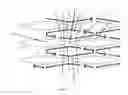


Sources:
- United States Patent and Trademark Office - verify current appl. status at the USPTO↗
Recent applications in this class:
- » 20250163407 2025-05-22
METHODS SELECTIVELY DEPLETING NUCLEIC ACID USING RNASE H - » 20250145988 2025-05-08
METHODS OF ENRICHING NUCLEIC ACIDS - » 20250051762 2025-02-13
PLATFORM USING DNA-ENCODED SMALL MOLECULE LIBRARIES AND RNA SELECTION TO DESIGN SMALL MOLECULES THAT TARGET RNA - » 20250051761 2025-02-13
PROCESSING METHODS FOR NUCLEIC ACID DATA STORAGE - » 20250043276 2025-02-06
Targeted Enrichment of Nucleic Acid Sequences - » 20250034556 2025-01-30
COMPOSITIONS AND METHODS FOR SCREENING CIS REGULATORY ELEMENTS - » 20250027077 2025-01-23
DEVICES AND METHODS FOR mtDNA EXTRACTION - » 20250027076 2025-01-23
LIQUID-PHASE HYBRID CAPTURE METHOD AND LIQUID-PHASE HYBRID CAPTURE KIT - » 20250019693 2025-01-16
METHODS AND COMPOSITIONS FOR ANALYZING NUCLEIC ACID - » 20250011763 2025-01-09
ACCURATE SEQUENCING LIBRARY GENERATION VIA ULTRA-HIGH PARTITIONING