Device that assists in lubricating installed door hinges
US20200078810A1
2020-03-12
16/232,048
2018-12-26
✅ Patent granted
US 10,603,682 B1
2020-03-31
-
-
Laura Edwards
Williams Intellectual Property | Benjamin F. Williams
2038-12-26
Abstract:
A device that assists in lubricating installed door hinges is disclosed. This invention isolates aerosol propelled lubricant to the specific area of an installed door hinge while preventing overspray and containing the lubricating liquid within the device.
Applicant:
Interested in similar patents?
Get notified when new applications in this technology area are published.
Classification:
E05D11/02 » CPC further
Additional features or accessories of hinges Lubricating arrangements
B05B12/20 » CPC further
Arrangements for controlling delivery; Arrangements for controlling the spray area for controlling the spray area Masking elements, i.e. elements defining uncoated areas on an object to be coated
E05D11/00 IPC
Additional features or accessories of hinges
B05C21/005 » CPC further
Masking devices
E05D11/0054 » CPC further
Additional features or accessories of hinges Covers, e.g. for protection
B05B12/34 » CPC main
Arrangements for controlling delivery; Arrangements for controlling the spray area for controlling the spray area; Shielding elements, i.e. elements preventing overspray from reaching areas other than the object to be sprayed movable relative to the spray area
Y10S16/02 » CPC further
Miscellaneous hardware, e.g. bushing, carpet fastener, caster, door closer, panel hanger, attachable or adjunct handle, hinge, window sash balance Paint guard, kick guard
Description
RELATED APPLICATIONS
This application claims the benefit of U.S. Provisional Application Ser. No. 62/728,120, filed on Sep. 7, 2018.
BACKGROUND OF THE INVENTION
Problem Solved
Allows lubrication to target an installed door hinge by isolating the lubricating spray stream while eliminating lubricating overspray from the surrounding door jam.
Without the use of a lubricating hinge shield (device), aerosol propelled lubricants will not target the hinge effectively, resulting in lubricant overspray to the surrounding door jam.
This invention isolates aerosol propelled lubricant to the specific area of an installed door hinge while preventing overspray and containing the lubricating liquid within the device.
DETAILED DESCRIPTION OF THE INVENTION
As stated above, allows lubrication to target an installed door hinge by isolating the lubricating spray stream while eliminating lubricating overspray from the surrounding door jam. The invention claimed here solves this problem.
The device slides over and surrounds an installed door hinge. It encapsulates the hinge and isolates the lubricating spray to the targeted hinge and within the device, eliminating overspray.
The claimed invention differs from what currently exists. There is no similar invention to date. This device effectively lubricates squeaky door hinges without removing the hinge pin. It prevents and isolates overspray created by aerosol propelled lubricants.
This invention is an improvement on what currently exists. There is no similar invention to date. This device effectively lubricates squeaky door hinges without removing the hinge pin. It prevents and isolates overspray created by aerosol propelled lubricants.
Without the use of this device, lubricating installed door hinges is cumbersome, time consuming, less effective, and messy.
This invention isolates aerosol propelled lubricant to the specific area of an installed door hinge while preventing overspray and containing the lubricating liquid within the device.
DRAWING FIGURE DESCRIPTION
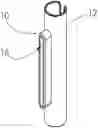
FIG. 1: is a front perspective view of the invention.
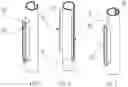
FIG. 2: is a rear perspective view of the invention.
FIG. 3: is an exploded perspective view of the invention.
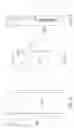
FIGS. 4-6: show the steps of installing the invention.
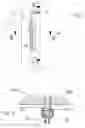
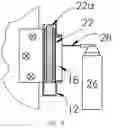
FIG. 7: shows the invention installed.
FIG. 8: is a cross-sectional view taken on line 8-8 of FIG. 7.
FIG. 9: is a cross-sectional view, with parts shown in full, taken on line 9-9 of FIG. 7.
ITEMIZED PARTS LIST
- 10: is the overall lubrication device for installed hinges invention.
- 12: is the hinge encasement tube.
- 16: is the spray nozzle guide slot or channel.
- 18: is the spray nozzle guide.
- 20: is the hinge clearance opening.
- 22: is the hinge.
- 22a: is the hinge pin.
- 24a: is the door.
- 24b: is the jamb.
- 26: is the aerosol lubricant dispenser.
- 28: is the aerosol lubricant nozzle.
The Version of the Invention Discussed Here Includes:
-
- 1. Hinge encasement tube (shield)
- 2. Spray nozzle guide
- 3. Hinge channel
Relationship Between the Components:
The hinge encasement tube (shield) (1) is installed around the door hinge by way of the hinge channel (3). The spray nozzle guide (2) allows a spray lubricant nozzle to travel the length of the door hinge while spray lubricant is being applied.
How the Invention Works:
The hinge shield (device) is slid over an installed door hinge from the bottom of the hinge, moving upward, by way of the hinge channel. Once the hinge shield covers the length of the door hinge, a lubricating aerosol nozzle/tube is inserted into the spray nozzle guide. Once inserted, the lubrication is sprayed directly on the hinge and contained within the encasement tube (shield) while moving the spray nozzle up, or down, the spray nozzle guide, applying lubricant to the length of the door hinge.
How to Make the Invention:
The component can be produced out of plastic resin or similar material.
How to Use the Invention:
To use this invention, one need simply to slide the device over an installed door hinge, insert a lubricating spray nozzle/tube into the spray nozzle guide, then activate the spray lubricant while moving the spray nozzle up or down the spray nozzle guide, applying lubricant to the length of the door hinge while containing the overspray within the hinge encasement tube (shield). After application slide the device down and away from the hinge and remove excess lubricating liquid held within the device (tube/shield).
Claims
1) hinge encasement tube (shield) which is installed around the door hinge by way of the hinge channel.
2) The spray nozzle guide which allows a spray lubricant nozzle to travel the length of the door hinge while spray lubricant is being applied.
Images & Drawings included:
Sources:
- United States Patent and Trademark Office - verify current appl. status at the USPTO↗
Recent applications in this class:
- » 20230108009 2023-04-06
Tire Rim Shield - » 16655224 2022-10-11
Retractable spray shield for agricultural use