Wide-angle lens assembly
US20200096746A1
2020-03-26
16/383,808
2019-04-15
✅ Patent granted
US 10,955,645 B2
2021-03-23
-
-
Joseph P Martinez | Vipin Patel
McClure, Qualey & Rodack, LLP
2039-12-04
Abstract:
A wide-angle lens assembly includes a first lens, a second lens, a third lens, a fourth lens, a fifth lens, a sixth lens, a seventh lens, an eighth lens, a ninth lens and a tenth lens arranged in order from an object side to an image side along an optical axis. The first lens has negative refractive power and includes a convex surface facing the object side and a concave surface facing the image side. The second lens has negative refractive power. The third lens has refractive power and includes a convex surface facing the image side. The fourth lens has positive refractive power and includes a convex surface facing the object side. The fifth lens has refractive power. The sixth lens has refractive power and includes a concave surface facing the object side. The seventh lens has positive refractive power. The eighth lens is a biconvex lens with positive refractive power. The ninth lens has negative refractive power. The tenth lens has refractive power and includes a convex surface facing the image side.
Assignee:
- ASIA OPTICAL CO., INC. 473 🇹🇼 Taichung, Taiwan
- SINTAI OPTICAL (SHENZHEN) CO., LTD. 90 🇨🇳 Shenzhen, China
Applicant:
Interested in similar patents?
Get notified when new applications in this technology area are published.
Classification:
G02B13/18 » CPC further
Optical objectives specially designed for the purposes specified below with lenses having one or more non-spherical faces, e.g. for reducing geometrical aberration
G02B13/04 » CPC main
Optical objectives specially designed for the purposes specified below Reversed telephoto objectives
G02B9/64 » CPC further
Optical objectives characterised both by the number of the components and their arrangements according to their sign, i.e. + or - having more than six components
Description
BACKGROUND OF THE INVENTION
Field of the Invention
The present disclosure is related to a wide-angle lens assembly.
Description of the Related Art
The development of wide-angle lens assemblies nowadays is tending toward a wide-angle lens assembly not only having a large view angle but also having less distortion and a high brightness according to a variety of application requirements. The wide-angle lens assemblies well known in the art have not been able to satisfy such a need. Therefore, a wide-angle lens assembly with another configuration having a large view angle, less distortion and a high brightness is required.
BRIEF SUMMARY OF THE INVENTION
For this reason, the present disclosure provides a wide-angle lens assembly that has a short total length, a wide view angle, a high brightness and less distortion and also has great optical performance.
A wide-angle lens assembly in the present disclosure includes a first lens, a second lens, a third lens, a fourth lens, a fifth lens, a sixth lens, a seventh lens, an eighth lens, a ninth lens and a tenth lens. The first lens has negative refractive power and includes a convex surface facing an object side and a concave surface facing an image side. The second lens has negative refractive power. The third lens has refractive power and includes a convex surface facing the image side. The fourth lens has positive refractive power and includes a convex surface facing the object side. The fifth lens has refractive power. The sixth lens has refractive power and includes a concave surface facing the object side. The seventh lens has positive refractive power. The eighth lens is a biconvex lens with positive refractive power. The ninth lens has negative refractive power. The tenth lens has refractive power and includes a convex surface facing the image side. The first to tenth lenses are arranged in order from the object side to the image side along an optical axis.
Another wide-angle lens assembly in the present disclosure includes a first lens, a second lens, a third lens, a fourth lens, a fifth lens, a sixth lens, a seventh lens, an eighth lens, a ninth lens and a tenth lens. The first lens has negative refractive power and includes a convex surface facing an object side and a concave surface facing an image side. The second lens has negative refractive power. The third lens has refractive power and includes a convex surface facing the image side. The fourth lens has positive refractive power and includes a convex surface facing the object side. The fifth lens has refractive power. The sixth lens has refractive power and includes a concave surface facing the object side. The seventh lens has positive refractive power. The eighth lens is a biconvex lens with positive refractive power. The ninth lens has negative refractive power and includes a concave surface facing the object side. The tenth lens has refractive power and includes a convex surface facing the image side. The first to tenth lenses are arranged in order from the object side to the image side along an optical axis.
In the above wide-angle lens assembly, the sixth lens has negative refractive power and further includes a convex surface facing the image side.
In the above wide-angle lens assembly, the sixth lens has negative refractive power and further includes a concave surface facing the image side.
In the above wide-angle lens assembly, the third lens has negative refractive power, the fourth lens further includes a convex surface facing the image side, the fifth lens is a biconvex lens with positive refractive power, the ninth lens includes a concave surface facing the image side, and the tenth lens has positive refractive power and further includes a convex surface facing the object side.
In the above wide-angle lens assembly, the fifth lens and the sixth lens form a doublet lens.
In the above wide-angle lens assembly, the eighth lens and the ninth lens form a doublet lens.
In the above wide-angle lens assembly, the wide-angle lens assembly satisfies the following condition: −20≤f3/f≤−2, wherein f3 is the focal length of the third lens, and f is the effective focal length of the wide-angle lens assembly.
In the above wide-angle lens assembly, the wide-angle lens assembly satisfies the following condition: −10≤f6/f≤20, wherein f6 is the focal length of the sixth lens, and f is the effective focal length of the wide-angle lens assembly.
In the above wide-angle lens assembly, the wide-angle lens assembly satisfies the following condition: 2≤f56/f≤30, wherein f56 is the effective focal length of the combination of the fifth lens and the sixth lens, and f is the effective focal length of the wide-angle lens assembly.
In the above wide-angle lens assembly, the wide-angle lens assembly satisfies the following condition: 10≤Vd1/Nd1≤4C, wherein Vd1 is the Abbe number of the first lens, and Nd1 is the refractive index of the first lens.
In the above wide-angle lens assembly, the wide-angle lens assembly satisfies the following condition: 10≤Vd4/Nd4≤30, wherein Vd4 is the Abbe number of the fourth lens, and Nd4 is the refractive index of the fourth lens.
In the above wide-angle lens assembly, the wide-angle lens assembly satisfies the following condition: 0<R31/R32<0.8, wherein R31 is the curvature radius of an object-side surface of the third lens, and R32 is the curvature radius of an image-side surface of the third lens.
In the above wide-angle lens assembly, the wide-angle lens assembly satisfies the following condition: −0.8≤R91/R92<0, wherein R91 is the curvature radius of an object-side surface of the ninth lens, and R92 is the curvature radius of an image-side surface of the ninth lens.
The above objects, features and advantages of the present disclosure will be more clearly understood from the following detailed description taken in conjunction with exemplary embodiments and the accompanying drawings.
BRIEF DESCRIPTION OF THE DRAWINGS
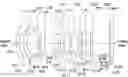
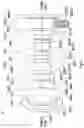
FIG. 1 is a schematic diagram illustrating the configuration of lenses of a wide-angle lens assembly according to the first embodiment of the present disclosure.
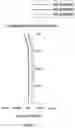
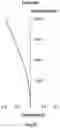
FIG. 2A is a schematic diagram illustrating the longitudinal spherical aberration of the wide-angle lens assembly in FIG. 1.
FIG. 2B is a schematic diagram illustrating the astigmatic field curvature of the wide-angle lens assembly in FIG. 1.
FIG. 2C is a schematic diagram illustrating the distortion of the wide-angle lens assembly in FIG. 1.
FIG. 3 is a schematic diagram illustrating the configuration of lenses of a wide-angle lens assembly according to the second embodiment of the present disclosure.
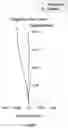
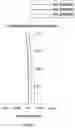
FIG. 4A is a schematic diagram illustrating the longitudinal spherical aberration of the wide-angle lens assembly in FIG. 3.
FIG. 4B is a schematic diagram illustrating the astigmatic field curvature of the wide-angle lens assembly in FIG. 3.
FIG. 4C is a schematic diagram illustrating the distortion of the wide-angle lens assembly in FIG. 3.
FIG. 5 is a schematic diagram illustrating the configuration of lenses of a wide-angle lens assembly according to the third embodiment of the present disclosure.
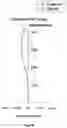
FIG. 6A is a schematic diagram illustrating the longitudinal spherical aberration of the wide-angle lens assembly in FIG. 5.
FIG. 6B is a schematic diagram illustrating the astigmatic field curvature of the wide-angle lens assembly in FIG. 5.
FIG. 6C is a schematic diagram illustrating the distortion of the wide-angle lens assembly in FIG. 5.
DETAILED DESCRIPTION OF THE INVENTION
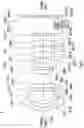
Please refer to FIG. 1. FIG. 1 is a schematic diagram illustrating the configuration of lenses of a wide-angle lens assembly according to the first embodiment of the present disclosure. The wide-angle lens assembly 1 includes, in order from an object side to an image side along an optical axis OA1, a first lens L11, a second lens L12, a third lens L13, a fourth lens L14, a fifth lens L15, a sixth lens L16, an aperture stop ST1, a seventh lens L17, an eighth lens L18, a ninth lens L19, a tenth lens L110, an optical filter OF1 and a protection glass plate CG1. In operation, the light from the object side is imaged on an imaging surface IMAl.
The first lens L11 is a meniscus lens with negative refractive power and is made of glass. The object-side surface S11 of the first lens L11 is a convex surface, and the image-side surface S12 of the first lens L11 is a concave surface. The object-side surface S11 and the image-side surface S12 are spherical surfaces.
The second lens L12 is a meniscus lens with negative refractive power and is made of plastic. The object-side surface S13 of the second lens L12 is a convex surface, and the image-side surface S14 of the second lens L12 is a concave surface. The object-side surface S13 and the image-side surface S14 are aspheric surfaces.
The third lens L13 is a meniscus lens with negative refractive power and is made of glass. The object-side surface S15 of the third lens L13 is a concave surface, and the image-side surface S16 of the third lens L13 is a convex surface. The object-side surface S15 and the image-side surface S16 are spherical surfaces.
The fourth lens L14 is a biconvex lens with positive refractive power and is made of glass. The object-side surface S17 of the fourth lens L14 is a convex surface, and the image-side surface S18 of the fourth lens L14 is a convex surface. The object-side surface S17 and the image-side surface S18 are spherical surfaces.
The fifth lens L15 is a biconvex lens with positive refractive power and is made of glass. The object-side surface S19 of the fifth lens L15 is a convex surface, and the image-side surface S110 of the fifth lens L15 is a convex surface. The object-side surface S19 and the image-side surface S110 are spherical surfaces.
The sixth lens L16 is a biconcave lens with negative refractive power and is made of glass. The object-side surface S110 of the sixth lens L16 is a concave surface, and the image-side surface S111 of the sixth lens L16 is a concave surface. The object-side surface S110 and the image-side surface S111 are spherical surfaces.
The fifth lens L15 and the sixth lens L16 together form a doublet lens.
The seventh lens L17 is a biconvex lens with positive refractive power and is made of glass. The object-side surface S113 of the seventh lens L17 is a convex surface, and the image-side surface S114 is a convex surface. The object-side surface S113 and the image-side surface S114 are spherical surfaces.
The eighth lens L18 is a biconvex lens with positive refractive power and is made of glass. The object-side surface S115 of the eighth lens L18 is a convex surface, and the image-side surface S116 of the eighth lens L18 is a convex surface. The object-side surface S115 and the image-side surface S116 are spherical surfaces.
The ninth lens L19 is a biconcave lens with negative refractive power and is made of glass. The object-side surface S116 of the ninth lens L19 is a concave surface, and the image-side surface S117 of the ninth lens L19 is a concave surface. The object-side surface S116 and the image-side surface S117 are spherical surfaces.
The eighth lens L18 and the ninth lens L19 together form a doublet lens.
The tenth lens L110 is a biconvex lens with positive refractive power and is made of plastic. The object-side surface S118 of the tenth lens L110 is a convex surface, and the image-side surface S119 of the tenth lens L110 is a convex surface. The object-side surface S118 and the image-side surface S119 are aspheric surfaces.
The object-side surface S120 and the image-side surface S121 of the optical filter OF1 are plane surfaces.
The object-side surface S122 and the image-side surface S123 of the protection glass plate CG1 are plane surfaces.
Moreover, the wide-angle lens assembly 1 in the first embodiment satisfies one of the following seven conditions:
−20≤f13/f 1≤−2 (1)
−10≤f16/f1≤2C (2)
2≤f156/f1≤3C (3)
10≤Vd11/Nd11≤40 (4)
10≤Vd14/Nd14≤30 (5)
0<R131/R132≤0.8 (6)
−0.8≤R191/R192<0 (7)
wherein f13 is the focal length of the third lens L13, f16 is the focal length of the sixth lens L16, f156 is the effective focal length of the combination of the fifth lens L15 and the sixth lens L16, f1 is the effective focal length of the wide-angle lens assembly 1, Vd11 is the Abbe number of the first lens L11, Nd11 is the refractive index of the first lens L11, Vd14 is the Abbe number of the fourth lens L14, Nd14 is the refractive index of the fourth lens L14, R131 is the curvature radius of the object-side surface S15 of the third lens L13, R132 is the curvature radius of the image-side surface S16 of the third lens L13, R191 is the curvature radius of the object-side surface S116 of the ninth lens L19, and R192 is the curvature radius of the image-side surface S117 of the ninth lens L19.
Because of the disposition of the above lenses and the aperture stop ST1 and satisfying one of the conditions (1) to (7), the wide-angle lens assembly 1 may have a minimized total length, a wider view angle, a higher brightness and minimized distortion and achieve the effective correction of aberration.
Table 1 illustrates the respective parameters of the respective lenses of the wide-angle lens assembly 1 shown in FIG. 1. For the wide-angle lens assembly 1 in the first embodiment, the effective focal length is 8.493 mm, the aperture value (i.e. F number) is 2.8, the total length is 41.000 mm, and the view angle is 88.439 degrees.
| TABLE 1 | |||||
| Curvature | Thick- | Abbe | |||
| radius | ness | Refractive | No. | ||
| Surface # | (mm) | (mm) | index Nd | Vd | Note |
| S11 | 14.324 | 0.982 | 1.688 | 50.1 | First lens L11 |
| S12 | 7.212 | 2.096 | |||
| S13 | 9.000 | 1.339 | 1.535 | 55.7 | Second lens L12 |
| S14 | 4.905 | 4.441 | |||
| S15 | −22.881 | 0.800 | 1.487 | 70.4 | Third lens L13 |
| S16 | −64.146 | 0.500 | |||
| S17 | 22.763 | 1.991 | 1.753 | 29.5 | Fourth lens L14 |
| S18 | −7222.532 | 3.669 | |||
| S19 | 23.501 | 1.953 | 1.744 | 44.9 | Fifth lens L15 |
| S110 | −23.501 | 0.800 | 1.637 | 34.7 | Sixth lens L16 |
| S111 | 19.608 | 0.544 | |||
| S112 | ∞ | 0.955 | Aperture stop ST1 | ||
| S113 | 11.729 | 2.490 | 1.664 | 53.1 | Seventh lens L17 |
| S114 | −22.324 | 0.809 | |||
| S115 | 23.511 | 2.813 | 1.620 | 60.3 | Eighth lens L18 |
| S116 | −9.497 | 0.800 | 1.755 | 27.6 | Ninth lens L19 |
| S117 | 18.479 | 0.844 | |||
| S118 | 126.647 | 1.645 | 1.535 | 55.7 | Tenth lens L110 |
| S119 | −21.754 | 2.000 | |||
| S120 | ∞ | 0.840 | 1.517 | 64.2 | Optical filter OF1 |
| S121 | ∞ | 7.000 | |||
| S122 | ∞ | 0.500 | 1.517 | 64.2 | Protection glass |
| plate CG1 | |||||
| S123 | ∞ | 1.189 | |||
The respective sag value z of the respective aspherical surface of the respective aspherical lens in Table 1 along the optical axis OA1 is expressed by the following equation:
z=ch2/{1+[1−(k+1)c2h2]1/2}+Ah4+Bh6+Ch8
wherein:
c: the curvature of the surface;
h: the distance between the optical axis and a point on the lens surface along a direction vertical to the optical axis;
k: the conic coefficient;
A˜C: the aspheric coefficients.
Table 2 illustrates the parameters of the respective aspherical surface of each lens listed in Table 2, wherein k is the conic constant, and A˜G are the aspheric coefficients.
| TABLE 2 | ||||
| Surface # | S13 | S14 | S118 | S119 |
| k | 2.3110E−01 | −5.6174E−01 | −3.2525E+02 | 0.0000E+00 |
| A | −1.4323E−05 | 1.8971E−04 | −2.2475E−04 | 3.9989E−04 |
| B | −2.4921E−06 | −2.3359E−06 | 1.9005E−06 | 6.2943E−06 |
| C | −1.5810E−08 | −1.0542E−08 | −2.2281E−07 | −1.2174E−08 |
Table 3 illustrates the parameters for the conditions (1) to (7) and the calculation results of the conditions (1) to (7). From Table 3, the wide-angle lens assembly 1 in the first embodiment can satisfy the conditions (1) to (7).
| TABLE 3 | ||||||||
| f13 | −73.2593 | mm | f16 | −16.5907 | mm | f156 | 189.54000 | mm |
| f1 | 8.493 | mm | Vd11 | 50.1 | Nd11 | 1.688 |
| Vd14 | 29.5 | Nd14 | 1.753 | R131 | −22.8814 | mm |
| R132 | −64.1459 | mm | R191 | −9.4970 | mm | R192 | 18.4795 | mm |
| f13/f1 | −8.626 | f16/f1 | −1.953 | f156/f1 | 22.317 |
| Vd11/Nd11 | 29.680 | Vd14/Nd14 | 16.828 | R131/R132 | 0.357 |
| R191/R192 | −0.514 |
In this case, since sufficiently-strong refractive power may hardly be provided if the calculation result of f13/f1 in the condition (1) is larger than −2, it would be better that the calculation result of f13/f1 is substantially equal to or smaller than −2. Therefore, the wide-angle lens assembly 1 possibly provides sufficiently-strong refractive power when satisfying the condition −20≤f13/f1≤−2.
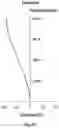
Furthermore, the wide-angle lens assembly 1 in the first embodiment can achieve the required optical performance in view of FIG. 2A to FIG. 2C. FIG. 2A is a schematic diagram illustrating the longitudinal spherical aberration of the wide-angle lens assembly 1 in the first embodiment. FIG. 2B is a schematic diagram illustrating the astigmatic field curvature of the wide-angle lens assembly 1 in the first embodiment. FIG. 2C is a schematic diagram illustrating the distortion of the wide-angle lens assembly 1 in the first embodiment.
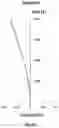
As shown in FIG. 2A, the longitudinal spherical aberration amount of the wide-angle lens assembly 1 in the first embodiment ranges from −0.025 mm to 0.025 mm for the reference wavelengths of 455.0000 nm, 558.0000 nm and 661.0000 nm.
As shown in FIG. 2B, the astigmatic field curvature amount of the wide-angle lens assembly 1in the first embodiment in the tangential direction and the sagittal direction ranges from −0.050 mm to 0.025 mm for the reference wavelength of 558.0000 nm.
As shown in FIG. 2C, the distortion amount of the wide-angle lens assembly 1 in the first embodiment ranges from −5% to 0% for the reference wavelength of 558.0000 nm.
It may be appreciate that the longitudinal spherical aberration, the astigmatic field curvature and the distortion in the wide-angle lens assembly 1 in the first embodiment can be effectively corrected to achieve better optical performance.
Please refer to FIG. 3. FIG. 3 is a schematic diagram illustrating the configuration of lenses of a wide-angle lens assembly according to the second embodiment of the present disclosure. The wide-angle lens assembly 2 includes, in order from an object side to an image side along an optical axis OA2, a first lens L21, a second lens L22, a third lens L23, a fourth lens L24, a fifth lens L25, a sixth lens L26, an aperture stop ST2, a seventh lens L27, an eighth lens L28, a ninth lens L29, a tenth lens L210, an optical filter OF2 and a protection glass plate CG2. In operation, the light from the object side is imaged on an imaging surface IMA2.
The first lens L21 is a meniscus lens with negative refractive power and is made of glass. The object-side surface S21 of the first lens L21 is a convex surface, and the image-side surface S22 of the first lens L21 is a concave surface. The object-side surface S21 and the image-side surface S22 are spherical surfaces.
The second lens L22 is a meniscus lens with negative refractive power and is made of plastic. The object-side surface S23 of the second lens L22 is a convex surface, and the image-side surface S24 is a concave surface. The object-side surface S23 and the image-side surface S24 are aspheric surfaces.
The third lens L23 is a meniscus lens with negative refractive power and is made of glass. The object-side surface S25 of the third lens L23 is a concave surface, and the image-side surface S26 is a convex surface. The object-side surface S25 and the image-side surface S26 are spherical surfaces.
The fourth lens L24 is a biconvex lens with positive refractive power and is made of glass. The object-side surface S27 of the fourth lens L24 is a convex surface, and the image-side surface S28 is a convex surface. The object-side surface S27 and the image-side surface S28 are spherical surfaces.
The fifth lens L25 is a biconvex lens with positive refractive power and is made of glass. The object-side surface S29 of the fifth lens L25 is a convex surface, and the image-side surface S210 of the fifth lens L25 is a convex surface. The object-side surface S29 and the image-side surface S210 are spherical surfaces.
The sixth lens L26 is a biconcave lens with negative refractive power and is made of glass. The object-side surface S210 of the sixth lens L26 is a concave surface, and the image-side surface S211 is a concave surface. The object-side surface S210 and the image-side surface S211 are spherical surfaces.
The fifth lens L25 and the sixth lens L26 together form a doublet lens.
The seventh lens L27 is a biconvex lens with positive refractive power and is made of glass. The object-side surface S213 of the seventh lens L27 is a convex surface, and the image-side surface S214 of the seventh lens L27 is a convex surface. The object-side surface S213 and the image-side surface S214 are spherical surfaces.
The eighth lens L28 is a biconvex lens with positive refractive power and is made of glass. The object-side surface S215 of the eighth lens L28 is a convex surface, and the image-side surface S216 of the eighth lens L28 is a convex surface. The object-side surface S215 and the image-side surface S216 are spherical surfaces.
The ninth lens L29 is a biconcave lens with negative refractive power and is made of glass. The object-side surface S216 of the ninth lens L29 is a concave surface, and the image-side surface S217 of the ninth lens L29 is a concave surface. The object-side surface S216 and the image-side surface S217 are spherical surfaces.
The eighth lens L28 and the ninth lens L29 together form a doublet lens.
The tenth lens L210 is a biconvex lens with positive refractive power and is made of plastic. The object-side surface S218 of the tenth lens L210 is a convex surface, and the image-side surface S219 of the tenth lens L210 is a convex surface. The object-side surface S218 and the image-side surface S219 l are aspheric surfaces.
The object-side surface S220 and the image-side surface S221 of the optical filter OF2 are plane surfaces.
The object-side surface S222 and the image-side surface S223 of the protection glass plate CG2 are plane surfaces.
Moreover, the wide-angle lens assembly 2 in the second embodiment satisfies one of the following seven conditions:
−20≤f23/f2≤−2 (8)
−10≤f26/f2≤20 (9)
2≤f256/f2≤30 (10)
10≤Vd21/Nd21≤40 (11)
10≤Vd24/Nd24≤30 (12)
0<R231/R232≤0.8 (13)
−0.8≤R291/R292<0 (14)
The definitions of f23, f26, f256, f2, Vd21, Nd21, Vd24, Nd24, R231, R232, R291 and R292 are respectively the same as those of f13, f16, f156, f1, Vd11, Nd11, Vd14, Nd14, R131, R132, R191 and R192 in the first embodiment, and thus, the related descriptions will be omitted hereafter.
Because of the disposition of the above lenses and the aperture stop ST2 and satisfying one of the conditions (8) to (14), the wide-angle lens assembly 2 may have a minimized total length, a wider view angle, a higher brightness and minimized distortion and achieve the effective correction of aberration.
Table 4 illustrates the respective parameters of the respective lenses of the wide-angle lens assembly 2 shown in FIG. 3. For the wide-angle lens assembly 2 in the second embodiment, the effective focal length is 8.472 mm, the aperture value is 2.8, the total length is 44.000 mm, and the view angle is 88.571 degrees.
| TABLE 4 | |||||
| Curvature | Thick- | Abbe | |||
| radius | ness | Refractive | No. | ||
| Surface # | (mm) | (mm) | index Nd | Vd | Note |
| S21 | 15.251 | 0.800 | 1.680 | 31.4 | First lens L21 |
| S22 | 7.710 | 1.929 | |||
| S23 | 10.647 | 0.800 | 1.535 | 55.7 | Second lens L22 |
| S24 | 6.204 | 7.466 | |||
| S25 | −11.582 | 2.934 | 1.487 | 70.4 | Third lens L23 |
| S26 | −24.733 | 0.500 | |||
| S27 | 30.698 | 2.817 | 1.744 | 44.9 | Fourth lens L24 |
| S28 | −42.400 | 1.332 | |||
| S29 | 14.920 | 4.089 | 1.744 | 44.9 | Fifth lens L25 |
| S210 | −14.920 | 1.072 | 1.619 | 36.5 | Sixth lens L26 |
| S211 | 22.998 | 1.417 | |||
| S212 | ∞ | 0.500 | Aperture stop ST2 | ||
| S213 | 26.457 | 1.589 | 1.616 | 60.6 | Seventh lens L27 |
| S214 | −89.929 | 0.500 | |||
| S215 | 13.823 | 3.989 | 1.557 | 64.1 | Eighth lens L28 |
| S216 | −7.053 | 0.800 | 1.755 | 27.6 | Ninth lens L29 |
| S217 | 13.360 | 0.500 | |||
| S218 | 18.824 | 2.046 | 1.535 | 55.7 | Tenth lens L210 |
| S219 | −27.161 | 2.000 | |||
| S220 | ∞ | 0.840 | 1.517 | 64.2 | Optical filter OF2 |
| S221 | ∞ | 4.500 | |||
| S222 | ∞ | 0.500 | 1.517 | 64.2 | Protection glass |
| plate CG2 | |||||
| S223 | ∞ | 1.080 | |||
The respective sag value z of the respective aspherical surface of the respective aspherical lens in Table 4 along the optical axis OA2 is expressed by the following equation:
z=ch2/{1+[1−(k+1)c2h2]1/2}+Ah4+Bh6+Ch8
wherein:
c: the curvature of the surface;
h: the distance between the optical axis and a point on the lens surface along a direction vertical to the optical axis;
k: the conic coefficient;
A˜C: the aspheric coefficients.
Table 5 illustrates the parameters of the respective aspherical surface of each lens listed in Table 4, wherein k is the conic constant, and A˜G are the aspheric coefficients.
| TABLE 5 | ||||
| Surface # | S23 | S24 | S218 | S219 |
| k | 8.0072E−01 | −2.0624E−01 | −1.0496E+01 | 0.0000E+00 |
| A | 3.4056E−06 | 4.0646E−05 | −1.1143E−04 | 1.1815E−04 |
| B | −8.8957E−07 | −2.2767E−06 | 3.9330E−06 | 3.8633E−05 |
| C | 1.0823E−08 | 2.4602E−07 | −1.8848E−07 | −7.9393E−07 |
Table 6 illustrates the parameters for the conditions (8) to (14) and the calculation results of the conditions (8) to (14). From Table 6, the wide-angle lens assembly 2 in the second embodiment can satisfy the conditions (8) to (14).
| TABLE 6 | ||||||||
| f23 | −48.1028 | mm | f26 | −14.3963 | mm | f256 | 28.91150 | mm |
| f2 | 8.472 | mm | Vd21 | 31.4 | Nd21 | 1.680 |
| Vd24 | 44.9 | Nd24 | 1.744 | R231 | −11.5822 | mm |
| R232 | −24.7326 | mm | R291 | −7.0534 | mm | R292 | 13.3604 | mm |
| f23/f2 | −5.678 | f26/f2 | −1.699 | f256/f2 | 3.413 |
| Vd21/Nd21 | 18.690 | Vd24/Nd24 | 25.745 | R231/R232 | 0.468 |
| R291/R292 | −0.528 |
In this case, since sufficiently-strong refractive power may hardly be provided if the calculation result of f26/f2 in the condition (9) is larger than 20, it would be better that the calculation result of f26/f2 is substantially equal to or smaller than 20. Therefore, the wide-angle lens assembly 2 may provide sufficiently-strong refractive power when satisfying −10≤f26/f2≤2C.
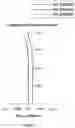
Moreover, the wide-angle lens assembly 2 in the second embodiment can achieve the required optical performance in view of FIG. 4A to FIG. 4C. FIG. 4A is a schematic diagram illustrating the longitudinal spherical aberration of the wide-angle lens assembly 2 in the second embodiment. FIG. 4B is a schematic diagram illustrating the astigmatic field curvature of the wide-angle lens assembly 2 in the second embodiment. FIG. 4C is a schematic diagram illustrating the distortion of the wide-angle lens assembly 2 in the second embodiment.
As shown in FIG. 4A, the longitudinal spherical aberration amount of the wide-angle lens assembly 2 in the second embodiment ranges from −0.025 mm to 0.025 mm for the reference wavelengths of 455.0000 nm, 558.0000 nm and 661.0000 nm.
As shown in FIG. 4B, the astigmatic field curvature amount of the wide-angle lens assembly 2 in the second embodiment in the tangential direction and the sagittal direction ranges −0.050 mm to 0.050 mm for the reference wavelength of 558.0000 nm.
As shown in FIG. 4C, the distortion amount of the wide-angle lens assembly 2 in the second embodiment ranges from −5% to 0% for the reference wavelength of 558.0000 nm.
It may be appreciate that the longitudinal spherical aberration, the astigmatic field curvature and the distortion in the wide-angle lens assembly 2 in the second embodiment can be effectively corrected to achieve better optical performance.
Please refer to FIG. 5. FIG. 5 is a schematic diagram illustrating the configuration of lenses of a wide-angle lens assembly according to the third embodiment of the present disclosure. The wide-angle lens assembly 3 includes, in order from an object side to an image side along an optical axis OA3, a first lens L31, a second lens L32, a third lens L33, a fourth lens L34, a fifth lens L35, a sixth lens L36, an aperture stop ST3, a seventh lens L37, an eighth lens L38, a ninth lens L39, a tenth lens L310, an optical filter OF3 and a protection glass plate CG3. In operation, the light from the object side is imaged on an imaging surface IMA3.
The first lens L31 is a meniscus lens with negative refractive power and is made of glass. The object-side surface S31 of the first lens L31 is a convex surface, and the image-side surface S32 of the first lens L31 is a concave surface. The object-side surface S31 and the image-side surface S32 are spherical surfaces.
The second lens L32 is a meniscus lens with negative refractive power and is made of plastic. The object-side surface S33 of the second lens L32 is a convex surface, and the image-side surface S34 of the second lens L32 is a concave surface. The object-side surface S33 and the image-side surface S34 are aspheric surfaces.
The third lens L33 is a meniscus lens with negative refractive power and is made of glass. The object-side surface S35 of the third lens L33 is a concave surface, and the image-side surface S36 of the third lens L33 is a convex surface. The object-side surface S35 and the image-side surface S36 are spherical surfaces.
The fourth lens L34 is a biconvex lens with positive refractive power and is made of glass. The object-side surface S37 of the fourth lens L34 is a convex surface, and the image-side surface S38 of the fourth lens L34 is a convex surface. The object-side surface S37 and the image-side surface S38 are spherical surfaces.
The fifth lens L35 is a biconvex lens with positive refractive power and is made of glass. The object-side surface S39 of the fifth lens L35 is a convex surface, and the image-side surface S310 of the fifth lens L35 is a convex surface. The object-side surface S39 and the image-side surface S310 are spherical surfaces.
The sixth lens L36 is a meniscus lens with negative refractive power and is made of glass. The object-side surface S310 of the sixth lens L36 is a concave surface, and the image-side surface S311 of the sixth lens L36 is a convex surface. The object-side surface S310 and the image-side surface S311 are spherical surfaces.
The fifth lens L35 and the sixth lens L36 together form a doublet lens.
The seventh lens L37 is a biconvex lens with positive refractive power and is made of glass. The object-side surface S313 of the seventh lens L37 is a convex surface, and the image-side surface S314 of the seventh lens L37 is a convex surface. The object-side surface S313 and the image-side surface S314 are spherical surfaces.
The eighth lens L38 is a biconvex lens with positive refractive power and is made of glass. The object-side surface S315 of the eighth lens L38 is a convex surface, and the image-side surface S316 of the eighth lens L38 is a convex surface. The object-side surface S315 and the image-side surface S316 are spherical surfaces.
The ninth lens L39 is a biconcave lens with negative refractive power and is made of glass. The object-side surface S316 of the ninth lens L39 is a concave surface, and the image-side surface S317 of the ninth lens L39 is a concave surface. The object-side surface S316 and the image-side surface S317 are spherical surfaces.
The eighth lens L38 and the ninth lens L39 together form a doublet lens.
The tenth lens L310 is a biconvex lens with positive refractive power and is made of plastic. The object-side surface S318 of the tenth lens L310 is a convex surface, and the image-side surface S319 of the tenth lens L310 is a convex surface. The object-side surface S318 and the image-side surface S319 are aspheric surfaces.
The object-side surface S320 and the image-side surface S321 of the optical filter OF3 are plane surfaces.
The object-side surface S322 and the image-side surface S323 of the protection glass plate CG3 are plane surfaces.
Moreover, the wide-angle lens assembly 3 in the third embodiment satisfies one of the following seven conditions:
−20≤f33/f3≤−2 (15)
−10≤f36/f3≤2C (16)
2≤f356/f3≤30 (17)
10≤Vd31/Nd31≤40 (18)
10≤Vd34/Nd34≤30 (19)
0<R331/R332≤0.8 (20)
−0.8≤R391/R392<0 (21)
The definitions of f33, f36, f356, f3, Vd31, Nd31, Vd34, Nd34, R331, R332, R391 and R392 are respectively the same as those of f13, f16, f156, f1, Vd11, Nd11, Vd14, Nd14, R131, R132, R191 and R192 in the first embodiment, and thus, the related descriptions will be omitted hereafter.
Because of the disposition of the above lenses and the aperture stop ST3 and satisfying one of the conditions (15) to (21), the wide-angle lens assembly 3 may have a minimized total length, a wider view angle, a higher brightness and minimized distortion and achieve the effective correction of aberration.
Table 7 illustrates the respective parameters of the respective lenses of the wide-angle lens assembly 3 shown in FIG. 5. For the wide-angle lens assembly 3 in the third embodiment, the effective focal length is 8.461 mm, the aperture value is 2.8, the total length is 41.000 mm, and the view angle is 88.183 degrees.
| TABLE 7 | |||||
| Curvature | Thick- | Abbe | |||
| radius | ness | Refractive | No. | ||
| Surface # | (mm) | (mm) | index Nd | Vd | Note |
| S31 | 14.220 | 0.984 | 1.729 | 54.7 | First lens L31 |
| S32 | 7.437 | 1.857 | |||
| S33 | 8.559 | 1.341 | 1.535 | 55.7 | Second lens L32 |
| S34 | 4.717 | 4.271 | |||
| S35 | −44.470 | 0.800 | 1.487 | 70.4 | Third lens L33 |
| S36 | −372.407 | 0.500 | |||
| S37 | 56.885 | 1.693 | 1.755 | 27.6 | Fourth lens L34 |
| S38 | −184.991 | 4.035 | |||
| S39 | 17.082 | 2.218 | 1.744 | 44.8 | Fifth lens L35 |
| S310 | −17.082 | 0.800 | 1.640 | 34.5 | Sixth lens L36 |
| S311 | −284.621 | 0.531 | |||
| S312 | ∞ | 1.291 | Aperture stop ST3 | ||
| S313 | 100.000 | 1.889 | 1.678 | 55.3 | Seventh lens L37 |
| S314 | −18.468 | 0.507 | |||
| S315 | 18.453 | 2.868 | 1.620 | 60.3 | Eighth lens L38 |
| S316 | −9.282 | 1.616 | 1.755 | 27.6 | Ninth lens L39 |
| S317 | 16.020 | 0.909 | |||
| S318 | 76.559 | 2.032 | 1.535 | 55.7 | Tenth lens L310 |
| S319 | −19.613 | 2.000 | |||
| S320 | ∞ | 0.840 | 1.517 | 64.2 | Optical filter OF3 |
| S321 | ∞ | 7.000 | |||
| S322 | ∞ | 0.500 | 1.517 | 64.2 | Protection glass |
| plate CG3 | |||||
| S323 | ∞ | 0.519 | |||
The respective sag value z of the respective aspherical surface of the respective aspherical lens in Table 7 along the optical axis OA3 is expressed by the following equation:
z=ch2/{1+[1−(k+1)c2h2]1/2}+Ah4+Bh6+Ch8
wherein:
c: the curvature of the surface;
h: the distance between the optical axis and a point on the lens surface along a direction vertical to the optical axis;
k: the conic coefficient;
A˜C: the aspheric coefficients.
Table 8 illustrates the parameters of the respective aspherical surface of each lens listed in Table 7, wherein k is the conic constant, and A˜G are the aspheric coefficients.
| TABLE 8 | ||||
| Surface # | S33 | S34 | S318 | S319 |
| k | −3.0384E−02 | −6.1329E−01 | 0.0000E+00 | 0.0000E+00 |
| A | −5.4565E−05 | 2.0512E−04 | −9.8714E−05 | 3.6170E−04 |
| B | −3.3034E−06 | −6.2421E−06 | 4.1953E−06 | 6.1424E−06 |
| C | 1.2607E−08 | 1.8682E−07 | −1.2804E−07 | −3.5358E−08 |
Table 9 illustrates the parameters for the conditions (15) to (21) and the calculation results of the conditions (15) to (21). From Table 9, the wide-angle lens assembly 3 in the third embodiment can satisfy the conditions (15) to (21).
| TABLE 9 | ||||||||
| f33 | −103.4321 | mm | f36 | −28.3033 | mm | f356 | 19.40330 | mm |
| f3 | 8.461 | mm | Vd31 | 54.7 | Nd31 | 1.729 |
| Vd34 | 27.6 | Nd34 | 1.755 | R331 | −44.4697 | mm |
| R332 | −372.4070 | mm | R391 | −9.2817 | mm | R392 | 16.0204 | mm |
| f33/f3 | −12.225 | f36/f3 | −3.345 | f356/f3 | 2.293 |
| Vd31/Nd31 | 31.637 | Vd34/Nd34 | 15.726 | R331/R332 | 0.119 |
| R391/R392 | −0.579 |
In the case, since the achromatic ability may become weak if the calculation result of Vd31/Nd31 in the condition (18) is larger than 40, it would be better that the calculation result of Vd31/Nd31 is substantially equal to or smaller than 40. Therefore, the wide-angle lens assembly 3 may have the optimal achromatic ability when satisfying 10≤Vd31/Nd31≤40.
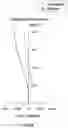
Additionally, the wide-angle lens assembly 3 in the third embodiment can achieve the required optical performance in view of FIG. 6A to FIG. 6C. FIG. 6A is a schematic diagram illustrating the longitudinal spherical aberration of the wide-angle lens assembly 3 in the third embodiment. FIG. 6B is a schematic diagram illustrating the astigmatic field curvature of the wide-angle lens assembly 3 in the third embodiment. FIG. 6C is a schematic diagram illustrating the distortion of the wide-angle lens assembly 3 in the third embodiment.
As shown in FIG. 6A, the longitudinal spherical aberration amount in the wide-angle lens assembly 3 in the third embodiment ranges from −0.025 mm to 0.025 mm for the reference wavelengths of 455.0000 nm, 558.0000 nm and 661.0000 nm.
As shown in FIG. 6B, the astigmatic field curvature amount in the wide-angle lens assembly 3 in the third embodiment in the tangential direction and the sagittal direction ranges from −0.075 mm to 0.025 mm for the 558.0000 nm reference wavelength.
As shown in FIG. 6C, the distortion amount of the wide-angle lens assembly 3 in the third embodiment ranges from −5% to 0% for the 558.0000 nm reference wavelength.
It may be appreciate that the longitudinal spherical aberration, the astigmatic field curvature and the distortion in the wide-angle lens assembly 3 in the third embodiment can be effectively corrected to achieve better optical performance.
Even though the primary conditions to be satisfied in the present disclosure are −20≤f3/f≤31 2, −10≤f6/f≤20 and 10≤Vd11/Nd1≤4C, the above embodiments also satisfy the other conditions. Satisfying −20≤f3/f≤−2 and −10≤f6/f−20enables the wide-angle lens assembly to have sufficiently-strong refractive power, and satisfying the condition 10≤Vd1/Nd1≤40 enables the wide-angle lens assembly to have the better achromatic ability.
It should be understood that although the present disclosure has been described with reference to the above preferred embodiments, these embodiments are not intended to retrain the present disclosure. It will be apparent to one of ordinary skill in the art that various changes or modifications to the described embodiments can be made without departing from the spirit of the present disclosure. Accordingly, the scope of the present disclosure is defined by the attached claims.
Claims
What is claimed is:1. A wide-angle lens assembly, comprising:
a first lens having negative refractive power, and the first lens comprising a convex surface facing an object side and a concave surface facing an image side;
a second lens having negative refractive power;
a third lens having refractive power, and the third lens comprising a convex surface facing the image side;
a fourth lens having positive refractive power, and the fourth lens comprising a convex surface facing the object side;
a fifth lens having refractive power;
a sixth lens having refractive power, and the sixth lens comprising a concave surface facing the object side and a convex surface facing an image side;
a seventh lens having positive refractive power;
an eighth lens having positive refractive power, and the eighth lens being a biconvex lens;
a ninth lens having negative refractive power; and
a tenth lens having refractive power, and the tenth lens comprising a convex surface facing the image side;
wherein the first lens, the second lens, the third lens, the fourth lens, the fifth lens, the sixth lens, the seventh lens, the eighth lens, the ninth lens and the tenth lens are arranged in order from the object side to the image side along an optical axis.
2. A wide-angle lens assembly, comprising:
a first lens having negative refractive power, and the first lens comprising a convex surface facing an object side and a concave surface facing an image side;
a second lens having negative refractive power;
a third lens having refractive power, and the third lens comprising a convex surface facing the image side;
a fourth lens having positive refractive power, and the fourth lens comprising a convex surface facing the object side;
a fifth lens having refractive power;
a sixth lens having refractive power, and the sixth lens comprising a concave surface facing the object side;
a seventh lens having positive refractive power;
an eighth lens having positive refractive power, and the eighth lens being a biconvex lens;
a ninth lens having negative refractive power; and
a tenth lens having refractive power, and the tenth lens comprising a convex surface facing the image side;
wherein the first lens, the second lens, the third lens, the fourth lens, the fifth lens, the sixth lens, the seventh lens, the eighth lens, the ninth lens and the tenth lens are arranged in order from the object side to the image side along an optical axis;
wherein the fifth lens and the sixth lens form a doublet lens.
3. A wide-angle lens assembly, comprising:
a first lens having negative refractive power, and the first lens comprising a convex surface facing an object side and a concave surface facing an image side;
a second lens having negative refractive power;
a third lens having refractive power, and the third lens comprising a convex surface facing the image side;
a fourth lens having positive refractive power, and the fourth lens comprising a convex surface facing the object side;
a fifth lens having refractive power;
a sixth lens having refractive power, and the sixth lens comprising a concave surface facing the object side;
a seventh lens having positive refractive power;
an eighth lens having positive refractive power, and the eighth lens being a biconvex lens;
a ninth lens having negative refractive power; and
a tenth lens having refractive power, and the tenth lens comprising a convex surface facing the image side;
wherein the first lens, the second lens, the third lens, the fourth lens, the fifth lens, the sixth lens, the seventh lens, the eighth lens, the ninth lens and the tenth lens are arranged in order from the object side to the image side along an optical axis ;
wherein the wide-angle lens assembly satisfies:
2≤f56/f≤3C;
wherein f56 is an effective focal length of a combination of the fifth lens and the sixth lens, and f is an effective focal length of the wide-angle lens assembly.
4. The wide-angle lens assembly according to claim 1, wherein the sixth lens has negative refractive power.
5. The wide-angle lens assembly according to claim 2, wherein the sixth lens has negative refractive power and further comprises a convex surface facing the image side.
6. The wide-angle lens assembly according to one of claims 3, wherein the sixth lens has negative refractive power and further comprises a convex surface facing the image side.
7. The wide-angle lens assembly according to claim 1, wherein the third lens has negative refractive power, the fourth lens further comprises a convex surface facing the image side, the fifth lens is a biconvex lens with positive refractive power, the ninth lens comprises a concave surface facing the image side, and the tenth lens has positive refractive
8. The wide-angle lens assembly according to claims 1, wherein the fifth lens and the sixth lens form a doublet lens, and the eighth lens and the ninth lens form a doublet lens.
9. The wide-angle lens assembly according to claims 2, wherein the eighth lens and the ninth lens form a doublet lens.
10. The wide-angle lens assembly according to claims 3, wherein the fifth lens and the sixth lens form a doublet lens, and the eighth lens and the ninth lens form a doublet lens.
11. The wide-angle lens assembly according to claim 7, wherein the wide-angle lens assembly satisfies:
2<f56/f≤3C;
wherein f56 is an effective focal length of a combination of the fifth lens and the sixth lens, and f is an effective focal length of the wide-angle lens assembly.
12. The wide-angle lens assembly according to claims 1, wherein the wide-angle lens assembly satisfies:
−20≤f3/f≤−2 and
wherein f3 is a focal length of the third lens and f is an effective focal length of the wide-angle lens assembly.
13. The wide-angle lens assembly according to claims 1, wherein the wide-angle lens assembly satisfies:
−10≤f6/f≤20;
f6 is a focal length of the sixth lens and f is an effective focal length of the wide-angle lens assembly.
14. The wide-angle lens assembly according to claim 2, wherein the wide-angle lens assembly satisfies:
2≤f56/f≤3C;
wherein f56 is an effective focal length of a combination of the fifth lens and the sixth lens, and f is an effective focal length of the wide-angle lens assembly.
15. The wide-angle lens assembly according to claims 1, wherein the wide-angle lens assembly satisfies:
10≤Vd1/Nd1≤4C;
wherein Vd1 is an Abbe number of the first lens and Nd1 is a refractive index of the first lens.
16. The wide-angle lens assembly according to one of claims 1, wherein the wide-angle lens assembly satisfies:
10≤Vd4/Nd4≤30;
Vd4 is an Abbe number of the fourth lens and Nd4 is a refractive index of the fourth lens.
17. The wide-angle lens assembly according to claims 1, wherein the wide-angle lens assembly satisfies:
0<R31/R32≤0.8;
wherein R31 is a curvature radius of an object-side surface of the third lens, R32 is a curvature radius of an image-side surface of the third lens.
18. The wide-angle lens assembly according to claims 1, wherein the wide-angle lens assembly satisfies:
−0.85≤R91/R92<0;
R91 is a curvature radius of an object-side surface of the ninth lens, and R92 is a curvature radius of an image-side surface of the ninth lens.
19. The wide-angle lens assembly according to claims 2, wherein the wide-angle lens assembly satisfies:
0<R31/R32≤0.8; and
−0.8≤R91/R92<0;
wherein R31 is a curvature radius of an object-side surface of the third lens, R32 is a curvature radius of an image-side surface of the third lens, R91 is a curvature radius of an object-side surface of the ninth lens, and R92 is a curvature radius of an image-side surface of the ninth lens.
20. The wide-angle lens assembly according to claims 3, wherein the wide-angle lens assembly satisfies:
0<R31/R32≤0.8; and
−0.8≤R91/R92<0;
wherein R31 is a curvature radius of an object-side surface of the third lens, R32 is a curvature radius of an image-side surface of the third lens, R91 is a curvature radius of an object-side surface of the ninth lens, and R92 is a curvature radius of an image-side surface of the ninth lens.
Images & Drawings included:
Sources:
- United States Patent and Trademark Office - verify current appl. status at the USPTO↗
Similar patent applications:
- » 20180335611
Wide-angle lens assembly - » 20190219798
Wide-angle lens assembly - » 20170315330
Wide-angle lens assembly - » 20180329183
Wide-angle lens assembly - » 20190033561
Wide-angle lens assembly - » 20190121106
Wide-angle lens assembly and imaging device - » 20150277088
Wide-angle lens assembly - » 20170052349
WIDE-ANGLE LENS ASSEMBLY - » 20180329177
Wide-angle lens assembly - » 20190339490
Wide-angle lens assembly
Recent applications in this class:
- » 20240118524 2024-04-11
IMAGING LENS SYSTEM FOR TRACKING CELESTIAL BODY - » 20240027738 2024-01-25
OPTICAL IMAGE CAPTURING SYSTEM, IMAGE CAPTURING DEVICE AND ELECTRONIC DEVICE - » 20230251469 2023-08-10
Imaging optical system, projection-type display apparatus, and imaging apparatus - » 20230112466 2023-04-13
Optical image capturing system, image capturing device and electronic device - » 20220121017 2022-04-21
Imaging lens and imaging apparatus - » 20210364767 2021-11-25
Imaging optical system, projection-type display apparatus, and imaging apparatus - » 20210255439 2021-08-19
Wide-angle optical system and image pickup apparatus using the same - » 20210088760 2021-03-25
Optical Assembly for a Compact Wide Field of View Digital Camera with High MTF - » 20210072517 2021-03-11
Wide-angle lens assembly including nine lenses of −−+++−++− or −−+++−+−+, or ten lenses of −−+++−−+++ or −−−+++−+−+ refractive powers - » 20210072516 2021-03-11
LENS SYSTEM AND IMAGE PICKUP APPARATUS
Recent applications for this Assignee:
- » 20240361104 2024-10-31
AIMING DEVICES AND METHODS THEREOF - » 20240361104 2024-10-31
AIMING DEVICES AND METHODS THEREOF - » 20230288683 2023-09-14
Optical system - » 20230288683 2023-09-14
Optical system - » 20230194256 2023-06-22
Range finder and lens assembly for display thereof - » 20230194256 2023-06-22
Range finder and lens assembly for display thereof - » 20230047206 2023-02-16
Lens device capable of operation of multi-magnifications, optical zoom in high magnification, and miniaturization of the lens module thereof - » 20230047206 2023-02-16
Lens device capable of operation of multi-magnifications, optical zoom in high magnification, and miniaturization of the lens module thereof - » 20230018568 2023-01-19
Lens Device - » 20230018568 2023-01-19
Lens Device