METHOD FOR PRODUCING AN ASSEMBLY
US20220156673A1
2022-05-19
17/584,024
2022-01-25
Abstract:
A method for producing an assembly is provided such that manufacturing defects and redundant work steps are preventively avoided.
Inventors:
- Oliver WESSEL 1 🇩🇪 Didderse, Germany
- Matthias HENSEL 1 🇩🇪 Wolfsburg, Germany
- Otto SCHLUESCHE 1 🇩🇪 Knesebeck, Germany
Assignee:
- VOLKSWAGEN AKTIENGESELLSCHAFT 1,304 🇩🇪 Wolfsburg, Germany
Interested in similar patents?
Get notified when new applications in this technology area are published.
Classification:
G06Q10/06398 » CPC main
Administration; Management; Resources, workflows, human or project management, e.g. organising, planning, scheduling or allocating time, human or machine resources; Enterprise planning; Organisational models; Operations research or analysis; Performance analysis Performance of employee with respect to a job function
G06Q10/06 IPC
Administration; Management Resources, workflows, human or project management, e.g. organising, planning, scheduling or allocating time, human or machine resources; Enterprise planning; Organisational models
G06Q50/04 » CPC further
Systems or methods specially adapted for specific business sectors, e.g. utilities or tourism Manufacturing
Description
METHOD FOR PRODUCING AN ASSEMBLY
This nonprovisional application is a continuation of International Application No. PCT/EP2020/070803, which was filed on Jul. 23, 2020, and which claims priority to German Patent Application No. 10 2019 120 167.5, which was filed in Germany on Jul. 25, 2019, and which are both herein incorporated by reference.
BACKGROUND OF THE INVENTION
Field of the Invention
The present invention relates to a method for producing an assembly and to an assembly.
Description of the Background Art
When producing an assembly, individual parts are usually manufactured first, and these are then joined to form the assembly with the help of handling processes.
A number of problems can arise in this regard that reduce the quality of the assembly, for example, of a vehicle.
For example, parts can be damaged in the course of handling, which conventionally should be avoided by applying a prefabricated protective film after the parts have been manufactured. Such downstream work steps increase the cost, however.
Furthermore, vehicles, for example, are built conventionally on the basis of chains of reference points. The chains of reference points run, for example, from a hole in a side member to a centering of a headliner of the vehicle. An accumulation of tolerances of individual parts over this distance often leads to the vehicle being incapable of being assembled. For example, a fender, regarded as a single part, can be manufactured entirely according to its drawing and thus be considered to be free of defects. Its length can, for example, be 0.5 mm longer than the nominal length within permissible tolerances. At the same time, for example, a vehicle door can also be made 0.5 mm longer than its nominal length. Although both individual parts are considered to be free of defects, it can happen that they do not fit together in the assembled state, because tolerances permissible in themselves accumulate disadvantageously. This then has to be corrected laboriously by reworking.
A further problem arises because, for example, a worker can evaluate his work result only after the assembly has been carried out and therefore must largely complete the assembly process before the abovementioned problems can be detected. Here, as well, there is an increased amount of rework required.
US 2014/035994A1 discloses a method for producing an assembly in which automated assembly steps are carried out by means of robots. Parts of a vehicle body are positioned. Gap dimensions are monitored automatically. If a gap dimension does not meet the quality requirements, the corresponding assembly is rejected as defective.
SUMMARY OF THE INVENTION
It is therefore an object of the present invention to improve methods for producing assemblies such that rework and unnecessary work steps are avoided.
In an exemplary embodiment, the invention relates to a method for producing an assembly comprising the steps:
a) performing manual assembly steps;
b) automated checking during the assembly steps whether assembly results meet defined quality requirements;
c) providing immediate feedback if an assembly result does not meet the quality requirements.
d) performing an immediate correction by the worker.
In other words, mounting of components takes place here, for example, according to dimensional specifications, using a system for worker guidance.
In this regard, checking of the work result and giving immediate feedback to the worker occur automatically. An immediate correction is then possible for the worker. This avoids further assembly steps being carried out in vain, because the error is pointed out in good time. Technical solutions for the automated checking of products, for example, for optical quality control, are known from other fields and can be selected accordingly by the skilled artisan and supplemented by the feedback function on the basis of the teaching disclosed herein.
The method of the invention plays a role preferably when fitting body shell components, after changing parts due to defects found in the paint, or also when installing other add-on parts.
A further aspect of the invention relates to an assembly produced in a method of the invention according to the preceding description.
In an exemplary embodiment of the assembly of the invention, it is provided that the assembly is a vehicle.
Summarized again in other words, the invention relates to a method for producing an assembly. It is provided that manufacturing defects and redundant work steps are preventively avoided.
Further scope of applicability of the present invention will become apparent from the detailed description given hereinafter. However, it should be understood that the detailed description and specific examples, while indicating preferred embodiments of the invention, are given by way of illustration only, since various changes, combinations, and modifications within the spirit and scope of the invention will become apparent to those skilled in the art from this detailed description.
BRIEF DESCRIPTION OF THE DRAWING
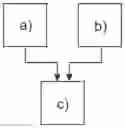
The present invention will become more fully understood from the detailed description given hereinbelow and the accompanying drawing which are given by way of illustration only, and thus, are not limitive of the present invention, and wherein the sole FIGURE shows a block diagram of the sequence of a further method of the invention for producing an assembly.
DETAILED DESCRIPTION
The FIGURE shows a block diagram of the sequence of a method of the invention for producing an assembly.
Manual assembly steps are carried out in a first method step a).
In a second method step b), an automated check takes place during the assembly steps in step a) whether assembly results meet defined quality requirements.
In a third method step c) immediate feedback is then provided if an assembly result does not meet the quality requirements.
An immediate correction occurs in a fourth method step d).
The assembly by way of example is a vehicle.
The invention being thus described, it will be obvious that the same may be varied in many ways. Such variations are not to be regarded as a departure from the spirit and scope of the invention, and all such modifications as would be obvious to one skilled in the art are to be included within the scope of the following claims.
Claims
What is claimed is:1. A method for producing an assembly, the method comprising:
performing manual assembly steps by a worker;
automated checking during the assembly steps whether assembly results meet defined quality requirements;
providing immediate feedback to the worker if an assembly result does not meet the quality requirements; and
performing an immediate correction by the worker.
2. An assembly produced by the method according to claim 1.
3. The assembly according to claim 2, wherein the assembly is a vehicle.
Images & Drawings included:

Sources:
- United States Patent and Trademark Office - verify current appl. status at the USPTO↗
Similar patent applications:
- » 20230109458
Cell assembly, method for producing cell assembly, solar cell, and method for producing solar cell - » 20220359340
COPPER/CERAMIC ASSEMBLY, INSULATED CIRCUIT BOARD, METHOD FOR PRODUCING COPPER/CERAMIC ASSEMBLY, AND METHOD FOR PRODUCING INSULATED CIRCUIT BOARD - » 20220230935
Copper/ceramic assembly, insulated circuit board, method for producing copper/ceramic assembly, and method for producing insulated circuit board - » 20210307179
Multi-core cable assembling method and multi-core cable assembly producing method - » 20240244941
MASK-SUPPORT ASSEMBLY, PRODUCING METHOD THEREOF, AND MASK-FRAME ASSEMBLY - » 20210086942
ASSEMBLY OF FLAT SHEETS, METHOD FOR PRODUCING THE ASSEMBLY, METHOD FOR MANUFACTURING A PACKAGING, AND METHOD FOR PACKAGING AN OBJECT - » 20060210464
Carbon nanohorn assembly producing method - » 20050094356
Circuit assembly, producing method of the same, distribution unit and bus bar substrate - » 20160229167
Vacuum ring for producing laminated assembly and method for producing laminated assembly using the same - » 20100248386
SEMICONDUCTOR PHOSPHOR NANOPARTICLE ASSEMBLY, PRODUCING METHOD THEREOF AND SINGLE MOLECULE OBSERVATION METHOD BY USE THEREOF
Recent applications in this class:
- » 20250165899 2025-05-22
DECISION MAKING SKILL DEVELOPMENT SYSTEMS, METHODS, AND COMPUTER READABLE MEDIUM - » 20250148400 2025-05-08
ADMINISTRATIVE MANAGEMENT OF USER ACTIVITY DATA USING GENERATIVE ARTIFICIAL INTELLIGENCE - » 20250139563 2025-05-01
OPERATOR FEEDBACK AND TRAINING FOR REFUSE VEHICLE - » 20250124392 2025-04-17
Travel Worker Mobile Application - » 20250117733 2025-04-10
COMPUTER-IMPLEMENTED METHODS AND SYSTEMS FOR PERSONALIZED AUTONOMOUS COACHING - » 20250103996 2025-03-27
INTELLIGENT SYSTEMS AND METHODS FOR EMPLOYEE PERFORMANCE EVALUATION - » 20250103995 2025-03-27
INFORMATION PROCESSING DEVICE, DETERMINATION METHOD, AND STORAGE MEDIUM - » 20250094911 2025-03-20
PHYSICAL DEMANDS CHARACTERIZATION SYSTEM AND METHODS - » 20250086562 2025-03-13
SYSTEM AND METHOD FOR DELIVERY METRIC ANALYSIS AND NOTIFICATION - » 20250086561 2025-03-13
APPARATUS AND METHOD OF ASSESSING INSTRUCTOR RATINGS ON A DEFINED RATING SCALE FOR SKEWNESS
Recent applications for this Assignee:
- » 20250154626 2025-05-15
Processing of Black Mass - » 20250149611 2025-05-08
ELECTRODE/SEPARATOR STACK FOR A BATTERY CELL, AND METHOD FOR MANUFACTURING SUCH AN ELECTRODE/SEPARATOR STACK - » 20250115296 2025-04-10
DRIVE UNIT FOR A WHEEL ACTUATOR OF A STEER-BY-WIRE SYSTEM FOR A VEHICLE, AND METHOD FOR DETERMINING THE POSITION OF THE CONTROL ROD OF A WHEEL ACTUATOR - » 20250112247 2025-04-03
NANOPOROUS POWDERS FOR FUEL CELL AND ELECTROLYZER APPLICATIONS - » 20250108815 2025-04-03
METHOD FOR INFLUENCING AN AGING PROCESS OF A COMPONENT OF AN EXHAUST AFTERTREATMENT SYSTEM FOR A VEHICLE, COMPUTER PROGRAM, CONTROL UNIT, DRIVING MACHINE, AND MOTOR VEHICLE - » 20250096401 2025-03-20
BATTERY CELL - » 20250096343 2025-03-20
BATTERY CELL - » 20250091411 2025-03-20
Elastocaloric Element for a Temperature Control System - » 20250062702 2025-02-20
Use of an inverter switching arrangement for operating a system with electric drive - » 20250055298 2025-02-13
METHOD AND APPARATUS FOR CHARGING OR DISCHARGING A BATTERY SYSTEM