Buffering Device for the Slide Rail of a Drawer
US20250176715A1
2025-06-05
18/913,773
2024-10-11
Smart Summary: A slide rail assembly helps drawers open and close smoothly. It has a fixed part with a channel and a hook plate that includes a groove for locking. A buffer frame can slide back and forth in this channel, and it has a toggle plate that can switch between two positions. When the toggle plate is free, a pin can move within the groove, but when it's locked, the pin stays in place. A movable slide rail interacts with the toggle plate to change its position, allowing for better control of the drawer's movement. 🚀 TL;DR
Abstract:
A slide rail assembly having a fixed slide rail with an open channel. A hook plate is mounted to the fixed slide rail. The hook plate has a locking groove. A base is attached to the fixed slide rail within the open channel. A buffer frame moves in the open channel between two positions. A toggle plate is mounted to the buffer frame. The toggle plate can rotate between a free and locked position. A locking pin extends from the toggle plate that engages the locking groove. The locking pin is free to move in the locking groove when the toggle plate is in its free position. The locking pin becomes locked in the locking groove when the toggle plate is in its locked position. A movable slide rail selectively moves within the open channel. The movable slide rail engages the toggle plate and moves the toggle plate between positions.
Inventors:
- Yiwei Huang 1 🇨🇳 Jieyang City, China
- Mingtao Hu 1 🇨🇳 Jieyang City, China
- Shaozhong Xu 1 🇨🇳 Jieyang City, China
- Jinming Lin 1 🇨🇳 Jieyang City, China
- Teng Long 1 🇨🇳 Jieyang City, China
Assignee:
- Comtrad Strategic Sourcing INC. 1 🇨🇦 Mississauga, Canada
Applicant:
Interested in similar patents?
Get notified when new applications in this technology area are published.
Classification:
A47B88/477 » CPC main
Drawers for tables, cabinets or like furniture; Guides for drawers; Sliding drawers; Slides or guides therefor; Braking devices, e.g. linear or rotational dampers or friction brakes; Buffers; End stops Buffers; End stops
Description
RELATED APPLICATIONS
This application claims the priority of China Utility Model application No. 202323300218.2, filed Dec. 4, 2023.
BACKGROUND OF THE INVENTION
1. Field of the Invention
The present invention relates to slide rail devices used in the opening and closing of drawers. More particularly, the present invention relates to buffering devices for a slide rail that slow the closing rate of an open drawer.
2. Prior Art Description
Many modern drawers use slide hardware to assist the drawer in opening and closing smoothly. At present, a conventional slide rail comprises an upper rail, a middle rail and a lower rail which are sequentially installed. The upper rail is installed on the drawer. The lower rail is installed on the cabinet body. The upper rail, the middle rail, and the lower rail are slidably connected to one another to enable the drawer to slide open or closed on the cabinet body. During use, a drawer may collide with the cabinet body, producing loud noise, affecting the use of the drawer, and even damaging the drawer and the cabinet body. For this reason, buffer dampers are often mounted on slide rails. However, in actual applications, slide rails that are provided with buffer dampers have other shortcomings. For example, it is difficult to ensure the reliable closing and locking of a drawer having a buffer damper. Often, the forces used to slow the drawer when closing act to prevent the drawer from fully closing or cause the drawer to open the drawer slightly after it is closed. The result is that many drawers with buffer dampers are constantly ajar. If the drawer is a safety drawer that is self-locking, the slide rail system may prevent the drawer from locking, which can present a safety hazard.
A need therefore exists for an improved slide rail assembly that can help a drawer close softly, yet does not prevent the drawer from closing fully. This need is met by the present invention as described and claimed below.
SUMMARY OF THE INVENTION
The present invention is a slide rail assembly for a drawer. The slide rail assembly has a fixed slide rail that extends a length between a first end and a second end. The fixed slide rail has a rear wall and side walls that define an open channel that extends along its length.
A hook plate is mounted to the fixed slide rail within the open channel. The hook plate has a locking groove formed within its structure.
A base is attached to the fixed slide rail within the open channel at the first end of the open channel. A buffer frame is positioned in the open channel next to the base. The buffer frame is disposed in the open channel between the base and the second end of the open channel. The buffer frame can move in the open channel between a first position and a second position. In the first position, the buffer frame is in abutment with the base. In the second position, the buffer frame is positioned over the hook plate.
A toggle plate is mounted at a pivot connection to the buffer frame. This enables the toggle plate to rotate about the pivot connection between a free position and a locked position. A locking pin extends from the toggle plate. The locking pin engages a locking groove on the hook plate when the buffer plate moves into its second position from its first position. The locking pin is free to move in the locking groove when the toggle plate is in its free position. Conversely, the locking pin becomes locked in the locking groove when the toggle plate is in its locked position.
A movable slide rail selectively moves within the open channel of the fixed slide rail. The movable slide rail engages the toggle plate and moves the toggle plate between its free position and its locked position as the movable slide rail moves. The toggle plate is moved to its free position as the movable slide rail moves toward the first end of the fixed slide rail. The toggle plate is moved to its locked position as the movable slide rail moves away from the first end of the fixed slide rail. Movement of the movable slide rail toward the first end of the fixed slide rail is assisted by retraction elements and is buffered by a damping element.
BRIEF DESCRIPTION OF THE DRAWINGS
For a better understanding of the present invention, reference is made to the following description of exemplary embodiments thereof, considered in conjunction with the accompanying drawings, in which:
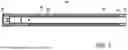
FIG. 1 shows a side view of an exemplary embodiment of a full slide rail assembly with the movable slide rail closed;
FIG. 2 shows a side view of an exemplary embodiment of a full slide rail assembly with the movable slide rail removed;
FIG. 3 is an enlarged view of the buffering device used in the slide rail assembly in a closed configuration;
FIG. 4 is an enlarged view of the buffering device used in the slide rail assembly in an open configuration;
FIG. 5 is an enlarged view of the toggle plate and locking pin used in the exemplary embodiment;
FIG. 6 shows a fragmented view of the first end of the slide rail assembly in a closed configuration; and
FIG. 7 shows a fragmented view of the first end of the slide rail assembly moving from an open configuration to a closed configuration.
DETAILED DESCRIPTION OF THE INVENTION
Although the present invention slide rail system and methodology can be embodied in many ways, only one exemplary embodiment is illustrated and described. The exemplary embodiment is being shown for the purposes of explanation and description. The exemplary embodiment is selected in order to set forth one of the best modes contemplated for the invention. The illustrated embodiment, however, is merely exemplary and should not be considered as a limitation when interpreting the scope of the appended claims.
Referring to FIG. 1 in conjunction with FIG. 2, a slide rail assembly 10 is shown. The slide rail assembly 10 is most commonly used to connect a sliding drawer to a cabinet or similar construction. The slide rail assembly 10 contains a fixed slide rail 12 that mounts to the structure of the cabinet and a movable slide rail 14 that mounts to the side of a drawer. The fixed slide rail 12 has a first end 16 that faces into the cabinet structure and a second end 18 that faces the front of a drawer. The fixed slide rail 12 has a rear wall 20 and two parallel side walls 22, 24 that define an open channel 26 that runs the length of the fixed slide rail 12.
The movable slide rail 14 is positioned within the open channel 26 of the fixed slide rail 12. The movable slide rail 14 is an assembly that includes a middle rail 28 and an inner rail 30. The middle rail 28 and the inner rail 30 are nested and are slidable relative to each other. The middle rail 28 and the inner rail 30 can move selectively beyond the second end 18 of the fixed slide rail 12, therein allowing a drawer to open and close.
Referring to FIG. 2 and FIG. 3 in conjunction with FIG. 1, it can be seen that a buffering device 32 is attached to the fixed slide rail 12. The buffering device 32 buffers certain movements between the fixed slide rail 12 and the movable slide rail 14. The buffering device 32 includes a base holder 34 that extends into the open channel 26 of the fixed slide rail 12 at the first end 16 of the fixed slide rail 12. A buffer frame 36 is initially positioned next to the base holder 34 and is supported within the confines of the open channel 26 of the fixed slide rail 12. The buffer frame 36 can move in the open channel 26 between a first position and a second position. In the first position, the buffer frame 36 is in abutment with the base holder 34. In the second position, the buffer frame 36 extends out over a hook plate 50 for a purpose that is later described. Furthermore, the buffer frame 36 supports a toggle plate 38 with a locking pin 39 for a purpose that is later described. The buffer frame 36 is connected to the fixed slide rail 12 but is free to reciprocally move within the open channel 26 within a given range of movement.
Referring to FIG. 3 and FIG. 4 in conjunction with FIG. 2, it can be seen that the movement of the buffer frame 36 is partially controlled by a damping element 40 and retraction elements 42. The damping element 40 preferably is a hydraulic cylinder 44 that biases the buffer frame 36 away from the base holder 34. The hydraulic cylinder 44 has a cylinder body 46 that is affixed to the base holder 34 and a piston rod 48 that is affixed to the buffer frame 36. The hydraulic pressure within the cylinder body 46 biases the piston rod 48 out of the cylinder body 46.
The retraction elements 42 counter the bias of the hydraulic cylinder 44. As such, the retraction elements 42 bias the buffer frame 36 toward the base holder 34. The retraction elements 42 can be bands of elastic material, but are preferably metal springs.
The hook plate 50 is attached to the rear wall 20 of the fixed slide rail 12 within the open channel 26. The hook plate 50 has a locking groove 52 formed into its structure. The end of the locking groove 52 is positioned at a distance D1 from the locking pin 39 of the toggle plate 38. The distance D1 between the locking groove 52 and the locking pin 39 is equal to the range of movement allotted to the buffer frame 36 relative the base holder 34. The distance D1 is also equal to the extension range of the piston rod 48 on the hydraulic cylinder 44.
Referring to FIG. 5 in conjunction with FIG. 3 and FIG. 4, it can be seen that the locking pin 39 extends from the toggle plate 38 at a perpendicular. The toggle plate 38 is connected to the buffer frame 36 at a pivot joint 54. The locking pin 39 extends through a guide slot 56 in the buffer frame 36. The toggle plate 38 can rotate about the pivot joint 54 while being limited by the movement of the locking pin 39 in the guide slot 56. As such, it will be understood that the toggle plate 38 can rotate about the pivot joint 54 between a free position and a locked position. In the free position, the locking pin 39 is free to move. In the locked position, the locking pin 39 is locked in place.
Referring to FIG. 6 in conjunction with FIG. 3, the slide rail assembly 10 is shown in a closed condition as it would be in if the drawer were closed in a cabinet. In this closed condition, the buffer frame 36 is pressed against the base holder 34. It can be seen that when a drawer is pulled open, the movable slide rail 14 moves forward in the open channel 26 of the fixed slide rail 12. This movement pulls the buffer frame 36 forward. As the buffer frame 36 moves forward, the hydraulic cylinder 44 expands. Furthermore, the locking pin 39 engages the locking groove 52 on the hook plate 50 and locks into position at the end of the locking groove 52. This locks the buffer frame 36 into a fixed position at a distance D1 from its initial position. As the locking pin 39 enters the locking groove 52, the toggle plate 38 rotates about the pivot joint 54. At the end of the locking groove 52, the orientation of the toggle plate 38 and the shape of the locking groove 52 locks the locking pin 39 in place and prevents the locking pin 39 from traveling backward in the locking groove 52.
Referring to FIG. 7 and FIG. 3, the slide rail assembly 10 is shown while a drawer is closing. When closing, the movable slide rail 14 contacts the locking pin 39 on the toggle plate 38. This rotates the toggle plate 38, therein moving the locking pin 39 out of its locked position. The locking pin 39 is then free to retreat along the locking groove 52. This enables the retraction elements 42 to move the buffer frame 36 backward with the movement of the movable slide rail 14. As the retraction elements 42 pull the buffer frame 36 back toward the base holder 34, the hydraulic cylinder 44 is compressed. The hydraulic cylinder 44 resists the compression and contracts at a slow rate. This slow rate of contraction is transferred to the movable slide rail 14 and the drawer attached thereto. Thus, the drawer closes at a slow controlled rate as it nears its fully closed position.
It will be understood that the embodiment of the present invention that is illustrated and described is merely exemplary and that a person skilled in the art can make many variations to that embodiment. All such embodiments are intended to be included within the scope of the present invention as defined by the claims.
Claims
What is claimed is:1. A slide rail assembly, comprising:
a fixed slide rail having a length between a first end and a second end, wherein said fixed slide rail has a rear wall and side walls that define an open channel that extends said length;
a hook plate mounted to said rear wall of said fixed slide rail within said open channel, wherein said hook plate has a locking groove formed therein;
a base affixed to said fixed slide rail within said open channel at said first end;
a buffer frame disposed in said open channel between said base and said second end, wherein said buffer frame can move in said open channel between a first position in abutment with said base and a second position over said hook plate;
a toggle plate mounted at a pivot connection to said buffer frame, wherein said toggle plate can rotate about said pivot connection between a free position and a locked position;
a locking pin that extends from said toggle plate, wherein said locking pin engages said locking groove on said hook plate when said buffer frame moves into said second position from said first position, and wherein said locking pin is free to move in said locking groove when said toggle plate is in said free position and becomes locked in said locking groove when said toggle plate is in said locked position;
a movable slide rail that selectively moves within said open channel of said fixed slide rail, wherein said movable slide rail engages said toggle plate and moves said toggle plate between said free position and said locked position as said movable slide rail moves toward said first end of said fixed slide rail and away from said first end of said fixed slide rail, respectively.
2. The slide rail assembly of claim 1, further including a damping element that slows movement of said buffer frame toward said base in said open channel.
3. The slide rail assembly of claim 2, wherein said damping element is a hydraulic cylinder that extends between said base and said buffer frame.
4. The slide rail assembly of claim 1 further including retraction elements that bias said buffer frame toward said base within said open channel.
5. The slide rail assembly of claim 1, wherein said retraction elements are springs.
6. A slide rail assembly, comprising:
a fixed slide rail having an open channel that extends along a length;
a hook plate mounted to said fixed slide rail within said open channel, wherein a locking groove is formed in said hook plate;
a base affixed to said fixed slide rail;
a buffer frame disposed in said open channel, wherein said buffer frame can move in said open channel;
a damping element connected between said base and said buffer frame that governs movement speed of said buffer frame relative to said base in said open channel;
a toggle plate mounted on said buffer frame, wherein said toggle plate can move between a free position and a locked position;
a locking pin that extends from said toggle plate, wherein said locking pin engages said locking groove on said hook plate, and wherein said locking pin is free to move in said locking groove when said toggle plate is in said free position and becomes locked in said locking groove when said toggle plate is in said locked position;
a movable slide rail that selectively moves within said open channel of said fixed slide rail, wherein said movable slide rail engages said toggle plate and moves said toggle plate between said free position and said locked position as said movable slide rail moves relative to said fixed slide rail.
7. The slide rail assembly of claim 6, wherein said damping element only slows movement of said buffer frame toward said base in said open channel.
8. The slide rail assembly of claim 6, wherein said damping element is a hydraulic cylinder that extends between said base and said buffer frame.
9. The slide rail assembly of claim 6 further including retraction elements that bias said buffer frame toward said base within said open channel.
10. The slide rail assembly of claim 9, wherein said retraction elements are springs.
Images & Drawings included:



Sources:
- United States Patent and Trademark Office - verify current appl. status at the USPTO↗
Recent applications in this class:
- » 20250176714 2025-06-05
SLIDE RAIL ASSEMBLY - » 20250176713 2025-06-05
Slide Rail Structure with Buffer Seat - » 20250127298 2025-04-24
DAMPING AND REBOUNDING SLIDING RAIL AND DRAWER ASSEMBLY HAVING SAME - » 20250120506 2025-04-17
SLIDE RAIL ASSEMBLY - » 20250017371 2025-01-16
LOCKING ARRANGEMENT FOR DRAWERS IN A CABINET, A CABINET COMPRISING SUCH ARRANGEMENT AND A DRAWER RAIL - » 20240156259 2024-05-16
SLIDE-STOP DEVICE - » 20240000228 2024-01-04
GUIDE RAIL MECHANISM FOR AN ARTICLE OF FURNITURE - » 20230413997 2023-12-28
Ball bearing slide - » 20230225507 2023-07-20
EXTENSION LIMITER, REINFORCED STOPPER AND SPACER FOR DRAWER GLIDES - » 20230157450 2023-05-25
Furniture damper