THREE-DIMENSIONAL MEMORY DEVICE HAVING CONTACT PLUGS AND FABRICATING METHOD THEREOF
US20250254875A1
2025-08-07
18/753,606
2024-06-25
Smart Summary: A new type of memory device is created using a stack of alternating layers of electrodes and insulating materials placed on a base. It features a contact plug that has a flat part at the same level as one of the electrode layers and a tall part that goes through the stack. Surrounding this tall part is a spacer that helps support it. Additionally, there are protective patterns located between the electrode layers around the spacer to enhance stability. This design aims to improve the performance and efficiency of memory storage. 🚀 TL;DR
Abstract:
A semiconductor device includes a stack including a plurality of electrode layers and a plurality of interlayer insulating layers that are alternately stacked on a substrate; a contact plug including a pad portion disposed in the same layer as one of the plurality of electrode layers and a pillar portion that extends to the pad portion by penetrating the stack; a spacer surrounding a side surface of the pillar portion; and hard mask patterns disposed between electrode layers around the spacer.
Applicant:
Interested in similar patents?
Get notified when new applications in this technology area are published.
Classification:
Description
CROSS-REFERENCE TO RELATED APPLICATION
The present application claims priority under 35 U.S.C. § 119 (a) to Korean Patent Application No. 10-2024-0017268 filed in the Korean Intellectual Property Office on Feb. 5, 2024, which is incorporated herein by reference in its entirety.
BACKGROUND
1. Technical Field
Various embodiments of the disclosed technology generally relate to semiconductor technology, and more particularly, to a three-dimensional memory device having contact plugs and a method of fabrication.
2. Related Art
A three-dimensional memory device has advantages in that, compared to a conventional device, a larger capacity may be realized within the same area by increasing the number of stacks and vertically stacking memory cells, thereby providing high performance and excellent power efficiency.
In a three-dimensional memory device, electrode layers connected to memory cells are disposed at different heights. In order to independently apply electrical signals to electrode layers disposed at different heights, contact plugs are connected to the respective electrode layers. To this end, methods of forming contact plugs extending to electrode layers by penetrating a stack have been studied.
SUMMARY
In an embodiment, a three-dimensional memory device may include: a stack including a plurality of electrode layers and a plurality of interlayer insulating layers, which are alternately stacked on a substrate; a contact plug including a pad portion disposed in the same layer as one of the plurality of electrode layers, and a pillar portion that penetrates the stack and extends to the pad portion; a spacer surrounding a side surface of the pillar portion; and hard mask patterns, disposed between electrode layers, that surround an outer surface of the spacer.
In an embodiment, a method for fabricating a three-dimensional memory device may include: forming a pre-stack by alternately stacking a plurality of sacrificial layers and a plurality of interlayer insulating layers on a substrate; forming a vertical hole that penetrates the pre-stack and extends to one of the plurality of sacrificial layers; forming, by removing sacrificial layers around the vertical hole, a first horizontal groove connected to a side surface of the vertical hole and a second horizontal groove connected to a lower end portion of the vertical hole; forming a first hard mask pattern in the first horizontal groove and forming a second hard mask pattern in the second horizontal groove common to an interlayer insulating layer; forming a spacer on a side surface of the vertical hole; removing the second hard mask pattern in the interlayer insulting layer; forming a contact plug including a pad portion that replaces the second hard mask pattern removed from the interlayer insulating layer and a pillar portion that fills the vertical hole; and replacing the plurality of sacrificial layers with a plurality of electrode layers.
BRIEF DESCRIPTION OF THE DRAWINGS
FIG. 1 is a cross-sectional view of a three-dimensional memory device according to an embodiment of the disclosure.
FIG. 2 is a plan view illustrating a connection region of FIG. 1.
FIG. 3 is an enlarged view of a part A of FIG. 1.
FIG. 4 is a flow chart showing a method for fabricating a three-dimensional memory device according to an embodiment of the disclosure.
FIGS. 5 to 13 are cross-sectional views showing a method of fabricating a three-dimensional memory device according to an embodiment of the disclosure.
DETAILED DESCRIPTION
Hereinafter, embodiments of the present disclosure will be described in detail with reference to the accompanying drawings. In the following description, the same elements will be designated by the same reference numerals although they may be shown in different drawings. Further, in the following description of the present disclosure, a detailed description of known functions and configurations incorporated herein will be omitted when it may make the subject matter of the present disclosure rather unclear. It is to be understood that the terms “comprising,” “having,” “including” and so on, used in the description and claims, should not be interpreted as being restricted to the means listed thereafter unless specifically stated otherwise. Where an indefinite or definite article is used when referring to a singular noun, e.g., “a,” “an” and “the,” the singular noun may include a plural of that noun unless specifically stated otherwise.
Also, in describing the components of the disclosure, there may be terms used like first, second, A, B, (a), and (b). These are solely for the purpose of differentiating one component from another component but do not limit the substances, order, sequence or number of the components.
In descriptions for the positional relationships of components, where it is described that at least two components are “connected,” “coupled” or “linked,” it is to be understood that the at least two components may be directly “connected,” “coupled” or “linked” but components may also be indirectly “connected,” “coupled” or “linked” with another component interposed between the two components. Here, another component may be included in at least one of the at least two components which are “connected,” “coupled” or “linked” with each other.
In descriptions of relationships of components, an operating method or a fabricating method with respect to the flow of time, “pre” and “post” relationships in terms of time or “pre” and “post” relationships in terms of flow are described, such as for example using terms “after,” “following,” “next” or “before”. Non-continuous cases may be included unless “immediately” or “directly” is used.
Where a numerical value for a component or its corresponding information is used, even though there is no separate explicit description, the numerical value or its corresponding information can be interpreted as including an error range related to by various factors (for example, a process variable, an internal or external shock, noise, etc.).
Hereinafter, various embodiments of the disclosed technology will be described in detail with reference to the accompanying drawings.
Various embodiments of the disclosed technology are directed to a three-dimensional memory device with contact plugs that penetrate a stack to extend to electrode layers.
According to the embodiments of the disclosed technology, it is possible to provide a three-dimensional memory device that has contact plugs that penetrate a stack and extending to electrode layers by penetrating a stack.
FIG. 1 is a cross-sectional view of a three-dimensional memory device according to an embodiment of the disclosure, and FIG. 2 is a plan view illustrating a connection region of FIG. 1.
Referring to FIG. 1, a stack ST may be disposed in a connection region CNR and a cell array region CAR of a substrate 10.
The stack ST may include a plurality of electrode layers 20 and a plurality of interlayer insulating layers 30, which are alternately stacked. The electrode layers 20 may include a conductive material. For example, the electrode layers 20 may include at least one selected from among doped semiconductor (e.g., doped silicon), metal (e.g., tungsten, copper or aluminum), conductive metal nitride (e.g., titanium nitride or tantalum nitride) and transition metal (e.g., titanium or tantalum). The interlayer insulating layers 30 may include oxide, for example, silicon oxide.
The electrode layers 20 may configure row lines. The row lines may include at least one source select line, at least one drain select line, and a plurality of word lines. Among the electrode layers 20, at least one electrode layer 20 from a lowermost electrode layer 20 may configure a source select line, and at least one electrode layer 20 from an uppermost electrode layer 20 may configure a drain select line. Electrode layers 20 between the source select line and the drain select line may configure word lines.
Contact plugs 40 may vertically penetrate through the stack ST in the connection region CNR. Each contact plug 40 may extend to one of the plurality of electrode layers 20 by vertically penetrating the stack ST from the upper surface of the stack ST, and may be electrically connected to the one electrode layer 20.
Each contact plug 40 may include a pad portion 41 and a pillar portion 42. The pad portion 41 may be disposed in the same layer as one of the plurality of electrode layers 20, and may be electrically connected to the one electrode layer 20. A side surface of the pad portion 41 may contact a side surface of the one electrode layer 20.
The pillar portion 42 may extend to the pad portion 41 by vertically penetrating the stack ST to the pad portion 41. The pad portion 41 and the pillar portion 42 may be simultaneously formed. The pad portion 41 and the pillar portion 42 may be provided as an integrated element or structure.
For the sake of simplicity in illustration, FIG. 1 illustrates only two contact plugs 40 connected to two electrode layers 20. However, a plurality of contact plugs 40 may be provided in correspondence to the plurality of electrode layers 20, respectively, and each contact plug 40 may be electrically connected to a corresponding electrode layer 20.
A spacer 50 may be disposed on the side surface of the pillar portion 42. As illustrated in FIG. 2, the spacer 50 may surround the side surface of the pillar portion 42. For example, the pillar portion 42 may have a pillar shape, and the spacer 50 may have a cylindrical or tubular structure that surrounds outer surfaces of the pillar portion 42. An inner surface of the spacer 50 may contact the outer surfaces of the pillar portion 42.
The spacer 50 may include oxide, for example, silicon oxide.
First hard mask patterns 61 may be disposed between the spacer 50 and electrode layers 20 around the spacer 50. The first hard mask patterns 61 may be disposed at the same layers as corresponding electrode layers 20, respectively.
As illustrated in FIG. 2, each of the first hard mask patterns 61 may be provided to surround an outer surface of the spacer 50. For example, the spacer 50 may have a cylindrical or tubular structure, and the first hard mask pattern 61 may have a cylindrical or tubular structure that surrounds the outer surface of the spacer 50. The inner surface of the first hard mask pattern 61 may contact an outer surface of the spacer 50.
The first hard mask patterns 61 may have a different etch selectivity from the spacer 50 and the interlayer insulating layers 30. For example, the spacer 50 and the interlayer insulating layers 30 may include oxide such as silicon oxide, and the first hard mask patterns 61 may include a material that has an etch selectivity different from oxide. For example, the first hard mask patterns 61 may include silicon oxynitride (SiON), which is thermally stable and is thus capable of withstanding high temperature without damage.
A plurality of cell plugs 70 may vertically pass through the stack ST in the cell array region CAR and extend into the substrate 10. Each cell plug 70 may include a memory pattern 71 and a channel structure 72.
Although not illustrated, the memory pattern 71 may include a tunnel insulating layer, a data storage layer and a first blocking insulating layer. The tunnel insulating layer may extend along the surface of the channel structure 72, and may include an insulating material capable of charge tunneling. The data storage layer may extend along the surface of the channel structure 72 with the tunnel insulating layer interposed therebetween. The data storage layer may include a material layer capable of storing data that may be changed, using Fowler-Nordheim tunneling. For example, the data storage layer may include a nitride layer capable of charge trapping, but examples are not limited thereto. The data storage layer may include a phase change material, nanodots, etc. The first blocking insulating layer may extend along the surface of the channel structure 72 with the tunnel insulating layer and the data storage layer interposed therebetween. The first blocking insulating layer may include an insulating material capable of blocking the movement of charges.
The channel structure 72 may include a cell channel layer 72A, a capping pattern 72B and a core insulating pattern 72C. The cell channel layer 72A is used as the channel of a memory cell string. The cell channel layer 72A is disposed on the memory pattern 71, and may be formed of a semiconductor material. For example, the cell channel layer 72A may include silicon. The capping pattern 72B and the core insulating pattern 72C may fill the central region of the channel structure 72. The core insulating pattern 72C may include oxide. The capping pattern 72B may be disposed on the core insulating pattern 72C, and may include a sidewall that is surrounded by the upper end portion of the cell channel layer 72A. The capping pattern 72B may include a doped semiconductor layer that includes at least one of an n-type impurity and a p-type impurity.
FIG. 3 is an enlarged view of a part A of FIG. 1.
Referring to FIG. 3, a horizontal dimension of a pad portion 41 of a contact plug 40 may be different from a horizontal dimension of a first hard mask pattern 61. As illustrated in FIG. 3, the horizontal dimension of the pad portion 41 is D1, the horizontal dimension of the first hard mask pattern 61 is D2, and D1 may be smaller than D2. The pad portion 41 may have a horizontal dimension smaller than the first hard mask pattern 61.
The horizontal dimension of the pad portion 41 of the contact plug 40 may be different from a horizontal dimension of a pillar portion 42 of the contact plug 40. As illustrated in FIG. 3, the horizontal dimension of the pad portion 41 is D1, the horizontal dimension of the pillar portion 42 is D3, and D1 may be larger than D3. The pad portion 41 may have a horizontal dimension larger than the pillar portion 42.
The pad portion 41 may include a recess R on an upper surface. The recess R may penetrate the upper surface of the pad portion 41. A spacer 50 may be disposed on a side surface of the recess R, and the pillar portion 42 may be disposed in a central region of the recess R. Within the recess R, the pillar portion 42 may be surrounded by the spacer 50. Although FIG. 3 illustrates a pad portion 41 provided with a recess R on an upper surface, the disclosed technology is not limited thereto, and in other embodiments the recess R may be omitted.
FIG. 4 is a flow chart showing a method for fabricating a three-dimensional memory device according to an embodiment of the disclosure, and FIGS. 5 to 13 are cross-sectional views showing a method of fabricating a three-dimensional memory device according to an embodiment of the disclosure.
Referring to FIGS. 4 and 5, a step of forming a pre-stack PST may be performed (S401). Although FIGS. 5 to 13 only show that the pre-stack PST is formed in the connection region CNR. Although not shown, the pre-stack PST is formed in the cell region as well as the connection region CNR.
The pre-stack PST may be formed by alternately stacking a plurality of sacrificial layers 22 and a plurality of interlayer insulating layers 30 on a substrate 10. The sacrificial layers 22 and the interlayer insulating layers 30 may have different etch selectivities. The interlayer insulating layers 30 may include oxide, such as for example silicon oxide, and the sacrificial layers 22 may include a material that has an etch selectivity different from oxide, such as for example nitride in silicon nitride.
Referring to FIGS. 4 and 6, a step of forming vertical holes VH may be performed (S402).
Each vertical hole VH may extend into one of the plurality of sacrificial layers 22 by penetrating the pre-stack PST from an upper surface of the pre-stack PST. For the sake of simplicity in illustration, only two vertical holes VH are illustrated in FIG. 6, but a plurality of vertical holes VH may be formed that correspond respectively to some of the plurality of the sacrificial layers 22.
Referring to FIGS. 4 and 7, a step of forming first and second horizontal grooves HH1 and HH2 may be performed (S403).
The first horizontal grooves HH1 and the second horizontal groove HH2 may be formed by selectively removing portions of sacrificial layers 22 that are exposed by the vertical hole VH. The first horizontal grooves HH1 may be connected to side surfaces of the vertical hole VH. The second horizontal groove HH2 may be connected to a lower end portion of the vertical hole VH.
The first and second horizontal grooves HH1 and HH2 may be formed using an isotropic etching process with an etchant capable of selectively removing the sacrificial layers 22.
The first horizontal grooves HH1 may extend in the horizontal direction from side surfaces of the vertical hole VH. The second horizontal groove HH2 may extend in the horizontal direction from a center portion of the lowermost sacrificial layer 22 common to vertical hole VH. Accordingly, the first horizontal groove HH1 and the second horizontal groove HH2 may have different dimensions. The second horizontal groove HH2 may have a cross-sectional dimension that is smaller than the first horizontal groove HH1.
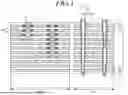
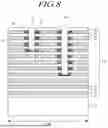
Referring to FIGS. 4 and 8, a step of forming first and second hard mask patterns 61 and 62 may be performed (S404).
A hard mask layer may be formed to fill the first and second horizontal grooves HH1 and HH2. The hard mask layer may have an etch selectivity different from the sacrificial layers 22 and the interlayer insulating layers 30. For example, the interlayer insulating layers 30 may include oxide (e.g., silicon oxide), the sacrificial layers 22 may include nitride (e.g., silicon nitride), and the hard mask layer may include a material that has an etch selectivity different from oxide and nitride. For example, the hard mask layer may include silicon oxynitride (SiON).
By removing the hard mask layer formed outside of the first and second horizontal grooves HH1 and HH2, the first hard mask patterns 61 may be formed in the first horizontal grooves HH1, and the second hard mask pattern 62 may be formed in the second horizontal groove HH2, while the vertical holes VH from FIG. 6 are substantially re-established.
While the first horizontal groove HH1 is completely filled with the hard mask layer, the central region of the second horizontal groove HH2 may be left partially unfilled, so that a recess R may be formed on an upper surface of the second hard mask pattern 62. Although FIG. 8 illustrates a recess R formed on the upper surface of the second hard mask pattern 62, the disclosed technology is not limited thereto, and in other embodiments the recess R may not be formed.
Referring to FIGS. 4, 9 and 10, a step of forming spacers 50 may be performed (S405).
An insulating layer 50A may be formed in the vertical holes VH. As illustrated in FIG. 9, the insulating layer 50A may be formed to completely fill a vertical hole VH. However, in other embodiments, the insulating layer 50A may be formed to cover the side surfaces of the vertical hole VH and only partially fill the central region of the vertical hole VH.
The insulating layer 50A may have an etch selectivity different from the sacrificial layers 22 and the second hard mask pattern 62. For example, the sacrificial layers 22 may include nitride (e.g., silicon nitride), the second hard mask pattern 62 may include silicon oxynitride (SiON), and the insulating layer 50A may include an insulating material that has an etch selectivity different from nitride and silicon oxynitride (SiON). For example, the insulating layer 50A may include oxide (e.g., silicon oxide).
As illustrated in FIG. 10, through an etching process using the second hard mask pattern 62 as an etch stopper, the insulating layer 50A in the central region of the vertical hole VH may be removed, leaving an insulating layer 50A on the side surfaces of the vertical hole VH. In this manner, a cylindrical or tubular shaped spacer 50 may be formed that extends into the second hard mask pattern 62.
Due to the difference in etch selectivity between the insulating layer 50A and the second hard mask pattern 62, etching during an etching process for removing the insulating layer 50A in the central region of the vertical hole VH may be stopped at the second hard mask pattern 62, by which it is possible to prevent the sacrificial layers 22 and the interlayer insulating layers 30 under the second hard mask pattern 62 from being etched. In other words, over-etching may be prevented.
Referring to FIGS. 4 and 11, a step of removing the second hard mask pattern 62 may be performed (S406).
The second hard mask pattern 62 may be removed using an etchant capable of selectively removing the second hard mask pattern 62.
Referring to FIGS. 4 and 12, a step of forming contact plugs 40 may be performed (S407).
A contact plug 40 may be formed of a conductive material that fills the second horizontal groove HH2 and the central region of the vertical hole VH exposed due to removal of the second hard mask pattern 62. The contact plug 40 may include a pad portion 41 that fills the second horizontal groove HH2 and a pillar portion 42 that fills the central region of the vertical hole VH.
The pad portion 41 and the pillar portion 42 may be formed by growing or depositing, at the same or substantially the same time, a conductive material in the central region of the vertical hole VH and the second horizontal groove HH2. Accordingly, the pad portion 41 and the pillar portion 42 may be integrally formed.
Referring to FIGS. 4 and 13, a step of replacing the sacrificial layers 22 with electrode layers 20 is performed (S408).
By selectively removing the sacrificial layers 22 and filling empty regions created due to removal of the sacrificial layers 22 with an electrode material, the electrode layers 20 are formed.
Although exemplary embodiments of the present disclosure have been described for illustrative purposes, those skilled in the art will appreciate that various modifications, additions and substitutions are possible, without departing from the scope and spirit of the present disclosure. Therefore, the embodiments disclosed above and in the accompanying drawings should be considered in a descriptive sense only and not for limiting the technological scope. The technological scope of the present disclosure is not limited by the embodiments and the accompanying drawings.
Claims
What is claimed is:1. A three-dimensional memory device comprising:
a stack including a plurality of electrode layers and a plurality of interlayer insulating layers, which are alternately stacked on a substrate;
a contact plug including a pad portion disposed in the same layer as one of the plurality of electrode layers, and a pillar portion that penetrates the stack and extends to the pad portion;
a spacer surrounding a side surface of the pillar portion; and
hard mask patterns disposed between electrode layers and the spacer.
2. The three-dimensional memory device according to claim 1, wherein the hard mask patterns have an etch selectivity different from an etch selectivity of the spacer.
3. The three-dimensional memory device according to claim 1, wherein the spacer includes oxide, and the hard mask patterns include silicon oxynitride.
4. The three-dimensional memory device according to claim 1, wherein the hard mask patterns have an etch selectivity different from an etch selectivity of the plurality of interlayer insulating layers.
5. The three-dimensional memory device according to claim 1, wherein the plurality of interlayer insulating layers include oxide, and the hard mask patterns include silicon oxynitride.
6. The three-dimensional memory device according to claim 1, wherein the pad portion has a horizontal dimension larger than a horizontal dimension of the pillar portion in a cross-section.
7. The three-dimensional memory device according to claim 1, wherein the pad portion has a horizontal dimension smaller than a horizontal dimension of the hard mask patterns in a cross-section.
8. The three-dimensional memory device according to claim 1, wherein the pad portion and the pillar portion are integrated.
9. The three-dimensional memory device according to claim 1, wherein
the spacer surrounds an outer surface of the pillar portion,
the hard mask patterns surround portions of an outer surface of the spacer, and
the hard mask patterns are disposed at the same layers as corresponding electrode layers.
10. The three-dimensional memory device according to claim 1, wherein
the pad portion includes a recess on an upper surface,
the spacer is disposed on a side surface of the recess, and
the pillar portion is disposed in a central region of the recess that is surrounded by the spacer.
11. A method for fabricating a three-dimensional memory device, comprising:
forming a pre-stack by alternately stacking a plurality of sacrificial layers and a plurality of interlayer insulating layers on a substrate;
forming a vertical hole that penetrates the pre-stack and extends to one of the plurality of sacrificial layers;
forming, by removing sacrificial layers around the vertical hole, a first horizontal groove connected to a side surface of the vertical hole and a second horizontal groove connected to a lower end portion of the vertical hole;
forming a first hard mask pattern in the first horizontal groove and forming a second hard mask pattern in the second horizontal groove common to an interlayer insulating layer;
forming a spacer on a side surface of the vertical hole;
removing the second hard mask pattern in the interlayer insulating layer;
forming a contact plug including a pad portion that replaces the second hard mask pattern removed from the interlayer insulating layer and a pillar portion that fills the vertical hole; and
replacing the plurality of sacrificial layers with a plurality of electrode layers.
12. The method according to claim 11, wherein the forming of the spacer comprises:
forming an insulating layer in the vertical hole; and
etching the insulating layer in a central region of the vertical hole using the second hard mask pattern as an etch stopper.
13. The method according to claim 11, wherein the second hard mask pattern has an etch selectivity different from an etch selectivity of the spacer.
14. The method according to claim 11, wherein the spacer includes oxide, and the second hard mask pattern includes silicon oxynitride.
15. The method according to claim 11, wherein the first and second hard mask patterns have an etch selectivity different from an etch selectivity of the plurality of interlayer insulating layers and the plurality of sacrificial layers.
16. The method according to claim 11, wherein the plurality of interlayer insulating layers include oxide, the plurality of sacrificial layers include nitride, and the hard mask patterns include silicon oxynitride.
17. The method according to claim 11, wherein the first and second horizontal grooves are formed by isotropically etching the sacrificial layers exposed by the vertical hole.
18. The method according to claim 11, wherein the second horizontal groove has a dimension smaller than a dimension of the first horizontal groove in a cross-section.
19. The method according to claim 11, wherein the second horizontal groove has a dimension larger than a dimension of the vertical hole in a cross-section.
20. The method according to claim 11, wherein the forming of the first and second hard mask patterns comprises:
forming a hard mask material to fill the first and second horizontal grooves; and
removing the hard mask material formed outside of the first and second horizontal grooves.
Images & Drawings included:





Sources:
- United States Patent and Trademark Office - verify current appl. status at the USPTO↗
Recent applications in this class:
- » 20250254879 2025-08-07
MEMORY BLOCK, MEMORY DEVICE, AND MEMORY CELL - » 20250254878 2025-08-07
VERTICAL MEMORY DEVICE WITH MULTIPLE SUPPORT LAYERS - » 20250254877 2025-08-07
THREE-DIMENSIONAL MEMORY DEVICES AND METHODS FOR FORMING THE SAME - » 20250254876 2025-08-07
SEMICONDUCTOR DEVICE AND ELECTRONIC SYSTEM INCLUDING THE SAME - » 20250254874 2025-08-07
SEMICONDUCTOR DEVICE AND MANUFACTURING METHOD OF SEMICONDUCTOR DEVICE - » 20250254873 2025-08-07
STAIRCASE STRUCTURES AND METHODS FOR FORMING THE SAME - » 20250254872 2025-08-07
MEMORY DEVICE INCLUDING A GERMANIUM-CONTAINING SOURCE STRUCTURE AND METHODS FOR FORMING THE SAME - » 20250248038 2025-07-31
SEMICONDUCTOR MEMORY DEVICE AND ELECTRONIC SYSTEM INCLUDING THE SAME - » 20250248037 2025-07-31
MEMORY DEVICE AND METHOD OF MANUFACTURING THE SAME - » 20250248036 2025-07-31
THREE-DIMENSIONAL MEMORY DEVICES AND METHODS FOR FORMING THE SAME