SILICONE COATING COMPOSITION WITH MICA
US20260109879A1
2026-04-23
19/148,060
2024-01-11
Smart Summary: A new coating is made using mica and a special type of silicone. This coating can stick well to different surfaces and resist cracking, even when exposed to high temperatures for a long time. It combines mica with either a silicone copolymer or a mixture of silicone resin and mica. The coating is designed to protect materials from heat damage. Overall, it helps keep surfaces safe and intact under tough conditions. 🚀 TL;DR
Abstract:
The present invention is a composition comprising a) a mica and a TPh-poly(phenylmethylsiloxane) copolymer; and/or b) a mixture of mica, a TPh resin, and a poly(phenylmethylsiloxane). The composition is useful as a coating for a substrate, which coating exhibits adhesion and crack-resistance when subjected to high temperatures for hundreds of hours.
Applicant:
Interested in similar patents?
Get notified when new applications in this technology area are published.
Classification:
C09D183/06 » CPC main
Coating compositions based on macromolecular compounds obtained by reactions forming in the main chain of the macromolecule a linkage containing silicon, with or without sulfur, nitrogen, oxygen, or carbon only; Coating compositions based on derivatives of such polymers; Polysiloxanes containing silicon bound to oxygen-containing groups
C08G77/18 » CPC further
Macromolecular compounds obtained by reactions forming a linkage containing silicon with or without sulfur, nitrogen, oxygen or carbon in the main chain of the macromolecule; Polysiloxanes containing silicon bound to oxygen-containing groups to alkoxy or aryloxy groups
C09D7/61 » CPC further
Features of coating compositions, not provided for in group ; Processes for incorporating ingredients in coating compositions; Additives non-macromolecular inorganic
C08G77/80 » CPC further
Macromolecular compounds obtained by reactions forming a linkage containing silicon with or without sulfur, nitrogen, oxygen or carbon in the main chain of the macromolecule Siloxanes having aromatic substituents, e.g. phenyl side groups
C08K2003/343 » CPC further
Use of inorganic substances as compounding ingredients; Silicon-containing compounds Peroxyhydrates, peroxyacids or salts thereof
C08G77/00 IPC
Macromolecular compounds obtained by reactions forming a linkage containing silicon with or without sulfur, nitrogen, oxygen or carbon in the main chain of the macromolecule
C08K3/34 IPC
Use of inorganic substances as compounding ingredients Silicon-containing compounds
Description
BACKGROUND OF THE INVENTION
The present invention relates to a silicone coating composition, more particularly a composition that is resistant to cracking and dielectric degradation at high temperatures, and a method for preparing the composition. High temperature protective coatings and insulating materials to protect a variety of equipment and devices against extremely high temperatures. Heater elements for electric vehicles, exhaust systems for automotive engines, power plants, and top coatings for stoves, for example, all benefit from such protective coatings. In many applications, the coating layers must withstand temperatures exceeding 300° C. over several months without cracking or losing dielectric and insulating properties and must pass aggressive thermal shock tests over a broad temperature range.
High temperature resistance of silicones ostensibly makes them promising candidates as high temperature protective coatings and sealants; nevertheless, silicone rubbers are not resistant to cracking above 250° C. beyond 2 weeks. The combination of silicone and inorganic filler such as SiO2, TiO2, and Al2O3 provides a composition with long term high temperature resistance; however, coatings prepared from such compositions require aging at temperatures exceeding 500° C. to form ceramic-like coatings. At such extreme temperatures, the coatings are likely to crack and suffer thermal shock failure; moreover, electronic elements beneath the surface of the coating are vulnerable to damage. It would therefore be an advance in the field of high temperature protective coatings to develop a composition that provides a coating that is resistant to cracking, delamination, and thermal shock failure, while maintaining acceptable dielectric properties at temperatures exceeding 300° C. for an extended period.
SUMMARY OF THE INVENTION
The present invention addresses a need in the art by providing a composition comprising a) a mica and a TPh-poly(phenylmethylsiloxane) copolymer; and/or b) a mixture of a mica, a TPh resin, and a silanol-terminated or C1-C4-alkoxy-terminated poly(phenylmethylsiloxane); wherein the weight-to-weight ratio of the mica to the copolymer or the mica to the sum of the TPh resin and the silanol-terminated or C1-C4-alkoxy-terminated poly(phenylmethylsiloxane) is in the range of from 10:90 to 90:10. The composition of the present invention is useful as a coating for a substrate, wherein the coating exhibits good adhesion, and crack-resistance when subjected to high temperatures for hundreds of hours.
DETAILED DESCRIPTION OF THE INVENTION
The present invention is a composition comprising a) a mica and a TPh-poly(phenylmethylsiloxane) copolymer; and/or b) a mixture of a mica, a TPh resin, and a silanol-terminated or C1-C4-alkoxy terminated poly(phenylmethylsiloxane); wherein the weight-to-weight ratio of the mica to the copolymer or the mica to the sum of the TP resin and the silanol-terminated or C1-C4-alkoxy-terminated poly(phenylmethylsiloxane) is in the range of from 10:90 to 90:10.
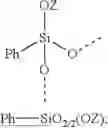
As used herein, the term “TPh-poly(phenylmethylsiloxane) copolymer” refers to a copolymer of a TPh resin and a poly(phenylmethylsiloxane). “TPh resin” refers to a kinetically stable three-dimensional polymer having repeat units of Ph-SiO3/2, Ph-SiO2/2(OZ), and optionally Ph-SiO1/2(OZ)2, where a unit of Ph-SiO3/2 is represented by the following structure:
where Z is H, C1-C4-alkyl, or C(O)CH3; and a unit of Ph-SiO1/2(OZ)2 is represented by the following structure:
Each Z in the TPh resin is preferably H. A commercially available TPh resin is DOWSIL™ RSN-0217 Flake Resin.
The TPh-poly(phenylmethylsiloxane) copolymer contains repeat units of phenylmethylsiloxane groups, as illustrated below:
Repeat Units of Phenylmethylsiloxane
where n (alternatively, the degree of polymerization) is preferably from 2 or from 5 or from 20 or from 40 or from 70 or from 100, to 300 or to 250 or to 200. The silanol-terminated or C1-C4-alkoxy-terminated poly(phenylmethylsiloxane) (PPhMS) in the blend is characterized as follows:
where X is H or C1-C4-alkyl; and n (alternatively, the degree of polymerization) is preferably from 2 or from 5 or from 20 or from 40 or from 70 or from 100, to 300 or to 250 or to 200.
For the copolymer, the weight-to-weight ratio of the TPh repeat units to the PPhMS repeat units is preferably in the range of from 20:80 or from 30:70 to 80:20 or to 70:30. Similarly, for the blend, the weight-to-weight ratio of TPh resin to the PPhMS is also preferably in the range of from 20:80 or from 30:70 to 80:20 or to 70:30.
The TPh-PPhMS copolymer may be prepared by first mixing in a suitable solvent and under reaction conditions a TPh resin, a silanol-terminated PPhMS and a crosslinking agent, wherein the crosslinking agent is preferably an acetoxylating or alkoxylating agent. Examples of suitable acetoxylating agents include alkyltriacetoxysilanes such as methyltriacetoxysilane and ethyltriacetoxysilane; suitable alkoxylating agents include phenyltrimethoxysilane, phenyltriethoxysilane, methyltrimethoxysilane, ethyltrimethoxysilane, methyltriethoxysilane, and ethyltriethoxysilane. A commercial example of an acetoxylating agent is XIAMETER™ OSF-1579 Silane (A Trademark of The Dow Chemical Company and its Affiliates), which is a 50:50 w/w blend of methyltriacetoxysilane and ethyltriacetoxysilane. Suitable solvents include aprotic solvents such as ethyl acetate, propyl acetate, propyl proprionate, butyl acetate, and propylene glycol methyl ether acetate (PGMEA).
The acetoxy or alkoxy terminated PPhMS formed from the reaction of the silanol- or alkoxy-terminated (R″MeSiO2/2)n polymer and a crosslinking agent is then advantageously contacted with the TPh resin and additional solvent at an advanced temperature to partially or completely convert the TPh resin to a TPh-PPhMS copolymer, and to completely consume or nearly completely consume the acetoxy or alkoxy terminated PPhMS. Volatiles can be removed from the mixture to form a blend of copolymer and free TPh resin that can be used without further purification.
Micas are hydrated aluminum silicate minerals including muscovite, biotite, fuchsite, phlogopite, margarite, glauconite, and lepidolite micas, of which muscovite mica and phlogopite mica are predominant. The w/w ratio of the mica to the TPh-PPhMS copolymer or the mica to the blend of TPh resin and the PPhMS is in the range of from 90:10 or from 80:20 or from 70:30, or from 65:35, to 10:90 or to 20:80 or to 30:70 or to 35:65. The composition may comprise the copolymer or the blend along and mica, or the copolymer and the blend and mica.
In another aspect of the present invention, the composition comprises a TPh-PPhMS copolymer and/or a blend of a TPh resin and a silanol-terminated or C1-C4-alkoxy terminated PPhMS; a mica; RSi(OR′)3, where R is C1-C12-alkyl or aryl, and R′ is C1-C4-alkyl, such as methyltrimethoxysilane, phenyltrimethoxysilane, methyltriethoxysilane, and ethyltrimethoxysilane; an aprotic solvent such as propylene glycol methyl ether acetate, ethyl acetate, propyl acetate, butyl acetate or propyl propionate; and a moisture cure catalyst, for example, a tin-based catalyst such as tin octanoate or tin butanoate, or a titanium-based catalyst such as tetraisopropyl titanate, tetra-n-butyl titanate, and tetra-t-butoxy titanate.
The amount of aprotic solvent is sufficient to achieve a viscosity in the range of from 20 cP or from 50 cP or from 100 cP, to 20,000 cP or to 10,000 cP or to 5,000 cP, or to 1200 cP; alternatively, the concentration of aprotic solvent is in the range of from 5 or from 10 or from 20 weight percent, to 90 or to 75 or to 60 weight percent, based on the weight of the composition.
In yet another aspect, the present invention is a process for preparing a cured coating on a substrate. The present invention is also an article comprising a substrate coated with the cured composition. The thickness of the coating is generally in the range of from 20 μm to 300 μm. The composition of the present invention provides a coating for a substrate such as a metal, a metal oxide, a ceramic, or a plastic substrate, that is tack-free in less than 30 minutes at ambient temperature, and thermally stable to cracking for hundreds or even thousands of hours.
EXAMPLES
In the following examples, pbw refer parts by weight.
Comparative Example 1—Preparation of a TPh-PPhMS Copolymer
Silanol-terminated PPhMS (65 pbw, n=170), XIAMETER™ OSF-1579 Silane (OSF-1579, 5 pbw), and butyl acetate (50 pbw) were added under nitrogen to a 500-mL, 3-necked, dried flask equipped with a Dean-Stark apparatus. The temperature was increased to 50° C. and the mixture was stirred for 30 min. DOWSIL™ RSN-0217 Flake Resin (217 flake, 35 pbw) and butyl acetate (60 pbw) were added to the reaction mixture, followed by heating to reflux for 1 h, during which time a mixture of acetic acid and H2O (˜1.5 pbw) was collected at the bottom of Dean-Stark trap. Then, a portion of the solvent (˜60 pbw) was gradually removed to yield a solids content about 68 wt %. The reaction solution was cooled and directly used in the coating composition without filtration or further purification.
Comparative Examples 2 and 3—Preparation of a Blends of TPh Resin and Silanol-Terminated PPhMS
A mixture of 217 flake (35 pbw), silanol-terminated PPhMS (65 pbw, n=8 or 140), methyltrimethoxysilane (5 pbw), tin (II) 2-ethylhexanoate (1 pbw), and butyl acetate (45 pbw) was added to a dry flask under N2 to form a blend with a solids content of 67%. The mixture was stirred for 30 min.
Examples 1 and 2—Preparation of Blend with Mica
MRX muscovite mica (median particle size 11.4 μm) was dried in vacuo at 120° C. for 10 h, then cooled to room temperature under N2. The dried mica (66.7 pbw or 100 pbw) was added to a vessel containing tin (II) 2-ethylhexanoate (1 pbw), silanol-terminated PPhMS (65 pbw), 217 flake (35 pbw), and butyl acetate (30 pbw).
Examples 3 and 4—Preparation of Copolymer with Mica
The examples were prepared by the following general procedure: C-4000 muscovite mica (K2Al4(Al2Si6O20)(OH)4 (median particle size 10.8 μm, obtained from IMERYS) or MRX muscovite mica (median particle size 11.4 μm) was dried in vacuo at 120° C. for 10 h, then cooled to room temperature under N2. The dried mica (100 pbw) was added to a vessel containing tin (II) 2-ethylhexanoate (1 pbw), the TPh-PPhMS copolymer (100 pbw), and butyl acetate (30 pbw). The contents of the vessel were mixed by mechanical stirring under N2. The mixture was then poured into a bottle and sealed for further use.
Preparation of Coatings
Aluminum panels (Type A from Gardco, 3″×6″) were washed with toluene and acetone and dried by air flow before use. A portion of the prepared formulation (2 g) was coated on the panel to form a film with a thickness in the range of from 50 μm to 100 μm films using a 4-mil drawdown bar. The coated films were dried at 70° C. for 30 min under air flow to remove solvents. The dry films were cured at room temperature or 200° C. for 10 min to 60 min, followed by thermally aging at 300° C.
Measurement of Cracking Time
The cured coatings were aged in an oven at 300° C. In the first 14 days (d), sample cracking was checked every other day for each sample, and then checked once per week. The cracking time was recorded when some cracks were observed to form in the coatings.
Thermal Cycle Test
Each formulation was coated as 100-μm thick film, followed by curing at room temperature or 150° C., then aged at 300° C. for 10 d. Then, the samples were subjected to 100 cycles of temperature cycling between −50° C. and 150° C. at a temperature ramping rate 20° C./min, 10 min per cycle, using a Tenney Thermal Chamber. A coated sample was deemed to pass the thermal cycle test if no cracks or delamination were observed after completion of the test.
Table 1 illustrates the results of cracking time for samples with and without mica. TCT refers to thermal cycle test. Mica/wt % refers to the wt % of mica based on the weight of the blend and the mica or the copolymer and the mica. PPhMS/n refers to the degree of polymerization of the PPhMS. MRX refers to MRX muscovite mica, and C-4000 refers to C-4000 muscovite mica.
| TABLE 1 |
| Crack time and Thermal Cycle Test Results for Coatings |
| Example | Resin | PPhMS/n | Type | Mica/wt % | Crack time | TCT |
| 1 | TPh | 8 | Blend | MRX/40% | 60 | d | Pass |
| 2 | TPh | 140 | Blend | MRX/50% | 88 | d | Pass |
| 3 | TPh | 170 | copolymer | MRX/50% | >100 | da | Pass |
| 4 | TPh | 170 | copolymer | C-4000/50% | >100 | da | Pass |
| C1 | TPh | 170 | copolymer | No mica | 11 | d | Pass |
| C2 | TPh | 8 | Blend | No mica | 3 | d | Fail |
| C3 | TPh | 140 | Blend | No Mica | 10 | d | Fail |
| atest was stopped at 100 days. |
The results show a dramatic difference in crack time and thermal cycle testing results for blends and copolymers that contained mica, versus mica free samples. Although the combination of the TPh-PPhMS copolymer gave robust crack time results, it has been surprisingly discovered that excellent crack times can also be achieved for samples prepared by merely blending the TPh resin, the silanol-terminated PPhMS, and the mica.
The combination of the TPh resin and mica alone was found to fail the cracking test within 2 d, while the combination of the PPhMS copolymer and mica alone delaminated readily from the substrate at 300° C. Moreover, of the fillers tested—silica, calcium carbonate, aluminum silicate, calcium silicate, alumina, ferric oxide, and mica—mica was found to be the only class of fillers to exhibit crack times beyond 120 h.
Claims
1. A composition comprising a) a mica and a TPh-poly(phenylmethylsiloxane) copolymer; and/or b) a mixture of a mica, a TPh resin, and a silanol-terminated or C1-C4-alkoxy terminated poly(phenylmethylsiloxane); wherein the weight-to-weight ratio of the mica to the copolymer or the mica to the sum of the TPh resin and the silanol-terminated or C1-C4-alkoxy terminated poly(phenylmethylsiloxane) is in the range of from 10:90 to 90:10.
2. The composition of claim 1 which further comprises a sufficient concentration of an aprotic solvent to achieve a composition viscosity in the range of from 20 cP to 10,000 cP.
3. The composition of claim 2 where the weight-to-weight ratio of the mica to the TPh-poly(phenylmethylsiloxane) copolymer or the mica to the sum of the TPh resin and the silanol-terminated or C1-C4-alkoxy terminated poly(phenylmethylsiloxane) is in the range of from 80:20 to 20:80, wherein the silanol-terminated or C1-C4-alkoxy terminated poly(phenylmethylsiloxane) has a degree of polymerization in the range of from 2 to 300; wherein the concentration of the aprotic solvent is sufficient to achieve a viscosity in the range of from 50 cP to 5,000 cP.
4. The composition of claim 3 which comprises the mica and a TPh-poly(phenylmethylsiloxane) copolymer, wherein the weight-to-weight ratio of the TPh portion of the copolymer to the poly(phenylmethylsiloxane) portion of the copolymer is in the range of 30:70 to 70:30; and wherein the mica is muscovite, biotite, fuchsite, phlogopite, margarite, glauconite, or lepidolite; wherein the concentration of the aprotic solvent is sufficient to achieve a viscosity in the range of from 100 cP to 1,200 cP.
5. The composition of claim 3 which comprises a mixture of mica, the TPh resin, and the silanol-terminated or C1-C4-alkoxy terminated poly(phenylmethylsiloxane), wherein the weight-to-weight ratio of the mica to the sum of the TPh resin and the silanol-terminated or C1-C4-alkoxy terminated poly(phenylmethylsiloxane) is in the range of from 30:70 to 70:30; wherein the silanol-terminated or C1-C4-alkoxy terminated poly(phenylmethylsiloxane) is a silanol-terminated poly(phenylmethylsiloxane); and wherein the mica is muscovite, biotite, fuchsite, phlogopite, margarite, glauconite, or lepidolite; wherein the concentration of the aprotic solvent is sufficient to achieve a viscosity in the range of from 100 cP to 1200 cP.
6. The composition of claim 4 wherein the poly(phenylmethylsiloxane) portion of the copolymer has a degree of polymerization in the range of from 5 to 250; the mica is muscovite or phlogopite; and the weight-to-weight ratio of the mica to the TPh-poly(phenylmethylsiloxane) copolymer is in the range of from 65:35 to 35:65.
7. The composition of claim 5 wherein the silanol-terminated poly(phenylmethylsiloxane) has a degree of polymerization in the range of from 5 to 250; the mica is muscovite or phlogopite; and the weight-to-weight ratio of the mica to the sum of the TPh resin and the poly(phenylmethylsiloxane) is in the range of from 65:35 to 35:65.
8. The composition of claim 1 which further comprises RSi(OR′)3, where R is C1-C12-alkyl or aryl, and R′ is C1-C4-alkyl; and a moisture cure catalyst.
9. The composition of claim 8 wherein RSi(OR′)3 is methyltrimethoxysilane or phenyltrimethoxysilane; the aprotic solvent is propylene glycol methyl ether acetate, ethyl acetate, propyl acetate, butyl acetate or propyl propionate; and the moisture cure catalyst is a tin-based or a titanium-based catalyst.
10. A process comprising the steps of coating a substrate with the composition of claim 8 then curing the coating.
11. An article comprising a substrate and a coating having a thickness in the range of from 20 μm to 300 μm disposed thereupon, where the coating comprises a cured composition of claim 8.
Images & Drawings included:


Sources:
- United States Patent and Trademark Office - verify current appl. status at the USPTO↗
Similar patent applications:
- » 20260092159
PROTECTIVE SILICONE COATING COMPOSITION WITH MICA
Recent applications in this class:
- » 20260022271 2026-01-22
COATING AGENT COMPOSITION - » 20260022270 2026-01-22
CURABLE BRANCHED ORGANOPOLYSILOXANE, HIGH ENERGY RAY-CURABLE COMPOSITION CONTAINING SAME, AND USE OF SAME - » 20250382499 2025-12-18
WATERBORNE COATING FORMULATION WITH POLYHEDRAL OLIGOMERIC SILSESQUIOXANE, SYNTHETIC METHOD AND APPLICATION THEREOF - » 20250382498 2025-12-18
PROTECTIVE COATING FOR ABLATOR COMPOSITION - » 20250368855 2025-12-04
An electron conducting coating - » 20250354030 2025-11-20
CURABLE SILICONE-BASED GEL COMPOSITION, CURED GEL THEREOF, ENCAPSULANT AGENT, ELECTRONIC ARTICLE AND PROTECTION METHOD FOR SEMICONDUCTOR CHIP - » 20250313716 2025-10-09
ADHESION BETWEEN BASE MATERIAL AND RESILIENT MATERIAL LAYER - » 20250304819 2025-10-02
Flexible and foldable abrasion resistant photopatternable siloxane hard coat - » 20250277132 2025-09-04
POLISH AND SEALANT COMPOSITIONS - » 20250257239 2025-08-14
POLYSILOXANE COMPOSITIONS FOR OPTOELECTRONIC DEVICE APPLICATIONS INVOLVING MOISTURE SENSITIVE LAYERS