PROTECTIVE MATERIAL FOR A LITHIUM METAL ANODE: METHOD FOR ITS PREPARATION AND USE
US20260128313A1
2026-05-07
19/440,521
2026-01-05
Smart Summary: A new protective material is designed to keep lithium metal sheets safe, especially for use in batteries. This material includes a metal fluoride, like aluminum fluoride, and a special type of carbonate called fluoro ethylene carbonate. Together, these components help protect the lithium metal from damage. The invention also includes a way to use this protective material effectively. Overall, it aims to improve the performance and safety of lithium batteries. 🚀 TL;DR
Abstract:
A protective material for protecting a lithium metal sheet, in particular a lithium metal anode. The material comprises a metal fluoride such as AlF3 and a fluoro alkylene carbonate such as fluoro ethylene carbonate (FEC). A method for using the protective material is provided.
Inventors:
- ABDELBAST GUERFI 96 🇨🇦 Brossard, Canada
- Karim Zaghib 138 🇨🇦 Longueuil, Canada
- Andrea PAOLELLA 9 🇨🇦 Montreal, Canada
- Catherine GAGNON 6 🇨🇦 Sainte-Julie, Canada
- Alexis PEREA 5 🇨🇦 Montréal, Canada
Assignee:
- HYDRO-QUÉBEC 60 🇨🇦 Montréal, Canada
Applicant:
Interested in similar patents?
Get notified when new applications in this technology area are published.
Classification:
H01M4/62 » CPC main
Electrodes; Electrodes composed of, or comprising, active material Selection of inactive substances as ingredients for active masses, e.g. binders, fillers
H01M4/134 » CPC further
Electrodes; Electrodes composed of, or comprising, active material; Electrodes for accumulators with non-aqueous electrolyte, e.g. for lithium-accumulators; Processes of manufacture thereof Electrodes based on metals, Si or alloys
H01M10/0525 » CPC further
Secondary cells; Manufacture thereof; Accumulators with non-aqueous electrolyte; Li-accumulators Rocking-chair batteries, i.e. batteries with lithium insertion or intercalation in both electrodes; Lithium-ion batteries
H01M10/0565 » CPC further
Secondary cells; Manufacture thereof; Accumulators with non-aqueous electrolyte characterised by the materials used as electrolytes, e.g. mixed inorganic/organic electrolytes the electrolyte being constituted of organic materials only Polymeric materials, e.g. gel-type or solid-type
H01M2004/027 » CPC further
Electrodes; Electrodes composed of, or comprising, active material characterised by the polarity Negative electrodes
H01M2004/028 » CPC further
Electrodes; Electrodes composed of, or comprising, active material characterised by the polarity Positive electrodes
H01M4/505 » CPC further
Electrodes; Electrodes composed of, or comprising, active material; Selection of substances as active materials, active masses, active liquids of inorganic oxides or hydroxides of manganese of mixed oxides or hydroxides containing manganese for inserting or intercalating light metals, e.g. LiMnO or LiMnOxFy
H01M4/525 » CPC further
Electrodes; Electrodes composed of, or comprising, active material; Selection of substances as active materials, active masses, active liquids of inorganic oxides or hydroxides of nickel, cobalt or iron of mixed oxides or hydroxides containing iron, cobalt or nickel for inserting or intercalating light metals, e.g. LiNiO, LiCoO or LiCoOxFy
H01M2300/0082 » CPC further
Electrolytes; Non-aqueous electrolytes; Solid electrolytes Organic polymers
H01M4/02 IPC
Electrodes Electrodes composed of, or comprising, active material
Description
CROSS-REFERENCE TO RELATED APPLICATIONS
This application is a divisional of U.S. application Ser. No. 17/430,838, filed Aug. 13, 2021, titled “PROTECTIVE MATERIAL FOR A LITHIUM METAL ANODE: METHOD FOR ITS PREPARATION AND USE,” now U.S. Pat. No. 12,519,110, issued Jan. 6, 2026 which is a U.S. national stage of International Application No. PCT/CA2020/050456, filed Apr. 6, 2020, titled “PROTECTIVE MATERIAL FOR A LITHIUM METAL ANODE: METHOD FOR ITS PREPARATION AND USE,” which claims priority to and the benefit of U.S. Provisional Application No. 62/830,777, filed Apr. 8, 2019, the contents of which are hereby incorporated by reference in their entireties.
FIELD OF THE INVENTION
The present invention relates generally to the control of the reactivity between metallic lithium and the electrolyte in a battery. More specifically, the invention relates to a protective material and use thereof for treating the surface of a lithium metal anode. The protective material according to the invention comprises a metal fluoride and a fluoro alkylene carbonate.
BACKGROUND OF THE INVENTION
Lithium metal is used as anode in lithium-ion batteries [1]. However, this use is somewhat limited, for safety reasons. Indeed, formation of lithium dendrite may occur, which causes short circuit in the battery. Efforts to deal with this issue have focused on the nature of the electrolyte [2]. Typically, not flammable electrolytes such as trimethylphosphate (TMP), triethylphosphate (TEP), tributylphosphate (TBP), triethylphosphite (TEPi) are used. However, these electrolytes are generally reactive toward lithium metal; and must be used in combination with carbonate solvents in order to avoid any occurrence of unwanted chemical reactions.
Other research efforts aim at finding methods of controlling the reactivity between metallic lithium and electrolytes. Various such methods are reported, which involve the use of AlF3. For example, Wang et al. have used AlF3 as scaffold for chemical reactions with melted lithium metal forming new composites based on lithium aluminium alloys and lithium fluoride (LAFN) [3]. AlF3 is used in rechargeable batteries to protect the surface of high voltage cathodes such as Li1.2Ni0.15Co0.10Mn0.55O2 [4] and LiNi0.8Co0.15Al0.05O2 [5]. Wang et al. have reported an improvement in the cycling stability of the battery when using a LiV3O8 cathode coated with AlF3 [6]. Tron et al. have reported an improvement of aqueous LiFePO4 battery performances following a 1-3% weight AlF3 coating of the cathode [7]. AlF3 is used to protect cathodes such as Li4Ti5O12 cathodes; in particular, Li et al. have reported that gas formation is avoided [8]. Graphite anode was protected by AlF3 when adding a mixture of ammonium fluoride and aluminium nitrate [9].
There is still a need for methods of controlling the reactivity between metallic lithium and the electrolyte in a battery. In particular, there is still a need for methods of protecting the surface of a lithium metal anode in a battery.
Moreover, there is a general need for methods of protecting a lithium metal surface toward reactivity with other reagents.
SUMMARY OF THE INVENTION
The inventors have designed and prepared a material for protecting the surface of a lithium metal sheet. In particular, the inventors have designed and performed a method of treating a lithium metal anode surface such as to avoid the occurrence of unwanted chemical reactions in a battery. The lithium metal anode surface is treated using the material according to the invention.
The method according to the invention involves use of a protective material which comprises a metal fluoride such as aluminum trifluoride (AlF3) and a fluoro alkylene carbonate such as fluoroethylene carbonate (FEC). The method comprises forming a coat of the protective material on the surface of the lithium metal anode.
The invention thus provides the following in accordance with aspects thereof:
-
- (1) Material for protecting a lithium metal sheet, comprising a metal fluoride and a fluoro alkylene carbonate.
- (2) The material according to (1), wherein the metal fluoride is selected from the group consisting of AlF3 and ZnF2.
- (3) The material according to (1) or (2), wherein the fluoro alkylene carbonate comprises a C2-15 fluoro alkylene group which is straight or branched; or the fluoro alkylene carbonate comprises a C2-6 fluoro alkylene group; optionally the fluoro alkylene carbonate is cyclic.
- (4) Material for protecting a lithium metal sheet, comprising AlF3 and fluoro ethylene carbonate (FEC).
- (5) The material according to any one of (1) to (3), wherein the metal fluoride and the fluoro alkylene carbonate are present in amounts of about 1 g and about 0.5-5 mL, respectively; or in amounts of about 1 g and about 2 mL, respectively; or in amounts of about 1 g and about 3 mL, respectively; or in amounts of about 1 g and about 1 mL, respectively; or in amounts of about 1 g and about 0.5 mL, respectively.
- (6) The material according to (4), wherein AlF3 and FEC are present in amounts of about 1 g and about 0.5-5 mL, respectively; or in amounts of about 1 g and about 2 mL, respectively; or in amounts of about 1 g and about 3 mL, respectively; or in amounts of about 1 g and about 1 mL, respectively; or in amounts of about 1 g and about 0.5 mL, respectively.
- (7) The material according to any one of (1) to (6), wherein the lithium metal sheet is for use as anode in a battery; optionally the battery is a lithium-ion battery.
- (8) The material according to any one of (1) to (7), which is stable for a period of at least about 2 weeks; optionally the material is stored under dry atmosphere; optionally the material is stored at ambient temperature.
- (9) A method of preparing a material for protecting a lithium metal sheet, comprising: (i) providing a metal fluoride; (ii) providing a fluoro alkylene carbonate; and (iii) mixing the metal fluoride and the fluoro alkylene carbonate to obtain the material, optionally the metal fluoride and the fluoro alkylene carbonate are mixed in a grinding jar (such as a SPEX) equipped with grinding balls (such as zirconia balls), optionally step (iii) is conducted at ambient temperature.
- (10) A method of preparing a material for protecting a lithium metal sheet, comprising: (i) providing AlF3; (ii) providing fluoro ethylene carbonate (FEC); and (iii) mixing AlF3 and FEC to obtain the material, optionally AlF3 and FEC are mixed in a grinding jar (such as a SPEX) which is equipped with grinding balls (such as zirconia balls), optionally step (iii) is conducted at ambient temperature.
- (11) The method according to (9) or (10), further comprising (iv) storing the material, optionally the material is stored under dry atmosphere, optionally the material is stored at ambient temperature, optionally the material is stored for a period of at least about 2 weeks.
- (12) A method of treating a surface of a lithium metal sheet, comprising: (a) providing a lithium metal sheet; (b) preparing a material which comprises a metal fluoride and a fluoro alkylene carbonate; (c) depositing the material on the surface of the lithium sheet and causing the material to spread on the surface; and (d) drying the material, thereby forming a coat of protective material on the surface.
- (13) A method of treating a surface of a lithium metal sheet, comprising: (a) providing a lithium metal sheet; (b) preparing a material which comprises AlF3 and fluoro ethylene carbonate (FEC); (c) depositing the material on the surface of the lithium sheet and causing the material to spread on the surface; and (d) drying the material, thereby forming a coat of protective material on the surface.
- (14) The method according to (12) or (13), wherein step (c) comprises passivating the surface.
- (15) The method according to any one of (12) to (14), wherein step (d) is conducted at ambient temperature.
- (16) The method according to any one of (12) to (15), wherein the lithium metal sheet is for use as anode in a battery; optionally the battery is a lithium-ion battery.
- (17) A lithium metal sheet having a surface treated by the method as defined in any one of (12) to (16).
- (18) A lithium metal sheet having a surface treated by the method as defined in (13).
- (19) A lithium metal sheet having coated on a surface thereof a lithium metal protective material as defined in any one of (1) to (8).
- (20) A lithium metal sheet having coated on a surface thereof a lithium metal protective material which comprises AlF3 and fluoro ethylene carbonate (FEC).
- (21) The lithium metal sheet according to any one of (17) to (20), which is for use as anode in a battery; optionally the battery is a lithium-ion battery.
- (22) A battery comprising a lithium metal anode having a surface thereof treated by the method as defined in any one of (12) to (16).
- (23) A battery comprising a lithium metal anode having a surface thereof treated by the method as defined in (13).
- (24) A battery comprising a lithium metal anode having coated on a surface thereof a lithium metal protective material as defined in any one of (1) to (8).
- (25) A battery comprising a lithium metal anode having coated on a surface thereof a lithium metal protective material which comprises AlF3 and fluoro ethylene carbonate (FEC).
- (26) The battery according to any one of (22) to (25), wherein the electrolyte is a not flammable electrolyte and/or the electrolyte is a gel polymer electrolyte; optionally the not flammable electrolyte is selected from the group consisting of trimethylphosphate (TMP), triethylphosphate (TEP), tributylphosphate (TBP), triethylphosphite (TEPi), and combinations thereof.
- (27) The battery according to any one of (22) to (26), wherein the cathode is a cathode having a nickel- and/or manganese-based material; optionally the cathode is selected from the group consisting of nickel manganese cobalt (NMC) and nickel cobalt aluminum oxide (NCA).
- (28) A battery comprising: a lithium metal anode having coated on a surface thereof a lithium metal protective material which comprises a metal fluoride and a fluoro alkylene carbonate; a not flammable electrolyte and/or a gel polymer electrolyte, optionally the not flammable electrolyte is selected from the group consisting of trimethylphosphate (TMP), triethylphosphate (TEP), tributylphosphate (TBP), triethylphosphite (TEPi), and combinations thereof; and a cathode having a nickel- and/or manganese-based material; optionally the cathode is selected from the group consisting of nickel manganese cobalt (NMC) and nickel cobalt aluminum oxide (NCA).
- (29) A battery comprising: a lithium metal anode having coated on a surface thereof a lithium metal protective material which comprises AlF3 and fluoro ethylene carbonate (FEC); a not flammable electrolyte and/or a gel polymer electrolyte, optionally the not flammable electrolyte is selected from the group consisting of trimethylphosphate (TMP), triethylphosphate (TEP), tributylphosphate (TBP), triethylphosphite (TEPi), and combinations thereof, and a cathode having a nickel- and/or manganese-based material, optionally the cathode is selected from the group consisting of nickel manganese cobalt (NMC) and nickel cobalt aluminum oxide (NCA).
- (30) A kit for use in the protection of a lithium metal sheet, comprising: (a) a metal fluoride; (b) a fluoro alkylene carbonate; and (c) instructions for use.
- (31) A kit for use in the protection of a lithium metal sheet, comprising: (a) AlF3; (b) fluoro ethylene carbonate (FEC); and (c) instructions for use.
- (32) A kit according to (30) or (31), wherein the lithium metal sheet is for use as anode in a battery; optionally the battery is a lithium-ion battery.
- (33) A kit for use in the protection of a lithium metal sheet, comprising: (a) a material which comprises a metal fluoride and a fluoro alkylene carbonate; and (b) instructions for use.
- (34) A kit for use in the protection of a lithium metal sheet, comprising: (a) a material which comprises AlF3 and fluoro ethylene carbonate (FEC); and (b) instructions for use.
- (35) A kit according to (33) or (34), wherein the lithium metal sheet is for use as anode in a battery; optionally the battery is a lithium-ion battery.
Other objects, advantages and features of the present invention will become more apparent upon reading of the following non-restrictive description of specific embodiments thereof, given by way of example only with reference to the accompanying drawings.
BRIEF DESCRIPTION OF THE DRAWINGS
The patent or application file contains at least one drawing executed in color. Copies of this patent or patent application publication with color drawing(s) will be provided by the Office upon request and payment of the necessary fee.
In the appended drawings:
FIG. 1: Charge (C/6) and discharge (C/2) of Li—AlF3 (1 g AlF3-0.5 mL FEC)//TMP//NMC with 1M LiPF6 in TMP. A=time (unit=hour), B=voltage (unit=Volt).
FIG. 2: Charge (C/6) and discharge (C/2) of Li—AlF3 (1 g AlF3-2 mL FEC)//TMP//NMC with 1M LiPF6 in TMP. A=time (unit-hour), B=voltage (unit=Volt).
FIG. 3: Protective material according to the invention—a complex is formed between AlF3 and FEC.
FIG. 4: Performance of a battery having a standard lithium metal anode and a trimethylphosphate (TMP) electrolyte.
FIG. 5: Performance of a battery having a lithium metal anode treated with FEC only.
DESCRIPTION OF ILLUSTRATIVE EMBODIMENTS
Before the present invention is further described, it is to be understood that the invention is not limited to the particular embodiments described below. Variations of these embodiments may be made and still fall within the scope of the appended claims. It is also to be understood that the terminology employed is for the purpose of describing particular embodiments; and is not intended to be limiting. Instead, the scope of the present invention will be established by the appended claims.
In order to provide a clear and consistent understanding of the terms used in the present specification, a number of definitions are provided below. Moreover, unless defined otherwise, all technical and scientific terms as used herein have the same meaning as commonly understood to one of ordinary skill in the art to which this disclosure pertains.
Use of the word “a” or “an” when used in conjunction with the term “comprising” in the claims and/or the specification may mean “one”, but it is also consistent with the meaning of “one or more”, “at least one”, and “one or more than one”. Similarly, the word “another” may mean at least a second or more.
As used in this specification and claim(s), the words “comprising” (and any form of comprising, such as “comprise” and “comprises”), “having” (and any form of having, such as “have” and “has”), “including” (and any form of including, such as “include” and “includes”) or “containing” (and any form of containing, such as “contain” and “contains”), are inclusive or open-ended and do not exclude additional, unrecited elements or process steps.
As used herein when referring to numerical values or percentages, the term “about” includes variations due to the methods used to determine the values or percentages, statistical variance and human error. Moreover, each numerical parameter in this application should at least be construed in light of the number of reported significant digits and by applying ordinary rounding techniques.
The term “alkylene” as used herein, represents a saturated divalent hydrocarbon group derived from a straight or branched chain saturated hydrocarbon by the removal of two hydrogen atoms, and is exemplified by methylene, ethylene, isopropylene and the like.
As used herein, the term “passivation” or “passivating” refers to the technique of forming a protective layer of material on a surface in order to regulate the chemical reactivity of the surface toward external agents. In particular, the term refers to the technique of forming a layer of the protective material according to the invention on a surface of the lithium anode.
The inventors have designed and prepared a material for protecting the surface of a lithium metal sheet. In particular, the inventors have designed and performed a method of treating a lithium metal anode surface such as to avoid the occurrence of unwanted chemical reactions in a battery. The lithium metal anode surface is treated using the material according to the invention.
The method according to the invention involves use of a protective material which comprises a metal fluoride such as aluminum trifluoride (AlF3) and a fluoro alkylene carbonate such as fluoroethylene carbonate (FEC). The method comprises forming a coat of the protective material on the surface of the lithium metal anode.
Reactive electrolyte toward metallic lithium on surface can be controlled by passivating the lithium metal surface with a mixture comprising aluminium fluoride AlF3 and fluoro ethylene carbonate (FEC). The mixture is prepared by adding the fluoride powder and the solvent in SPEX jar with zirconia balls. A drop of the final mixture is deposited on the lithium metal surface and spread thereby forming a coating on the surface. In other words, the lithium metal surface is passivated with the mixture. The passivated lithium metal is then dried at room temperature and further assembled in battery. Various amounts of AlF3 and FEC can be used to prepare the mixture. For example, about 1 g of AlF3 can be mixed with about 0.5 mL up to about 5 mL of FEC. In embodiments of the invention, 1 g of AlF3 can be mixed with 0.5 mL of FEC or 1 mL of FEC or 2 mL of FEC or 3 mL of FEC.
As illustrated in FIG. 3, a complex is formed between AlF3 and FEC.
The present invention constitutes a novel method for protecting a lithium metal anode in order to preserve it during cycling. The invention outlines how the mixture comprising aluminium fluoride (AlF3) and fluoro ethylene carbonate (FEC) is beneficial for the lithium anode surface when a not flammable electrolyte is used.
Wang et al. have used AlF3 as scaffold for chemical reactions with melted lithium metal forming new composites based on lithium aluminium alloys and lithium fluoride (LAFN) as indicated above [3]. The present invention offers a scalable method for protecting a lithium metal core with an artificial Solid Electrolyte Interphase (SEI), i.e., a coat of the protective material according to the invention. In embodiments of the invention, substantially no heating is involved.
The present invention is illustrated in further details by the following non-limiting examples.
Example 1: 1 g of AlF3 was mixed with 0.5 mL of fluoro ethylene carbonate (FEC) with SPEX. 10 microliters of the final slurry were deposited on a lithium metal surface and spread thereon. The lithium metal surface was then subjected to drying, at ambient temperature. The lithium metal so treated was used in coin cell battery as anode material in combination with NMC 532 cathode, Celgard 3501 separator and 1M LiPF6 in trimethylphosphate (TMP) electrolyte. 30 cycles of charge (C/6) and discharge (C/2) are reported in FIG. 1.
Example 2: 1 g of AlF3 was mixed with 2 mL of fluoro ethylene carbonate (FEC). 10 microliters of the final slurry were deposited on a lithium metal surface and spread thereon. The lithium metal surface was then subjected to drying, at ambient temperature. The lithium metal so treated was tested in coin cell battery as anode material in combination with NMC 532 cathode, Celgard 3501 separator and 1M LiPF6 in trimethylphosphate (TMP) electrolyte. The cycling is reported in FIG. 2.
Trimethylphosphate (TMP) is a not flammable solvent and known to present a high reactivity towards lithium metal. This is outlined in FIG. 4. However, when used as electrolyte in a battery wherein the lithium anode is treated with the protective material according to the invention, the performance of the battery is enhanced (FIGS. 1-2).
FIG. 5 outlines the performance of a battery having a lithium metal anode treated with FEC only. As can be seen, FEC alone does not appear to protect the lithium metal anode from the TMP electrolyte.
In embodiments of the invention, a gel polymer electrolyte may also be used. As will be understood by a skilled person, other suitable electrolytes may be used.
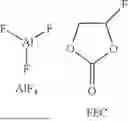
Embodiments of the present invention provide for a material for protecting a lithium metal sheet. The material comprises a metal fluoride and a fluoro alkylene carbonate. The metal fluoride may be AlF3 or ZnF2. The fluoro alkylene carbonate may be a C2-15 fluoro alkylene group which is straight or branched. In embodiments of the invention, the fluoro alkylene carbonate may be a C2-6 fluoro alkylene group. Optionally, the fluoro alkylene carbonate is cyclic. In embodiments of the invention, the material comprises AlF3 and fluoro ethylene carbonate (FEC) outlined below.
AlF3 and FEC (or the metal fluoride and the fluoro alkylene carbonate) are present in amounts of about 1 g and about 0.5-5 mL, respectively. In embodiments of the invention, AlF3 and FEC (or the metal fluoride and the fluoro alkylene carbonate) are present in amounts of about 1 g and about 2 mL, respectively; or in amounts of about 1 g and about 3 mL, respectively; or in amounts of about 1 g and about 1 mL, respectively; or in amounts of about 1 g and about 0.5 mL, respectively.
The protective material according to the invention is stable for a period of at least about 2 weeks. The material may be stored under dry atmosphere and/or at ambient temperature.
In embodiments of the invention as described above, the lithium metal sheet is for use as anode in a battery. The battery may be a lithium-ion battery.
Embodiments of the invention provide for a method of preparing the protective material. Also, embodiments of the invention provide for a method of treating the surface of a lithium metal sheet; in particular the surface of a lithium metal anode.
Embodiments of the invention provide for a lithium metal sheet, in particular a lithium metal anode treated by the method of the invention. Also, embodiments of the invention provide for a battery which comprises an anode treated by the method of the invention. Optionally, the electrolyte in the battery is a not flammable electrolyte. Such electrolyte may be for example trimethylphosphate (TMP), triethylphosphate (TEP), tributylphosphate (TBP), triethylphosphite (TEPi), or a combination thereof. Optionally, the cathode in the battery is a cathode having a nickel- and/or manganese-based material; preferably the cathode is of nickel manganese cobalt (NMC) or of nickel cobalt aluminum oxide (NCA).
Embodiments of the invention provide for a kit for use in the protective treatment method of the invention. As outlined above, the protective material of the invention is stable when stored under suitable conditions. Accordingly, the kit may comprise either individual components for the preparation of the material, or the material already prepared and ready for use.
The scope of the claims should not be limited by the preferred embodiments set forth in the examples; but should be given the broadest interpretation consistent with the description as a whole.
The present description refers to a number of documents, the content of which is herein incorporated by reference in their entirety.
REFERENCES
- 1. Xu, R et al. Artificial soft-rigid protective layer for dendrite-free lithium metal oxide. Lithium Metal Anodes (2018) 28, 1705838.
- 2. Guerfi, A. et al. Improved electrolytes for Li-ion batteries: Mixtures of ionic liquid and organic electrolyte with enhanced safety and electrochemical performance. J. Power Source (2010) 195, 845-852.
- 3. Wang, H., Lin, D., Liu, Y., Li, Y. & Cui, Y. Ultrahigh-current density anodes with interconnected Li metal reservoir through overlithiation of mesoporous AlF3 framework. Sci. Adv. (2017) 3, e1701301.
- 4. Wang, C. & Zhang, J. Functioning Mechanism of AlF3 Coating on the Li- and Mn-Rich Cathode Materials. Chem. Mater. (2014) 26, 6320-6327.
- 5. Lee, S., Seung, C., Amine, K. & Sun, Y. Improvement of long-term cycling performance of Li[Ni0.8Co0.15Al0.05]O2 by AlF3 coating. J. Power Sources (2013) 234, 201-207.
- 6. Wang, H. et al. AlF3 coated LiV3O8 nanosheets with significantly improved cycling stability as cathode material for Li-ion battery. Solid State Ionics (2013) 236, 37-42.
- 7. Tron, A., Jo, Y. N., Oh, S. H., Park, Y. D. & Mun, J. Surface Modification of the LiFePO4 Cathode for the Aqueous Rechargeable Lithium Ion Battery. ACS Appl. Mater. Interfaces (2017) 9, 12391-12399.
- 8. Li, W. et al. AlF3 modification to suppress the gas generation of Li4Ti5O12 anode battery.
- Electrochim. Acta (2014) 139, 104-110.
- 9. Chem, J. M. Enhanced performance of graphite anode materials by AlF3 coating for lithium-ion batteries. J. Mater. Chemistry (2012) 22, 12745-12751.
Claims
1. A method of treating a surface of a lithium metal sheet, comprising:
(a) providing a lithium metal sheet;
(b) preparing a material which comprises a complex formed from a mixture comprising a metal fluoride and a fluoro alkylene carbonate;
(c) depositing the material on the surface of the lithium sheet and causing the material to spread on the surface; and
(d) drying the material, thereby forming a coat of protective material on the surface.
2. The method according to claim 1, wherein step (c) comprises passivating the surface.
3. The method according to claim 1, wherein step (d) is conducted at ambient temperature.
4. The method according to claim 1, wherein the metal fluoride is selected from the group consisting of AlF3 and ZnF2; and the fluoro alkylene carbonate is a C2-15 fluoro alkylene carbonate.
5. The method according to claim 4, wherein the C2-15 fluoro alkylene carbonate is a straight chain hydrofluorocarbon or a branched chain hydrofluorocarbon.
6. The method according to claim 1, wherein the metal fluoride is selected from the group consisting of AlF3 and ZnF2; and the fluoro alkylene carbonate is a C2-6 fluoro alkylene carbonate.
7. The method according to claim 1, wherein the metal fluoride is AlF3 and the fluoro alkylene carbonate is fluoro ethylene carbonate (FEC).
8. A method of treating a surface of a lithium metal sheet, comprising:
(a) providing a lithium metal sheet;
(b) preparing a material which comprises a complex formed from a mixture comprising AlF3 and fluoro ethylene carbonate (FEC);
(c) depositing the material on the surface of the lithium sheet and causing the material to spread on the surface; and
(d) drying the material, thereby forming a coat of protective material on the surface.
9. The method according to claim 1, wherein the lithium metal sheet is for use as anode in a battery; optionally the battery is a lithium-ion battery.
10. A lithium metal sheet having a surface treated by the method as defined in claim 1.
11. A battery comprising a lithium metal anode having a surface thereof treated by the method as defined in claim 1.
12. The battery according to claim 11, wherein the electrolyte is a not flammable electrolyte and/or the electrolyte is a gel polymer electrolyte; optionally the not flammable electrolyte is selected from the group consisting of trimethylphosphate (TMP), triethylphosphate (TEP), tributylphosphate (TBP), triethylphosphite (TEPi), and combinations thereof.
13. The battery according to claim 11, wherein the cathode is a cathode having a nickel- and/or manganese-based material; optionally the cathode is selected from the group consisting of nickel manganese cobalt (NMC) and nickel cobalt aluminum oxide (NCA).
14. A kit for use in the treatment of a lithium metal sheet, comprising: (a) a metal fluoride; (b) a fluoro alkylene carbonate; and (c) instructions for use.
15. The kit according to claim 14, wherein the instructions comprise: instructions for preparing a material which is a complex formed from a mixture of the metal fluoride and the fluoro alkylene carbonate; and/or instructions for depositing the material on the surface of the lithium sheet and causing the material to spread on the surface; and/or instructions for drying the material, thereby forming a coat of protective material on the surface.
16. The kit according to claim 14, wherein the metal fluoride is selected from the group consisting of AlF3 and ZnF2; and the fluoro alkylene carbonate is a C2-15 fluoro alkylene carbonate.
17. The method according to claim 16, wherein the C2-15 fluoro alkylene carbonate is a straight chain hydrofluorocarbon or a branched chain hydrofluorocarbon.
18. The kit according to claim 14, wherein the metal fluoride is selected from the group consisting of AlF3 and ZnF2; and the fluoro alkylene carbonate is a C2-6 fluoro alkylene carbonate.
19. The kit according to claim 14, wherein the metal fluoride is AlF3 and the fluoro alkylene carbonate is fluoro ethylene carbonate (FEC).
20. The kit according to claim 14, wherein the lithium metal sheet is for use as anode in a battery; optionally the battery is a lithium-ion battery.
Images & Drawings included:



Sources:
- United States Patent and Trademark Office - verify current appl. status at the USPTO↗
Similar patent applications:
Recent applications in this class:
- » 20260128312 2026-05-07
PROCESSING AID FOR FREESTANDING ELECTRODE FABRICATION - » 20260112633 2026-04-23
POROUS ANODE FOR A LITHIUM ION BATTERY CELL, METHOD OF FABRICATING A POROUS ANODE, AND METHOD OF ASSEMBLING A LITHIUM ION BATTERY CELL - » 20260100368 2026-04-09
SECONDARY BATTERY - » 20260081162 2026-03-19
Polymer Coating Process For Electrode Assemblies Incorporating Ion Exchange Materials - » 20260081161 2026-03-19
METHOD OF MANUFACTURING ELECTRODE-LAMINATED BODY MODULE - » 20260066300 2026-03-05
POSITIVE ELECTRODE AND RECHARGEABLE LITHIUM BATTERY INCLUDING THE SAME - » 20260066299 2026-03-05
SALT-PHILIC SOLVENT-PHOBIC (SP2) INTERFACIAL COATING FOR ANODES - » 20260058148 2026-02-26
POSITIVE ELECTRODE FOR LITHIUM ION SECONDARY BATTERY, POSITIVE ELECTRODE SHEET FOR LITHIUM ION SECONDARY BATTERY, AND METHOD FOR MANUFACTURING THE SAME - » 20260058147 2026-02-26
SECONDARY BATTERY AND ELECTRONIC DEVICE - » 20260058146 2026-02-26
LITHIUM METAL BATTERY AND METHOD OF FABRICATING THE SAME
Recent applications for this Assignee:
- » 20260103555 2026-04-16
GLYCIDYL-CONTAINING POLYMERS, POLYMER COMPOSITIONS COMPRISING THEM AND THEIR USE IN ELECTROCHEMICAL CELLS - » 20260018666 2026-01-15
INORGANIC COMPOUNDS HAVING AN ARGYRODITE-TYPE STRUCTURE, THEIR PREPARATION PROCESSES AND THEIR USES IN ELECTROCHEMICAL APPLICATIONS - » 20250260011 2025-08-14
OLIVINE-TYPE COMPOUNDS: METHOD FOR THEIR PREPARATION AND USE IN CATHODE MATERIALS FOR SODIUM-ION BATTERIES - » 20250158063 2025-05-15
ELECTRODE MATERIALS AND PROCESSES FOR THEIR PREPARATION - » 20250129207 2025-04-24
SQUARIC ACID-BASED POLYMERS, THEIR MANUFACTURING PROCESSES AND THEIR USES - » 20250038355 2025-01-30
CELLULOSE-BASED SEPARATORS COMPRISING FLAME RETARDANT, AND USES THEREOF IN ELECTROCHEMISTRY - » 20250023099 2025-01-16
ADDITIVES FOR ELECTROLYTES IN Li-ION BATTERIES - » 20240363845 2024-10-31
ADDITIVES FOR ELECTROLYTE AND CATHODE MATERIAL IN Li-ION BATTERIES COMPRISING METAL-BASED CATHODE MATERIAL WHICH PRODUCES M2+ METAL IONS - » 20240317690 2024-09-26
LITHIUM SALTS OF CYANO-SUBSTITUTED IMIDAZOLE FOR LITHIUM ION BATTERIES - » 20240279055 2024-08-22
METHOD AND REACTOR FOR PRODUCING SYNTHESIS GAS FROM A CARBON AND HYDROGEN SOURCE IN THE PRESENCE OF AN OXY FLAME