Method of drying honeycomb formed body
US20050115101A1
2005-06-02
10/506,968
2003-02-05
Abstract:
A method of drying a honeycomb formed body comprising an outer wall, partition walls disposed inside the outer wall, and cells surrounded by the partition walls and extending in an axial direction of the honeycomb formed body. The method of drying a honeycomb formed body comprises a drying step of starting to dry in a state of covering at least a part of the outer wall 7a and 7b with a guide 12 covering the outer wall 7a and/or 7b so as not to come into contact with the outer wall 7a and/or 7b. Alternatively, the method of drying a honeycomb formed body comprises a drying step of drying in a state of covering at least a part of the outer wall with a guide that covers the outer wall so as to come into contact with the outer wall, wherein in the drying step the pressure applied to the outer wall by the guide at the contact portion is less than 0.2 MPa. A method of drying a honeycomb formed body causing less distortion and cross sectional deformation in the honeycomb formed body is provided.
Inventors:
- Masayuki NATE 10 🇯🇵 Nagoya-City, Japan
- Takahisa Kaneko 9 🇯🇵 Nagoya-city, Japan
- Makoto Osamura 2 🇯🇵 Nagoya-city, Japan
- Yukihisa Wada 4 🇯🇵 Nagoya-city, Japan
Interested in similar patents?
Get notified when new applications in this technology area are published.
Classification:
C04B35/6365 » CPC main
Shaped ceramic products characterised by their composition ; Ceramics compositions ; Processing powders of inorganic compounds preparatory to the manufacturing of ceramic products; Forming processes; Processing powders of inorganic compounds preparatory to the manufacturing of ceramic products; Preparing or treating the powders individually or as batches ; preparing or treating macroscopic reinforcing agents for ceramic products, e.g. fibres; mechanical aspects section using additives specially adapted for forming the products, e.g.. binder binders; Organic additives; Polysaccharides or derivatives thereof Cellulose or derivatives thereof
B28B3/269 » CPC further
Producing shaped articles from the material by using presses ; Presses specially adapted therefor wherein the material is extruded; Extrusion dies For multi-channeled structures, e.g. honeycomb structures
B28B11/243 » CPC further
Apparatus or processes for treating or working the shaped or preshaped articles for curing, setting or hardening Setting, e.g. drying, dehydrating or firing ceramic articles
B28B11/248 » CPC further
Apparatus or processes for treating or working the shaped or preshaped articles for curing, setting or hardening Supports for drying
C04B35/62655 » CPC further
Shaped ceramic products characterised by their composition ; Ceramics compositions ; Processing powders of inorganic compounds preparatory to the manufacturing of ceramic products; Forming processes; Processing powders of inorganic compounds preparatory to the manufacturing of ceramic products; Preparing or treating the powders individually or as batches ; preparing or treating macroscopic reinforcing agents for ceramic products, e.g. fibres; mechanical aspects section; Treating the starting powders individually or as mixtures; Thermal treatment of powders or mixtures thereof other than sintering Drying, e.g. freeze-drying, spray-drying, microwave or supercritical drying
F27D5/00 » CPC further
Supports, screens, or the like for the charge within the furnace
C04B2111/00793 » CPC further
Mortars, concrete or artificial stone or mixtures to prepare them, characterised by specific function, property or use; Uses not provided for elsewhere in as filters or diaphragms
C04B2111/0081 » CPC further
Mortars, concrete or artificial stone or mixtures to prepare them, characterised by specific function, property or use; Uses not provided for elsewhere in as catalysts or catalyst carriers
C04B2235/428 » CPC further
Aspects relating to ceramic starting mixtures or sintered ceramic products; Composition of constituents of the starting material or of secondary phases of the final product; Constituents and secondary phases not being of a fibrous nature; Non metallic elements added as constituents or additives, e.g. sulfur, phosphor, selenium or tellurium Silicon
C04B2235/6021 » CPC further
Aspects relating to ceramic starting mixtures or sintered ceramic products; Aspects relating to the preparation, properties or mechanical treatment of green bodies or pre-forms; Making the green bodies or pre-forms by moulding Extrusion moulding
C04B2235/728 » CPC further
Aspects relating to ceramic starting mixtures or sintered ceramic products; Aspects relating to sintered or melt-casted ceramic products; Products characterised by the absence or the low content of specific components, e.g. alkali metal free alumina ceramics Silicon content
C04B2235/80 » CPC further
Aspects relating to ceramic starting mixtures or sintered ceramic products; Aspects relating to sintered or melt-casted ceramic products Phases present in the sintered or melt-cast ceramic products other than the main phase
C04B2235/9638 » CPC further
Aspects relating to ceramic starting mixtures or sintered ceramic products; Aspects relating to sintered or melt-casted ceramic products; Properties of ceramic products, e.g. mechanical properties such as strength, toughness, wear resistance; Surface properties, e.g. surface roughness Tolerance; Dimensional accuracy
C04B38/0006 » CPC further
Porous mortars, concrete, artificial stone or ceramic ware; Preparation thereof Honeycomb structures
C04B35/565 » CPC further
Shaped ceramic products characterised by their composition ; Ceramics compositions ; Processing powders of inorganic compounds preparatory to the manufacturing of ceramic products based on non-oxide ceramics based on carbides or oxycarbides based on silicon carbide
C04B40/02 » CPC further
Processes, in general, for influencing or modifying the properties of mortars, concrete or artificial stone compositions, e.g. their setting or hardening ability Selection of the hardening environment
C04B40/0218 » CPC further
Processes, in general, for influencing or modifying the properties of mortars, concrete or artificial stone compositions, e.g. their setting or hardening ability; Selection of the hardening environment making use of electric or wave energy or particle radiation; Electromagnetic waves Microwaves
Description
TECHNICAL FIELDThe present invention relates to a method of drying a honeycomb formed body. Particularly, the present invention relates to a method of drying a honeycomb formed body in which distortion or cross sectional deformation of a honeycomb formed body can be reduced.
BACKGROUND ARTA honeycomb structure is widely used for catalyst carriers and various filters. Recently, The honeycomb structure gets attention as a filter for trapping particulate matter exhausted from diesel engine (hereinafter referred to as DPF).
Such a honeycomb structure generally contains ceramics as a main component in many cases. Following method is generally taken for producing the honeycomb structure. After adding water and several kinds of additives to the ceramic raw material to form kneaded clay, the kneaded clay is extruded to form honeycomb formed body, then the formed body is dried and fired to obtain the honeycomb structure.
Such a drying process in the production method is faced with the problem that deformation such as distortion or twist occurs in the honeycomb formed body. Sometimes the honeycomb formed body is formed by joining a plurality of segments having honeycomb structure into an integral body. This approach is also faced with the problem that any deformation such as distortion or twisting occurring in any segment may complicate the joining process.
As a method for inhibiting distortion and the like in drying, there is a method for drying a ceramic formed body having a honeycomb structure by using a drying jig having an upper jig and a lower jig equipped with pressure applying means, the applied pressure being preferably 0.4 to 0.6 MPa as disclosed in Japanese Patent Application Laid-open No. 2001-130973. There is a drying jig having two separate jigs formed in such a way that they enclose in a closely contacted state nearly the whole surface of sides parallel to a longitudinal direction of a ceramic formed body having a honeycomb structure as disclosed in Japanese Patent Application Laid-open No. 2001-19533. In these methods, though the distortion of the formed body can be inhibited, cells may be collapsed in some cases, which may result in cross sectional deformation of the formed body.
DISCLOSURE OF THE INVENTIONThe present invention has been made in view of such a situation and aims to provide a method of drying a honeycomb formed body in which distortion or cross sectional deformation of a honeycomb formed body can be reduced.
The present invention provides first a method of drying a honeycomb formed body comprising an outer wall, partition walls disposed inside the outer wall, and cells surrounded by the partition walls and extending in an axial direction of the honeycomb formed body, wherein the method comprises a drying step of starting to dry in a state of covering at least a part of the outer wall with a guide covering the outer wall so as not to come into contact with the outer wall (a first aspect of the invention).
In the first aspect of the invention, the drying step preferably starts with a distance between the outer wall and the guide covering the outer wall of 0.1 to 1.0 mm. Furthermore, in the case where the outer wall and the guide come into contact with each other during the drying step that starts with a distance between the outer wall and the guide covering the outer wall of 0.1 mm or less, the pressure applied to the outer wall from the guide is preferably less than 0.2 MPa.
Secondly, the present invention provides a method of drying a honeycomb formed body comprising an outer wall, partition walls disposed inside the outer wall and a plurality of cells surrounded by the partition walls and extending in an axial direction of the honeycomb formed body, and the method comprises comprising the step of drying the honeycomb formed body in a state where at least a part of the outer wall is covered with a guide that covers the outer wall while being in contact with the outer wall, wherein in the drying step the pressure applied to the outer wall from the guide at the point of contact is less than 0.2 MPa (a second aspect of the invention).
In the first or second aspect of the invention, it is preferred that the guide has an opening, and the extent that the guide covers the outer wall is in the range of 20 to 100%, relative to the surface area of the entire outer wall face. It is also preferred that the drying step includes a microwave drying step and a hot air drying step, and the hot air drying step is conducted after the microwave drying step. In this case, the drying preferably starts in a state where at least a part of the outer wall is covered with the guide at least in the hot air drying step, and also the drying preferably starts in a state where at least a part of the outer wall is covered with the guide at least in the microwave drying step. Additionally, in the microwave drying step, output of microwave per unit mass of the honeycomb formed body is preferably in the range of 0.5 to 3 kW/kg, and dewatering ratio relative to the total dewatering amount in the complete drying step is preferably in the range of 30 to 80% by mass. It is also preferred that the honeycomb formed body contains ceramics as a main component and the main component contains silicon carbide.
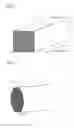
BRIEF DESCRIPTION OF THE DRAWINGSFIG. 1 is a schematic perspective view showing an embodiment of the honeycomb formed body of the present invention.
FIG. 2 is a schematic perspective view showing another embodiment of the honeycomb formed body of the present invention.
FIG. 3 is a schematic perspective view showing a honeycomb formed body of the present invention placed on a mounting jig.
FIG. 4 is a schematic perspective view showing a honeycomb formed body of the present invention covered with a guide.
FIG. 5 is a schematic perspective view showing a honeycomb formed body of the present invention covered with another type of the guide.
FIG. 6 is a schematic front view showing a honeycomb formed body of the present invention placed on another type of the mounting jig.
FIG. 7 is a schematic perspective view showing a honeycomb formed body of the present invention covered with still another type of the guide.
FIG. 8(a), FIG. 8(b) and FIG. 8(c) are schematic front views showing a honeycomb formed body of the present invention covered with still another type of the guide respectively.
FIG. 9 is a schematic perspective view showing a honeycomb formed body of the present invention covered with still another type of the guide.
FIG. 10 is a schematic side view showing a method for measuring distortion of a honeycomb formed body of the present invention.
BEST MODE FOR CARRYING OUT THE INVENTIONMethods of drying a honeycomb formed body according to the first and the second aspects of the present invention are described below in detail with reference to the concrete embodiments. However, the present invention is not restricted to the following embodiments. Incidentally, in the present description, the expression “section” means a section perpendicular to the axial direction shown in FIG. 1, unless otherwise specified.
As shown in FIG. 1 or FIG. 2, for example, the honeycomb formed body according to the first aspect and the second aspect comprises an outer wall 7, partition walls 2 disposed inside the outer wall 7 and a plurality of cells 3 surrounded by the partition walls 2 and extending in an axial direction of the honeycomb formed body. A significant feature of the first aspect is provision of the drying step which, in drying such a honeycomb formed body, starts drying in a state where at least a part of the outer walls 7a and 7b is covered with a guide 12 covering the outer wall so as not to come into contact with the outer wall, for example the outer wall 7a and/or 7b as shown in FIG. 3 and FIG. 4, namely in a state where the guide covers the outer wall at a certain distance.
By starting the drying step in such a state, it is possible to dry the honeycomb formed body while preventing it from being distorted without applying an excessive pressure. Therefore, it is possible to prevent occurrence of both the cross sectional deformation and the distortion of the honeycomb formed body.
In the first aspect, if the distance between the outer wall and the guide, or a distance a between the outer wall 7a and the guide 12 as shown, for example, in FIG. 4 is too large, the effect of preventing distortion is difficult to be achieved, so that such distance is not preferable. Therefore, the distance a is preferably 1.0 mm or less. On the other hand, if the distance a is too small, the effect of preventing cross sectional deformation of the honeycomb formed body is difficult to be achieved, so that such distance is not preferable. Therefore, the distance a is preferably 0.1 mm or more. Likewise, the distance between the outer wall 7b located on the lateral side and the guide is preferably in the range of 0.1 mm and 1.0 mm.
If these distances are 0.1 mm or less, the maximum pressure at the time the honeycomb formed body and the guide come into contact with each other during the drying step is desirably set to less than 0.2 MPa, preferably 0.05 MPa or less in order to prevent the sectional shape from deforming to some extent.
FIG. 5 shows another embodiment of the first aspect. FIG. 5 shows a preferred example when a honeycomb formed body of cylindrical shape is subjected to drying. The honeycomb formed body is placed on a mounting jig 10 having a recess of semi-cylindrical shape, and then the outer wall 7 is covered with a guide 12 having a recess portion of semi-cylindrical shape with a radius slightly larger than the sectional radius of the honeycomb formed body. In this manner, it is possible to cover the outer wall so that a part of the outer wall 7, namely, the outer wall located on the upper side does not come into contact with the guide 12.
Still another embodiment is shown in FIG. 6 and FIG. 7. In this case, a honeycomb formed body 1 of rectangular prism is received by amounting jig 10 having a V-shaped cross section, and the outer wall 7a on the upper side of the honeycomb formed body is covered with a guide 12 having a V-shaped cross section which is formed by sides each being slightly larger than one side of the rectangular cross section of the honeycomb formed body 1. At this time, since the load of the guide 12 is received at or in the vicinity of an end face 14 of the mounting jig, the guide 12 and the upper outer wall 7a will not come into contact with each other.
In the above embodiments, although the honeycomb formed body is surrounded by the combination of the mounting jig and the guide, the mounting jig is not an essential element, and the embodiment shown in FIG. 3 may lack the mounting jig, for example. In the embodiment shown in FIG. 5 or FIG. 7, the mounting jig and the guide may be integrally formed. In such a case, the outer wall on the lower side of the honeycomb formed body comes into contact with the lower part of the guide because the honeycomb formed body is placed in the integrated guide, however, the effect of the present invention can be achieved because the part being in no contact is positioned upside.
Next, a preferred specific example in the second aspect of the present invention will be explained. The honeycomb formed body according to the second aspect is similar to that of the first aspect. A significant feature of the second aspect is the drying step which starts drying in a state where at least a part of outer wall of the honeycomb formed body is covered with a guide 12 in such a manner that the guide is in contact with at least a part of outer wall 7, as shown in FIGS. 8(a) to 8(c), for example, wherein the pressure applied by the guide 12 on the outer wall 7 at the contact portion is less than 0.2 MPa, preferably 0.05 MPa or less in the drying step.
If the drying is conducted in a state where the guide and the outer wall are in contact with each other and that a generally-used pressure, such as pressures of 0.2 MPa or more is applied on the outer wall by the guide, the sectional shape of the honeycomb formed body deforms although distortion is prevented. However, by setting the pressure applied during the drying less than 0.2 MPa, preferably 0.05 MPa or less, it is possible to prevent the sectional shape from deforming to some extent, while preventing the distortion.
In the second aspect, all the surface that the guide covers is not necessarily in contact with the outer wall, and in the embodiment as shown in FIG. 8(a), for example, when the outer wall located on the upper side is in contact with the guide, the outer wall located on the lateral side may not be in contact with the guide 12. In this case, the distance is preferably in the range of 0.1 to 1.0 mm.
In the second aspect, the way of applying pressure is not particularly limited, and examples of the pressure application method include applying a load downward from above the guide, applying pressure by guide's own weight, and applying pressure from lateral side by pressure applying means in the embodiment as shown in FIG. 8(a).
In the first or second aspect of the invention, it is also preferred to cover the outer wall 7 using a guide 12 having an opening 13 as shown in FIG. 9, for example. By employing such a configuration, it is possible to improve the evaporation efficiency of moisture of the honeycomb formed body and improve the drying efficiency. In this case, the shape and the position of the opening are not particularly limited. Preferably, the opening of larger size is desired from the view point of the drying efficiency. However, if the opening is too large, the extent of the outer wall covered with the guide becomes too small to make the present invention difficult to give the effect. Therefore, the opening area of the opening is preferably 80% or less, more preferably 70% or less and still preferably 60% or less, relative to the area of the guide including the opening.
Likewise, from the view point of suppressing the distortion, the extent of the outer wall covered with the guide is preferably in the range of 20 to 100%, more preferably in the range of 30 to 100%, and still preferably in the range of 40 to 100%, relative to the surface area of the entire surface of the outer wall. From the view point of realizing suppression of distortion and improvement of drying efficiency, the extent is preferably in the range of 20 to 90%, more preferably in the range of 30 to 80%, and still preferably in the range of 40 to 70%. Therefore, in the case of providing an opening, it is preferred to provide the opening so as to satisfy the above ranges. Herein the expression “extent of the outer wall covered with the guide” means the extent excluding the opening if exists.
The drying means in the first or second aspect of the invention is not particularly limited, however, microwave drying and/or hot air drying is preferably used. The microwave drying has an advantage of executing rapid drying, however, the drying cannot be completed by the microwave drying in some cases. Therefore, it is preferred to combine the microwave drying and the hot air drying. Also preferred is conducting the hot air drying after removing moisture to some extent by conducting the microwave drying.
In the case where the hot air drying is conducted after the microwave drying, it is preferred that the drying is started in a state where at least a part of the outer wall is covered with the guide according to the first aspect or the second aspect of the present invention in either the microwave drying step or the hot air drying step. It is more preferred that the guide is used in the microwave drying step. It is especially preferred that the drying is started in a state where at least a part of the outer wall is covered with the guide in both of the drying steps.
The output of microwave in the microwave drying step is not particularly limited, however it is preferably in the range of about 0.5 to 3 kW/kg. If the output of microwave is too low, longer drying time is required to possibly cause collapse by the own weight. On the other hand, if the output of microwave is too high, a problem may occur that the binder starts burning. From the view point of preventing occurrence of distortion, it is also preferred that 30 to 80% by mass of the total dewatering amount, preferably 30 to 60% by mass of the total dewatering amount is dewatered in the microwave drying step, and the remaining moisture is dewatered in the hot air drying step. Also, it is preferred to use ventilating type or hot air circulating type hot air drying means.
The honeycomb formed body according to the first or second aspect preferably contains ceramics as a main component in the case of using the honeycomb formed body as various kinds of filters and carries. It is especially preferred that the main component contains silicon carbide from the view point of heat resistance or the like in the case where the honeycomb formed body is used as DPF or the like.
The present invention will concretely be described hereinafter in terms of examples. However the present invention is not limited to these examples.
(Production of Honeycomb Formed Body)
As a raw material, a mixed powder containing 80% by mass of SiC powder and 20% by mass of metal Si powder was prepared. To the powder, methyl cellulose, hydroxypropoxyl methyl cellulose, surfactant, and water were added to prepare kneaded clay having plasticity. This kneaded clay was extruded to form a honeycomb formed body A of rectangular prism as shown in FIG. 1 having a sectional shape of square 40 mm on a side and a length of 400 mm, and a honeycomb formed body B of cylindrical shape as shown in FIG. 2 having a diameter of 50 mm and a length of 400 mm.
EXAMPLE 1The honeycomb formed body B was set into the mounting jig and the guide as shown in FIG. 8(b) having no space with the outer wall of the honeycomb formed body B. That is, the outer wall of the honeycomb formed body B was covered with the mounting jig and the guide that covers the outer wall such that the outer wall and the guide come into direct contact. After applying pressure on the honeycomb formed body B by applying a load downward from above the guide at pressures listed in Table 1, microwave drying was conducted, followed by hot air drying to the complete dried state. Then, the honeycomb formed body was taken out and a difference between the maximum diameter and the minimum diameter of the end face was measured for checking deformation of the sectional shape, and the resultant values are shown in Table 1 as a tolerance of product profile.
EXAMPLES 2 AND 3Using the honeycomb formed body A, the test similar to Example 1 was conducted except that the mounting jig and the guide as shown in FIG. 8(a) were used in Example 2 and the mounting jig and the guide as shown in FIG. 8(c) were used in Example 3. The results are shown in Table 1
| TABLE 1 | |
| Tolerance of | Applied pressure (MPa) |
| product profile (mm) | 0.01 | 0.03 | 0.05 | 0.2 | 0.4 | 0.6 |
| Example 1 | 0.8 | 1.1 | 1.5 | 2.6 | 4.8 | 6.2 |
| Example 2 | 0.3 | 0.8 | 1.2 | 2.0 | 2.5 | 5.0 |
| Example 3 | 0.8 | 1.5 | 1.8 | 3.2 | 5.8 | 7.0 |
| Comprehensive | Satisfactory | Satisfactory | Satisfactory | Unsatisfactory | Unsatisfactory | Unsatisfactory |
| evaluation | ||||||
Reviewing the results of Examples 1 to 3 in Table 1 comprehensively, the honeycomb formed body collapsed and the sectional shape was largely deformed near the part where the outer wall was in contact with the guide when the applied pressure was 0.2 MPa or more. On the other hand, when the applied pressure was 0.05 MPa or less, the deformation was not so significant.
EXAMPLE 4Using the honeycomb formed body B, the drying was conducted in the drying condition similar to that of Example 1 while using the mounting jig and the guide as shown in FIG. 5 and changing the space a between the guide and the outer wall from 0.2 to 3.0 mm as shown in Table 3. Then, the distortion amount B of each honeycomb formed body was measured. As shown in FIG. 10, the distortion amount B was determined using a dial gauge by placing the honeycomb formed body on a specific jig, and measuring the difference between the average of vertical positions at two points x1 and x2 located at ends of the longitudinal direction and the vertical position of the outer wall in the mid point of these two points. The results are shown in Table 2. At a distance a in the range of 0.2 to 1.0 mm, the distortion amount was small and allowable, however, at a distance a of 1.5 mm or more, the distortion amount was large and exceeded the allowable range.
| TABLE 2 | |
| Distortion | Distance(mm) |
| amount(mm) | 0.2 | 0.5 | 1.0 | 1.5 | 2.0 | 3.0 |
| Example 4 | 0.1 | 0.4 | 0.6 | 0.7 | 0.9 | 1.2 |
| Comprehensive | Satisfactory | Satisfactory | Satisfactory | Unsatisfactory | Unsatisfactory | Unsatisfactory |
| evaluation | ||||||
The honeycomb formed body A was placed on the mounting jig 10 and covered with the guide 12 having the opening 13 as shown in FIG. 9 so that the guide was disposed at a distance of 0.5 mm from the outer wall. The opening area of the opening 13 was varied at 60%, 30% and 0% (i.e. no opening) relative to the area of the guide including the opening 13, and a sample not covered with the guide was also prepared. These samples were subjected to microwave drying for 160 seconds at an output of 2.0 kW/kg, followed by hot air drying at 120° C. for 20minutes. From the relation between the drying time and the moisture evaporation ratio, a relative moisture evaporation rate was determined relative to the moisture evaporation rate obtained by the sample not having the guide. The distortion amount of the honeycomb formed body was also determined. The results shown in Table 4 demonstrate that the distortion amount is reduced by the guide, and the moisture evaporation rate is increased by providing an opening in the guide and reducing the area of the guide covering the outer wall.
| TABLE 3 | |||||
| Example 5 | Opening ratio of guide (%) | No guide | 60 | 30 | 0 |
| Relative moisture | 1.00 | 0.95 | 0.90 | 0.85 | |
| evaporation rate | |||||
| Distortion amount (mm) | 2.0 | 0.5 | 0.4 | 0.5 | |
| Comprehensive evaluation | Unsatisfactory | Satisfactory | Satisfactory | satisfactory | |
The honeycomb formed body B was dried by microwave at an output of 3 kW/kg without using the guide. By varying the drying time, honeycomb formed bodies having moisture evaporation ratios of 0% which was not subjected to the microwave drying, to 80% were obtained. Then these honeycomb formed bodies were set between the mounting jig and the guide having the shapes as shown in FIG. 5 at a distance a between the guide and the outer wall of 0.5 mm, and subjected to hot air drying under the condition of 120° C. and wind speed of 5 m/sec. After the remaining moisture was evaporated, distortion amounts of these honeycomb formed bodies were measured. The results are shown in Table 4.
EXAMPLES 7 AND 8The test similar to Example 6 was conducted except that the mounting jig and the guide as shown in FIG. 4 were used in Example 7 and the mounting jig and the guide as shown in FIG. 7 were used in Example 8. The results are shown in Table 4.
Table 4 shows the existence of an optimum range in the moisture evaporation ratio accomplished by microwave where the distortion amount is very small compared to the case where the moisture evaporation ratio is too high or too low.
| TABLE 4 | |
| Moisture evaporation ratio (%) | |
| Microwave drying |
| 80 | 70 | 50 | 30 | 20 | 0 |
| Distortion | Hot air drying |
| amount (mm) | 20 | 30 | 50 | 70 | 80 | 100 |
| Example 6 | 1.2 | 0.5 | 0.3 | 0.5 | 0.9 | 1.3 |
| Example 7 | 1.5 | 0.6 | 0.5 | 0.6 | 1.3 | 1.6 |
| Example 8 | 1.0 | 0.6 | 0.5 | 0.5 | 0.8 | 2.0 |
| Comprehensive | Unsatisfactory | Satisfactory | Satisfactory | Satisfactory | Unsatisfactory | Unsatisfactory |
| example | ||||||
Industrial Applicability
As described above, by using the drying method of the honeycomb formed body according to the first or second aspect of the invention, it was possible to avoid both distortion and cross sectional deformation during the drying. Therefore, the present invention can be advantageously used for drying a honeycomb formed body.
Claims
1-13. (canceled)
14. A method of drying a honeycomb formed body comprising an outer wall, partition walls disposed inside the outer wall, and a plurality of cells surrounded by the partition walls and extending in an axial direction of the honeycomb formed body,
characterized in that the method comprises a drying step starting in a state of covering at least a part of the outer wall with a guide covering the outer wall so as not to come into contact with the outer wall.
15. The method of drying a honeycomb formed body according to claim 14, wherein the drying step starts with a distance between the outer wall and the guide covering the outer wall of 0.1 to 1.0 mm.
16. The method of drying a honeycomb formed body according to claim 14, wherein in the case where the outer wall and the guide come into contact with each other during the drying step that starts with a distance between the outer wall and the guide covering the outer wall of 0.1 mm or less, the pressure applied to the outer wall from the guide is less than 0.2 MPa.
17. A method of drying a honeycomb formed body comprising an outer wall, partition walls disposed inside the outer wall, and cells surrounded by the partition walls and extending in an axial direction of the honeycomb formed body, characterized in that the method comprises a drying step drying in a state of covering
at least a part of the outer wall with a guide covering the outer wall so as to come into contact with the outer wall,
pressure from the guide to the outer wall being less than 0.2 MPa at a part where the guide comes into contact with the outer wall in the drying step.
18. The method of drying a honeycomb formed body according to claim 14, wherein the guide has an opening.
19. The method of drying a honeycomb formed body according to claim 17, wherein the guide has an opening.
20. The method of drying a honeycomb formed body according to claim 14, wherein the extent that the guide covers the outer wall is in the range of 20 to 100% relative to the surface area of the entire outer wall.
21. The method of drying a honeycomb formed body according to claim 17, wherein the extent that the guide covers the outer wall is in the range of 20 to 100% relative to the surface area of the entire outer wall.
22. The method of drying a honeycomb formed body according to claim 14, wherein the drying includes a microwave drying step and a hot air drying step, and the hot air drying step is conducted after the microwave drying step.
23. The method of drying a honeycomb formed body according to claim 17, wherein the drying includes a microwave drying step and a hot air drying step, and the hot air drying step is conducted after the microwave drying step.
24. The method of drying a honeycomb formed body according to claim 22, wherein at least in the hot air drying step, drying is started in a state where at least a part of the outer wall is covered with the guide.
25. The method of drying a honeycomb formed body according to claim 23, wherein at least in the hot air drying step, drying is started in a state where at least a part of the outer wall is covered with the guide.
26. The method of drying a honeycomb formed body according to claim 22, wherein at least in the microwave drying step, drying is started in a state where at least a part of the outer wall is covered with the guide.
27. The method of drying a honeycomb formed body according to claim 23, wherein at least in the microwave drying step, drying is started in a state where at least a part of the outer wall is covered with the guide.
28. The method of drying a honeycomb formed body according to claim 22, wherein in the microwave drying step, microwave output per unit mass of the honeycomb formed body is in the range of 0.5 to 3 kW/kg.
29. The method of drying a honeycomb formed body according to claim 23, wherein in the microwave drying step, microwave output per unit mass of the honeycomb formed body is in the range of 0.5 to 3 kW/kg.
30. The method of drying a honeycomb formed body according to claim 22, wherein dewatering ratio in the microwave drying step is 30 to 80% by mass, relative to the total dewatering amount in the complete drying step.
31. The method of drying a honeycomb formed body according to claim 23, wherein dewatering ratio in the microwave drying step is 30 to 80% by mass, relative to the total dewatering amount in the complete drying step.
32. The method of drying a honeycomb formed body according to claim 14, wherein the honeycomb formed body contains ceramics as a main component.
33. The method of drying a honeycomb formed body according to claim 32, wherein the main component contains silicon carbide.
Images & Drawings included:



Sources:
- United States Patent and Trademark Office - verify current appl. status at the USPTO↗
Similar patent applications:
- » 20180354157
Method for drying honeycomb formed body and method for manufacturing honeycomb structure - » 20180273434
Method for drying columnar honeycomb formed body and method for producing columnar honeycomb structure - » 20110227256
Method of drying honeycomb formed body - » 20060042116
Microwave drying method of honeycomb formed bodies - » 20160288364
Microwave drying method of honeycomb formed body - » 20160288365
Microwave drying method of honeycomb formed body - » 20110241263
Drying apparatus and drying method for honeycomb formed body - » 20080115383
Method of drying honeycomb formed body - » 20070006480
Method and apparatus for drying honeycomb formed body
Recent applications in this class:
- » 20220371964 2022-11-24
COMPOSITE MEMBER - » 20190016642 2019-01-17
Cellulose nanocrystal-modified ceramic blank and preparation method thereof - » 20160318813 2016-11-03
Heat moldable ceramic composition - » 20120165518 2012-06-28
Ceramic extrusion molding composition and binder - » 20120115717 2012-05-10
FLOW-THROUGH SORBENT COMPRISING A METAL SULFIDE - » 20120025432 2012-02-02
Ceramics manufacture using rapidly dissolvable cellulosic binder - » 20110262689 2011-10-27
COMPOSITION FOR EXTRUSION-MOLDED BODIES - » 20110245062 2011-10-06
EXTRUSION MOLDING COMPOSITION AND METHOD FOR PRODUCING EXTRUSION MOLDED PART - » 20110125288 2011-05-26
Tissue Augmentation Material And Method - » 20100240946 2010-09-23
Tissue Augmentation Material And Method