Method and device for producing a DVD
US20050133148A1
2005-06-23
10/973,454
2004-10-27
Abstract:
A device for gluing together two disc halves which are each provided with a central hole, to produce a disc, for example an optical data carrier, such as a DVD, includes a rotatable carrier provided with a mandrel on which the disc halves can be accommodated, in such a manner that the mandrel fits through their central holes. Furthermore, there is a radially displaced light radiation source which emits a light beam which can be displaced in the radial direction with respect to the mandrel.
Inventors:
- Antonius Martinus Lambertus Habraken 1 🇳🇱 Oedenrode, Netherlands
- Marc Evers 1 🇳🇱 Geldrop, Netherlands
- Bob Reuser 1 🇳🇱 Eindhoven, Netherlands
Interested in similar patents?
Get notified when new applications in this technology area are published.
Classification:
B29C65/7811 » CPC main
Joining of preformed parts ; Apparatus therefor; Means for handling the parts to be joined, e.g. for making containers or hollow articles, e.g. means for handling sheets, plates, web-like materials, tubular articles, hollow articles or elements to be joined therewith; Means for discharging the joined articles from the joining apparatus; Positioning the parts to be joined, e.g. aligning, indexing or centring the parts to be joined comprising positioning features in the form of holes or slots for centring purposes
B29C65/14 » CPC further
Joining of preformed parts ; Apparatus therefor by heating, with or without pressure using wave energy or particle radiation
B29C65/1406 » CPC further
Joining of preformed parts ; Apparatus therefor by heating, with or without pressure using wave energy or particle radiation characterised by the type of electromagnetic or particle radiation Ultraviolet [UV] radiation
B29C65/4845 » CPC further
Joining of preformed parts ; Apparatus therefor using adhesives, i.e. using supplementary joining material; solvent bonding characterised by the type of adhesives; Reactive adhesives, e.g. chemically curing adhesives Radiation curing adhesives, e.g. UV light curing adhesives
B29C66/1122 » CPC further
General aspects of processes or apparatus for joining preformed parts; General aspects dealing with the joint area or with the area to be joined; Particular design of joint configurations particular design of the joint cross-sections; Joint cross-sections comprising a single joint-segment, i.e. one of the parts to be joined comprising a single joint-segment in the joint cross-section; Single lapped joints Single lap to lap joints, i.e. overlap joints
B29C66/452 » CPC further
General aspects of processes or apparatus for joining preformed parts; General aspects of joining substantially flat articles, e.g. plates, sheets or web-like materials; Making flat seams in tubular or hollow articles; Joining single elements to substantially flat surfaces; Joining substantially flat articles ; Making flat seams in tubular or hollow articles; Joining of substantially the whole surface of the articles the article having a disc form, e.g. making CDs or DVDs
G11B7/26 » CPC further
Recording or reproducing by optical means, e.g. recording using a thermal beam of optical radiation , reproducing using an optical beam at lower power ; Record carriers therefor; Record carriers characterised by shape, structure or physical properties, or by the selection of the material Apparatus or processes specially adapted for the manufacture of record carriers
B29C2035/0827 » CPC further
Heating, cooling or curing, e.g. crosslinking or vulcanising; Apparatus therefor; Heating or curing, e.g. crosslinking or vulcanizing during moulding, e.g. in a mould by wave energy or particle radiation using electromagnetic radiation using UV radiation
B29L2017/005 » CPC further
Carriers for sound or information; Carriers of records containing fine grooves or impressions, e.g. disc records for needle playback, cylinder records; Records or discs CD''s, DVD''s
B29C65/521 » CPC further
Joining of preformed parts ; Apparatus therefor using adhesives, i.e. using supplementary joining material; solvent bonding applying the adhesive by spin coating
B29C65/00 » CPC further
Joining of preformed parts ; Apparatus therefor
Description
CROSS REFERENCE TO RELATED APPLICATIONSThis application is a division of co-pending Application No. 09/905,486, filed on Jul. 16, 2001, the entire contents of which are hereby incorporated by reference.
BACKGROUND OF THE INVENTIONThe invention relates to the field of producing a disc from two disc halves. Discs of this type are generally optical data carriers with a high storage capacity, such as DVDs. In this case, both disc halves bear a series of helical minuscule pits or bumps which can be read by means of a laser beam.
The disc halves are attached to one another by gluing. The glue is arranged in the area between the two disc halves in the vicinity of their central hole and is then spread by centrifugal forces over the entire surface area between the disc halves.
In this way, it is possible to ensure a reliable and complete join between the disc halves. Moreover, the centrifugal force ensures that the relatively thick bead of glue which was initially applied in the vicinity of the central hole is spread out very uniformly. The bead of glue spreads out along a front which expands in
the radial direction towards the edges of the disc halves. In the process, the problem may arise that, on account of the speed and force at which the front is being thrown outwards, the glue which is located directly behind this front is carried along with it. As a result, the thickness of the layer of glue becomes too small to ensure good adhesion. SUMMARY OF THE INVENTION
It is an object of the invention to provide a method for producing discs as described above which does not have this drawback. This object is achieved by means of a method for gluing together two disc halves to produce a disc, for example an optical data carrier, such as a DVD, comprising the steps of:
-
- placing one disc half (5) on a rotary member (3, 4);
- applying a quantity of glue (20) to the disc half (5) in a central region thereof;
- placing the second disc half concentrically onto the first disc half (5), so as to enclose the glue (20);
- rotating the rotary member (3, 4) with the two disc halves (5, 21) in such a manner that, under the influence of the centrifugal force which is generated, the glue (20) spreads along an expanding front between the two disc halves (5, 21);
- stabilizing the glue which is immediately behind the glue front by means of light radiation from a light source being radially displaced, in a radial direction, to follow the progression of the glue front, the radial displacement of the light source being in synchronization with the progression of the glue front so that the light source is focused on the glue immediately behind the progressing glue front;
- curing the glue (20);
- removing the glued-together disc halves (5, 21) from the rotary member (3, 4).
Since, in the method according to the invention, the glue which is located immediately behind the glue front is stabilized and brought into a gel-like state, it is no longer possible for it to be sucked along with the glue front. Consequently, the desired thickness of the layer of glue is maintained over the entire surface of the disc halves. Usually, both disc halves have a central hole through which a mandrel provided on the rotary member can extend. The space between the two disc halves at the location of the central hole can be sealed by expanding the mandrel. Consequently, the glue cannot leak out into the hole, not even if the disc halves are pressed onto one another slightly. Consequently, the mandrel cannot become soiled.
It is preferable to use a mandrel with a relatively hard core and a flexible sleeve which surrounds the core, which sleeve can be expanded by means of compressed air.
In this case, the procedure can be as follows:
-
- the first disc half is put in place;
- the mandrel is then expanded;
- glue is then applied to the first disc half;
- the second disc half is then placed over the expanded mandrel, taking with it any glue adhering to the mandrel.
The glue is, as it were, scraped off the flexible sleeve by the second disc half, so that the sleeve does not become soiled even after large numbers of discs have been produced.
The invention also relates to a device for gluing together two disc halves which are each provided with a central hole, to produce a disc, for example an optical data carrier such as a DVD. According to the invention, this device has a radiation source which emits a light beam which can be displaced in the radial direction with respect to the mandrel. The light source stabilizes the glue which is immediately behind the glue front by being radially displaced, in a radial direction, to follow the progression of the glue front, the radial displacement of the light source being in synchronization with the progression of the glue front so that the light source is focused on the glue immediately behind the progressing glue front.
The expandable mandrel can be designed in various ways. The mandrel preferably comprises a central core and a flexible sleeve which is connected in an airtight manner to the core, which core has an air-supply duct which opens out into the interior of the flexible sleeve.
BRIEF DESCRIPTION FO THE DRAWINGSThe invention will now be explained in more detail with reference to an exemplary embodiment illustrated in the figures.
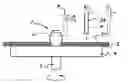
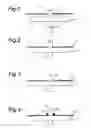
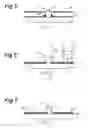
FIGS. 1-7 show the steps of the method according to the invention.
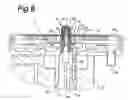
FIG. 8 shows a cross section through the device according to the invention.
DESCRIPTION OF THE PREFERRED EMBODIMENTSThe device for carrying out the method which is shown in FIG. 8 comprises a rotary member which is denoted overall by 1 and is mounted rotatably in a housing 2. The rotary member 1 comprises a spindle 3 which can rotate in the said housing 2 and a carrier 4 on which a first disc half 5 is arranged. This disc half 5 has a central hole 6 through which the mandrel, which is denoted overall by 7, fits. This mandrel 7 is attached to the spindle 3 and comprises a relatively hard core 8 with a bore 9 which is connected to the feed bore 10 in the spindle 3.
The core 8 has a constricted section 11 in which a flexible sleeve 12, for example made from rubber, is accommodated in a tight-fitting manner. This flexible sleeve 12 has recesses 13 which engage in ridges 14 of the core 8.
At the top, the flexible sleeve 12 is mounted within an attachment ring 15 and at the underside is mounted within an attachment ring 16.
Four radial ducts 17 run from the duct 9 in the core 8 towards the inner surface of the flexible sleeve 12. If compressed air is fed into the spindle 3 via the feed duct 10, the flexible member 12 expands as a result, in such a manner that it comes to bear firmly against the inner wall of the hole 6, which will be explained in more detail with reference to FIGS. 1-8.
At the outer circumference of the carrier 4 there is a collection rim 18 which is fixed to the housing 2. This collection rim collects any glue which is flung outwards during rotation of the disc halves 5 and discharges it via the outlet 19.
In the method according to the invention, the procedure is as shown diagrammatically in FIGS. 1-7, which in each case show the spindle 3, the carrier 4 and the mandrel 7. The other parts of the device according to the invention have been omitted for the sake of clarity.
As shown in FIG. 1, first of all a first disc half 5 is placed over the mandrel 7 onto carrier 4. The mandrel 7 has not yet been expanded.
In doing so, the state shown in FIG. 2 is reached, in which the first disc half 5 rests on the carrier 4. As shown in FIG. 3, the sleeve 12 is expanded so that it comes to bear firmly against the inner wall of the hole 6 in the first disc half 5. Then, as shown in FIG. 4, a bead of glue 20 is applied around the expanded sleeve 12, in the region of the first disc half 5 which adjoins the central hole in this disc half.
Then, as shown in FIG. 5, the second disc half 21 is placed onto the expanded sleeve 12, during which process the glue 20 adhering to the expanded sleeve 12 is scraped down towards the first disc half 5.
The disc halves 5, 21 which have been arranged on top of one another are rotated, in such a manner that the glue is spread, as a result of the centrifugal force which is thereby generated, over the whole of the mutually facing surfaces of the disc halves 5, 21. Under the influence of the centrifugal forces which are produced by rotation of the disc halves 5, 21, the layer of glue spreads outwards as an expanding front. This may cause the problem of the layer of glue immediately behind the said front becoming too thin on account of the glue being sucked along by the front.
In order to maintain the desired thickness of the layer of glue, according to the invention the glue immediately behind the front is stabilized by means of a source 24 which emits a beam of ultraviolet light. As a result, a gel-like character is imparted to the glue, thus preventing it from being sucked along by the front.
Further, the stabilization of the glue, and the control of the desired thickness of the glue layer, is achieved by the light source 24 being radially displaced as shown in FIG. 6. Position ‘A’, shown with dotted lines, as an initial position, position ‘B’ is an intermediate position, and position ‘C’ is a final position. The light source 24 is moved in the radial direction, to follow the progression of the glue front, the radial displacement of the light source being in synchronization with the progression of the glue front so that the light source is focused on the glue immediately behind the progressing glue front.
Finally, as shown in FIG. 8, the sleeve is depressurized, so that it returns to its original form, and the disc 23 which has been produced, comprising the disc halves 5, 21 which have now been glued together, can be removed from the carrier 4.
Claims
1. Method for gluing together two disc halves (5, 21) to produce a disc (23), comprising the steps of:
placing a first disc half (5) on a rotary member (3, 4);
applying a quantity of glue (20) to the first disc half (5) in a central region thereof;
placing a second disc half concentrically onto the first disc half (5), so as to enclose the glue (20);
rotating the rotary member (3, 4) with the two disc halves (5, 21) in such a manner that, under the influence of the centrifugal force which is generated by the rotation, the glue (20) spreads along an expanding front between the two disc halves (5, 21);
stabilizing the glue which is immediately behind the glue front by radially displacing a light source in a radial direction following the progression of the glue front;
curing the glue (20);
removing the glued-together disc halves (5, 21) from the rotary member (3, 4).
2. Method according to claim 1, wherein the stabilizing step applies UV light radiation from the radially displaced light source.
3. Method according to claim 1, wherein, the rotary member comprises a mandrel and the mandrel (7) fits through the central hole (6) in the first disc half (5);
the mandrel (7) is expanded in such a manner that the mandrel comes to bear flush against the wall of the central hole (6) of the first disc half.
4. Method according to claim 3, comprising the further step of providing a mandrel (7) which has a relatively hard core (8) and a flexible sleeve which surrounds the core (18), and expanding the sleeve (12) by means of compressed air.
5. Method according to claim 1, wherein, the rotary member is a mandel,
the mandrel (7) is expanded after having the first disc half placed thereupon; and
the second disc half (21) is placed over the expanded mandrel (7), taking with it any glue (20) adhering thereto.
6. Device for gluing together two disc halves (5, 21) to produce a disc (23), using the method according to claim 1, comprising a rotatable carrier (3, 4) on which the disc halves (5, 21) can be accommodated, characterized in that a light radiation source is provided which emits a light beam for curing the glue,
wherein the light beam can be displaced in the radial direction with respect to the mandrel by radially displacing the light source in a radial direction following the progression of the glue front and focused immediately behind the glue front.
7. Device according to claim 6 for gluing together two disc halves (5, 21) which are each provided with a central hole (6), in which the carrier (3, 4) is provided with a mandrel (7) which can be fitted through the central holes (6) in the disc halves, the mandrel (7) being expandable in the radial direction.
8. Device according to claim 6, in which the mandrel (7) comprises a central core (8) and a flexible sleeve (12) which is connected to the core (8) in an airtight manner, which core (8) has an air-supply duct (9, 10) which opens out into the interior of the flexible sleeve (12).
9. Device according to claim 6, in which the mandrel (7) comprises a cylindrical core (8) provided with a central air-supply duct (9) to which at least one radial transverse duct (10), which opens out on the outer surface of the core (8), is connected.
10. Device according to claim 9, in which the core (8) comprises a constricted region (11) in which the sleeve (12) is accommodated.
11. Device according to claim 10, in which the sleeve is clamped in at both ends between a clamping ring (15, 16).
12. Device according to claim 6, in which the sleeve (12) has at least one internal recess (13), and the mandrel (7) has at least one corresponding ridge (14) which engages in the recess (13).
13. Method for gluing together two disc halves (5, 21) to produce an optic data carrier (23), comprising the sequential steps of:
placing a first disc half (5) on a rotary member (3, 4);
applying a quantity of glue (20) to the first disc half (5) in a central region thereof;
placing a second disc half concentrically onto the first disc half (5) so as to enclose the glue (20);
rotating the rotary member (3, 4) with the two disc halves (5, 21) in such a manner that, under the influence of the centrifugal force which is generated, the glue (20) spreads along an expanding front between the two disc halves (5, 21);
stabilizing the glue which is immediately behind the glue front by light radiation applied from a light source being radially displaced, in a radial direction, to follow the progression of the glue front, the radial displacement of the light source being in synchronization with the progression of the glue front so that the light source is focused on the glue immediately behind the progressing glue front;
curing the stabilized glue (20); and
removing the glued-together disc halves (5, 21) from the rotary member (3, 4).
14. The method of claim 13, wherein, the stabilization of the glue by applying a moving light radiation focuses immediately behind the progressing glue front, includes controlling a desired thickness of the thus-stabilized glue layer.
15. Method for gluing together two disc halves (5, 21) to produce an optic data carrier (23), comprising the sequential steps of:
placing a first disc half (5) on a rotary member (3, 4);
applying a quantity of glue (20) to the first disc half (5) in a central region of the first disc half;
placing a second disc half concentrically onto the first disc half (5) to enclose the glue (20) between the first and second disc halves;
rotating the rotary member (3, 4) with the two disc halves (5, 21) in such a manner that, under the influence of the centrifugal force which is generated by the rotation, the glue (20) spreads outward along an expanding glue front between the two disc halves (5, 21);
stabilizing the glue immediately behind the glue front by applying light radiation from a light source being radially displaced, in a radial direction, to follow the progression of the glue front, the radial displacement of the light source being in synchronization with the progression of the glue front so that the light radiation is focused on the glue immediately behind the progressing glue front.
16. The method of claim 15, wherein, the stabilization of the glue by applying a moving, focused light radiation, includes controlling a desired thickness of the thus-stabilized glue layer.
Images & Drawings included:
Sources:
- United States Patent and Trademark Office - verify current appl. status at the USPTO↗