Efficiency optimization control for permanent magnet motor drive
US20050146297A1
2005-07-07
11/057,346
2005-02-14
✅ Patent granted
US 6,979,967 B2
2005-12-27
-
-
Bentsu Ro
2025-02-14
Abstract:
A method and system for modifying an estimated rotor angle for improved efficiency in a PMSM drive system. A module monitors a run command, a torque command, and an estimated speed; and in response thereto, generates an output correction angle for modifying the estimated rotor angle. The output correction angle may be added to the estimated rotor angle. The output correction angle may be generated only for predetermined conditions of said run command, torque command, and speed. In particular, the output correction angle may be generated (1) when the run command is asserted, (2) when the torque command is above a predetermined level, and (3) when variations in the speed are within predetermined limits.
Assignee:
- INTERNATIONAL RECTIFIER CORPORATION 879 🇺🇸 EL SEGUNDO, CA, United States
Interested in similar patents?
Get notified when new applications in this technology area are published.
Classification:
H02P21/18 » CPC main
Arrangements or methods for the control of electric machines by vector control, e.g. by control of field orientation; Estimation or adaptation of machine parameters, e.g. flux, current or voltage Estimation of position or speed
H02P21/26 » CPC further
Arrangements or methods for the control of electric machines by vector control, e.g. by control of field orientation; Vector control not involving the use of rotor position or rotor speed sensors Rotor flux based control
H02P2207/05 » CPC further
Indexing scheme relating to controlling arrangements characterised by the type of motor Synchronous machines, e.g. with permanent magnets or DC excitation
Y02P80/10 » CPC further
Climate change mitigation technologies for sector-wide applications Efficient use of energy, e.g. using compressed air or pressurized fluid as energy carrier
Y02P80/10 » CPC further
Climate change mitigation technologies for sector-wide applications Efficient use of energy, e.g. using compressed air or pressurized fluid as energy carrier
Description
CROSS-REFERENCEThis is a continuation of U.S. patent application Ser. No. 10/684,928, filed Oct. 14, 2003, entitled EFFICIENCY OPTIMIZATION CONTROL FOR PERMANENT MAGNET MOTOR DRIVE. This application is based upon and claims priority of U.S. Provisional Application Ser. No. 60/418,735 filed Oct. 15, 2002, incorporated by reference.
BACKGROUND OF THE INVENTION1. Field of the Invention
The present invention relates to motor drives, and more particularly to a motor drive with improved rotor angle estimation for greater efficiency.
2. Description of the Related Art
Most low cost motor drive systems employ encoderless (sensorless) control techniques. The rotor angle is estimated based on a motor model or motor back emf sensing, for example. The motor efficiency and torque per ampere capability can be significantly reduced if an incorrect rotor angle is used for controlling a permanent magnet synchronous motor (PMSM). Rotor angle estimation errors may be due to inaccuracies in estimator (angle) parameters or in motor back emf feedback sensing.
FIG. 2 is a graph illustrating motor output power versus rotor angle error for a surface-mounted permanent magnet motor operating at rated current and speed. As can be seen from FIG. 2, the output power is maximized when rotor angle error is zero.
A known optimization scheme of background interest is described in F. Abrahamsen et al., IEEE/IAS Transactions on Industry Applications, Vol. 37, No. 6 (November/December 2001), “Efficiency-Optimized Control of Medium-Size Induction Motor Drives,” incorporated by reference. In a related paper, “Energy Optimal Control of Induction Motor Drives,” Inst. Of Energy Technology, Aalborg University (February 2000), incorporated by reference, F. Abrahamsen proposes several measures for driving induction motors at variable speed, including motor drives with pulse-width modulated voltage source inverters.
Inverters for three-phase motor drives are well known in the industry. Typically a DC bus supplies switched power to different phases of an AC motor. With this type of motor control, it is desirable to accurately estimate rotor angle, for example on the basis of current feedback, for high performance control of the motor.
A rotor angle estimation scheme of background interest is described in the present inventor's Ser. No. 10/294,201 filed Nov. 12, 2002; and Ser. No. 60/465,890 filed Apr. 25, 2003, both incorporated by reference.
SUMMARY OF THE INVENTIONThe invention relates to an efficiency optimization control algorithm and to a control system using the algorithm, which can be applied to vector controlled permanent magnet AC motor drives to improve motor efficiency. The efficiency optimization algorithm and system continuously modify (using a control algorithm described herein) the estimated rotor angle until the torque command reaches its minimum value under steady state conditions.
According to an aspect of the invention, a system and method for modifying an estimated rotor angle for improved efficiency in a PMSM drive system, may comprise the steps of monitoring a run command, a torque command, and an estimated speed; and in response thereto, generating an output correction angle for modifying the estimated rotor angle. The output correction angle may be added to the estimated rotor angle. The output correction angle may be generated only for predetermined conditions of said run command, torque command, and speed. In particular, the output correction angle may be generated (1) when the run command is asserted, (2) when the torque command is above a predetermined level, and (3) when variations in the speed are within predetermined limits.
Other features and advantages of the present invention will become apparent from the following description of embodiments of the invention which refers to the accompanying drawings.
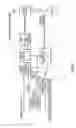
BRIEF DESCRIPTION OF THE DRAWING(S)FIG. 1 is a block diagram of a vector-controlled motor drive system utilizing the invention.
FIG. 2 is a graph illustrating motor output power versus rotor angle error for a PMSM.
FIG. 3 is a detailed block diagram of the efficiency optimization controller.
FIG. 4 is a series of graphs illustrating a simulation run of the efficiency control algorithm.
DESCRIPTION OF EMBODIMENTS OF THE INVENTIONFIG. 1 is a block diagram illustrating the placement of the efficiency control algorithm module 20 in a vector controlled system 10.
FIG. 3 shows the efficiency optimization control module in more detail. The efficiency optimization on/off control 25 monitors the drive run command, the estimated motor speed and the torque command. If (1) the run command is asserted, (2) speed variation (speed derivative) stays within certain bounds, and (3) motor current (torque command) is above a certain level then switch SW1 is activated. The output correction angle (D_Ang) is discharged (10 sec) to zero if any of the above three conditions cannot be satisfied.
The torque difference block 30 computes a difference (between present and a past sample) in the average (filtered 10 rad/sec) command torque. The search control block 35 determines the state of SW2 based on the sign of D_Trq. If the torque difference (D_Trq) is equal to or larger than zero then switch SW2 will switch state; otherwise SW2 will maintain (take no action) at its former state. Gain K1 is used to adjust the controller response and constant A provides an excitation test signal for searching minimum torque level.
The characteristics of power versus angle error (FIG. 2) can be predicted offline. Then K1 and A can be formulated based on the power (torque) sensitivity versus rotor angle error.
FIG. 4 shows a simulation run of the efficiency control algorithm. A surface-mounted permanent magnet motor driving a compressor load was used for this simulation run. An initial rotor angle error of 0.5 rad was used. When the efficiency optimization control was activated (at time=1.8 sec), the angle error was corrected and the drive torque per ampere was improved (Te* reduced in FIG. 4). Since the magnitude of motor current is proportional to command torque level, therefore the motor current was also reduced.
Definitions
- D_Trq—Difference between filtered command torque (present and past samples)
- D_Ang—Angle output of efficiency optimization controller (Rad.)
- Te*—Torque command (N-M)
- Te—Motor torque (N-M)
- Load—Compressor load
- Ang_Error—Angle difference between estimated angle and actual rotor angle (Rad.)
Although the present invention has been described in relation to particular embodiments thereof, many other variations and modifications and other uses will become apparent to those skilled in the art. Therefore, the present invention is not limited by the specific disclosure herein.
Claims
1. A method of modifying an estimated rotor angle for improved efficiency in a PMSM drive system, comprising the steps of:
monitoring a run command, a torque command, and an estimated speed; and in response thereto,
generating an output correction angle for modifying said estimated rotor angle.
2. The method of claim 1, wherein said output correction angle is added to said estimated rotor angle.
3. The method of claim 1, wherein said output correction angle is generated only for predetermined conditions of said run command, torque command, and speed.
4. The method of claim 3, wherein said output correction angle is generated (1) when the run command is asserted, (2) when said torque command is above a predetermined level, and (3) when variations in said speed are within predetermined limits.
5. A motor drive system in which an estimated rotor angle is modified for improved efficiency in a PMSM drive system, comprising:
a module which estimates a rotor angle of a motor; and
a module which monitors a run command, a torque command, and an estimated speed of said motor; and in response thereto, generates an output correction angle for modifying said estimated rotor angle.
6. The system of claim 5, wherein said output correction angle is added to said estimated rotor angle.
7. The system of claim 5, wherein said output correction angle is generated only for predetermined conditions of said run command, torque command, and speed.
8. The system of claim 7, wherein said output correction angle is generated (1) when the run command is asserted, (2) when said torque command is above a predetermined level, and (3) when variations in said speed are within predetermined limits.
Images & Drawings included:



Sources:
- United States Patent and Trademark Office - verify current appl. status at the USPTO↗
Similar patent applications:
Recent applications in this class:
- » 20250293624 2025-09-18
METHOD FOR DETERMINING AN INITIAL ROTOR POSITION OF A ROTOR, COMPUTER PROGRAM PRODUCT, CONTROL UNIT, ELECTRIC MACHINE, INSPECTION AND/OR TEST METHOD AND TEST STAND - » 20250266777 2025-08-21
ELECTRIC MOTOR CONTROLLER AND RELATED METHODS - » 20250253789 2025-08-07
SYSTEM AND METHOD FOR INDIRECTLY MEASURING AN ANGULAR POSITION AND/OR ROTATIONAL SPEED OF A WOUND-ROTOR MOTOR - » 20250233538 2025-07-17
METHODS AND SYSTEM FOR ELECTRIC MACHINE POSITION OFFSET ESTIMATION - » 20250211149 2025-06-26
CONTROL DEVICE FOR ALTERNATING-CURRENT ELECTRIC MOTOR AND ELECTRIC VEHICLE EQUIPPED WITH THE SAME, AND ELECTRIC AIRCRAFT - » 20250175104 2025-05-29
LOCKED-ROTOR DETECTION DEVICE, SYSTEM AND METHOD - » 20250150011 2025-05-08
CONTROL DEVICE FOR A PERMANENT-MAGNET SYNCHRONOUS THREE-PHASE ROTATING MACHINE - » 20250141378 2025-05-01
Determining an Initial Angular Position of a Rotor of a Salient-Pole Permanent Magnet Electrical Machine - » 20250132708 2025-04-24
METHOD FOR DETERMINING FAULT IN POSITION SIGNAL OF MOTOR, DEVICE, SYSTEM, AND VEHICLE - » 20250112575 2025-04-03
MOTOR CONTROL
Recent applications for this Assignee:
- » 20150130036 2015-05-14
Semiconductor package with low profile switch node integrated heat spreader - » 20150037965 2015-02-05
Fabrication of III-nitride semiconductor device and related structures - » 20150008572 2015-01-08
Power semiconductor package with multiple dies - » 20150001599 2015-01-01
Power semiconductor package with non-contiguous, multi-section conductive carrier - » 20140353680 2014-12-04
Gallium nitride semiconductor structures with compositionally-graded transition layer - » 20140339686 2014-11-20
Group III-V device with a selectively modified impurity concentration - » 20140339651 2014-11-20
Semiconductor device with a field plate double trench having a thick bottom dielectric - » 20140332879 2014-11-13
Power semiconductor device with reduced on-resistance and increased breakdown voltage - » 20140327014 2014-11-06
III-nitride rectifier package - » 20140319665 2014-10-30
Power semiconductor package