External apparatus for feeding-liquid temperature conditioning for washing machines
US20050178162A1
2005-08-18
10/708,188
2004-02-13
Abstract:
An apparatus is proposed to be used to supply the water feed of a standard washing machine with pre-warmed liquid in order to minimize the power consumption of the washing machine for the heating of the washing liquid. The desired temperature of the pre-warmed liquid is produced within the proposed apparatus by mixing liquids of different temperature at a suitable ratio. Instead of altering the design of conventional washing machines or proposing a new washing-machine this invention is about an external apparatus, which should be used with existing washing machines.
Assignee:
- Franz Madritsch 1 🇩🇪 Muenchen, Germany
Interested in similar patents?
Get notified when new applications in this technology area are published.
Classification:
D06F39/088 » CPC main
Details of washing machines not specific to a single type of machines covered by groups - ; Liquid supply or discharge arrangements Liquid supply arrangements
D06F39/04 » CPC further
Details of washing machines not specific to a single type of machines covered by groups - Heating arrangements
Description
CROSS REFERENCE TO RELATED APPLICATIONSU.S. Pat. No. 6,327,730; U.S. Pat. No. 4,525,709; U.S. Pat. No. 5,299,340
BACKGROUND OF INVENTION1. Field of the Invention
The most energy in household washing machines such as cloth- or dish- washing machines, depending on the chosen program, is used to heat the water or the detergent solution, respectively. The heating of the water is accomplished usually by means of an electric heater. Electric energy might become more expensive and the availability of warm water-supply from alternative energy sources is likely to increase in the future. This invention is about an apparatus to deliver pre-warmed water as feeding water for a washing machine in order to minimise the demand for electrical heating within the washing machine. The pre-warmed water is obtained by mixing cold and hot water at a suitable ratio to provide the desired washing temperature. As hot water supply, water heated by solar energy or any other available source may be utilised. The apparatus shall be useable for any existing washing machine whereby no need to alter the existing machine shall arise. By feeding the machine with pre-warmed water the internal thermostat will simply not switch on the internal heater or switch it on for a reduced period of time if the desired washing temperature is not reached by the pre-warmed water.
2. Discussion of the Prior Art
Most washing machines use a feed for cold water only. The water usually mixed with some detergent is heated then until a thermostat, present at a certain temperature switches of the heater. This pre-set temperature of course depends on the chosen washing program. This method is practical and economical regarding production costs. But from the point of view of energy consumption and efficiency to use electricity for heating may not be the most economic way. Several proposals to use hot and cold water to achieve the desired liquid temperature in washing machines have been made. For example, U.S. Pat. No. 4,525,709 proposes a system where both temperature and flow rate of cold and hot water are separately sensed. Using this information and the desired overall liquid temperature and amount, the right amounts of cold and hot water are calculated and admitted into the tub. U.S. Pat. No. 6,327,730 describes an adjustable liquid temperature system where in a washing machine the desired liquid temperature is achieved by fixed pre-programmed but adjustable mixing ratios of the in-flowing cold and hot water. In this way the need for temperature sensors is removed.
A system with fault tolerance is introduced by U.S. Pat. No. 5,299,340. Here mainly two washing modes are considered, one for wool and one boiling wash mode. Two water feeds are checked if the required water pressure and temperature for either the wool or the boiling mode is available. Depending on the mode selection of the user one of the water feeds is activated. If the selected mode cannot be executed with the available water supplies without harm for the clothes an alarm is indicated.
All these proposals deal with washing machines where cold and hot water flow control mechanisms are incorporated to lead to an improved washing machine which accepts hot and cold water to reduce the consumption of electricity. The control of the water feeds usually is part of the control of the washing machine. Most commercially available household washing machines however do only have one water supply.
The present invention is about an apparatus external to the washing machine which may be used with existing washing machines.
SUMMARY OF INVENTIONThe invented apparatus is an adapter which is connected to the standard water inlet of a washing machine. The purpose of the apparatus is to supply pre-warmed water to the washing machine instead of cold water, depending on the water temperature requirements for the actual washing mode. The typical apparatus will usually have water inlets for cold and for hot water. A mixing unit within the apparatus establishes the proper mixing ratio between the cold and the hot water to deliver water of the desired temperature depending on the setting made by the user.
This mixing ratio may be determined then by the user-setting either in a direct way or in an indirect way by setting the temperature. Furthermore a timer mechanism can be incorporated to disable the hot water supply after a certain period of time to prevent the waste of hot water for later stages of the washing operation, e.g. for flushing-modes where only cold water is required.
BRIEF DESCRIPTION OF DRAWINGSFIG. 1: Shows the placement of a mixing apparatus connected to the water inlet of the washing machine with cold and hot water supplies.
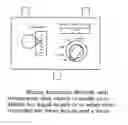
FIG. 2: Shows a possible embodiment of the mixing apparatus with temperature dial, switch to enable or to disable the hot water supply, or to select the timer controlled hot water supply and a dial to set the timer.
FIG. 3: Shows the principle of a mechanical mixing unit with 3 different settings.
DETAILED DESCRIPTIONIn a preferred embodiment the mixing apparatus is realised substantially without electronics and “high-tech” components. The adjustment of the mixing-ratio of the in-flowing cold and hot liquid is accomplished by a principle where valves are connected and moved mechanically. One possible realisation of this principle is depicted in FIG. 3a-3c. Here a lever can be moved between two limits. One limit corresponds to the setting where only the flow of cold liquid is enabled (FIG. 3a). The other limit permits the flow of hot liquid only (FIG. 3c). All the settings between these limits correspond to certain mixing-ratios of cold and hot liquid. FIG. 3b shows one such setting. Of course other mechanical solutions with valves are thinkable too. A certain mixing-ratio of cold and hot liquid however does not guarantee a certain temperature of the resulting out-flowing liquid since it also depends on the temperature and the pressure of the cold and hot in-flowing liquids. For a certain location these conditions may not vary very much, the pressure, for example could be stabilised by pressure limiters. The most significant variation in the conditions of the in-flowing liquids may exits most likely in the temperature of the hot liquid, especially if water, heated by solar energy is used.
To set the mixing-ratio a lever or knob is moved, in accordance with this movement a pointer moves along a scale (FIG. 3a). The scale can carry the values of the corresponding mixing-ratios or temperature values of the desired temperature of the out-flowing liquid.
Such a temperature-scale preferably takes into account the conditions of the in-flowing liquids. Different scales, adjusted to a certain set of conditions, may be employed. These scales may be printed onto inserts which can be replaced by the user. A number of such insets can be prepared for a variety of conditions. In addition empty describable inserts may allow the user to make her own marks for different washing modes under certain conditions.
To monitor the temperature of the out-flowing liquid a thermometer may be incorporated in the flow of the combined liquids. A further thermometer may also be used to check the temperature of the in-flowing hot liquid and perhaps another to check the temperature of the in-flowing cold liquid too.
Most washing machines, in later states of the washing program, use cold water to flush the laundry or the dishes. To use pre-warmed water here also, would in many cases be a waste of energy. Because of that a timing mechanism may be introduced. This timer may be started with the beginning of the washing operation and set for a certain period of time. This period of time may be set by the user and determines after which time, measured from the activation, the supply of hot water is reduced or inhibited. The period of time is preferably set to a duration sufficient to supply the washing operation when pre-warmed water is required, but should preferably also be short enough that substantially no hot water is wasted for the flushing. A simple realisation may consists of, but is not limited to, a spring-loaded valve that is triggered with an “egg-clock”-type of timer. When the timer expires the spring-loaded valve is triggered and then closed in this way. In addition a switch can be incorporated which enables or disables the hot water supply or selects the timer controlled hot water supply. A possible arrangement of these controls on the apparatus is depicted in FIG. 2.
Alternatively in a more comfortable embodiment of the invention, differing temperatures of the in-flowing liquids may be taken into account and be compensated automatically. Such a mechanism can, for example, be realised by a negative feedback of the resulting temperature to a valve that controls the flow of the in-flowing hot liquid. Such a feedback could also adjust the mixing ratio. Mechanically such mechanism can be implemented, for example, by the use of bimetallic elements acting as a sensor and an actuator simultaneously. The control mechanism can also be realised by electronics employing electromechanical actuators and appropriate sensors.
Additionally, an interface may be introduced which allows the control of the apparatus externally, for example, by the washing machine. In this way the mixing ratio may be controlled or also the timing of the flow of the different liquids.
Claims
1. An apparatus as external adapter for washing machines to supply the water feed of the washing machine with pre-warmed liquid which is generated by mixing liquids of different temperature supplied to the apparatus.
2. An apparatus, according to claim 1, which generates out of a user temperature-setting the proper mixing ratio of liquids to match the temperature of the resulting out-flowing liquid with the user temperature-setting in a suitable way.
3. An apparatus according to claim 2 or claim 1, where the user-set position-setting of a lever or a knob corresponds to a mixing ratio of cold and hot liquid.
4. An apparatus according to claim 3, including a fastening for interchangeable inserts with different scales, where the lever or knob is moved or turned along, respectively. Each of the interchangeable inserts may correspond to combinations of cold and hot liquid supply temperatures and pressures. The scales on the inserts may carry marks of the desired temperatures of the out-flowing liquid, where, if the lever or knob is aligned with, may correspond to the required mixing ratio of the cold and hot liquid under certain conditions of the temperature and pressure of the cold and hot in-flowing liquids. In addition an empty inscribeable insert can be used for the user to make her own marks for different washing modes under certain conditions.
5. An apparatus according to any of the previous claims (claim1 or claim2 or claim 3 or claim4), including a thermometer to check the temperature of the out-flowing liquid.
6. An apparatus according to any of the previous claims (claim 1 or claim2 or claim 3 or claim4 or claim5), including one or more thermometers to check one or more temperatures of the in-flowing liquids.
7. An apparatus according to claim 1 or claim 2, including a mechanism which determines and sets the mixing ratio of the different in-flowing liquids according to the user-setting of the desired temperature of the out-flowing liquid where the temperature and/or pressure conditions of the in-flowing liquids are taken into account.
8. An apparatus according to claim 7, employing bimetallic sensor/actuator elements.
9. An apparatus according to claim 8 where some bimetallic elements are replaced by electronic sensors and actuators and also electronic components may be employed to realise the proper control functions.
10. An apparatus according to any of the previous claims (claim1 or claim2 or claim 3 or claim4 or claim5 or claim6 or claim7 or claim8 or claim9), including an additional timer which controls one or more inlets for heated liquids in the following way: The timer can be set to a certain duration. When the timer is started, the controlled inlets are enabled, after the timer has expired after the set duration, the controlled inlets are disabled.
11. An apparatus according to claim 10, where the whole timer control mechanism can be enabled or disabled.
12. An apparatus according to any of the previous claims (claim1 or claim2 or claim 3 or claim4 or claim5 or claim6 or claim7 or claim8 or claim9 or claim10 or claim11), including pressure limiters for one or more in-flowing liquids.
13. An apparatus according to claim 1, where the throughput of the in-flowing liquid is controlled by a source external to the apparatus, for example the washing machine itself. Sensor data from the apparatus may be provided to external devices.
14. The method of supplying the water feed of a washing machine with pre-warmed liquid by mixing liquids of different temperature.
Images & Drawings included:

Sources:
- United States Patent and Trademark Office - verify current appl. status at the USPTO↗
Recent applications in this class:
- » 20250146208 2025-05-08
CLOTHING PROCESSING APPARATUS AND METHOD FOR CONTROLLING CLOTHING PROCESSING APPARATUS - » 20250129538 2025-04-24
WATER JET SYSTEM FOR A WASHING MACHINE APPLIANCE - » 20250116051 2025-04-10
EJECTOR, DISPENSING DEVICE AND LAUNDRY TREATMENT APPLIANCE - » 20250066983 2025-02-27
CLOTHES CARE APPARATUS - » 20250066982 2025-02-27
DETERGENT COMPARTMENT AND LAUNDRY PROCESSING DEVICE - » 20240376659 2024-11-14
DISPENSING SYSTEM OF LAUNDRY TREATMENT APPARATUS, AND LAUNDRY TREATMENT APPARATUS HAVING SAME - » 20240352649 2024-10-24
Valve support bracket for torsional support of fluid valves during installation of a rotational fitting - » 20240301611 2024-09-12
WASHING MACHINE OUTLET BOX COVERS - » 20240200258 2024-06-20
WATER-GUIDING DOMESTIC APPLIANCE - » 20240150953 2024-05-09
WATER BEARING APPLIANCE, CONTROL METHOD, AND SYSTEM