Roofing tile and snow-melting, tiled roof using the same
US20050198917A1
2005-09-15
11/074,573
2005-03-08
Abstract:
A tile is made of a fire-resistant ceramic, which is obtained by mixing and kneading defatted bran obtained from rice bran and a thermosetting resin, primarily baking the resulting mixture in an inert gas at 700° C. to 1000° C., crushing the resulting product into carbonized powder, mixing and kneading the carbonized powder with a ceramic powder, a solvent and, optionally, a binder to provide a plasticized mixture (ceramic-solvent mixture), pressure-forming the mixture at a compression pressure of 10 MPa to 100 MPa, and heat-treating the resulting compact again in an atmosphere of an inert gas at 500 to 1400° C.
Interested in similar patents?
Get notified when new applications in this technology area are published.
Classification:
E04D13/103 » CPC main
Special arrangements or devices in connection with roof coverings; Protection against birds ; Roof drainage; Sky-lights; Snow traps ; Removing snow from roofs; Snow melters De-icing devices or snow melters
C04B18/101 » CPC further
Use of agglomerated or waste materials or refuse as fillers for mortars, concrete or artificial stone ; Treatment of agglomerated or waste materials or refuse, specially adapted to enhance their filling properties in mortars, concrete or artificial stone; Waste materials; Refuse; Combustion residues, e.g. purification products of smoke, fumes or exhaust gases; Burned or pyrolised refuse Burned rice husks or other burned vegetable material
C04B33/132 » CPC further
Clay-wares; Preparing or treating the raw materials individually or as batches; Compounding ingredients Waste materials; Refuse
C04B33/135 » CPC further
Clay-wares; Preparing or treating the raw materials individually or as batches; Compounding ingredients; Waste materials; Refuse Combustion residues, e.g. fly ash, incineration waste
C04B33/20 » CPC further
Clay-wares; Preparing or treating the raw materials individually or as batches for dry-pressing
C04B33/32 » CPC further
Clay-wares Burning methods
C04B33/36 » CPC further
Clay-wares Reinforced clay-wares
C04B35/10 » CPC further
Shaped ceramic products characterised by their composition ; Ceramics compositions ; Processing powders of inorganic compounds preparatory to the manufacturing of ceramic products based on oxide ceramics based on aluminium oxide
C04B35/14 » CPC further
Shaped ceramic products characterised by their composition ; Ceramics compositions ; Processing powders of inorganic compounds preparatory to the manufacturing of ceramic products based on oxide ceramics based on silica
C04B35/48 » CPC further
Shaped ceramic products characterised by their composition ; Ceramics compositions ; Processing powders of inorganic compounds preparatory to the manufacturing of ceramic products based on oxide ceramics based on zirconium or hafnium oxides, zirconates, zircon or hafnates
C04B35/5626 » CPC further
Shaped ceramic products characterised by their composition ; Ceramics compositions ; Processing powders of inorganic compounds preparatory to the manufacturing of ceramic products based on non-oxide ceramics based on carbides or oxycarbides based on refractory metal carbides based on tungsten carbides
C04B35/565 » CPC further
Shaped ceramic products characterised by their composition ; Ceramics compositions ; Processing powders of inorganic compounds preparatory to the manufacturing of ceramic products based on non-oxide ceramics based on carbides or oxycarbides based on silicon carbide
C04B35/583 » CPC further
Shaped ceramic products characterised by their composition ; Ceramics compositions ; Processing powders of inorganic compounds preparatory to the manufacturing of ceramic products based on non-oxide ceramics based on borides, nitrides, or silicides based on boron nitride
C04B35/584 » CPC further
Shaped ceramic products characterised by their composition ; Ceramics compositions ; Processing powders of inorganic compounds preparatory to the manufacturing of ceramic products based on non-oxide ceramics based on borides, nitrides, or silicides based on silicon nitride
C04B35/597 » CPC further
Shaped ceramic products characterised by their composition ; Ceramics compositions ; Processing powders of inorganic compounds preparatory to the manufacturing of ceramic products based on non-oxide ceramics based on borides, nitrides, or silicides based on silicon oxynitride, e.g. SIALONS
C04B35/62204 » CPC further
Shaped ceramic products characterised by their composition ; Ceramics compositions ; Processing powders of inorganic compounds preparatory to the manufacturing of ceramic products; Forming processes; Processing powders of inorganic compounds preparatory to the manufacturing of ceramic products using waste materials or refuse
C04B35/62213 » CPC further
Shaped ceramic products characterised by their composition ; Ceramics compositions ; Processing powders of inorganic compounds preparatory to the manufacturing of ceramic products; Forming processes; Processing powders of inorganic compounds preparatory to the manufacturing of ceramic products using waste materials or refuse using rice material, e.g. bran or hulls or husks
C04B35/6262 » CPC further
Shaped ceramic products characterised by their composition ; Ceramics compositions ; Processing powders of inorganic compounds preparatory to the manufacturing of ceramic products; Forming processes; Processing powders of inorganic compounds preparatory to the manufacturing of ceramic products; Preparing or treating the powders individually or as batches ; preparing or treating macroscopic reinforcing agents for ceramic products, e.g. fibres; mechanical aspects section; Treating the starting powders individually or as mixtures; Milling of calcined, sintered clinker or ceramics
C04B35/6263 » CPC further
Shaped ceramic products characterised by their composition ; Ceramics compositions ; Processing powders of inorganic compounds preparatory to the manufacturing of ceramic products; Forming processes; Processing powders of inorganic compounds preparatory to the manufacturing of ceramic products; Preparing or treating the powders individually or as batches ; preparing or treating macroscopic reinforcing agents for ceramic products, e.g. fibres; mechanical aspects section; Treating the starting powders individually or as mixtures; Wet mixtures characterised by their solids loadings, i.e. the percentage of solids
C04B35/6264 » CPC further
Shaped ceramic products characterised by their composition ; Ceramics compositions ; Processing powders of inorganic compounds preparatory to the manufacturing of ceramic products; Forming processes; Processing powders of inorganic compounds preparatory to the manufacturing of ceramic products; Preparing or treating the powders individually or as batches ; preparing or treating macroscopic reinforcing agents for ceramic products, e.g. fibres; mechanical aspects section; Treating the starting powders individually or as mixtures; Wet mixtures Mixing media, e.g. organic solvents
C04B35/6309 » CPC further
Shaped ceramic products characterised by their composition ; Ceramics compositions ; Processing powders of inorganic compounds preparatory to the manufacturing of ceramic products; Forming processes; Processing powders of inorganic compounds preparatory to the manufacturing of ceramic products; Preparing or treating the powders individually or as batches ; preparing or treating macroscopic reinforcing agents for ceramic products, e.g. fibres; mechanical aspects section using additives specially adapted for forming the products, e.g.. binder binders; Inorganic additives; Binders based on phosphoric acids or phosphates Aluminium phosphates
E04D1/34 » CPC further
Roof covering by making use of tiles, slates, shingles, or other small roofing elements Fastenings for attaching roof-covering elements to the supporting elements
E04D12/004 » CPC further
Non-structural supports for roofing materials, e.g. battens, boards Battens
C04B2235/3201 » CPC further
Aspects relating to ceramic starting mixtures or sintered ceramic products; Composition of constituents of the starting material or of secondary phases of the final product; Constituents and secondary phases not being of a fibrous nature; Metal oxides, mixed metal oxides, or oxide-forming salts thereof, e.g. carbonates, nitrates, (oxy)hydroxides, chlorides Alkali metal oxides or oxide-forming salts thereof
C04B2235/3217 » CPC further
Aspects relating to ceramic starting mixtures or sintered ceramic products; Composition of constituents of the starting material or of secondary phases of the final product; Constituents and secondary phases not being of a fibrous nature; Metal oxides, mixed metal oxides, or oxide-forming salts thereof, e.g. carbonates, nitrates, (oxy)hydroxides, chlorides Aluminum oxide or oxide forming salts thereof, e.g. bauxite, alpha-alumina
C04B2235/3244 » CPC further
Aspects relating to ceramic starting mixtures or sintered ceramic products; Composition of constituents of the starting material or of secondary phases of the final product; Constituents and secondary phases not being of a fibrous nature; Metal oxides, mixed metal oxides, or oxide-forming salts thereof, e.g. carbonates, nitrates, (oxy)hydroxides, chlorides; Refractory metal oxides, their mixed metal oxides, or oxide-forming salts thereof Zirconium oxides, zirconates, hafnium oxides, hafnates, or oxide-forming salts thereof
C04B2235/3418 » CPC further
Aspects relating to ceramic starting mixtures or sintered ceramic products; Composition of constituents of the starting material or of secondary phases of the final product; Constituents and secondary phases not being of a fibrous nature; Non-metal oxides, non-metal mixed oxides, or salts thereof that form the non-metal oxides upon heating, e.g. carbonates, nitrates, (oxy)hydroxides, chlorides Silicon oxide, silicic acids, or oxide forming salts thereof, e.g. silica sol, fused silica, silica fume, cristobalite, quartz or flint
C04B2235/3427 » CPC further
Aspects relating to ceramic starting mixtures or sintered ceramic products; Composition of constituents of the starting material or of secondary phases of the final product; Constituents and secondary phases not being of a fibrous nature; Non-metal oxides, non-metal mixed oxides, or salts thereof that form the non-metal oxides upon heating, e.g. carbonates, nitrates, (oxy)hydroxides, chlorides Silicates other than clay, e.g. water glass
C04B2235/349 » CPC further
Aspects relating to ceramic starting mixtures or sintered ceramic products; Composition of constituents of the starting material or of secondary phases of the final product; Constituents and secondary phases not being of a fibrous nature; Non-metal oxides, non-metal mixed oxides, or salts thereof that form the non-metal oxides upon heating, e.g. carbonates, nitrates, (oxy)hydroxides, chlorides Clays, e.g. bentonites, smectites such as montmorillonite, vermiculites or kaolines, e.g. illite, talc or sepiolite
C04B2235/3826 » CPC further
Aspects relating to ceramic starting mixtures or sintered ceramic products; Composition of constituents of the starting material or of secondary phases of the final product; Constituents and secondary phases not being of a fibrous nature; Non-oxide ceramic constituents or additives; Carbides Silicon carbides
C04B2235/3843 » CPC further
Aspects relating to ceramic starting mixtures or sintered ceramic products; Composition of constituents of the starting material or of secondary phases of the final product; Constituents and secondary phases not being of a fibrous nature; Non-oxide ceramic constituents or additives; Carbides; Refractory metal carbides Titanium carbides
C04B2235/3847 » CPC further
Aspects relating to ceramic starting mixtures or sintered ceramic products; Composition of constituents of the starting material or of secondary phases of the final product; Constituents and secondary phases not being of a fibrous nature; Non-oxide ceramic constituents or additives; Carbides; Refractory metal carbides Tungsten carbides
C04B2235/386 » CPC further
Aspects relating to ceramic starting mixtures or sintered ceramic products; Composition of constituents of the starting material or of secondary phases of the final product; Constituents and secondary phases not being of a fibrous nature; Non-oxide ceramic constituents or additives; Nitrides, e.g. oxynitrides, carbonitrides, oxycarbonitrides, lithium nitride, magnesium nitride Boron nitrides
C04B2235/3869 » CPC further
Aspects relating to ceramic starting mixtures or sintered ceramic products; Composition of constituents of the starting material or of secondary phases of the final product; Constituents and secondary phases not being of a fibrous nature; Non-oxide ceramic constituents or additives; Nitrides, e.g. oxynitrides, carbonitrides, oxycarbonitrides, lithium nitride, magnesium nitride; Aluminium nitrides Aluminium oxynitrides, e.g. AlON, sialon
C04B2235/3873 » CPC further
Aspects relating to ceramic starting mixtures or sintered ceramic products; Composition of constituents of the starting material or of secondary phases of the final product; Constituents and secondary phases not being of a fibrous nature; Non-oxide ceramic constituents or additives; Nitrides, e.g. oxynitrides, carbonitrides, oxycarbonitrides, lithium nitride, magnesium nitride Silicon nitrides, e.g. silicon carbonitride, silicon oxynitride
C04B2235/48 » CPC further
Aspects relating to ceramic starting mixtures or sintered ceramic products; Composition of constituents of the starting material or of secondary phases of the final product; Constituents and secondary phases not being of a fibrous nature Organic compounds becoming part of a ceramic after heat treatment, e.g. carbonising phenol resins
C04B2235/5436 » CPC further
Aspects relating to ceramic starting mixtures or sintered ceramic products; Composition of constituents of the starting material or of secondary phases of the final product; Constituents or additives of the starting mixture chosen for their shape or used because of their shape or their physical appearance; Particle size related information expressed by the size of the particles or aggregates thereof micrometer sized, i.e. from 1 to 100 micron
C04B2235/604 » CPC further
Aspects relating to ceramic starting mixtures or sintered ceramic products; Aspects relating to the preparation, properties or mechanical treatment of green bodies or pre-forms Pressing at temperatures other than sintering temperatures
C04B2235/6562 » CPC further
Aspects relating to ceramic starting mixtures or sintered ceramic products; Aspects relating to heat treatments of ceramic bodies such as green ceramics or pre-sintered ceramics, e.g. burning, sintering or melting processes characterised by specific heating conditions during heat treatment Heating rate
C04B2235/6565 » CPC further
Aspects relating to ceramic starting mixtures or sintered ceramic products; Aspects relating to heat treatments of ceramic bodies such as green ceramics or pre-sintered ceramics, e.g. burning, sintering or melting processes characterised by specific heating conditions during heat treatment Cooling rate
C04B2235/6567 » CPC further
Aspects relating to ceramic starting mixtures or sintered ceramic products; Aspects relating to heat treatments of ceramic bodies such as green ceramics or pre-sintered ceramics, e.g. burning, sintering or melting processes characterised by specific heating conditions during heat treatment Treatment time
C04B2235/94 » CPC further
Aspects relating to ceramic starting mixtures or sintered ceramic products; Aspects relating to sintered or melt-casted ceramic products Products characterised by their shape
E04D2001/345 » CPC further
Roof covering by making use of tiles, slates, shingles, or other small roofing elements; Fastenings for attaching roof-covering elements to the supporting elements characterised by the roof covering or structure with integral or premounted fastening means the fastening means being integral or premounted to the roof structure
E04D2001/3455 » CPC further
Roof covering by making use of tiles, slates, shingles, or other small roofing elements; Fastenings for attaching roof-covering elements to the supporting elements characterised by the location of the fastening means on the internal surface of the roof covering elements
E04D2001/3473 » CPC further
Roof covering by making use of tiles, slates, shingles, or other small roofing elements; Fastenings for attaching roof-covering elements to the supporting elements characterised by the fastening pattern fastening single roof elements to the roof structure with or without indirect clamping of neighbouring roof covering elements
Y02P40/60 » CPC further
Technologies relating to the processing of minerals Production of ceramic materials or ceramic elements, e.g. substitution of clay or shale by alternative raw materials, e.g. ashes
Y02P40/60 » CPC further
Technologies relating to the processing of minerals Production of ceramic materials or ceramic elements, e.g. substitution of clay or shale by alternative raw materials, e.g. ashes
Y02W30/91 » CPC further
Technologies for solid waste management; Reuse, recycling or recovery technologies Use of waste materials as fillers for mortars or concrete
Y02W30/91 » CPC further
Technologies for solid waste management; Reuse, recycling or recovery technologies Use of waste materials as fillers for mortars or concrete
Description
CROSS-REFERENCE TO RELATED APPLICATIONSThis application is a continuation-in-part of U.S. Ser. No. 10/125,797, filed on Apr. 18, 2002.
BACKGROUND OF THE INVENTION1. Field of the Invention
This invention relates to a roofing tile made of a novel type of fire resistant CRB ceramic material and also to a snow-melting roof structure using the same.
2. Description of Prior Art
Currently employed materials used for making roofing tiles include clay and cement. An ordinary roofing tile is so thick that the weight per unit tile is very great, thus imposing a great load on pillars supporting the roof.
Roofing tiles used for a snow-melting roof are also made of clay or cement, thus presenting the problem that a great load is imposed on the pillars supporting a roof as well.
Moreover, with the tiles used for a snow-melting roof, it is essential to build a heating element in individual tiles.
SUMMARY OF THE INVENTIONAn object of the invention is to provide a roofing tile which overcomes the drawbacks of the prior-art counterparts and which is lightweight, weatherable and resistant to corrosion and is unlikely to suffer an influence of a change in humidity along with the ease in fabrication.
Another object of the invention is to provide a snow-melting roof structure using such roofing tiles as mentioned above.
A further object of the present invention is to provide an environmentally friendly, fire-resistant roofing tile and a snow-melting roof having a light weight, good strength and that are easy to manufacture.
The roofing tile of the invention fundamentally makes use of a fire-resistant CRB ceramic obtained by improving an RB ceramic and/or a CRB ceramic.
The RB ceramic and CRB ceramic are those materials made according to the following process.
The carbon material obtained by using rice bran produced at 900,000 tons/year in Japan and at 33,000,000 tons/year in the world is known according to the studies made by Kazuo Hokkirigawa, one of the co-inventors of this application (see “Functional Materials” May 1997, Vol. 17, No. 5 pp. 24 to 28).
In this literature, reference is made to a carbon material (hereinafter referred to as the RB ceramic) and the preparation thereof wherein the material is obtained by mixing and kneading defatted bran derived from rice bran and a thermosetting resin, followed by drying a pressure-formed compact and carbonizing the dried compact in an atmosphere of an inert gas.
With such a method of forming the RB ceramic as described above, however, it has been practically difficult to form the compact with high precision because there occurs the discrepancy in dimensions by as much as 25% in terms of a contraction ratio of the dimensions of the compact obtained by pressure-forming to those of a finished compact obtained after baking the former in the inert gas. However, another ceramic (the CRB ceramic) representing an improvement on the RB ceramic has since been developed.
The CRB ceramic is made of an improved material of the RB ceramic that is obtained from defatted bran derived from rice bran and a thermosetting resin. More particularly, the defatted bran derived from rice bran and a thermosetting resin are mixed and kneaded and subjected to a primary baking in an inert gas at 700° C. to 1000° C., followed by crushing to a size of 60 mesh or below to obtain a carbonized powder. The powder and a thermosetting resin are mixed and kneaded, and pressure-formed at a pressure of 20 MPa to 30 MPa, and the resulting compact is heat-treated again in an atmosphere of an inert gas at 500° C. to 1100° C. to obtain porous ceramic. The greatest difference from the RB ceramic resides in that, in contrast with the RB ceramic having the contraction ratio of the dimensions of the compact obtained by pressure-forming to those of the finished compact at as high as 25%, the CRB ceramic is superior to the RB ceramic in respect of the contraction ratio at not more than 3%, which is very low.
The general properties of the RB ceramic and CRB ceramic, which may be employed as an electrical resistor for heat generation in the present invention are indicated below.
-
- high strength
- higher hardness
- smaller expansion coefficient
- good electrical conductivity
- specific gravity is small with a light weight
- excellent abrasion resistance
- easy to form and easy to produce in a die
- Ceramics having a diversity of features can be formed by formulation of different types of resins and ceramics.
- the material being made of rice bran, they have little adverse effect on global environment, and are recyclable, thereby leading to conservation of natural resources.
Hence, this ceramic material meets requirements, particularly, suited for application to buildings, such as good weatherability, light weight, excellent abrasion resistance, unlikeliness to damage, long life and the like. Especially, the ceramic obtained from the CRB ceramic having undergone a secondary heat treatment temperature of 500° C. or over is very high in hardness and porous, has good air permeability, is lightweight because of the small specific gravity and strong, and is thus excellent as an outdoor building material. Both an RB ceramic and a CRB ceramic can be recycled by transforming them into powder after use.
Although the RB ceramic exhibits a difference in contraction ratio between the dimension of a compact as formed and that of a finished compact as great as 25%, a roofing tile formed of the RB ceramic may be controlled in size by cutting the roofing tile made beforehand. Except for the final dimensions, both an RB ceramic and a CRB ceramic have substantially similar properties. In view of this, the use of an RB ceramic as a material for roofing tiles is possible. In this connection, because a higher dimensional accuracy is ensured by one forming, the use of a CRB ceramic is advantageous.
A good fire resistance is required for a roof tile used in a house or a building. As the RB ceramic and the CRB ceramic were not developed with special attention to impart a fire-resistant property to them, a new roof tile material having the excellent qualities of a CRB ceramic, such as a high strength, light weight and the like, combined with a superior fire-resistance was desired.
In order to provide a new material having the good qualities such as good weatherability, light weight, excellent abrasion resistance, unlikeliness to damage, long life and the like combined with an improved fire resistance, the primarily baked carbonized powder is mixed and kneaded with one or more of ceramic powders selected from the group consisting of SiO2, Si3N4, ZrO2, Al2O3, SiC, BN, WC, TiC, sialons, porcelain clay, feldspar clay and kaolin along with a solvent and, if desired, a binder, to provide a plasticized product (i.e. a kind of clay-water mixture). This is pressure-formed at a pressure of 10 MPa to 100 MPa and the resulting compact is heat-treated again in an atmosphere of an inert gas at 500° C. to 1400° C. to obtain a ceramic material. This improved fire-resistant ceramic material is used in the invention and hereinafter referred to as the fire-resistant CRB ceramic.
In the practice of the invention, the fire-resistant CRB ceramic that is weatherable, lightweight, hard and physically strong is preferably used as a material for a roofing tile. Due to the addition of conventional ceramic powder, the fire-resistant CRB ceramic shows a lower electrical conductivity and less porosity when compared to a RB ceramic or CRB ceramic, which means a better quality for roof tile application.
The inventor made roofing tiles from the fire-resistant CRB ceramic material and found that different types of roofing tiles having a diversity of characteristic properties can be made.
Moreover, it has also been found that when conventional ceramics or steel-based metal materials are used in appropriate combinations, roofing tiles having more diverse characteristic properties can be made.
More particularly, the invention provides a black, hard and lightweight roofing tile which is made of a fire-resistant CRB ceramic and in which an electrical resistor for heat generation made of an RB ceramic, a CRB ceramic or a metal material, such as a nichrome wire, is incorporated, and also a snow-melting roof structure using the tiles.
Additionally, the present invention also provides a hard and lightweight roofing tile which is made of a fire-resistant CRB ceramic and utilizes an RB ceramic or CRB ceramic as a resistive material through which an electric current is passed to heat the roofing tile. This kind of structure is possible because a fire-resistant CRB ceramic does not have a good electrical conductivity like an RB ceramic or CRB ceramic. Since this embodiment of the present invention does not contain a metallic resistive heating element, it can easily be recycled by transforming the used tile into a powder which can be used in the manufacture of the fire-resistant CRB ceramic without a separating step being necessary for the removal of a metal resistive element.
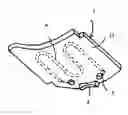
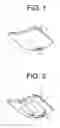
BRIEF DESCRIPTION OF THE DRAWINGSFIG. 1 is a schematic perspective view of a roofing tile according to the invention;
FIG. 2 is a schematic perspective view of a roofing tile including a heating element therein; and
FIG. 3 is an illustrative view showing a snow-melting roof structure according to the invention.
EMBODIMENTS OF THE INVENTIONThe fire-resistant CRB ceramic, RB ceramic or CRB ceramic materials according to the invention is made of defatted bran irrespective of the kind of rice and may be of either domestic or foreign origin.
Further, for the thermosetting resin, any thermosetting resin may be used as long as it has a thermosetting property, and typical examples thereof include phenolic resins, diaryl phthalate resins, unsaturated polyester resins, epoxy resins, polyimide resins, and triazine resins, of which phenolic resins are preferably used.
Furthermore, a thermoplastic resin such as a polyamide and the like may also be used in combination in such amounts as not to depart from the spirit and scope of the invention.
The mixing ratio by weight between the defatted bran and the thermosetting resin ranges from 50:50 to 90:10, preferably 70:30 to 80:20.
Next, a method of preparing the fire-resistant CRB ceramic material is briefly described hereinafter.
The defatted bran derived from rice bran and a thermosetting resin are mixed and kneaded, and primarily baked in an inert gas at 700° C. to 1000° C., followed by crushing the resulting carbonized compact into powder. The carbonized powder is mixed with a conventional ceramic powder, a solvent and a binder to form a plasticized mixture. A powder of recycled RB ceramic, recycled CRB ceramic and recycled fire-resistant CRB ceramic may also be mixed, individually or in combination, with the plasticized mixture to partly replace the carbonized powder. The plasticized mixture is further pressure-formed in the final shape at a pressure of 10 MPa to 100 MPa, and the resulting compact is heat-treated again in an atmosphere of an inert gas at 500° C. to 1400° C. The die temperature is preferably at about 150° C.
The thermosetting resin used for the primary baking should preferably be a liquid resin having a relatively small molecular weight.
For the primary baking, it is usual to use a rotary kiln, and the baking time ranges from about 40 to 120 minutes. The mixing ratio between the carbonized powder obtained through the primary baking and the ceramic powder ranges from 5:95 to 95:5 on the weight basis. To calculate the mixing ratio, the powder of recycled RB ceramic, recycled CRB ceramic or recycled fire-resistant CRB ceramic should be considered as a carbonized powder. The binder is added to the sum of carbonized powder and the ceramic powder in a mixing ratio by weight ranging from 1:100 to 50:100.
For the heat treatment, a well controlled electric furnace is normally employed, and the heat-treating time ranges from about 60 to 360 minutes.
A preferred heat-treating temperature ranges from 600° C. to 1100° C., and a heating rate before reaching the heat-treating temperature is such that a relatively moderate temperature rise is required up to 500° C. More particularly, the heating rate is at 0.5 to 2° C./minute, preferably about 1° C./minute.
In order to lower the temperature after baking by such a heat treatment, a cooling rate is required to be relatively moderate until reaching 500° C. Upon the temperature dropping below 500° C., the compact is left to cool by itself. More particularly, the cooling rate is at 0.5 to 4° C./minute, preferably at about 1° C./minute. The inert gas used in the primary baking and heat treatment may be any of helium, argon, neon or nitrogen gas, of which nitrogen gas is preferred. It will be noted that the fire-resistant CRB ceramic used in the invention should preferably be dehydrated at a temperature of 100° C. after forming.
The roofing tile of the invention can be made by integrally assembling or building an electrical resistor for heat generation made of an RB ceramic, a CRB ceramic or a metal material such as a nichrome wire in a fire-resistant CRB ceramic tile when formed.
As a matter of course, clay, cement, metals, synthetic resins, which are ordinarily employed as a conventional tile material, may also be used in combination with the fire-resistant CRB ceramic material.
Examples of the conventional ceramic powder used to form the fire-resistant CRB ceramic include SiO2, Si3N4, ZrO2, Al2O3, SiC, BN, WC, TiC, sialons (Si—Al—O—N-based compound solid solutions), porcelain clay, feldspar clay, kaolin and the like. These ceramic powders may be used singly or in combinations of two or more. The mixing ratio to the carbonized powder is conveniently in the range of 10:100 to 150:100 on the weight basis.
The embodiments of the invention are summarized below.
(1) A roofing tile comprising a fire-resistant CRB ceramic, said fire-resistant CRB ceramic being obtained by providing a defatted bran derived from rice bran, mixing the defatted bran with a thermosetting resin comprising at least one resin selected from the group consisting of a phenolic resin, a diaryl phthalate resin, an unsaturated polyester resin, an epoxy resin, a polyimide resin and a triazine resin at a mixing ratio by weight between the defatted bran and the thermosetting resin of 50:50 to 90:10 to form a first mixture, kneading the first mixture, baking the first mixture in an inert gas at a temperature of 700° C. to 1000° C. to form a first compact, crushing the first compact into carbonized powder, mixing the carbonized powder with a ceramic powder, a solvent and a binder to form a plasticized mixture, the ceramic powder being at least one member selected from the group consisting of SiO2, Si3N4, ZrO2, Al2O3, SiC, BN, WC, TiC, a sialon, porcelain clay, feldspar clay and kaolin, the mixing ratio by weight between the carbonized powder and the ceramic powder ranging from 5:95 to 95:5 and the binder being added to the sum of the carbonized powder and the ceramic powder in a mixing ratio by weight therebetween of 1:100 to 50:100, pressure-forming the plasticized mixture at a pressure of 10 to 100 MPa to form a second compact and heat-treating the second compact in an inert gas atmosphere or an atmosphere not containing oxygen at a temperature of from 500° C. to 1400° C.
(2) The roofing tile as recited in (1) above additionally comprising a projection integrally formed therewith for fixing the tile to a cleat.
(3) The roofing tile as recited in (1) above, additionally comprising terminal holes provided in the tile for permitting passage of an electric current.
(4) The roofing tile as recited in (1) above, additionally comprising an electrical resistor integrally embedded inside the tile for heat generation.
(5) The roofing tile as recited in (4) above, wherein the electrical resistor is made of a nichrome wire, an RB ceramic or a CRB ceramic.
(6) The roofing tile as recited in (4) above, wherein the electrical resistor is made of an RB ceramic or a CRB ceramic.
(7) The roofing tile as recited in (6) above, wherein the electrical resistor is made of a CRB ceramic.
(8) A snow-melting roof comprising a plurality of roofing tiles, each individual roofing tile comprising a fire-resistant CRB ceramic, said fire-resistant CRB ceramic being obtained by providing a defatted bran derived from rice bran, mixing the defatted bran with a thermosetting resin comprising at least one resin selected from the group consisting of a phenolic resin, a diaryl phthalate resin, an unsaturated polyester resin, an epoxy resin, a polyimide resin and a triazine resin at a mixing ratio by weight between the defatted bran and the thermosetting resin of 50:50 to 90:10 to form a first mixture, kneading the first mixture, baking the first mixture in an inert gas at a temperature of 700° C. to 1000° C. to form a first compact, crushing the first compact into carbonized powder, mixing the carbonized powder with a ceramic powder, a solvent and a binder to form a plasticized mixture, the ceramic powder being at least one member selected from the group consisting of SiO2, Si3N4, ZrO2, Al2O3, SiC, BN, WC, TiC, a sialon, porcelain clay, feldspar clay and kaolin, the mixing ratio by weight between the carbonized powder and the ceramic powder ranging from 5:95 to 95:5 and the binder being added to the sum of the carbonized powder and the ceramic powder in a mixing ratio by weight therebetween of 1:100 to 50:100, pressure-forming the plasticized mixture at a pressure of 10 to 100 MPa to form a second compact and heat-treating the second compact in an inert gas atmosphere or an atmosphere not containing oxygen at a temperature of from 500° C. to 1400° C., each individual roofing tile additionally comprising terminal holes containing terminals of a conductive member embedded therein.
(9) The snow-melting roof as recited in (8) above, additionally comprising a crosspiece having a plurality of terminals and lead wires connecting said terminals, said crosspiece terminals being inserted in the terminal holes of the tiles to allow the tiles to be electrically connected with one another such that when an electric potential is applied across the plurality of roofing tiles, heat is generated by the conductive members embedded therein to permit the melting of snow.
(10) The snow-melting roof as recited in (8) above, wherein the conductive member is made of nichrome wire, an RB ceramic or a CRB ceramic.
(11) The snow-melting roof as recited in (10) above, wherein the conductive member is made of an RB ceramic or a CRB ceramic.
(12) The snow-melting roof as recited in (11) above, wherein the conductive member is made of a CRB ceramic.
(13) The roofing tile as recited in (1) above, wherein the fire-resistant CRB ceramic contains at least one recycled material selected from the group of a recycled RB ceramic, a recycled CRB ceramic and a recycled fire-resistant CRB ceramic.
(14) The snow-melting roof as recited in (8) above, wherein the fire-resistant CRB ceramic contains at least one recycled material selected from the group of a recycled RB ceramic, a recycled CRB ceramic and a recycled fire-resistant CRB ceramic.
Reference is now made to FIGS. 1 to 3, showing a tile 1 with a standard dimension. The tile 1 has a projection 2 and terminal holes 3 (which are shown as a female type, but may be of the male type), both provided at back side 11 of the tile 1. The tile also has a resistor 4, which may be provided, if necessary, and works as a heater. In FIG. 3, a crosspiece 5 for tiles is shown as having terminals 6 (shown as a male type, but a female type may be used) and lead wires 7 connecting the terminals therewith.
The projection 2 is a protruded portion for fixing tiles to the crosspiece 5. This is not always formed as a projection. Alternatively, a through-hole may be made in individual tiles for fixing with a wire, a bolt and nut, a weatherable rope or the like.
As is particularly shown in FIG. 3, one tile and an adjacent tile are electrically connected with each other by inserting the terminals 6 (shown as a male type although a female type may be used) into corresponding terminal holes 3 of the tiles to be electrically connected via the lead wire 7 in a manner as shown. In this way, the tiles over the entire roof are electrically connected with one another to complete a snow-melting roof structure.
This structure ensures passage of an electric current to individual tiles and enables one to confirm the current passage.
The resistor 4 can be built in the tile by embedding a metal conductor, such as a nichrome wire or the like, when forming the tile which can then be baked together. In this connection, however, the resistor working as a heater should not be always a metal resistor.
For instance, an RB ceramic or CRB ceramic material is electrically conductive in nature. Such an RB ceramic or CRB ceramic is formed in the form of a heating element beforehand and can be integrated with the fire-resistant CRB ceramics when the fire-resistant CRB ceramics is subjected to a secondary heat treatment.
Further, the resistor 4 may be formed on the back surface of the tile by means of a weatherable conductive ink or paint.
The tile of the invention may be used in the field of applications other than snow-melting roof. Because of the light weight and good weatherability, earthquake-proofing of a house can be enhanced as a whole.
The tile of the invention is black in color after molding, and a desired hue can be imparted to the tile by applying thereto a coating, preferably an inorganic coating dispersing a pigment in an inorganic vehicle.
The tile of the invention is fundamentally lightweight, hard and physically strong along with a high resistance to corrosion and excellent fire-proofing properties. If the mixing ratio of ceramic powder, secondary heat-treating temperature and the like conditions are properly controlled, a diversity of properties may be imparted to a final tile.
The invention is more particularly described by way of examples, which should not be construed as limiting the invention thereto.
EXAMPLE 1(Preparation of Fire-Resistant CRB Ceramic)
55 kg of defatted bran derived from rice bran and 45 kg of a liquid phenolic resin (resol) were mixed and kneaded while heating to 50° C. to 60° C. A plastic homogeneous mixture was obtained.
The mixture was subjected to a baking in a rotary kiln in an atmosphere of nitrogen at 1000° C. for 70 minutes. The resulting carbonized, baked compact was crushed by means of a crusher and sieved through a 200 mesh screen to obtain a carbonized powder having an average particle size of 100 μm.
70 kg of the thus obtained carbonized powder, 10 kg of silica powder, 20 kg of alumina powder, 10 kg of a phenolic resin used as a binder, 5 kg of sodium silicate, and 15 kg of water and 5 kg of ethanol, both used as a solvent, were mixed and kneaded to obtain a homogeneous mixture having plasticity.
The silica used had a particle size of 5 to 10 μm and the alumina had a particle size of 10 to 20 μm.
(Forming of Fire-Resistant Tile)
Next, the plasticized mixture was subjected to pressure-forming at a pressure of 80 MPa to provide a tile 1 having a projection 2 as shown in FIG. 1. The temperature of the die was 150° C.
The compact was removed from the die, after which it was heated in an atmosphere of nitrogen at a heating rate of 2.5° C./minute up to 500° C. and maintained at 500° C. over 60 minutes, followed by sintering at 1150° C. to 1200° C. for 100 to 130 minutes.
Subsequently, the temperature was lowered to 500° C. at a cooling rate of 2° C. to 3° C./minute, and was allowed to cool naturally upon the temperature dropping below 500° C., thereby obtaining a tile compact.
(Characteristics of the Obtained Tile)
Hard and strong.
Good weatherability and corrosion resistance.
Good Fire-proofing properties.
EXAMPLE 2(Preparation of Fire-Resistant CRB Ceramic)
75 kg of defatted bran derived from rice bran and 25 kg of a liquid phenolic resin (resol) were mixed and kneaded while heating to 50° C. to 60° C. A plastic homogeneous mixture was obtained.
The mixture was subjected to a baking in a rotary kiln in an atmosphere of nitrogen at 900° C. for 60 minutes. The resulting carbonized, baked compact was crushed by means of a crusher and sieved through a 200 mesh screen to obtain a carbonized powder having an average particle size of 90 μm.
80 kg of the thus obtained carbonized powder, 60 kg of alumina powder, 10 kg of aluminum phosphate used as a binder, and 25 kg of water used as a solvent were mixed and kneaded to obtain a homogeneous mixture having plasticity.
The alumina used had an average particle size of 10 to 20 μm.
(Forming of Fire-Resistant Tile)
Next, a resistor 4 made of a nichrome wire was embedded in the plasticized mixture as shown in FIG. 2, followed by pressure-forming at a pressure of 50 MPa to provide a tile 1 having a projection 2 and female terminals 3. The temperature of the die was 150° C.
The compact was removed from the die, after which it was heated in an atmosphere of nitrogen at a heating rate of 2.0° C./minute up to 500° C. and maintained at 500° C. over 60 minutes, followed by sintering at 1100° C. for 100 to 130 minutes.
Subsequently, the temperature was lowered to 500° C. at a cooling rate of 2° C./minute, and was allowed to cool naturally upon the temperature dropping below 500° C., thereby obtaining a tile compact.
(Characteristics of the Obtained Tile)
The fire-resistant CRB ceramic has a specific gravity greater than that of the ceramic of Example 1, and is hard and resistant to heat.
The tile has good weatherability and corrosion resistance along with good fire-proofing properties.
EXAMPLE 3A fire-resistant CRB ceramic tile having a heating element made of a CRB ceramic is made in the following manner.
(Preparation of CRB Ceramic)
75 kg of defatted bran derived from rice bran and 25 kg of a liquid phenolic resin (resol) were mixed and kneaded while heating to 50° C. to 60° C. A plastic homogeneous mixture was obtained.
The mixture was subjected to a primary baking by use of a rotary kiln in an atmosphere of nitrogen at 900° C. for 60 minutes. The resultant carbonized, baked compact was crushed by means of a crusher and sieved through a 100 mesh screen to obtain a carbonized powder having a size of 50 to 250 μm.
75 kg of the thus obtained carbonized powder and 25 kg of a solid phenolic resin (resol) were mixed and kneaded while heating to 100° C. to 150° C. to obtain a homogeneous mixture having plasticity.
(Forming of a Heating Element)
The plasticized mixture was pressure-formed in the form of an electrical resistor for heat generation, shown in FIG. 2, at a pressure of 22 MPa. The temperature of the die was at 150° C.
The resulting compact 2 was removed from the die, and was heated at a heating range of 1° C./minute up to 500° C. in an atmosphere of nitrogen and maintained at 500° C. for 60 minutes, followed by heat treatment at 700° C. for about 120 minutes.
Subsequently, the temperature was lowered to 500° C. at a cooling rate of 2° C. to 3° C./minute, and was allowed to cool naturally upon the temperature dropping below 500° C.
(Characteristics of the Resultant Heating Element)
The element is lightweight and strong with good working properties.
The electric resistance is stable within a certain range.
When integrally formed with a tile, the heating element does not undergo oxidation and is stable against temperature.
(Forming of Roofing Tile)
The fire-resistant CRB ceramic of Example 2 was used, and the heating element obtained above was placed in position of a mold, followed by pressure-forming into a tile 1 having a projection 2 and female terminals 3 shown in FIG. 2 at a pressure of 75 MPa. The die temperature was set at 150° C.
The resulting compact was removed from the die, and was heated to 500° C. at a heating rate of 2.0° C./minute in an atmosphere of nitrogen and maintained at 500° C. for 60 minutes, followed by sintering at 1100° C. for 100 to 130 minutes.
Thereafter, the temperature was lowered to 500° C. at a cooling range of 2° C./minute and was allowed to cool naturally upon the temperature dropping below 500° C., thereby obtaining a tile compact.
(Characteristics of the Resultant Tile)
The tile obtained was hard and strong.
The tile had good weatherability and corrosion resistance.
The tile was light in weight.
EXAMPLE 4Fabrication of Snow-Melting Roof:
Fire-resistant CRB ceramic tiles made in a manner as described in Example 2 were arranged on a crosspiece 5 so that the projection 2 of individual tiles 5 was engaged with the side face of the crosspiece 5. The tiles were each fixed by inserting a male terminal 6 of the crosspiece 5 into a corresponding terminal hole 3 of the tile, thereby ensuring electrical conduction therebetween. An electric current of a low voltage was passed to confirm heat generation.
As will be apparent from the above, the fire-resistant CRB ceramic tile of the invention is black in color and has such characteristics as a light weight, good weatherability and good corrosion resistance. The tiles are found effective when applied to as a roofing tile for a snow-melting roof. Moreover, the tile is environmentally friendly. Since the tile does not contain a metallic resistive heating element, it can easily be recycled by transforming the used tile into a powder which can be used in the manufacture of the fire-resistant CRB ceramic.
Claims
1. A roofing tile comprising a fire-resistant CRB ceramic, said fire-resistant CRB ceramic being obtained by providing a defatted bran derived from rice bran, mixing the defatted bran with a thermosetting resin comprising at least one resin selected from the group consisting of a phenolic resin, a diaryl phthalate resin, an unsaturated polyester resin, an epoxy resin, a polyimide resin and a triazine resin at a mixing ratio by weight between the defatted bran and the thermosetting resin of 50:50 to 90:10 to form a first mixture, kneading the first mixture, baking the first mixture in an inert gas at a temperature of 700° C. to 1000° C. to form a first compact, crushing the first compact into carbonized powder, mixing the carbonized powder with a ceramic powder, a solvent and a binder to form a plasticized mixture, the ceramic powder being at least one member selected from the group consisting of SiO2, Si3N4, ZrO2, Al2O3, SiC, BN, WC, TiC, a sialon, porcelain clay, feldspar clay and kaolin, the mixing ratio by weight between the carbonized powder and the ceramic powder ranging from 5:95 to 95:5 and the binder being added to the sum of the carbonized powder and the ceramic powder in a mixing ratio by weight therebetween of 1:100 to 50:100, pressure-forming the plasticized mixture at a pressure of 10 to 100 MPa to form a second compact and heat-treating the second compact in an inert gas atmosphere or an atmosphere not containing oxygen at a temperature of from 500° C. to 1400° C.
2. The roofing tile of claim 1, additionally comprising a projection integrally formed therewith for fixing the tile to a cleat.
3. The roofing tile of claim 1, additionally comprising terminal holes provided in the tile for permitting passage of an electric current.
4. The roofing tile of claim 1, additionally comprising an electrical resistor integrally embedded inside the tile for heat generation.
5. The roofing tile of claim 4, wherein the electrical resistor is made of a nichrome wire, an RB ceramic or a CRB ceramic.
6. The roofing tile of claim 4, wherein the electrical resistor is made of an RB ceramic or a CRB ceramic.
7. The roofing tile of claim 6, wherein the electrical resistor is made of a CRB ceramic.
8. A snow-melting roof comprising a plurality of roofing tiles, each individual roofing tile comprising a fire-resistant CRB ceramic, said fire-resistant CRB ceramic being obtained by providing a defatted bran derived from rice bran, mixing the defatted bran with a thermosetting resin comprising at least one resin selected from the group consisting of a phenolic resin, a diaryl phthalate resin, an unsaturated polyester resin, an epoxy resin, a polyimide resin and a triazine resin at a mixing ratio by weight between the defatted bran and the thermosetting resin of 50:50 to 90:10 to form a first mixture, kneading the first mixture, baking the first mixture in an inert gas at a temperature of 700° C. to 1000° C. to form a first compact, crushing the first compact into carbonized powder, mixing the carbonized powder with a ceramic powder, a solvent and a binder to form a plasticized mixture, the ceramic powder being at least one member selected from the group consisting of SiO2, Si3N4, ZrO2, Al2O3, SiC, BN, WC, TiC, a sialon, porcelain clay, feldspar clay and kaolin, the mixing ratio by weight between the carbonized powder and the ceramic powder ranging from 5:95 to 95:5 and the binder being added to the sum of the carbonized powder and the ceramic powder in a mixing ratio by weight therebetween of 1:100 to 50:100, pressure-forming the plasticized mixture at a pressure of 10 to 100 MPa to form a second compact and heat-treating the second compact in an inert gas atmosphere or an atmosphere not containing oxygen at a temperature of from 500° C. to 1400° C., each individual roofing tile additionally comprising terminal holes containing terminals of a conductive member embedded therein.
9. The snow-melting roof of claim 8, additionally comprising a crosspiece having a plurality of terminals and lead wires connecting said terminals, said crosspiece terminals being inserted in the terminal holes of the tiles to allow the tiles to be electrically connected with one another such that when an electric potential is applied across the plurality of roofing tiles, heat is generated by the conductive members embedded therein to permit the melting of snow.
10. The snow-melting roof of claim 8, wherein the conductive member is made of nichrome wire, an RB ceramic or a CRB ceramic.
11. The snow-melting roof of claim 10, wherein the conductive member is made of an RB ceramic or a CRB ceramic.
12. The snow-melting roof of claim 11, wherein the conductive member is made of a CRB ceramic.
13. The roofing tile of claim 1, wherein the fire-resistant CRB ceramic contains at least one recycled material selected from the group of a recycled RB ceramic, a recycled CRB ceramic and a recycled fire-resistant CRB ceramic.
14. The snow-melting roof of claim 8, wherein the fire-resistant CRB ceramic contains at least one recycled material selected from the group of a recycled RB ceramic, a recycled CRB ceramic and a recycled fire-resistant CRB ceramic.
Images & Drawings included:

Sources:
- United States Patent and Trademark Office - verify current appl. status at the USPTO↗
Recent applications in this class:
- » 20250137259 2025-05-01
Exposed Structure Heating Apparatus And Methods Of Making And Use - » 20250129612 2025-04-24
REPOSITIONABLE CABLE CLIP SYSTEM FOR USE ON STANDING SEAM METAL ROOFS - » 20250101746 2025-03-27
ICE MELTING ASSEMBLY - » 20240401338 2024-12-05
ICE MELTING BODY AND DISPENSER - » 20240167284 2024-05-23
CABLE CLIP SYSTEM FOR USE ON FLAT ROOF SURFACE - » 20240026686 2024-01-25
EXPOSED STRUCTURE HEATING APPARATUS AND METHODS OF MAKING AND USE - » 20230235563 2023-07-27
REPOSITIONABLE CABLE CLIP SYSTEM FOR USE ON STANDING SEAM METAL ROOFS - » 20230175268 2023-06-08
Exposed structure heating apparatus and methods of making and use - » 20230115753 2023-04-13
Heated Panel Valley End Cap - » 20230003029 2023-01-05
Limiting ice and ice dam formation and related methods and devices