Dielectric ceramic material and multilayer ceramic substrate
US20050215411A1
2005-09-29
11/057,218
2005-02-15
✅ Patent granted
US 7,189,669 B2
2007-03-13
-
-
Karl Group
2025-05-15
Abstract:
A dielectric ceramic material which is obtained by firing a raw material comprising an alumina powder and a glass powder containing at least SiO2 and MgO, the dielectric ceramic material being characterized in that a ratio (MgAl2O4 (311)/Al2O3 (116)) in X-ray diffraction peak intensity of an MgAl2O4 (311) to an Al2O3 (116) is at least 0.5.
Inventors:
- Hiroshi Nonoue 46 🇯🇵 Hirakata-city, Japan
- Hiroshi Nonoue 42 🇯🇵 Hirakata, Japan
- Koh Masahara 3 🇯🇵 Osaka, Japan
- Kenichiro Wakisaka 7 🇯🇵 Iga, Japan
- Kenichiro Wakisaka 6 🇯🇵 Iga-city, Japan
- Koh Masahara 1 🇯🇵 Osaka-city, Japan
Assignee:
- SANYO ELECTRIC CO., LTD. 4,445 🇯🇵 Osaka, Japan
Interested in similar patents?
Get notified when new applications in this technology area are published.
Classification:
C04B35/117 » CPC main
Shaped ceramic products characterised by their composition ; Ceramics compositions ; Processing powders of inorganic compounds preparatory to the manufacturing of ceramic products based on oxide ceramics based on aluminium oxide; Fine ceramics Composites
C03C10/0045 » CPC further
Devitrified glass ceramics, i.e. glass ceramics having a crystalline phase dispersed in a glassy phase and constituting at least 50% by weight of the total composition containing SiO, AlO and a divalent metal oxide as main constituents containing SiO, AlO and MgO as main constituents
C03C14/004 » CPC further
Glass compositions containing a non-glass component, e.g. compositions containing fibres, filaments, whiskers, platelets, or the like, dispersed in a glass matrix the non-glass component being in the form of particles or flakes
C03C2214/04 » CPC further
Nature of the non-vitreous component Particles; Flakes
C04B2235/3206 » CPC further
Aspects relating to ceramic starting mixtures or sintered ceramic products; Composition of constituents of the starting material or of secondary phases of the final product; Constituents and secondary phases not being of a fibrous nature; Metal oxides, mixed metal oxides, or oxide-forming salts thereof, e.g. carbonates, nitrates, (oxy)hydroxides, chlorides; Alkaline earth oxides or oxide forming salts thereof, e.g. beryllium oxide Magnesium oxides or oxide-forming salts thereof
C04B2235/3217 » CPC further
Aspects relating to ceramic starting mixtures or sintered ceramic products; Composition of constituents of the starting material or of secondary phases of the final product; Constituents and secondary phases not being of a fibrous nature; Metal oxides, mixed metal oxides, or oxide-forming salts thereof, e.g. carbonates, nitrates, (oxy)hydroxides, chlorides Aluminum oxide or oxide forming salts thereof, e.g. bauxite, alpha-alumina
C04B2235/3222 » CPC further
Aspects relating to ceramic starting mixtures or sintered ceramic products; Composition of constituents of the starting material or of secondary phases of the final product; Constituents and secondary phases not being of a fibrous nature; Metal oxides, mixed metal oxides, or oxide-forming salts thereof, e.g. carbonates, nitrates, (oxy)hydroxides, chlorides; Aluminum oxide or oxide forming salts thereof, e.g. bauxite, alpha-alumina Aluminates other than alumino-silicates, e.g. spinel (MgAlO)
C04B2235/36 » CPC further
Aspects relating to ceramic starting mixtures or sintered ceramic products; Composition of constituents of the starting material or of secondary phases of the final product; Constituents and secondary phases not being of a fibrous nature Glass starting materials for making ceramics, e.g. silica glass
C04B2235/5436 » CPC further
Aspects relating to ceramic starting mixtures or sintered ceramic products; Composition of constituents of the starting material or of secondary phases of the final product; Constituents or additives of the starting mixture chosen for their shape or used because of their shape or their physical appearance; Particle size related information expressed by the size of the particles or aggregates thereof micrometer sized, i.e. from 1 to 100 micron
C04B2235/6025 » CPC further
Aspects relating to ceramic starting mixtures or sintered ceramic products; Aspects relating to the preparation, properties or mechanical treatment of green bodies or pre-forms; Making the green bodies or pre-forms by moulding Tape casting, e.g. with a doctor blade
C04B2235/656 » CPC further
Aspects relating to ceramic starting mixtures or sintered ceramic products; Aspects relating to heat treatments of ceramic bodies such as green ceramics or pre-sintered ceramics, e.g. burning, sintering or melting processes characterised by specific heating conditions during heat treatment
C04B2235/6562 » CPC further
Aspects relating to ceramic starting mixtures or sintered ceramic products; Aspects relating to heat treatments of ceramic bodies such as green ceramics or pre-sintered ceramics, e.g. burning, sintering or melting processes characterised by specific heating conditions during heat treatment Heating rate
C04B2235/80 » CPC further
Aspects relating to ceramic starting mixtures or sintered ceramic products; Aspects relating to sintered or melt-casted ceramic products Phases present in the sintered or melt-cast ceramic products other than the main phase
C04B2235/96 » CPC further
Aspects relating to ceramic starting mixtures or sintered ceramic products; Aspects relating to sintered or melt-casted ceramic products Properties of ceramic products, e.g. mechanical properties such as strength, toughness, wear resistance
H05K1/0306 » CPC further
Printed circuits; Details; Use of materials for the substrate Inorganic insulating substrates, e.g. ceramic, glass
H05K1/0306 » CPC further
Printed circuits; Details; Use of materials for the substrate Inorganic insulating substrates, e.g. ceramic, glass
H05K3/4629 » CPC further
Apparatus or processes for manufacturing printed circuits; Manufacturing multilayer circuits by laminating two or more circuit boards characterised by the insulating layers or materials laminating inorganic sheets comprising printed circuits, e.g. green ceramic sheets
H05K3/4629 » CPC further
Apparatus or processes for manufacturing printed circuits; Manufacturing multilayer circuits by laminating two or more circuit boards characterised by the insulating layers or materials laminating inorganic sheets comprising printed circuits, e.g. green ceramic sheets
C03C14/00 IPC
Glass compositions containing a non-glass component, e.g. compositions containing fibres, filaments, whiskers, platelets, or the like, dispersed in a glass matrix
Description
The priority Japanese Patent Application Number 2004-932425 upon which this patent application is based is hereby incorporated by reference.
BACKGROUND OF THE INVENTION1. Field of the Invention
The present invention relates to a dielectric ceramic material which can be obtained through low-temperature firing and also to a multilayer ceramic substrate using the dielectric ceramic material.
2. Description of Related Art
With the need of miniaturizing recently spread mobile communication equipment, such as portable phones, and portable communication terminals, the size reduction and performance increase of high-frequency circuit parts for use therein have been pursued.
In high-frequency circuit substrates, a conventional module including a printed substrate and a capacitor or inductor mounted on its surface has been increasingly replaced by a smaller size module consisting of multilayers of dielectric ceramic substrates each patterned with a capacitor or an inductor circuit.
The multilayer ceramic substrate is generally fabricated by providing multilayers of green sheets, such as glass ceramics, each carrying a predetermined circuit pattern formed by screen printing or the like, and firing them at a temperature of about 900° C.-about 1,000° C. A popular material used for the circuit pattern is high-conductivity and air-firable silver (Ag).
Where silver is used as a material for circuit pattern, a dielectric ceramic material for use in the multilayer ceramic substrate needs to be fired at a low temperature of about 900° C.-about 1,000° C., as described above, and generally comprises a low-firable glass ceramic material obtained by mixing a ceramic filler, e.g. alumina, and a glass (See, for example, Japanese Patent No. 3441924 and Japanese Patent Laying-Open No. Hei 10-120436). However, the higher glass loading lowers mechanical strength, which has been a problem.
SUMMARY OF THE INVENTIONIt is an object of the present invention to provide a dielectric ceramic material which can be obtained through low-temperature firing and has high mechanical strength, as well as providing a multilayer ceramic substrate using the dielectric ceramic material.
The dielectric ceramic material of the present invention is obtained by firing a raw material comprising an alumina powder and a glass powder containing at least SiO2 and MgO. Characteristically, a ratio (MgAl2O4 (311)/Al2O3 (116)) in X-ray diffraction peak intensity of an MgAl2O4 (311) to an Al2O3 (116) is at least 0.5.
The inventors of this application have come to complete this invention through their finding that a high-mechanical strength dielectric ceramic material is obtained by firing a raw material comprising an alumina powder and a glass powder containing at least SiO2 and MgO such that a ratio (MgAl2O4 (311)/Al2O3 (116)) in X-ray diffraction peak intensity of an MgAl2O4 (311) to an Al2O3 (116) is brought to at least 0.5. In accordance with the present invention, a dielectric ceramic material is provided which can be obtained through firing at a low temperature of about 900° C.-about 1,000° C. and yet exhibits high mechanical strength.
In the present invention, the MgAl2O4 crystals are generally formed by firing. A preferred method for formation of the MgAl2O4 crystals preferably involve maintaining the raw material at a temperature near a softening point of the glass powder for a certain period of time during the firing process. Specifically, the raw material is preferably maintained for 0.5 hours-10 hours, more preferably 1 hour-5 hours. Also preferably, a maximum temperature during the firing process is set at a level above a crystallization initiating temperature of the glass powder.
Formation of the MgAl2O4 crystals are rendered easier when a ratio of the alumina powder to the glass powder is kept within a suitable range.
The glass powder for use in the present invention suffices if it contains at least SiO2 and MgO. The glass powder for use in the present invention preferably comprises a crystallizable glass and more preferably comprises a crystallizable glass containing SiO2, MgO and CaO. The crystallizable glass, as used herein, refers to a glass which crystallizes when it is fired. Such a glass may have a composition comprising 40-70% by weight of SiO2, 20-40% by weight of CaO, 10-30% by weight of MgO and 10-20% by weight of ZnO, for example.
In the present invention, the glass powder and the alumina powder may be blended in any ratio. It is however preferred that they are blended in the ratio of 30:70-60:40.
The multilayer ceramic substrate of the present invention is obtained by firing multilayers of ceramic green sheets each comprising a dielectric layer and an electrode layer formed on the dielectric layer. Characteristically, the dielectric layer after the firing comprises the dielectric ceramic material of the present invention.
Since its dielectric layers comprise the dielectric ceramic material of the present invention, the multilayer ceramic substrate of the present invention can be obtained through low-temperature firing and has high mechanical strength.
In accordance with the present invention, a dielectric ceramic material and a multilayer ceramic substrate are provided which can both be obtained through firing at a low temperature of about 900° C.-about 1,000° C. and have high mechanical strength.
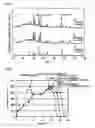
BRIEF DESCRIPTION OF THE DRAWINGSFIG. 1 is a graph showing an XRD profile for dielectric ceramic materials prepared in Example in accordance with the present invention;
FIG. 2 is a graph showing firing profiles used in Example in accordance with the present invention;
FIG. 3 shows a bending strength in relation to an X-ray diffraction peak intensity ratio (MgAl2O4 (311)/Al2O3 (116));
FIG. 4 is an exploded perspective view showing an embodiment of a multilayer ceramic substrate in accordance with the present invention; and
FIG. 5 is a perspective view showing an embodiment of a multilayer ceramic substrate in accordance with the present invention.
DESCRIPTION OF THE PREFERRED EXAMPLESThe present invention is now described in detail with reference to examples. The following examples illustrate the practice of the present invention but are not intended to be limiting thereof.
(Preparation of Dielectric Ceramic Material)
450 g of α-alumina powder (mean particle diameter 3 μm), 550 g of a crystallizable glass (50 wt. % SiO2, 20 wt. % CaO, 20 wt. % MgO, 10 wt. % ZnO, mean particle diameter 3 μm, softening point 750° C., crystallization initiating temperature 800° C., 450 g of isopropanol (IPA), 300 g of butyl acetate, 20 g of an olefin-maleic acid copolymer dispersant, 120 g of a polyvinyl acetate binder and 50 g of an acrylic binder were pulverized and mixed in a ball mill for 4 hours.
The resulting slurry was formed into a 50 μm thick sheet using a doctor blade equipment. 50 mm square layers were cut out from this sheet. 20 of such layers were stacked in a pile and press bonded to provide a sheet. Then, 20 mm long and 5 mm wide test pieces were cut out from the press bonded sheet.
The obtained test pieces were fired using the four different profiles shown in FIGS. 1 and 2; the profile (A) with a maximum temperature of 900° C., the profile (A) with a maximum temperature of 950° C., the profile (A) with a maximum temperature of 1,000° C., and the profile (B).
Also, the above procedure was followed, except that the α-alumina powder and crystallizable glass were each used in the amount of 500 g, to prepare a slurry. Using this slurry, test pieces were fabricated and fired in the same manner as above.
| TABLE 1 | |||
| Firing | Firing | Firing | |
| Profile (A) | Profile (A) | Profile (A) | |
| Maximum | Maximum | Maximum | |
| Temperature | Temperature | Temperature | Firing |
| 900° C. | 950° C. | 1000° C. | Profile (B) |
| Temperature | Temperature | Temperature | Temperature | ||||
| Time (h) | (° C.) | Time (h) | (° C.) | Time (h) | (° C.) | Time (h) | (° C.) |
| 0 | 0 | 0 | 0 | 0 | 0 | 0 | 0 |
| 1 | 200 | 1 | 200 | 1 | 200 | 2 | 400 |
| 7 | 500 | 7 | 500 | 7 | 500 | 4 | 400 |
| 9.5 | 750 | 9.5 | 750 | 9.5 | 750 | 6.5 | 900 |
| 14.5 | 750 | 14.5 | 750 | 14.5 | 750 | 8.5 | 900 |
| 17.5 | 900 | 18.5 | 950 | 19.5 | 1000 | 10.5 | 20 |
| 19.5 | 900 | 20.5 | 950 | 21.5 | 1000 | ||
| 21.5 | 800 | 23.5 | 800 | 25.5 | 800 | ||
| 23.5 | 20 | 25.5 | 20 | 27.5 | 20 | ||
As can be clearly seen from Table 1 and FIG. 2, when the firing profile (A) is used, the test pieces were maintained at a softening point of the crystallizable glass, i.e., at 750° C. for a duration of 5 hours.
(Measurement of Bending Strength)
The bending strength (three-point bending strength) for each of the obtained samples was measured. The measurement results are shown in Table 2.
| TABLE 2 | |||||
| X-Ray Diffraction | |||||
| Peak Intensity | |||||
| Sam- | Maximum | Glass: | Ratio | Bending | |
| ple | Firing | Temperature | Alumina | MgAl2O4 (311)/ | Strength |
| No. | Profile | (° C.) | Weight Ratio | Al2O3 (116) | (MPa) |
| {circle over (1)} | A | 900 | 55:45 | 0.77 | 274 |
| {circle over (2)} | A | 950 | 55:45 | 1.50 | 254 |
| {circle over (3)} | A | 1000 | 55:45 | 2.42 | 398 |
| {circle over (4)} | A | 900 | 50:50 | 0.49 | 188 |
| {circle over (5)} | A | 950 | 50:50 | 0.63 | 203 |
| {circle over (6)} | A | 1000 | 50:50 | 0.98 | 249 |
| {circle over (7)} | B | 900 | 50:50 | 0.00 | 130 |
(X-ray Diffraction (XRD) Measurement)
An XRD profile was measured for the sample Nos. 1-7 specified in Table 2. FIG. 1 shows a graph for XRD profiles of the sample Nos. 1, 3 and 7. As apparent from FIG. 1, a peak for the MgAl2O4 (311) was observed for the sample Nos. 1 and 3. On the other hand, the peak for the MgAl2O4 (311) was not observed for the sample No. 7.
A ratio (MgAl2O4 (311)/Al2O3 (116)) in peak intensity of the MgAl2O4 (311) to the Al2O3 (116) was determined and shown in Table 2. A bending strength in relation to this X-ray diffraction peak intensity ratio is also shown in FIG. 3.
As can be clearly seen from Table 2 and FIG. 3, the sample Nos. 1-6 each including the MgAl2O4 crystal phase, which is a spinel-type crystal phase, exhibit higher bending strength compared to the sample No. 7 excluding this crystal phase. As can also be clearly seen from FIG. 3, the higher bending strength is obtained as the X-ray diffraction peak intensity ratio increases. Particularly when the X-ray diffraction peak intensity ratio is at least 0.5, a high bending strength of about 200 MPa or above is obtained.
(Multilayer Ceramic Substrate)
FIGS. 4 and 5 are an exploded perspective view and a perspective view, respectively, which show an embodiment of a multilayer ceramic substrate of the present invention. As shown in FIG. 4, an electrode layer 3, composed of silver, is formed on a dielectric layer 2. Superposing and subsequent firing of such dielectric layers 2 results in obtaining a multilayer ceramic substrate 1 as shown in FIG. 5. An inductor or capacitor, according to a circuit pattern of the electrode layer 3, is provided internally of the multilayer ceramic substrate 1.
The use of the dielectric ceramic material of the present invention for the dielectric layer 2 enables fabrication of a multilayer ceramic substrate which can be obtained through low-temperature firing and has a high bending strength.
Claims
1. A dielectric ceramic material which is obtained by firing a raw material comprising an alumina powder and a glass powder containing at least SiO2 and MgO, said dielectric ceramic material being characterized that a ratio in X-ray diffraction peak intensity of an MgAl2O4 (311) to an Al2O3 (116) is at least 0.5.
2. A multilayer ceramic substrate which is obtained by firing multilayers of ceramic green sheets each having a dielectric layer composed of said raw material comprising the alumina powder and glass powder and an electrode layer formed on the dielectric layer, said multilayer ceramic substrate being characterized that said dielectric layer after the firing comprises the dielectric ceramic material as recited in claim 1.
Images & Drawings included:


Sources:
- United States Patent and Trademark Office - verify current appl. status at the USPTO↗
Recent applications in this class:
- » 20250197291 2025-06-19
METHOD FOR PRODUCING CERAMIC PARTS AND USE OF THE PARTS OBTAINED BY THIS METHOD - » 20250109072 2025-04-03
CERAMIC ARTICLES AND METHODS FOR FORMING SAME - » 20240417330 2024-12-19
BOEHMITE STRUCTURE AND METHOD FOR PRODUCING SAME - » 20240409468 2024-12-12
ALUMINA-BASED SINTERED BODY AND ELECTROSTATIC CHUCK - » 20240336533 2024-10-10
COMPOSITE MEMBER - » 20240336532 2024-10-10
CERAMIC SINTERED BODY, CERAMIC SUBSTRATE, MOUNTING SUBSTRATE, ELECTRONIC DEVICE, AND METHOD FOR MANUFACTURING CERAMIC SINTERED BODY - » 20240294435 2024-09-05
POROUS CERAMIC SUPPORTS, MEMBRANES, METHODS AND USES THEREOF - » 20240124360 2024-04-18
Composite member - » 20240067567 2024-02-29
ALUMINA-BASED CERAMIC TOOL MATERIAL WITH LOW THERMAL EXPANSION AND PREPARATION PROCESS THEREOF - » 20240051875 2024-02-15
EROSION-RESISTANT CERAMIC MATERIAL, POWDER, SLIP AND COMPONENT
Recent applications for this Assignee:
- » 20250231288 2025-07-17
POWER SUPPLY DEVICE, ELECTRIC VEHICLE USING SAME, AND POWER STORAGE DEVICE - » 20250192345 2025-06-12
SECONDARY BATTERY - » 20250096278 2025-03-20
RECTANGULAR SECONDARY BATTERY AND METHOD OF MANUFACTURING THE SAME - » 20250055043 2025-02-13
PRISMATIC SECONDARY BATTERY AND ASSEMBLED BATTERY USING THE SAME - » 20250038213 2025-01-30
SLURRY FOR NON-AQUEOUS ELECTROLYTE SECONDARY CELL, METHOD FOR MANUFACTURING SLURRY FOR NON-AQUEOUS ELECTROLYTE SECONDARY CELL, ELECTRODE FOR NON-AQUEOUS ELECTROLYTE SECONDARY CELL, AND NON-AQUEOUS ELECTROLYTE SECONDARY CELL - » 20240297386 2024-09-05
BATTERY PACK - » 20240283051 2024-08-22
BATTERY MODULE - » 20240213513 2024-06-27
ELECTRICITY STORAGE DEVICE COMPRISING A COVERING MEMBER FOR A LIQUID INJECTION HOLE - » 20240204339 2024-06-20
GAS DISCHARGE VALVE OF BATTERY AND BATTERY - » 20240204259 2024-06-20
NON-AQUEOUS ELECTROLYTE SECONDARY BATTERY