Transformer
US20050225417A1
2005-10-13
10/813,024
2004-03-31
✅ Patent granted
US 6,946,942 B1
2005-09-20
-
-
Anh Mai
2024-03-31
Abstract:
A transformer comprises a rectangular insulative housing, a plurality of inductive coils received in the insulative housing, and a plurality of soldering tails. The insulative housing includes a bottom wall and four sidewalls, and forms a plurality of partitions therein for receiving the inductive coils. Each inductive coil has a first wire and a second wire. The soldering tails are provided at two opposing sidewalls of the insulative housing. Each soldering tail has a soldering end at exterior of the insulative housing for electrically connecting with a PCB of a communication connector, and a wiring end at interior of the insulative housing for connecting with the first wire and the second wire of the inductive coils. The transformer is modularly produced, and is tested before it is assembled to a communication connector. Thus the manufacture process is flexible and the communication connector provides stable signal transmission.
Assignee:
- Amphenol Taiwan Corporation 4 🇹🇼 Taoyuan, Taiwan
Interested in similar patents?
Get notified when new applications in this technology area are published.
Classification:
H01F27/02 » CPC main
Details of transformers or inductances, in general Casings
H01F19/00 » CPC further
Fixed transformers or mutual inductances of the signal type
H01F27/04 » CPC further
Details of transformers or inductances, in general; Casings Leading of conductors or axles through casings, e.g. for tap-changing arrangements
H01F2038/006 » CPC further
Adaptations of transformers or inductances for specific applications or functions matrix transformer consisting of several interconnected individual transformers working as a whole
Description
BACKGROUND OF THE INVENTION1. Field of the Invention
The present invention relates to a transformer, and particularly to a transformer used in a communication connector for stably transmitting signals.
2. Related Art
Signal transmission, especially high-speed signal transmission, is subject to current and external interference. Currently, in order to make signal transmission stable, transformers are popularly used in communication connectors for signal transmission between computers and peripherals. Such a transformer often has filtering function, as disclosed in U.S. Pat. Nos. 4,754,370, 5,015,204, 5,139,442, 5,687,233, 5,872,492, 5,833,496, 6,102,741 and 6,456,180.
The conventional transformer usually has inductive/impedance coils. Each inductive/impedance coil has two ends respectively serving for mating with a mating connector and soldering to a PCB, sometimes serving for connecting with the communication connector and soldering to a PCB. There are some deficiencies of this design in manufacture and use as followings.
(1) manufacture process is inflexible. An end of the inductive/ impedance coil, which serves for mating with a mating connector or serves for connecting with the communication connector, has to be assembled on an assembling board, or has to connect with terminals of the communication connector via a series of connecting process in advance. Then it connects with a PCB before testing signal transmission of each terminal. Thus the manufacture process is constrained of series connecting/assembling first. Some conventional communication connectors provide instruction lights for displaying proper signal transmission. Similarly, the instruction lights have to be mounted on a housing and assembled to a PCB first before testing.
(2) mass production is inefficient. Manufacturing as described above, once problems are found in testing process, for example, a terminal fails to communicate with inductive/impedance coils or instruction lights can't work, the defective products have to back to the series connected/assembled mentioned before to reproduce. This makes manufacture process troublesome.
SUMMARY OF THE INVENTIONAccordingly, an object of the present invention is to provide a transformer, which is modularly produced and separately assembled on a communication connector for making manufacture process flexible and rapid.
Another object of the present invention is to provide a transformer which is easily assembled independent of soldering and which prevents from electromagnetic and noise interference for stable signal transmission.
The transformer of the present invention comprises a rectangular insulative housing, a plurality of inductive coils and a plurality of soldering tails. The insulative housing includes a bottom wall and four sidewalls, and defines an opening toward a top thereof. A plurality of partitions is formed in the insulative housing for receiving the inductive coils. Each inductive coil has a first wire and a second wire. The soldering tails are provided at two opposing sidewalls of the insulative housing. Each soldering tail has a soldering end at exterior of the insulative housing for electrically connecting with a PCB of a communication connector, and a wiring end at interior of the insulative housing for connecting with the first wire and the second wire of the inductive coils.
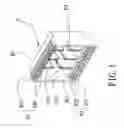
BRIEF DESCRIPTION OF THE DRAWINGSFIG. 1 is a perspective view of an insulative housing of a transformer according to the present invention.
FIG. 2 is a plane view of the insulative housing of FIG. 1 with inductive coils assembled therein.
FIG. 3 is a perspective view of the transformer of FIG. 1 assembled on a PCB of a communication connector.
FIG. 4 is a perspective view according to another embodiment of the present invention.
DESCRIPTION OF THE PREFERRED EMBODIMENTSWith reference to FIGS. 1 and 2, a transformer 6 in accordance with the present invention comprises a rectangular insulative housing 60, a plurality of inductive coils 61 and a plurality of soldering tails 62. The insulative housing 60 includes a bottom wall (not labeled) and four side walls (not labeled), and defines an opening 601 toward a top thereof. Two tables 603 are respectively formed at inner surfaces of two opposing sidewalls of the insulative housing 60 for positioning the soldering tails 62. A plurality of partitions 602 is formed in the insulative housing 60 and is spaced the same distance from each other for receiving the inductive coils 61. A channel 63 is defined through a middle of the partitions 602 for accommodating more inductive coils 61. Each inductive coil 61 has a first wire 610 and a second wire 611. The soldering tails 62 are mounted on two opposing sidewalls of the insulative housing 60 and extend beyond from the opening 601. Each soldering tail 62 has a soldering end 621 at exterior of the insulative housing 60 for electrically connecting with a PCB 3 (shown in FIG. 3) of a communication connector (not labeled), and a wiring end 622 at interior of the insulative housing 60 for connecting with the first wires 610 and the second wires 611. Each soldering end 621 forms an extreme end (not labeled) bending perpendicularly therefrom and extending beyond the insulative housing 60.
The insulative housing 60, the inductive coils 61 and the soldering tails 62 are assembled together to form a modular transformer 6, which is tested independently. Referring to FIG. 3, the transformer is assembled to the communication connector at another manufacture process. During assembly, the transformer 6 is tested, and then is soldered to the PCB 3 of the communication connector. Thus, terminals 4 and solder pins 5 of the communication connector transmit signals stably.
Further referring to FIG. 4, a transformer 6′ of another embodiment of the present invention is similar to the transformer 6 of FIG. 1 except each soldering end 621′ of the soldering tails 62′ is mounted on opposing sidewalls of the bottom wall of the insulative housing 60′ and bended perpendicularly therefrom to be planar with the bottom wall. The inductive coils 61′ are arranged in such a way that the inductive coils 61′ at middle of the insulation housing 60′ are substantially in a line while the inductive coils 61′ at two sides are substantially perpendicular to the ones at middle.
It is understood that the invention may be embodied in other forms without departing from the spirit thereof. Thus, the present examples and embodiments are to be considered in all respects as illustrative and not restrictive, and the invention is not to be limited to the details given herein.
Claims
1. A transformer comprising:
a rectangular insulative housing having a bottom wall and four sidewalls, and defining an opening toward a top thereof, a plurality of partitions being formed in the insulative housing;
a plurality of inductive coils received between the partitions of the insulative housing, and each inductive coil having a first wire and a signal wire; and
a plurality of soldering tails mounted on opposing side walls of the insulative housing, each soldering tail having a soldering end at exterior of the insulative housing for electrically connecting with a PCB of a communication connector, and a wiring end at interior of the insulative housing for connecting with the first wire and the second wire of the inductive coils.
2. The transformer as claimed in claim 1, wherein the partitions are spaced the same distance from each other for receiving the inductive coils.
3. The transformer as claimed in claim 2, wherein a channel is defined through a middle of the partitions for accommodating more inductive coils.
4. The transformer as claimed in claim 3, wherein the bottom wall of the insulative housing is defined being flat.
5. The transformer as claimed in claim 4, wherein two tables are respectively formed on inner surfaces of the opposing sidewalls of the insulative housing for positioning the soldering tails.
6. The transformer as claimed in claim 5, wherein each soldering end of the soldering tails are mounted on opposing sidewalls of the bottom wall of the insulative housing and bended perpendicularly therefrom to be planar with the bottom wall.
7. The transformer as claimed in claim 5, wherein the soldering tails are mounted on opposing sidewalls of the opening of said insulative housing and bended perpendicularly therefrom to be planar with the opening.
8. A transformer comprising:
a rectangular insulative housing having a bottom wall and four sidewalls, and defining an opening toward a top thereof, a plurality of partitions being formed in the insulative housing;
a plurality of inductive coils received between the partitions of the insulative housing, and arranged in such a way that the inductive coils at middle of the insulation housing are substantially in a line while the inductive coils at two sides are substantially perpendicular to the ones at middle, each inductive coil having a first wire and a signal wire; and
a plurality of soldering tails mounted on opposing side walls of the insulative housing, each soldering tail having a soldering end at exterior of the insulative housing for electrically connecting with a PCB of a communication connector, and a wiring end at interior of the insulative housing for connecting with the first wire and the second wire of the inductive coils.
9. The transformer as claimed in claim 8, wherein the partitions are spaced the same distance from each other for receiving the inductive coils.
10. The transformer as claimed in claim 9, wherein a channel is defined through a middle of the partitions for accommodating more inductive coils.
Images & Drawings included:



Sources:
- United States Patent and Trademark Office - verify current appl. status at the USPTO↗
Similar patent applications:
- » 20150301340
Beam transformation element, device for transforming electromagnetic radiation, method for producing a beam transformation element, and method for transforming an electromagnetic emission - » 20220264093
Encoder that determines an intra prediction mode used for a current block and performs quantization on first transform coefficients or second transform coefficients based on whether a primary transform basis is included in predetermined transform bases - » 20100268753
INVERSE LAPLACE TRANSFORM PROGRAM, PROGRAM FOR FORMING TABLE FOR INVERSE LAPLACE TRANSFORM, PROGRAM FOR CALCULATING NUMERICAL SOLUTION OF INVERSE LAPLACE TRANSFORM, AND INVERSE LAPLACE TRANSFORM DEVICE - » 20140176181
Pre space transformer, space transformer manufactured using the pre space transformer, and semiconductor device inspecting apparatus including the space transformer - » 20170169931
Pre space transformer, space transformer manufactured using the pre space transformer, and semiconductor device inspecting apparatus including the space transformer - » 20170330677
SPACE TRANSFORMERS, PLANARIZATION LAYERS FOR SPACE TRANSFORMERS, METHODS OF FABRICATING SPACE TRANSFORMERS, AND METHODS OF PLANARIZING SPACE TRANSFORMERS - » 20060072846
Transformation or inverse transformation method and apparatus capable of transforming or inversely transforming blocks having various sizes - » 20060122825
Method and apparatus for non-overlapped transforming of an audio signal, method and apparatus for adaptively encoding audio signal with the transforming, method and apparatus for inverse non-overlapped transforming of an audio signal, and method and apparatus for adaptively decoding audio signal with the inverse transforming - » 20140176171
PRE SPACE TRANSFORMER, SPACE TRANSFORMER MANUFACTURED USING THE PRE SPACE TRANSFORMER, AND SEMICONDUCTOR DEVICE INSPECTING APPARATUS INCLUDING THE SPACE TRANSFORMER - » 20240087792
Transformer tank for a shell type transformer, shell type transformer and method for clamping a magnetic core of a shell type transformer
Recent applications in this class:
- » 20250266201 2025-08-21
TRANSFORMER PACKAGES HAVING CORE COVERS WITH COIL PORTIONS - » 20250232905 2025-07-17
TRANSFORMER MODULE - » 20250201463 2025-06-19
DIVERTER DEVICE FOR TRANSFORMER FLUIDS - » 20250095899 2025-03-20
CT ENERGY EXTRACTION DEVICE - » 20240395449 2024-11-28
ENCLOSURE FOR MITIGATING RF POWER RAMP UP IN ICP SOURCE - » 20240355525 2024-10-24
DUAL INDUCTOR ASSEMBLY - » 20240355524 2024-10-24
Universal Cap for Arrester Brackets - » 20240203632 2024-06-20
ELECTRONIC COMPONENT - » 20240145153 2024-05-02
INDUCTOR COMPONENT - » 20240096539 2024-03-21
HEADER COMPONENT, INDUCTIVE DEVICE AND METHOD FOR ASSEMBLING AN INDUCTIVE DEVICE
Recent applications for this Assignee:
- » 20070173118 2007-07-26
Receptacle connector - » 10971078 2005-09-27
Board-to-board connector assembly - » 10813022 2005-03-15
Memory card connector