Evans easy start
US20050229892A1
2005-10-20
10/827,386
2004-04-19
Abstract:
The device, called “easy start” will provide a viable and convenient means for starting pull-type motors. With a hollow tube/pipe, spring inside, rope, rod or chain attached to spring, you now have the ingredients to start a pull-type motor.
Interested in similar patents?
Get notified when new applications in this technology area are published.
Classification:
F02N3/02 » CPC main
Other muscle-operated starting apparatus having pull-cords
F02N3/04 » CPC further
Other muscle-operated starting apparatus having foot-actuated levers
F02N5/02 » CPC further
Starting apparatus having mechanical power storage of spring type
F02D2400/06 » CPC further
Control systems adapted for specific engine types; Special features of engine control systems not otherwise provided for; Power supply, connectors or cabling for engine control systems Small engines with electronic control, e.g. for hand held tools
Description
PROBLEM ANALYSISPull type motors are often difficult to start.
SOLUTIONA device which helps start pull-type motors.
SCOPE OF INTENT
-
- A. The device will provide a viable and convenient means for starting pull-type motors, such as lawn mowers, etc.
- B. The device will consist of a hollow pipe slotted at one end to receive a lever control for hand and/or foot operation and a spring that connects to lever for operation.
- C. The spring will be activated within the housing and the motor rope will be connected to the spring. A trigger mechanism will be released, pulling against the rope, thus starting the engine.
- D. A rod or rope can be used to bring up the spring also-not just the lever as in “B” above (see drawing also).
The model I made consists of a PVC pipe thirty-six inches long with an eighteen-inch spring inside of the pipe. The pipe and spring length can vary; the stronger the spring, the shorter the pipe. Clip or tie a rope to the spring inside of the pipe. Pull the spring up to the end of the pipe. Place the pin through the pipe and spring. Now, one has a loaded spring within a pipe. Hook on the motor rope (engine one is starting), and pull pin. As one pulls, the spring goes back down in the pipe where it was before loading (stretching) it. This would work about the same way if permanently adapted on Briggs & Stratton engines. It would use the slotted pipe (see drawing).
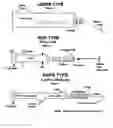
DETAILED DESCRIPTIONFIG. 1 #1 is a metal pipe slotted at the side for #2 Level (foot) control pedal
-
- #3 Spring inside of pipe
- #4 Motor rope to spring
- Push down lever #2 foot pedal/spring #3 is attached to lever inside of pipe coming out slotted side 2-3 inches
FIG. 2 #1 capped end of #3 PVC pipe
-
- #2 Eye bolt goes through cap and PVC pipe with #9 spring fastened to eye bolt inside of pipe
- To load: Bring up spring using #6 foot operation while holding to #8 handle. Insert pin #4 through pipe and spring. It holds spring in place. Handle #6 has threads on it. Screw threads into #7 toggle bolt to bring up spring for operation.
FIG. 3 # 1 a PVC pipe (2 joints) with #2 eye bolt at end which is capped. #3 coil spring inside with a pin #4 towards the open end. #5 snap is fixed on spring from #6 rope. #7 for foot operation.
Claims
1. A hollow pipe comprising of PVC, metal, or iron with a spring inside of the pipe.
2. The apparatus of claim #1 further including a rope, rod or chain fastened to the spring.
3. I further claim a single-piece of pipe (spring inside) held in hand or permanently adapted on motors. It can/will start pull-type engines. It can either be a permanent device welded on the motor or a single piece of pipe held in one's hand for hand/foot operation.
Images & Drawings included:

Sources:
- United States Patent and Trademark Office - verify current appl. status at the USPTO↗
Recent applications in this class:
- » 20240044309 2024-02-08
EASY ENGINE STARTING SYSTEM - » 20230123394 2023-04-20
Starter pulley arrangement - » 20220299001 2022-09-22
Recoil starter - » 20220299000 2022-09-22
Recoil starter - » 20220090570 2022-03-24
Rope reel for recoil starter, and recoil - » 20210404432 2021-12-30
Engine starting device - » 20200291912 2020-09-17
Starter device, pulley assembly for a starter device, and connecting spring for a pulley assembly - » 20200158067 2020-05-21
Engine system - » 20190383255 2019-12-19
Starter device for an internal combustion engine and backpack power tool with an internal combustion engine and with a starter device for the internal combustion engine - » 20180252194 2018-09-06
Recoil starter and engine