Method and apparatus for folding the projecting end of a covering or decorative layer
US20050263241A1
2005-12-01
11/136,360
2005-05-25
Abstract:
The invention relates to a method and apparatus for folding the projecting end of a covering or decorative layer over the edge of a supporting part, where at least the edge area of the supporting part is made of thermoplastic material and where at least one heatable punching element is provided, which can be applied to the folded-over end of the covering or decorative layer. The invention proposes that the projecting end of the covering or decorative layer be folded by a folding slide, which preferably is guided in a mold holding the supporting part, and which has openings or recesses for the passage of the at least one heatable punching element, which presses the covering or decorative layer at least point-wise into the edge area of the supporting part softened by the punching element.
Interested in similar patents?
Get notified when new applications in this technology area are published.
Classification:
B29C65/18 » CPC main
Joining of preformed parts ; Apparatus therefor by heating, with or without pressure using heated tools
B29C63/04 » CPC further
Lining or sheathing, i.e. applying preformed layers or sheathings of plastics; Apparatus therefor using sheet or web-like material by folding, winding, bending or the like
B29C65/7437 » CPC further
Joining of preformed parts ; Apparatus therefor by welding and severing, or by joining and severing, the severing being performed in the area to be joined, next to the area to be joined, in the joint area or next to the joint area using the same tool for both joining and severing, said tool being monobloc or formed by several parts mounted together and forming a monobloc the tool being a perforating tool
B29C65/7841 » CPC further
Joining of preformed parts ; Apparatus therefor; Means for handling the parts to be joined, e.g. for making containers or hollow articles, e.g. means for handling sheets, plates, web-like materials, tubular articles, hollow articles or elements to be joined therewith; Means for discharging the joined articles from the joining apparatus Holding or clamping means for handling purposes
B29C66/112 » CPC further
General aspects of processes or apparatus for joining preformed parts; General aspects dealing with the joint area or with the area to be joined; Particular design of joint configurations particular design of the joint cross-sections; Joint cross-sections comprising a single joint-segment, i.e. one of the parts to be joined comprising a single joint-segment in the joint cross-section Single lapped joints
B29C66/1122 » CPC further
General aspects of processes or apparatus for joining preformed parts; General aspects dealing with the joint area or with the area to be joined; Particular design of joint configurations particular design of the joint cross-sections; Joint cross-sections comprising a single joint-segment, i.e. one of the parts to be joined comprising a single joint-segment in the joint cross-section; Single lapped joints Single lap to lap joints, i.e. overlap joints
B29C66/135 » CPC further
General aspects of processes or apparatus for joining preformed parts; General aspects dealing with the joint area or with the area to be joined; Particular design of joint configurations particular design of the joint cross-sections; Single flanged joints; Fin-type joints; Single hem joints; Edge joints; Interpenetrating fingered joints; Other specific particular designs of joint cross-sections not provided for in groups - Single hemmed joints, i.e. one of the parts to be joined being hemmed in the joint area
B29C66/21 » CPC further
General aspects of processes or apparatus for joining preformed parts; General aspects dealing with the joint area or with the area to be joined; Particular design of joint configurations particular design of the joint lines, e.g. of the weld lines said joint lines being formed by a single dot or dash or by several dots or dashes, i.e. spot joining or spot welding
B29C66/43 » CPC further
General aspects of processes or apparatus for joining preformed parts; General aspects of joining substantially flat articles, e.g. plates, sheets or web-like materials; Making flat seams in tubular or hollow articles; Joining single elements to substantially flat surfaces; Joining substantially flat articles ; Making flat seams in tubular or hollow articles Joining a relatively small portion of the surface of said articles
B29C66/80 » CPC further
General aspects of processes or apparatus for joining preformed parts General aspects of machine operations or constructions and parts thereof
B29C66/81429 » CPC further
General aspects of processes or apparatus for joining preformed parts; General aspects of machine operations or constructions and parts thereof; General aspects of the pressing elements, i.e. the elements applying pressure on the parts to be joined in the area to be joined, e.g. the welding jaws or clamps characterised by the design of the pressing elements, e.g. of the welding jaws or clamps characterised by the surface geometry of the part of the pressing elements, e.g. welding jaws or clamps, coming into contact with the parts to be joined comprising a single ridge, e.g. for making a weakening line; comprising a single tooth comprising a single tooth
B29C66/81433 » CPC further
General aspects of processes or apparatus for joining preformed parts; General aspects of machine operations or constructions and parts thereof; General aspects of the pressing elements, i.e. the elements applying pressure on the parts to be joined in the area to be joined, e.g. the welding jaws or clamps characterised by the design of the pressing elements, e.g. of the welding jaws or clamps characterised by the surface geometry of the part of the pressing elements, e.g. welding jaws or clamps, coming into contact with the parts to be joined being toothed, i.e. comprising several teeth or pins , or being patterned
B29C66/81463 » CPC further
General aspects of processes or apparatus for joining preformed parts; General aspects of machine operations or constructions and parts thereof; General aspects of the pressing elements, i.e. the elements applying pressure on the parts to be joined in the area to be joined, e.g. the welding jaws or clamps characterised by the design of the pressing elements, e.g. of the welding jaws or clamps characterised by the constructional aspects of the pressing elements, e.g. of the welding jaws or clamps comprising a plurality of single pressing elements, e.g. a plurality of sonotrodes, or comprising a plurality of single counter-pressing elements, e.g. a plurality of anvils, said plurality of said single elements being suitable for making a single joint
B29C66/8322 » CPC further
General aspects of processes or apparatus for joining preformed parts; General aspects of machine operations or constructions and parts thereof characterised by the movement of the joining or pressing tools; Reciprocating joining or pressing tools Joining or pressing tools reciprocating along one axis
B29C66/8432 » CPC further
General aspects of processes or apparatus for joining preformed parts; General aspects of machine operations or constructions and parts thereof; Specific machine types or machines suitable for specific applications; Machines for making separate joints at the same time in different planes; Machines for making separate joints at the same time mounted in parallel or in series Machines for making separate joints at the same time mounted in parallel or in series
B29C65/08 » CPC further
Joining of preformed parts ; Apparatus therefor by heating, with or without pressure using ultrasonic vibrations
B29C65/10 » CPC further
Joining of preformed parts ; Apparatus therefor by heating, with or without pressure using hot gases (e.g. combustion gases) or flames coming in contact with at least one of the parts to be joined
B29C65/1412 » CPC further
Joining of preformed parts ; Apparatus therefor by heating, with or without pressure using wave energy or particle radiation characterised by the type of electromagnetic or particle radiation Infrared [IR] radiation
B29C65/7847 » CPC further
Joining of preformed parts ; Apparatus therefor; Means for handling the parts to be joined, e.g. for making containers or hollow articles, e.g. means for handling sheets, plates, web-like materials, tubular articles, hollow articles or elements to be joined therewith; Means for discharging the joined articles from the joining apparatus; Holding or clamping means for handling purposes using vacuum to hold at least one of the parts to be joined
B29C66/729 » CPC further
General aspects of processes or apparatus for joining preformed parts characterised by the composition, physical properties or the structure of the material of the parts to be joined; Joining with non-plastics material characterised by the structure of the material of the parts to be joined Textile or other fibrous material made from plastics
B29C66/91421 » CPC further
General aspects of processes or apparatus for joining preformed parts; Measuring or controlling the joining process by measuring or controlling the temperature, the heat or the thermal flux by controlling or regulating the temperature, the heat or the thermal flux by controlling or regulating the temperature of the joining tools
B29C66/91431 » CPC further
General aspects of processes or apparatus for joining preformed parts; Measuring or controlling the joining process by measuring or controlling the temperature, the heat or the thermal flux by controlling or regulating the temperature, the heat or the thermal flux by controlling or regulating the temperature the temperature being kept constant over time
B29C66/919 » CPC further
General aspects of processes or apparatus for joining preformed parts; Measuring or controlling the joining process by measuring or controlling the temperature, the heat or the thermal flux characterised by specific temperature, heat or thermal flux values or ranges
B29L2031/3005 » CPC further
Other particular articles; Vehicles, e.g. ships or aircraft, or body parts thereof Body finishings
Y10T156/1034 » CPC further
Adhesive bonding and miscellaneous chemical manufacture; Methods of surface bonding and/or assembly therefor with permanent bending or reshaping or surface deformation of self sustaining lamina Overedge bending of lamina about edges of sheetlike base
B29C66/303 » CPC further
General aspects of processes or apparatus for joining preformed parts; General aspects dealing with the joint area or with the area to be joined; Particular design of joint configurations the joint involving an anchoring effect
B29C65/00 » CPC further
Joining of preformed parts ; Apparatus therefor
Description
BACKGROUND OF THE INVENTIONThe invention relates to a method and apparatus for folding the projecting end of a covering or decorative layer over the edge of a supporting part, where at least the edge area of the supporting part consists of thermoplastic material and where the folded-over end is pressed into the softening edge area of the supporting part by means of at least one heatable punching element.
Trim and lining parts, especially for the interior of automotive vehicles, e.g., dashboards, covers of glove compartments, linings of structural parts etc., usually are made of a dimensionally stable supporting part covered by a covering or decorative layer, for instance a textile lining or plastic sheeting. In order to lend an attractive appearance to the edges of such parts it is necessary to fold the covering or decorative material over the edge of the supporting part and to fasten it to the inner surface of the supporting part.
DESCRIPTION OF PRIOR ARTDevices for folding over the decorative material are known in a large number of variants and usually consist of a mold for holding the supporting part during the trimming process, and a number of sliding elements for attaching the folded end of the decorative material on the inner surface of the supporting part.
Adherence of the folded-over end of the decorative material on the inner surface of the supporting part is achieved in many known cases by applying an adhesive on the periphery of the inner surface of the supporting part. The adhesives used are either contact adhesives or heat-activated adhesives. The latter are rendered adherent prior to the folding process by subjecting them to hot air or heat radiation, or they are activated through the folded end of the trim layer by the heated faces of the folding slide.
From DE 43 08 925 A1 a method and apparatus for the folding-over and fastening of the projecting ends of a covering material for interior lining parts of vehicles are known in which the adhesive is heated and thus activated by means of a hot air nozzle. Subsequently the covering material is folded over the edge and glued to the rear of the part.
The use of an adhesive has the disadvantage that the adhesive itself contributes to the cost of material and costly procedure steps are necessary for the clean and emission-free application of the adhesive. In this context DE 295 07 067 U1 has made known a device for the adhesive-free folding-over of covering materials on lining parts, in which the fastening of the folded-over border of the decorative material on the inner surface of the supporting part is achieved without an adhesive by partly melting, and thus rendering adhesive, the surface of the supporting part along the edge by means of hot air or an infrared radiation source. For this purpose the lining part is brought into the vicinity of the heating element by a moveable holder and is then lowered, and the projecting end of the decorative material is folded over by means of a folding slide, and the part is pressed against the folding slide to apply the necessary bonding pressure.
It is also known to fasten the folded-over border of the trim layer by means of ultrasonic welding. This incurs the disadvantage of relatively high cost of apparatus and considerable sound emission by the ultrasonic generator.
From EP 0 792 734 B1 a method and device for the manufacture of a molded part with a surface covered by a decorative material are known in which the molded part is made by laminate molding, i.e., by injecting a suitable plastic material onto the decorative material placed in the molding cavity. After the injection process the decorative material is fixed by pressing it into the still deformable molded part. The method is relatively costly, especially if trim parts with complicated exterior contours must be enfolded.
Finally a method and device for the folding-over of covering or decorative materials is known from DE 197 06 712 A1, in which a rotating tool is used that has an angular recess into which the free edge of a molded part together with the projecting end of decorative material projects. When the rotating tool is turned the projecting end is taken up and folded over onto the side of the molded part which is not covered by covering or decorative material. Due to the absence of counter pressure or a firm support of the molded part efficient pressing of the decorative material onto the back of the molded part is not possible. The projecting end of the covering or decorative material or the rotating tool may be heated prior to the fold-over operation in order to achieve better adhesion on the molded part.
From JP 62-211127 A and JP 10-202737 A methods and devices are known for folding-over the projecting end of a covering or decorative layer, in which the folded end is pressed into the softening edge area of a supporting part by means of a heatable punching element (see e.g. FIG. 4 of JP 62-211127 A).
From JP 10-202737 A there is known, additionally to a folding slide for the folding-over of the projecting end, a spring-loaded element, which is attached to the holder of the heatable punching element and by which the folded-over end of the decorative layer may still be held against the supporting part while the heatable punching element is already being lifted.
SUMMARY OF THE INVENTIONIt is the object of the present invention to propose improvements of known methods and devices for the adhesive-free folding-over of covering or decorative layers, which simplify the procedure and apparatus required while maintaining the quality standards of the finished product.
According to the invention this object is achieved by providing that the end of the covering or decorative layer be folded over and held in the position to be fixed by a folding slide, and that the at least one heatable punching element act on the covering or decorative layer through at least one opening or recess of the folding slide. Folding and fixing the covering or decorative layer thus requires only one part, i.e., the folding slide, while one or more heatable punching elements accurately act on the end of the decorative layer to be fixed, through the openings or recesses in the folding slide. In the method according to the invention folding-over of the end of the covering or decorative layer occurs in the unheated state with the heatable punching element ensuring secure attachment of the decorative layer in the edge area. In contrast to known procedures using hot air nozzles or infrared radiators, the quantity of heat which must be supplied for bonding may thus be applied point-wise with great precision.
In further development of the invention it is provided that the covering or decorative layer is penetrated by the heatable punching elements at least in partial areas. This will result in a particularly effective fastening.
According to the invention an apparatus for folding the projecting end of a covering or decorative layer over the edge area of a supporting part, where at least the edge area of the supporting part is made of thermoplastic material and where at least one heatable punching element is provided which can be applied to the folded end of the covering or decorative layer, is characterized in that for the folding of the projecting end of the covering or decorative layer a folding slide is provided, which preferably is guided in a mold holding the supporting part, and which has openings or recesses for the passage of at least one heatable punching element for pressing the covering or decorative layer at least point-wise into the edge area of the supporting part softened by the punching element.
According to the invention the heatable punching elements may have a structure on the their surface facing the covering or decorative layer, which penetrates the covering or decorative layer at least point-wise, for instance cone- or pyramid-shaped elevations. This will improve attachment of the covering or decorative layer on the supporting part.
BRIEF DESCRIPTION OF THE DRAWINGThe invention will be further described by way of example with reference to the accompanying drawings, in which
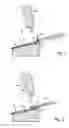
FIG. 1 shows in a schematic section an apparatus according to the invention for folding the projecting end of a covering or decorative layer over the edge of a supporting part in a first operating state;
FIGS. 2 and 3 show the apparatus of FIG. 1 in a second and third operating state;
FIG. 4 shows a detail of the apparatus of FIG. 1 in an oblique view.
DETAILED DESCRIPTION OF THE PREFERRED EMBODIMENTThe apparatus presented in FIGS. 1 to 3 in different operational states shows in a mold 1 a lining element 2 comprising a supporting part 3 whose outer surface is covered by a covering or decorative layer 4 having a projecting end 5. The lining element 2 which is placed in the mold 1 for the folding-over process is held by means not further shown in the drawing, for instance by a partial vacuum generated between the mold 1 and the lining element 2. To fold the projecting end 5 of the covering or decorative layer 4 a folding slide 6 is provided, which is for instance guided in the mold 1 holding the lining element 2 and which by an advancing motion indicated by arrow 7 brings the end 5, which is lifted by a shoulder 12 of the mold 1, into a position shown in FIG. 2, in which the folded end 5′ of the covering or decorative layer 4 is held fixed by the folding slide 6. The folding slide 6 has openings or recesses 8 through which heatable punching elements 9 can be applied to the covering or decorative layer 4, or rather its folded end 5′. The advancing motion of the at least one heatable punching element 9 (see arrow 10) is essentially perpendicular to the surface of the edge area 11 of the supporting part 3, and the covering or decorative layer 4 is pressed at least point-wise into the edge area 11 of the supporting part 3, which area is being softened by the punching element 9.
To improve attachment of the covering or decorative layer 4 to the edge area of the supporting part 3 the heatable punching elements 9 are provided on their surface facing the covering or decorative layer 4, with a structure which penetrates the covering or decorative layer 4 at least point-wise. This structure may be a serrated pattern, as shown in FIG. 4, with conical or pyramidal elevations 13. The serrated pattern of the punching elements 9 transfers thermal energy through the covering or decorative material (for instance a textile weave) to the thermoplastic supporting part, thus welding the textile material and the supporting part together. A control unit, not shown, keeps the punching elements 9 at a constant temperature between 150° C. and 300° C., depending on the materials used. A plurality of punching elements 9 may be mounted on a guiding member and may be simultaneously applied on the lining part at a defined pressure.
Claims
1. (canceled)
2. (canceled)
3. (canceled)
4. (canceled)
5. (canceled)
6. A method for folding the projecting end of a covering or decorative layer over the edge of a supporting part, where at least the edge area of the supporting part consists of thermoplastic material, wherein the projecting end of the covering or decorative layer is folded over and held in a position to be fixed by a folding slide, wherein at least one heatable punching element acts on the covering or decorative layer through at least one opening or recess of the folding slide and wherein the folded-over end is pressed into the softening edge area of the supporting part by the at least one heatable punching element.
7. A method according to claim 6, wherein the covering or decorative layer is penetrated at least in partial areas by the at least one heatable punching element.
8. An apparatus for folding the projecting end of a covering or decorative layer over the edge area of a supporting part to form a folded-over end, where at least an edge area of the supporting part consists of thermoplastic material, wherein a folding slide is provided for the folding of the projecting end of the covering or decorative layer, which folding slide has openings or recesses for admitting at least one heatable punching element for pressing the folded-over end of the covering or decorative layer at least point-wise into the edge area of the supporting part softened by the heatable punching element.
9. An apparatus according to claim 8, wherein the folding slide is guided in a mold holding the supporting part.
10. An apparatus according to claim 8, wherein the heatable punching element comprises a surface facing the covering or decorative layer, having a structure which penetrates the covering or decorative layer at least point-wise.
11. An apparatus according to claim 10, wherein the structure on the surface of the punching elements facing the covering or decorative layer has a serrated pattern.
12. An apparatus according to claim 11, wherein the separated pattern comprises conical or pyramidal elevations.
Images & Drawings included:


Sources:
- United States Patent and Trademark Office - verify current appl. status at the USPTO↗
Recent applications in this class:
- » 20250121566 2025-04-17
Apparatus and Method for Sealing Pouch-Type Secondary Battery - » 20250042096 2025-02-06
SEALING DEVICE, SEALING STATION AND METHOD FOR OPERATING A SEALING DEVICE - » 20240246300 2024-07-25
Heat Sealing System - » 20240227313 2024-07-11
CONTAINER WITH PRODUCT VISUALIZATION APERTURE - » 20230321923 2023-10-12
Joining thermoplastic components - » 20230311423 2023-10-05
Low profile heat transfer press - » 20230264430 2023-08-24
Sealing Apparatus for Secondary Battery - » 20230087955 2023-03-23
Method of Making A Barn Curtain With Joined Panels - » 20220227064 2022-07-21
Contact welding tool and method for operating same - » 20220194016 2022-06-23
Container with product visualization aperture