Combination blade cleaner, sharpener and method
US20060016293A1
2006-01-26
10/897,475
2004-07-23
Abstract:
A tool 10 for sharpening a cutting edge 12 and cleaning between adjacent cutting edges 14, 16. The tool includes an elongate gripping section 18 with a first end 20 and a second end 22. Means for sharpening 24 extend from the first end. Extending from the second end is a means for cleaning. The method for sharpening includes the step of moving a V-shaped abrasive surface in relation to the blade that requires rejuvenation. A method for cleaning between adjacent blades involve inserting a cleaning means therebetween, thereby dislodging unwanted debris.
Inventors:
- Ian Saulles 1 🇺🇸 Commerce Township, MI, United States
- Reinhard Lakamper 1 🇺🇸 Rochester Hills, MI, United States
Interested in similar patents?
Get notified when new applications in this technology area are published.
Classification:
B26B21/40 » CPC main
Razors of the open or knife type; Safety razors or other shaving implements of the planing type; Hair-trimming devices involving a razor-blade; Equipment therefor Details or accessories
B24D15/08 » CPC further
Hand tools or other devices for non-rotary grinding, polishing, or stropping specially designed for sharpening cutting edges of knives; of razors
B21K11/00 IPC
Making cutlery wares; Making garden tools or the like
Description
BACKGROUND OF THE INVENTION1. Field of the Invention
This invention relates to a blade cleaner and sharpener. More specifically, the invention relates to cleaning and sharpening apparatus and method that is ideally suited to treat a used razor blade.
2. Background Art
The life of today's razor blade may last for up to seven days of comfortable use. After that, the blade's effectiveness tends to diminish rapidly. A razor blade becomes uncomfortable to use when its edge(s) becomes dulled. A loss of sharpness occurs when the leading edge of a blade bends. Such problem can be ameliorated when, for example, a leather strap is applied to an open-faced or cut-throat razor blade. Such a method, however, is ill-suited for contemporary razorblade heads which are often encased in a plastic housing.
A deformed edge typically fractures after prolonged deployment. This results in the cutting surface becoming consequently damaged. In shaving operations, such an edge on the leading edge of a blade is uncomfortable and results in unwanted cuts. After superficial cuts and abrasions occur, the blade and/or razor are ultimately thrown away.
Counterpart observations are also applicable to other applications and uses that require a finely honed edge. Such applications include tools, kitchen knives, and surgical equipment.
In the case of razor blades, a satisfactory experience upon use is often diminished when the space between adjacent blades of a multi-blade shaver head becomes clogged with the debris that results from cutting. Accordingly, it would be desirable to clean away such debris that may remain after rinsing under a faucet with a tool that was specially designed for the purpose.
Against this background, it would be desirable to have a tool for rejuvenating a used edge so that disposal can be avoided and the edge can again be imbued with sharpness.
SUMMARY OF THE INVENTIONOne object of the present invention is to provide a combined apparatus for cleaning between the blades of a razor head and sharpening the blade in order to rejuvenate it and restore it to a mint condition.
It is also an objective of the invention to extend the useful service life of a razorblade.
Another purpose of the present invention is to provide in one tool a means for cleaning and for sharpening so that early disposal of the blade is avoided. Otherwise, tools may need separately to be purchased, used and perhaps become mislaid.
Additionally, it would be desirable to provide a tool that is entirely portable, safe to use, does not require a source of electrical energy, can be used on any brand of disposable razor, is easy to use, and has a reasonably long life expectancy.
Accordingly, the invention includes a tool for sharpening a cutting edge and cleaning between adjacent cutting edges. The tool has an elongate gripping section between a first end and a second end. Extending from the first end is a means for sharpening. A means for cleaning extends from the second end.
Preferably, the means for sharpening comprises a V-shaped abrasive surface that receives the edge to be sharpened.
In one embodiment, the means for cleaning includes a strip of resilient material having a periphery that can be moved within an area to be cleaned, from which debris can be dislodged by inserting the strip laterally and inwardly and outwardly.
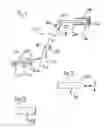
BRIEF DESCRIPTION OF THE DRAWINGSFIG. 1 is a side view of a tool for sharpening a cutting edge and cleaning between adjacent cutting edges;
FIG. 2 is a top view of a means for cleaning that extends from one end of the tool; and
FIG. 3 is a top view of a means for sharpening that extends from the other end of the tool.
DETAILED DESCRIPTION OF THE MODE FOR CARRYING OUT THE INVENTIONReferring now to FIGS. 1-3, there is depicted a tool 10 for sharpening a cutting edge 12 and for cleaning between adjacent cutting edges 14, 16. The tool includes an elongate gripping section 18 that has a first end 20 and a second end 22. Extending from the first end is a means for sharpening 24. A means for cleaning 26 extends from the second end.
Preferably, the means for sharpening includes a V-shaped abrasive surface 28 that receives the edge 12 to be sharpened.
At the other end of the elongate gripping section 18 from the V-shaped abrasive surface 28 is a strip 30 of resilient material. This material has a periphery 32 that can be moved adjacent to an area 34 to be cleaned from which debris can be dislodged by inserting the strip 30 and moving it laterally and inwardly and outwardly.
Ideally, the length of the disclosed tool is about 4-5 inches with a width of about 3/16 of an inch and a thickness also of about 3/16 of an inch. It will be appreciated that the object depicted in FIGS. 1-3 are not to scale. The main body of the elongate gripping section 18 is preferably about 1½ inches. It is formed from brass, or from a 304 stainless steel or similar material.
To facilitate manipulation, the gripping section 18 has a vulcanized or rubberized grip 36.
At the first end 20 there is provided the means for sharpening 24. Preferably, the means for sharpening 24 has an abrasive surface such as sand paper, emery paper, or a file-like material. Preferably, the sharpener is about ¼ of an inch in width and each jaw is about 1/32 of an inch in depth. The means for sharpening 24 is connected to the elongate gripping section 18 by a neck portion 38. The neck portion 38 comprises a weldment that may provide rigidity or flexibility of the means for sharpening in relation to the gripping section as desired.
Preferably, the means for sharpening 24 is embodied in two pieces of file stock, each of which having one abrasive face. In one form of the invention, the means for sharpening is about 1/32 of an inch long, and about 1/32 of an inch thick, with the abrasive surfaces oriented inwardly. A gap of about 1/32 of an inch separates the facing jaws of the V-shaped abrasive surface 28. This gap allows insertion of an edge to be sharpened. The open end of the V-shaped means for sharpening 24 is preferably rounded to avoid injury.
The means for cleaning 26 extends from the other end of the elongate gripping section 18. Preferably, the means for cleaning 26 extends at about a 45° angle to longitudinal axis of the elongate gripping section 18. The means for cleaning 26 includes a material that is about 3/16 of an inch thick and 3/16 of an inch wide. Preferably, it is formed from a plastic material such as ABS (acrylonitrile-butadiene-styrene) copolymer. The material from which the cleaner is made is preferably a high polymer can be shaped or molded with or without the application of heat.
Preferably, a tapered section 40 links a means for cleaning 26 and the elongate gripping section 18. If desired, the means for cleaning 26 can be attached to the elongate gripping section 18 by a compatible epoxy.
In use, the disclosed tool can, if desired, first be used to clean between adjacent blades and housings. To do this, the means for cleaning 26 is inserted in a space defined between adjacent blades and gently move laterally to remove cutting debris.
Once the blades are cleaned, the means for cleaning 26 is removed and the tool is inverted. The means for sharpening is then inserted over the blade surface to be rejuvenated and is again moved laterally. In practice, approximately 4-5 strokes per blade is all that is needed, depending upon the abrasive characteristics of the V-shaped abrasive surface 28. Finally, the razor is rinsed off and is again ready for use.
While embodiments of the invention have been illustrated and described, it is not intended that these embodiments illustrate and describe all possible forms of the invention. Rather, the words used in the specification are words of description rather than limitation, and it is understood that various changes may be made without departing from the spirit and scope of the invention.
Claims
What is claimed is:1. A tool for sharpening a cutting edge and cleaning between adjacent cutting edges, the tool comprising:
an elongate gripping section having a first end and a second end;
means for sharpening extending from the first end; and
means for cleaning extending from the second end.
2. The tool of claim 1 wherein the means for sharpening comprises:
a V-shaped abrasive surface that receives the edge to be sharpened.
3. The tool of claim 1, wherein the means for cleaning comprises:
a strip of resilient material having a periphery that can be moved adjacent to an area to be cleaned from which debris can be removed by inserting the strip and moving it laterally and inwardly and outwardly.
4. The tool of claim 2, wherein the V-shaped abrasive surface includes jaws that have edges that are rounded to avoid injury.
5. The tool of claim 1, wherein the means for cleaning and the second end of the elongate gripping section 18 are connected by a neck portion.
6. The tool of claim 1, further includes a gripping surface that is disposed at least partially on the elongate gripping section.
7. The tool of claim 1, wherein the means for cleaning and the second end of the elongate gripping section are connected by a tapered section of the second end of the elongate gripping section.
8. The tool of claim 3, wherein the strip of resilient material has a periphery with square edges.
9. A method for using a tool for sharpening a razorblade, the tool having an elongate gripping section, a sharpening means, and a cleaning means, the method comprising the steps of:
moving an edge to be rejuvenated in relation to the sharpening means;
sliding the sharpening means laterally in relation to the edge to be rejuvenated, thus forming a rejuvenated edge; and
removing the rejuvenated edge from the sharpening means.
10. A method for cleaning between adjacent cutting edges, the method comprising the steps of inserting a cleaning means that extends from an end of a tool between blades to be sharpened;
moving the cleaning means laterally in relation to the space that contains debris to be dislodged; and
removing the cleaning means.
Images & Drawings included:

Sources:
- United States Patent and Trademark Office - verify current appl. status at the USPTO↗
Recent applications in this class:
- » 20240025064 2024-01-25
Razor blade snapper cleaning device - » 20160368157 2016-12-22
Razor accessory - » 20140373362 2014-12-25
Shaving blade assembly with a blade unit and a skin contact member - » 20140366390 2014-12-18
Organizational Device - » 20140259689 2014-09-18
Concaved cutter head assembly for hair trimmer - » 20140182134 2014-07-03
Shaving device with a pad - » 20140137883 2014-05-22
RAZOR INCLUDING AN IMAGING DEVICE - » 20140123496 2014-05-08
Blade cartridge guard comprising an array of flexible fins extending in multiple directions - » 20140059862 2014-03-06
Shaving blade unit and shaver having such a blade unit - » 20140059861 2014-03-06
Shaving blade unit and shaver having such a blade unit