Fingerprint extraction
US20060041753A1
2006-02-23
10/529,360
2003-08-11
Abstract:
Fingerprints are bit strings extracted from a media signal (e.g. an audio or video clip) to identify said media signal. Typically, they are derived from a perceptual property of the signal, for example, the spectral energy distribution of an audio fragment or the luminance distribution of a video image. A method and arrangement for extracting a fingerprint is here disclosed which is robust with respect to shifts of the perceptual property. Such shifts occur, inter alia, when the fingerprint is derived from a logarithmically mapped spectral energy distribution of an audio signal and said audio signal is subjected to speed changes. According to the invention, the fingerprint is not derived from the perceptual property as such, but from its auto-correlation function.
Assignee:
- Koninklijke Philips Electronics, N.V. 12,159 🇳🇱 Eindhoven, Netherlands
Interested in similar patents?
Get notified when new applications in this technology area are published.
Classification:
G10H1/0058 » CPC main
Details of electrophonic musical instruments; Recording/reproducing or transmission of music for electrophonic musical instruments in coded form Transmission between separate instruments or between individual components of a musical system
H04N1/32122 » CPC further
Scanning, transmission or reproduction of documents or the like, e.g. facsimile transmission; Details thereof; Circuits or arrangements for control or supervision between transmitter and receiver or between image input and image output device, e.g. between a still-image camera and its memory or between a still-image camera and a printer device; Display, printing, storage or transmission of additional information, e.g. ID code, date and time or title separate from the image data, e.g. in a different computer file in a separate device, e.g. in a memory or on a display separate from image data
G10H2250/135 » CPC further
Aspects of algorithms or signal processing methods without intrinsic musical character, yet specifically adapted for or used in electrophonic musical processing; Mathematical functions for musical analysis, processing, synthesis or composition Autocorrelation
G10H2250/161 » CPC further
Aspects of algorithms or signal processing methods without intrinsic musical character, yet specifically adapted for or used in electrophonic musical processing; Mathematical functions for musical analysis, processing, synthesis or composition Logarithmic functions, scaling or conversion, e.g. to reflect human auditory perception of loudness or frequency
G10H2250/235 » CPC further
Aspects of algorithms or signal processing methods without intrinsic musical character, yet specifically adapted for or used in electrophonic musical processing; Mathematical functions for musical analysis, processing, synthesis or composition; Transforms, i.e. mathematical transforms into domains appropriate for musical signal processing, coding or compression Fourier transform; Discrete Fourier Transform [DFT]; Fast Fourier Transform [FFT]
G10L19/018 » CPC further
Speech or audio signals analysis-synthesis techniques for redundancy reduction, e.g. in vocoders; Coding or decoding of speech or audio signals, using source filter models or psychoacoustic analysis Audio watermarking, i.e. embedding inaudible data in the audio signal
H04N2201/3235 » CPC further
Indexing scheme relating to scanning, transmission or reproduction of documents or the like, and to details thereof; Circuits or arrangements for control or supervision between transmitter and receiver or between image input and image output device, e.g. between a still-image camera and its memory or between a still-image camera and a printer device; Display, printing, storage or transmission of additional information, e.g. ID code, date and time or title of data relating to an image, a page or a document of authentication information, e.g. digital signature, watermark Checking or certification of the authentication information, e.g. by comparison with data stored independently
H04N2201/3236 » CPC further
Indexing scheme relating to scanning, transmission or reproduction of documents or the like, and to details thereof; Circuits or arrangements for control or supervision between transmitter and receiver or between image input and image output device, e.g. between a still-image camera and its memory or between a still-image camera and a printer device; Display, printing, storage or transmission of additional information, e.g. ID code, date and time or title of data relating to an image, a page or a document of authentication information, e.g. digital signature, watermark Details of authentication information generation
H04N2201/3274 » CPC further
Indexing scheme relating to scanning, transmission or reproduction of documents or the like, and to details thereof; Circuits or arrangements for control or supervision between transmitter and receiver or between image input and image output device, e.g. between a still-image camera and its memory or between a still-image camera and a printer device; Display, printing, storage or transmission of additional information, e.g. ID code, date and time or title Storage or retrieval of prestored additional information
H04L9/00 IPC
arrangements for secret or secure communications Cryptographic mechanisms or cryptographic ; Network security protocols
Description
FIELD OF THE INVENTIONThe invention relates to a method and arrangement for extracting a fingerprint from a media signal.
BACKGROUND OF THE INVENTIONA fingerprint, also often referred to as signature or hash, is a sequence of bits that is derived from multimedia content, e.g. an audio song, an image, a video clip, etc. Multimedia fingerprints are used, inter alia, in the field of authentication where it is desired to verify whether received content is original or detect whether the content has been tampered with. Fingerprints are also used to identify media content. A service that is likely to become very popular in the near future is audio identification. A fingerprint being derived from an unknown piece of music is sent to a database where the title, artist and other metadata is looked up and returned to the consumer.
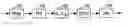
A known method of extracting a fingerprint from a media signal is disclosed in Applicant's International Patent Application WO 02/065782. A schematic diagram of this prior-art method is shown in FIG. 1. The media signal (here an audio song) is divided into overlapping frames (101). A spectral representation of each frame is obtained by performing a Fast Fourier Transform (102). The energy of the audio signal in 33 logarithmically spaced sub-bands is subsequently computed (103). The bands lie in the range of 300-2000 Hz which is perceptually the most relevant range. The 33 energy levels constitute a sequence of perceptual property samples of the respective audio signal frame. In order to be invariant with respect to the absolute loudness of the audio signal and to prevent a major single audio frequency from producing identical sequences for successive frames, a simple 2-dimensional filter (104) is applied to the spectrogram prior to obtaining 32 differential property samples. The sequence is subsequently converted into a bit string by an appropriate thresholding operation (105). More particularly, a sub-band in a particular frame is assigned a bit ‘1’ if the energy difference with its neighboring sub-band is larger than the energy difference with its neighboring sub-band in the previous frame. Otherwise, the fingerprint bit is ‘0’.
The known method produces a string of 32 bits for each audio frame (≈0.4 sec). The frames are preferably overlapping (e.g. by a factor of 31/32) so that the bit strings change slowly with time. This makes the fingerprint extraction invariant with respect to time shifting and frame boundary positioning. Typically, blocks of 256 overlapping frames, i.e. 256×32=8192 bits (≈3 sec of audio) are used to identify a song.
The prior-art fingerprint extraction method has turned out to be very robust against almost all commonly used audio processing steps such as MP3 encoding, sample rate conversion, D/A and A/D conversion, equalization. However, it is not very robust against speed changes. It is quite common for radio stations to speed up audio by a few percent. They supposedly do this for two reasons. First, the duration of songs is then shorter and therefore it enables them to broadcast more commercials. Secondly, the beat of the song is faster and listeners seem to prefer this. The speed changes typically lie between zero and four percent.
OBJECT AND SUMMARY OF THE INVENTIONIt is an object of the invention to provide an improved method and arrangement for extracting a fingerprint from a media signal.
To this end, the method according to the invention comprises the steps of deriving from said media signal a sequence of samples of a given perceptual property of the signal; subjecting the sequence of property samples to an auto-correlation function to obtain a sequence of auto-correlation values; comparing said auto-correlation values with respective thresholds; and representing the results of said comparisons by respective bits of the fingerprint.
The method according to the invention differs from the prior-art method in that the fingerprint bits are not derived from the perceptual property of the signal as such, but from the auto-correlation of said property. The invention is based on the recognition that a speed change of an audio signal causes energy levels in sub-bands to be shifted from one sub-band to another, and exploits the insight that the auto-correlation function is shift invariant.
The auto-correlation function is well-known in the continuous (time) domain. However, we are dealing here with a finite sequence of property values (e.g. energy levels). Therefore, in a practical embodiment of the method according to the invention, the desired auto-correlation is approximated by correlating a sub-sequence of property samples with the complete sequence of property samples.
The auto-correlation function is preferably computed from a statistically significant number of property samples, which is larger than the desired number of fingerprint bits. Down-sampling of the computed auto-correlation function is provided to obtain the desired number of auto-correlation values.
BRIEF DESCRIPTION OF THE DRAWINGSFIG. 1 shows schematically a prior-art arrangement for extracting a fingerprint from an audio signal.
FIG. 2 shows schematically an arrangement for extracting a fingerprint from an audio signal according to the invention.
DESCRIPTION OF EMBODIMENTSSpeed changes of an audio signal cause misalignment in both the temporal and frequency domain. Considering time misalignment, an audio excerpt subjected to a speed change of, say, 2% causes the 250th fingerprint of this excerpt to be extracted at the position of the 255thfingerprint of the original excerpt. Fortunately, in order to be shift-invariant, the fingerprints are constructed in such a way that they possess correlation along the time-axis. Therefore, the BER (bit error rate) between the original excerpt and the same excerpt with a speed change does not increase dramatically due to the temporal misalignment.
The main problem caused by large speed changes is therefore the frequency misalignment. In the prior arrangement, which is shown in FIG. 1, a 2% speedup will result in a scaling of the frequency axis of the spectrum that is obtained with the Fourier Transform. For example, a tone of 500 Hz then results in a tone of 510 Hz and a tone of 1000 Hz results in a tone of 1020 Hz. After calculating the spectrum, the energy in logarithmically spaced bands is determined. Since the bands are logarithmically spaced, the speed change results in a shift of energy from one band to the next. The more energy that shifts from one band to the next, the greater the probability that the extracted fingerprint bits are erroneous. This is due to the fact that the fingerprint bits are determined by energy differences of neighboring bands.
It has been proposed to use a brute force approach for identifying audio with large speed changes. The brute force approach consists of storing fingerprints extracted at multiple speeds in the database, or querying the database with fingerprints that are extracted at multiple speeds. The disadvantage of this method is that the search speed and/or storage requirements increase by a factor N, where N is the number of different speeds that is necessary for a certain application.
FIG. 2 shows an arrangement for extracting a fingerprint from an audio signal according to the invention. In the Figure, the same reference numerals are used for functions that are identical with or similar to the steps that have already been discussed with reference to FIG. 1. More particularly, the audio signal is divided into overlapping frames (101) and the spectrum of each frame is computed (102).
An auto-correlation step (202) is the fundamental step to achieve the better speed-change resilience. A speed change results in a shift of the computed energy vector. Auto-correlation has the property that it is shift-invariant. As is generally known, the auto-correlation ρ(x) of a continuous function f(t) is: ρ ( x ) = ∫ - ∞ ∞ f ( t ) f ( t + x ) ⅆ t
However, we are not dealing here with an infinite continuous function f(t) but a finite sequence of property samples (energies). In order to compute the auto-correlation from a statistically significant number of property samples, the energy of 512 sub-bands is computed (201) instead of 33. The bands are still logarithmic and still lie in the range of 300 to 2000 Hz. Thus the bands have a smaller width. The auto-correlation is approximated by correlating a sub-sequence of energies with the complete sequence. More specifically, the auto-correlation ρ[x] is calculated from the sub-band energy samples E(j) as follows:
ρ
[
x
]
=
∑
j
=
1
M
E
(
K
+
j
)
E
(
x
+
j
)
for
x
=
1
,
2
,
…
,
N
-
M
where N denotes the length of the whole energy vector (here N=512), M denotes the length of the sub-sequence and K denotes the position where the sub-sequence starts in the complete sequence. Typical settings for M and K are 64 and 96, respectively. To increase robustness, the resulting auto-correlation values are optionally low-pass filtered (203). The low-pass filtered auto-correlation has 512−64=448 values, whereas 33 input values are required for the 2-dimensional filter (104) preceding the threshold operation (105). Therefore, the 448 auto-correlation values are down-sampled to 33 values in a down-sampler (204). The resulting fingerprint is a 32-bit string for each frame.
Although embodiments of the method and arrangement have been described with reference to audio fingerprint extraction, the invention is not restricted thereto. Applicant's International Patent Application WO 02/065782, already cited above, discloses a video fingerprint extracting method in which the fingerprint is derived from the mean luminance values of image blocks into which each image is divided. According to the invention, each image is now divided into a larger number of blocks, and a sub-set of the blocks (a “super-block”) is correlated with the whole image for a number of positions of said super-block. The obtained sequence of auto-correlation values is invariant to shifts of the video image. The sequence is optionally low-pass filtered and subsequently down-sampled.
The invention can be summarized as follows. Fingerprints are bit strings extracted from a media signal (e.g. an audio or video clip) to identify said media signal. Typically, they are derived from a perceptual property of the signal, for example, the spectral energy distribution of an audio fragment or the luminance distribution of a video image. A method and arrangement for extracting a fingerprint is here disclosed which is robust with respect to shifts of the perceptual property. Such shifts occur, inter alia, when the fingerprint is derived from a logarithmically mapped spectral energy distribution of an audio signal and said audio signal is subjected to speed changes. According to the invention, the fingerprint is not derived from the perceptual property as such, but from its auto-correlation function.
Claims
1. A method of extracting a fingerprint from a media signal, comprising the steps of extracting from said media signal a sequence of samples of a given perceptual property of the signal, and deriving from said sequence a binary sequence constituting said fingerprint, characterized in that the method comprises the steps of:
subjecting the sequence of property samples to an auto-correlation function (202) to obtain a sequence of auto-correlation values;
comparing (105) said auto-correlation values with respective thresholds; and
representing the results of said comparisons by respective bits of the fingerprint.
2. A method as claimed in claim 1, wherein said step of subjecting the sequence of property samples to an auto-correlation function comprises correlating a sub-sequence of property samples with the complete sequence of property samples.
3. A method as claimed in claim 1, wherein said step of subjecting the sequence of property samples to an auto-correlation function further includes down-sampling (204) the sequence of auto-correlation values to obtain a desired number of auto-correlation values.
4. A method as claimed in claim 1, wherein said step of deriving from said media signal a sequence of perceptual property values comprises dividing an audio signal into sub-bands and computing the energies of said audio sub-bands.
5. A method as claimed in claim 1, wherein said step of deriving from said media signal a sequence of perceptual properties comprises dividing an image into blocks and computing the luminances of said image blocks.
6. An apparatus for extracting a fingerprint from a media signal, comprising means for deriving from said media signal a sequence of samples of a given perceptual property of the signal, and means for deriving from said sequence a binary sequence constituting said fingerprint, characterized in that the apparatus comprises:
means for subjecting the sequence of property samples to an auto-correlation function to obtain a sequence of auto-correlation values;
means for comparing said auto-correlation values with respective thresholds; and
representing the results of said comparisons by respective bits of the fingerprint.
7. A computer program comprising instructions to cause a programmable device to perform the steps of:
deriving from a received media signal a sequence of samples of a given perceptual property of the signal;
subjecting the sequence of property samples to an auto-correlation function to obtain a sequence of auto-correlation values;
comparing said auto-correlation values with respective thresholds; and
representing the results of said comparisons by respective bits of a fingerprint.
Images & Drawings included:


Sources:
- United States Patent and Trademark Office - verify current appl. status at the USPTO↗
Similar patent applications:
- » 20130290330
METHOD FOR EXTRACTING FINGERPRINT OF PUBLICATION, APPARATUS FOR EXTRACTING FINGERPRINT OF PUBLICATION, SYSTEM FOR IDENTIFYING PUBLICATION USING FINGERPRINT, AND METHOD FOR IDENTIFYING PUBLICATION USING FINGERPRINT - » 20160196461
Fingerprint core extraction device for fingerprint matching, fingerprint matching system, fingerprint core extraction method, and program therefor - » 20190130032
Audio fingerprint extraction and audio recognition using said fingerprints - » 20120209612
Audio fingerprint extraction by scaling in time and resampling - » 20200273483
Audio fingerprint extraction method and device - » 20110268315
Scalable media fingerprint extraction - » 20200184189
Extracting fingerprint feature data from a fingerprint image - » 20210306232
Dynamic resource allocation based on fingerprint extraction of workload telemetry data - » 20220318347
A DEVICE FINGERPRINT EXTRACTION METHOD BASED ON SMART PHONE SENSOR - » 20230118211
Fingerprint extraction apparatus and method
Recent applications in this class:
- » 20250149013 2025-05-08
CONTROL SYSTEM FOR PERSONAL STAGE MONITORING AND MIXING SYSTEMS - » 20230065117 2023-03-02
MUSIC RECORDING AND COLLABORATION PLATFORM - » 20230032698 2023-02-02
Dynamic Pedal and Display - » 20230009481 2023-01-12
Computer-Implemented Method, System, and Non-Transitory Computer-Readable Storage Medium for Inferring Evaluation of Performance Information - » 20230005460 2023-01-05
SIGNAL PROCESSING APPARATUS, SIGNAL PROCESSING METHOD, PROGRAM, SIGNAL PROCESSING SYSTEM, AND ENCODING APPARATUS - » 20220215819 2022-07-07
Methods, systems, apparatuses, and devices for facilitating the interactive creation of live music by multiple users - » 20220208157 2022-06-30
System and method for providing electronic musical scores - » 20220122570 2022-04-21
INTERACTIVE PERFORMANCE SYSTEM AND METHOD - » 20210035541 2021-02-04
SYSTEMS AND METHODS FOR RECOMMENDING COLLABORATIVE CONTENT - » 20200402489 2020-12-24
INFORMATION PROCESSING APPARATUS, INFORMATION PROCESSING METHOD, AND PROGRAM
Recent applications for this Assignee:
- » 20210337645 2021-10-28
METHOD AND ADJUSTMENT SYSTEM FOR ADJUSTING SUPPLY POWERS FOR SOURCES OF ARTIFICIAL LIGHT - » 20210290972 2021-09-23
BODY ILLUMINATION SYSTEM USING BLUE LIGHT - » 20190191921 2019-06-27
METHOD AND SYSTEM FOR BREWING INGREDIENTS IN A SOLVENT, APPARATUS USING SAID SYSTEM - » 20170325686 2017-11-16
System and method for extracting physiological information from remotely detected electromagnetic radiation - » 20150380899 2015-12-31
Eye-safe laser-based lighting - » 20150305720 2015-10-29
Ultrasonic synthetic transmit focusing with motion compensation - » 20150189712 2015-07-02
LED lighting arrangement and method of controlling a LED lighting arrangement - » 20150181667 2015-06-25
Driver circuit between fluorescent ballast and LED - » 20150171273 2015-06-18
Solid state light emitting devices based on crystallographically relaxed structures - » 20150146407 2015-05-28
Lighting device having a remote wavelength converting layer