HIGH EFFICIENCY SWITCHING POWER CONVERTER
US20060062027A1
2006-03-23
10/946,352
2004-09-21
Abstract:
A high efficiency switching power converter has a flyback converter and a scavenger circuit to recycle the unavailable magnetic energy stored in the converter wiring and core leakage flux. Recycling this energy, which is normally dissipated in snubber networks, improves efficiency and considerably extends the feasible power levels of the flyback topology enabling high power output, low cost offline converters with low line current harmonics and active PFC.
Interested in similar patents?
Get notified when new applications in this technology area are published.
Classification:
H02M1/34 » CPC main
Details of apparatus for conversion; Means for protecting converters other than automatic disconnection Snubber circuits
H02M1/4208 » CPC further
Details of apparatus for conversion; Circuits or arrangements for compensating for or adjusting power factor in converters or inverters Arrangements for improving power factor of AC input
H02M3/33576 » CPC further
Conversion of dc power input into dc power output with intermediate conversion into ac by static converters using discharge tubes with control electrode or semiconductor devices with control electrode to produce the intermediate ac using devices of a triode or a transistor type requiring continuous application of a control signal using semiconductor devices only having several active switching elements having at least one active switching element at the secondary side of an isolation transformer
H02M1/342 » CPC further
Details of apparatus for conversion; Means for protecting converters other than automatic disconnection; Snubber circuits Active non-dissipative snubbers
Y02B70/10 » CPC further
Technologies for an efficient end-user side electric power management and consumption Technologies improving the efficiency by using switched-mode power supplies [SMPS], i.e. efficient power electronics conversion e.g. power factor correction or reduction of losses in power supplies or efficient standby modes
Y02B70/10 » CPC further
Technologies for an efficient end-user side electric power management and consumption Technologies improving the efficiency by using switched-mode power supplies [SMPS], i.e. efficient power electronics conversion e.g. power factor correction or reduction of losses in power supplies or efficient standby modes
H02M3/335 IPC
Conversion of dc power input into dc power output with intermediate conversion into ac by static converters using discharge tubes with control electrode or semiconductor devices with control electrode to produce the intermediate ac using devices of a triode or a transistor type requiring continuous application of a control signal using semiconductor devices only
Description
FIELD OF THE INVENTIONThe invention relates to electronic switching offline power converters.
BACKGROUND OF THE INVENTIONThere is a global requirement for lower cost and more efficient electrical power converter design with active power factor correction.
With the advent of regulations controlling Power Factor and line current harmonic levels of power converters connected to the AC mains supply, many higher power designs must include an additional active PFC correction stage at the front end, adding cost and further reducing the efficiency of the resulting multistage converter.
A single stage offline flyback converter with PFC modulation can be devised however a significant amount of energy is unavoidably stored in stray circuit inductance both in the transformer and other high current conductors. This energy is not flux linked to the transformer secondary side output circuits, and if not controlled in some manner, causes destructive transient conditions on power supply components during their off condition. To protect semiconductor components this energy is normally captured by “snubber” networks, which limit the amplitude of voltage transients to safe levels. This energy is intentionally dissipated as heat and wasted, reducing the overall conversion efficiency and incurring consequential costs in both manufacturing and use.
SUMMARY OF THE INVENTIONA cost effective solution to improve the overall efficiency of such power converters is described in which the power normally wasted in snubbers is scavenged and recycled by circuitry which delivers the majority of this energy to the secondary side load circuit. This is especially useful in high power, offline flyback converters where the high percentage of energy wasted in such snubber circuits places an effective practical limit on the maximum power ratings of the flyback topology. The invention is capable of multi-kilowatt power levels with high efficiency and low manufacturing costs.
According to the present invention there is provided a flyback type switching power supply topology providing regulated outputs with galvanic isolation from AC input.
The present invention consists in a switching power supply operative to generate primary energy in a power transformer having primary winding driven from a main semiconductor switch and a secondary winding coupled to provide rectified output power and a scavenger circuit operative to capture energy from transient waveforms on the primary winding of said power transformer, said scavenger circuit comprising: an auxiliary semiconductor switch coupled to conduct said transient energy to a primary winding of an auxiliary transformer, and a rectifier, coupled to transfer said captured energy from a secondary winding of said auxiliary transformer as an addition to the rectified output from the secondary winding of the power transformer.
A scavenger circuit comprising a rectifier and capacitor is used to store the excess energy and limit the consequential voltage rise on the main converter switch. An auxiliary semiconductor switching element driving a feedforward transformer/rectifier combination transferring said scavenged energy to the PSU secondary side output circuit.
The voltage imposed on the scavenger capacitor is the sum of the instantaneous AC input voltage, the primary side flyback voltage plus the voltage rise due to scavenged energy. The voltage imposed on the scavenger transformer primary during the scavenger switch on-time is the difference between scavenger capacitor voltage minus instantaneous AC input voltage (this is equal to the sum of the primary side flyback voltage plus the voltage rise due to excess energy). The turns ratio of the scavenger transformer is arranged such that the scavenger secondary side rectifiers will become forward biased only with the voltage contribution of the scavenged energy and not with primary side flyback voltage alone. Significant current will then flow into the secondary side circuit only as a result of scavenged energy. This current flow reduces the voltage on the scavenger capacitor and consequently limits the peak transient voltage stress on the primary switch to within safe limits.
The scavenger semiconductor switch may preferably be controlled by a winding on the main converter transformer or by the main Pulse Width Modulation chip, a separate controller circuit, or any combination of such.
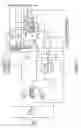
A flyback converter PSU topology is shown which comprises input rectification and filtering, PWM control circuitry, semiconductor switch, power transformer, secondary side rectifiers and output reservoir capacitors. It has an additional scavenger circuit comprising a transient capture circuit, an auxiliary semiconductor switch which is preferably driven from the main conversion transformer, an additional transformer and rectifier to transfer the recovered energy to the PSU output.
BRIEF DESCRIPTION OF THE DRAWINGSA specific embodiment of the invention will now be described by way of example with reference to the accompanying drawing in which:
FIG. 1 shows the block schematic for a typical embodiment of the invention;
FIG. 2 shows the block schematic with alternative series connection of Q2 and T2; and,
FIGS. 3a-3g show typical waveforms for the basic circuit shown in FIG. 1.
DESCRIPTION OF PARTICULAR EMBODIMENTSReferring to FIG. 1 it can be seen that a flyback converter stage is augmented with an efficiency boosting scavenger circuit comprising D3, C2, Q2, T2 and D4 thru D7. With reference to FIG. 3a the peak voltage acquired across C2 is the sum of [instantaneous rectified AC input voltage+T1 primary flyback voltage+voltage rise due to energy stored in stray inductance of T1 Primary]. FIGS. 3b, 3c and 3d show Q1 switching waveforms in expanded timebase and is typical of flyback operation in discontinuous mode. FIG. 3e shows the energy capturing action of D3 and C2, arranged also to prevent excessive voltage transients on Q1 due to T1 primary winding leakage inductance, current limiting is inherent in T1 flyback mode, so peak currents in Q2 and T2 are controlled to safe values.
FIGS. 3g and 3f show T2 primary current and voltage waveforms during scavenged energy transfer. Q2 is driven from a winding on T1 shown here with Q2 in ON-state during T1 flyback period, although this may also be connected in reverse phase. This places a voltage of [T1 primary flyback voltage+voltage rise due to energy stored in stray inductance of T1 Primary] across T2 primary winding. If the voltage on C2 is greater than T1 primary flyback voltage then energy transfer takes place as follows; The turns ratio of T1 is arranged for correct PSU output voltage, T2 turns ratio is further arranged such that scavenger rectifiers D4 and D5 are only conducting due to excess voltage on C2 from captured stray inductance energy of T1 primary (ie. When C2 has discharged to a voltage equal to T1 primary flyback voltage then D4 and D5 will have ceased to conduct).
Thus energy stored in T1 leakage inductance is captured by D3 and C2 and transferred to the PSU output via Q2, T2, D4 and D5. At the point when Q2 switches off there is a relatively small amount of energy stored in T2 due to magnetising current and this is transferred to the load via D6 and D7. The small amount of energy stored in T2 primary winding leakage inductance is dissipated in the transient protection diode connected across T2 primary and protects Q2 from excessive voltage transients.
The synchronous switching nature of Q1 and Q2 in the preferred embodiment minimises the scavenger capacitor value required and minimises the amount of additional Radio Frequency Interference generated, mutual interference between switching stages is also minimised.
Scavenging currents do not affect the AC input PFC/harmonics figures for the converter.
Claims
1. A switching power supply operative to generate primary energy in a power transformer having a primary winding driven from a main semiconductor switch and a secondary winding coupled to provide rectified output power and a scavenger circuit operative to capture energy from transient waveforms on the primary winding of said power transformer, said scavenger circuit comprising: an auxiliary semiconductor switch coupled to conduct the captured transient energy to a primary winding of an auxiliary transformer, and a rectifier, coupled to transfer said captured transient energy from a secondary winding of said auxiliary transformer as an addition to the rectified output from the secondary of the power transformer.
2. A switching power supply, according to claim 1, where the power transformer comprises a switching winding and wherein said switching winding is coupled to control switching of the auxiliary semiconductor switch.
3. A switching power supply, according to claim 2, wherein the switching of the auxiliary semiconductor switch is in a selectable phase relationship with the switching of the main semiconductor switch.
4. A switching power supply, according to claim 1, comprising a main pulse width modulation circuit for controlling switching of the main semiconductor switch, said main pulse width modulator circuit being coupled to control switching of the auxiliary semiconductor switch.
5. A switching power supply, according to claim 4, wherein the switching of the auxiliary semiconductor switch is in a selectable phase relationship with the switching of the main semiconductor switch.
6. A switching power supply, according to claim 1, comprising an auxiliary pulse width modulation circuit, coupled to control switching of the auxiliary semiconductor switch.
7. A switching power supply, according to claim 6, wherein the switching of the auxiliary semiconductor switch is in a selectable phase relationship with the switching of the main semiconductor switch.
8. A switching power supply, according to claim 6, comprising a main pulse width modulation circuit for controlling switching of the main semiconductor switch.
9. A switching power supply, according to claim 7, comprising a main pulse width modulation circuit for controlling switching of the main semiconductor switch.
10. A switching power supply, according to claims 4, driven from an AC supply input, wherein said main pulse width modulation circuit is operative to provide modulation to effect power factor correction on the supply current of said AC supply input.
11. A switching power supply, according to claim 5, driven from an AC supply input, wherein said main pulse width modulation circuit is operative to provide modulation to effect power factor correction on the supply current of said AC supply input.
12. A switching power supply, according to claim 8, driven from an AC supply input, wherein said main pulse width modulation circuit is operative to provide modulation to effect power factor correction on the supply current of said AC supply input.
13. A switching power supply, according to claim 9, driven from an AC supply input, wherein said main pulse width modulation circuit is operative to provide modulation to effect power factor correction on the supply current of said AC supply input.
14. (canceled)
15. (canceled)
16. (canceled)
17. (canceled)
18. A switching power supply, according to claim 1, wherein said auxiliary transformer comprises an auxiliary output winding for providing an auxiliary power output, separate from said rectified output power provided by said secondary winding on said power transformer.
19. A switching power supply, according to claim 2, wherein said auxiliary transformer comprises an auxiliary output winding for providing an auxiliary power output, separate from said rectified output power provided by said secondary winding on said power transformer.
20. A switching power supply, according to claim 3, wherein said auxiliary transformer comprises an auxiliary output winding for providing an auxiliary power output, separate from said rectified output power provided by said secondary winding on said power transformer.
21. A switching power supply operative to generate primary energy in a power transformer having a primary winding driven from a main semiconductor switch and a secondary winding coupled to provide rectified output power, and a scavenger circuit operative to capture energy from transient waveforms on the primary winding of said power transformer, an auxiliary transformer having a primary winding and a secondary winding, said scavenger circuit comprising: an auxiliary semiconductor switch operatively coupled between the secondary winding of the power transformer and the primary winding of the auxiliary transformer to conduct the energy from transient waveforms to the primary winding of the auxiliary transformer thereby capturing transient energy and a rectifier operatively coupled between the secondary winding of said auxiliary transformer and an output to transfer the energy captured from the secondary winding of said auxiliary transformer to the output as an addition to the rectified output from the secondary winding of the power transformer.
22. A switching power supply, according to claim 21, wherein the secondary winding of the power transformer comprises a switching winding which is operatively coupled to the auxiliary semiconductor switch to control switching thereof.
23. A switching power supply, according to any one of claims 1-13, wherein the switching power supply is configured as one of a flyback switching power supply and a feed forward switching power supply; and the switching power supply is configured as one of a half bridge switching power supply and a full bridge switching power supply.
Images & Drawings included:



Sources:
- United States Patent and Trademark Office - verify current appl. status at the USPTO↗
Similar patent applications:
- » 20070297197
Highly efficient switching power converter using a charge pump to power the drive circuit - » 20140009989
High-efficiency Switching Power converter and method for enhancing switching power conversion efficiency - » 20210351693
High energy efficiency switched-capacitor power converter - » 20200403506
High-efficiency pulse width modulation for switching power converters - » 20210399636
High-efficiency pulse width modulation for switching power converters - » 20220302830
High efficiency power obfuscation switched capacitor DC-DC converter architecture - » 20150070943
High efficiency zero-voltage switching (ZVS) assistance circuit for power converter - » 20120274139
Switching coordination of distributed dc-dc converters for highly efficient photovoltaic power plants - » 20120313607
Control circuit for switching loss reduction and smooth mode transition of a high efficiency buck-boost power converter
Recent applications in this class:
- » 20250015710 2025-01-09
NON-ISOLATED ZERO CURRENT AND VOLTAGE TRANSITION TECHNIQUE (ZCVTT) - » 20250007393 2025-01-02
POWER CONVERTING APPARATUS, MOTOR DRIVE APPARATUS, AND REFRIGERATION-CYCLE APPLICATION DEVICE - » 20240266949 2024-08-08
SNUBBER CIRCUIT, CONVERTER COMPRISING THE SAME AND BATTERY CHARGING APPARATUS - » 20240235380 2024-07-11
ACTIVE SNUBBER CIRCUIT - » 20240106324 2024-03-28
DC-DC CONVERTER - » 20240039396 2024-02-01
Surge protection circuit - » 20230353041 2023-11-02
Short circuit regulating device and modular multi-level converter comprising same - » 20230029203 2023-01-26
Snubber circuit - » 20220407411 2022-12-22
Integrated transistor and resistor-diode-capacitor snubber - » 20220352814 2022-11-03
Contactor for battery packs