Table-tennis bat(pen-holding type)
US20060084533A1
2006-04-20
11/292,119
2005-12-02
✅ Patent granted
US 7,993,222 B2
2011-08-09
-
-
Raleigh W. Chiu
2026-06-15
Abstract:
The inventions published consist of ‘split-level step’ between bat handle and contact section. This said step provides the newly inventions here the concept of critical holding points (called as C.H.P.) for the thumb, forefinger and any of other three fingers. These fingers can grip firmly onto the said step. This allows better swing of the bat, angle control, flexibility of bat manipulation and power. These C.H.P. also provides the proper gripping areas so that finger deformation problem is less likely to happen. In addition, it is less strainuous physically for the wrist and fingers, so the better power and performance of the players can be maintained longer naturally throughout the games. Besides, the invented C.H.P.concept can also be achieved (although it is less ideal compared to the ‘split level Step’) without adopting the ‘split-level step’ by having ‘raised-height-block’ or raised step or ‘prolonged bottom handle’ in front and/or at the back of the bat (see Y & Z in drawing C,D,E,F &G) so as to act as the C.H.P. as found in the split-leveled step.(see X in drawing B,D &G) (Note: to use drawing D for article publication purpose)
Interested in similar patents?
Get notified when new applications in this technology area are published.
Classification:
A63B59/40 » CPC main
Bats, rackets, or the like, not covered by groups - Rackets or the like with flat striking surfaces for hitting a ball in the air, e.g. for table tennis
A63B59/45 » CPC further
Bats, rackets, or the like, not covered by groups -; Rackets or the like with flat striking surfaces for hitting a ball in the air, e.g. for table tennis with solid surfaces Rubber parts thereof; characterised by bonding between a rubber part and the racket body
A63B60/10 » CPC further
Details or accessories of golf clubs, bats, rackets or the like; Handles with means for indicating correct holding positions
A63B49/08 » CPC further
Stringed rackets, e.g. for tennis; Frames with special construction of the handle
A63B60/06 » CPC further
Details or accessories of golf clubs, bats, rackets or the like Handles
A63B60/08 » CPC further
Details or accessories of golf clubs, bats, rackets or the like; Handles characterised by the material
A63B60/12 » CPC further
Details or accessories of golf clubs, bats, rackets or the like; Handles contoured according to the anatomy of the user's hand
A63B60/34 » CPC further
Details or accessories of golf clubs, bats, rackets or the like; Handles with the handle axis different from the main axis of the implement
A63B2102/16 » CPC further
Application of clubs, bats, rackets or the like to the sporting activity ; particular sports involving the use of balls and clubs, bats, rackets, or the like Table tennis
A63B49/02 IPC
Stringed rackets, e.g. for tennis Frames
A63B59/00 IPC
Bats, rackets, or the like, not covered by groups -
Description
TECHNICAL FIELDThe present innovation relates to pen-holding type of table-tennis bat.
BACKGROUND ARTThe existing pen-holding-table tennis bats are made as shown in drawing A. (the literature here below all refers to pen-holding table tennis bats) These bats are not ergonomics enough for firm holding and flexibility for good exertion of wrist and finger strengths for better power and performance of the players.
This is due to insufficient firm and critical holding points on the bat for the exertion of wrist and finger power. This reduces the power of the play and also at times causes more possible deformation of the finger (eg: the middle finger is ‘bent’ and deformed slightly) due to exertion of finger strength onto the bat without proper holding points on the bat.
The new invention shown here consists of a ‘split-level step’ between bat handle and contact section (bat contact section here refers to the section of the bat where the rubber is adhered to). This means that either one of the plane of the handle and the contact section is higher than the other (see drawing B). This is improved from existing old design where both sections are made in the same plane. This said step (see ‘x’ in drawing B) provides the new invention and concept of ‘critical holding points’ (so called ‘C.H.P.’ in the following literature) for thumb, forefinger and any of other three fingers. These fingers can grip firmly onto the said step. This allows better swing of the bat, angle control, flexibility of bat manipulation and power. These C.H.P also provides the proper gripping areas for finger rest so that finger deformation problem is less likely to happen. In addition, due to this invention of the good C.H.P., it is less strainuous physically for the wrist and fingers, so better power and performance of the players can be maintained longer naturally through out the game.
In addition to the published new invention of ‘split-level step’, the C.H.P. concept can be achieved (although it is less ideal compared to the ‘split level step’ design) without adopting the ‘split-level step’ by having ‘raised height’-block or step or ‘prolonged bottom handle’ design in front and/or at the back of the bat (See Y&X in drawing C,D,E,F&G) acting as the C.H.P. as found in the ‘split-level step’.(see X in drawing B,D&G). These ‘raisedheight’ blocks or steps and ‘prolonged bottom handle’ are also claimed and published here as the new design or invention here. (see under ‘Claims’)
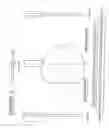
DETAILED DESCRIPTION OF DRAWING B,C,D, E, F AND G.‘U’_‘means contact surface’
‘V’ means ‘handle section’
‘W’ means ‘split-level step’ between handle and contact
‘X’ means ‘bend or step or joint’
‘Y’ means ‘raised-height block or strip’
‘Z’ means ‘prolonged or lengthen bottom handle’
Claims
1) A bat (pen-holding type) for playing table tennis and the like, comprises of a flat planar section with a handle integrally joined to the said flat planar section forming two different planes with a split-level step in such a manner that the bat contains special finger-rest areas (so called ‘critical holding points’, or, C.H.P.) at critical locations where all or any of the five fingers can exert strength in the unique gripping direction and ergonomically well manner towards each other and at the same time firmly onto the bat.
2) The bat according to claim 1 wherein a prolonged bottom handle piece with tapered and thicker curved portion (or of any shapes or forms) at one end stretching from the handle section towards the flat planar section is used to act as critical holding points for all or any of the middle, forth and little fingers, and, provide the fingers such unique gripping direction from the bat bottom surface and ergonomically good rest areas onto the bat.
3) The bat according to claim 1 wherein single or multiple ‘raised-height-blocks’ of any forms or shapes at the bottom side of the flat planar section are used to act as critical holding points and provide unique gripping direction from the bat bottom surface and ergonomically good rest areas onto the bat for any of the middle, forth and the little fingers.
4) The bat according to claim 1 wherein the joining portion between the handle and flat planar section forms an integral or joined part of the handle portion in a 45 degree or any other inclination angle slope or step of any forms in which the slope itself provides the unique critical holding points or part of the critical holding points and unique gripping directions for all or any of the five fingers.
5) The bat according to claim 1 wherein a prolonged bottom handle piece without any tapered and thicker curved portion (or of any shapes or forms) stretching from the handle section towards the flat planar section, can be used to act as critical holding points and unique gripping direction from the bat bottom surface and firmly towards the bat for all or any of the middle, forth and little finger.
6) A bat (pen-holding type) for playing table tennis and the like, comprises of a flat planar section with a handle integrally joined to the said flat planar section in the same plane in such a manner that a prolonged bottom handle piece with tapered and thicker curved portion (or of any shapes or forms) at one end stretching from the handle section towards the flat planar section is used to act as critical holding points for all or any of the middle, forth & little fingers, and, provide the fingers such unique gripping direction from the bat bottom surface and ergonomically good rest areas onto the bat.
7) A bat (pen-holding type) for playing table tennis and the like, comprises of a flat planar section with a handle integrally joined to the said flat planar section in the same plane in such a manner that single or multiple ‘raised-height-blocks’ of any forms or shapes at the bottom side of the flat planar section are used to act as critical holding points and provide unique gripping direction from the bat bottom surface and ergonomically good rest areas onto the bat for any of the middle, forth and the little fingers.
8) A bat (pen-holding type) for playing table tennis and the like, comprises of a flat planar section with a handle integrally joined to the said flat planar section in the same plane in such a manner that a prolonged bottom handle piece without any tapered and thicker curved portion (or of any shapes or forms) stretching from the handle section towards the flat planar section, can be used to act as critical holding points and unique gripping direction from the bat bottom surface and firmly towards the bat for all or any of the middle, forth and little finger.
9) A bat (pen-holding type) for playing table tennis and the like, comprises of a flat planar section with a handle integrally joined to the said flat planar section in such a manner that features like a ‘split-level step’, a prolonged bottom handle piece or a raised-height block or blocks at the bottom of the bat surface or combination of all or some of the said features constitute the critical holding points that provide the unique gripping direction and ergonomically good resting areas for all or any of the five fingers to press onto the said bat.
Images & Drawings included:



Sources:
- United States Patent and Trademark Office - verify current appl. status at the USPTO↗
Recent applications in this class:
- » 20250256177 2025-08-14
NOVEL ADJUSTABLE RACKET - » 20250108274 2025-04-03
PICKLEBALL PADDLE AND METHODS OF MANUFACTURING THEREOF USING ARAMID FIBERS - » 20250108273 2025-04-03
PICKLEBALL PADDLE AND METHODS OF MANUFACTURING THEREOF - » 20240252893 2024-08-01
PLAYING IMPLEMENT FOR A PADDLE FOR FACILITATING PLAYING WITH THE PADDLE - » 20230392895 2023-12-07
Paddle for discipline with pivoting handle and related methods - » 20220288474 2022-09-15
INFLATABLE APPARATUS FOR STRIKING AND PROPELLING AN OBJECT - » 20170021247 2017-01-26
DUAL CORE PICKLEBALL PADDLE - » 20120010031 2012-01-12
Table tennis paddle - » 20110319207 2011-12-29
Table tennis racket - » 20100317468 2010-12-16
Table Tennis Racket or Like Racket Played by Hand Controlled by Fingers and Palm