Tool for piercing nut
US20060096083A1
2006-05-11
10/526,719
2002-09-05
✅ Patent granted
US 7,269,893 B2
2007-09-18
WO; PCT/SE02/01580; 20020905
WO; WO2004/022281; 20040318
Essama Omgba
2022-09-23
Abstract:
The invention relates to a tool for piercing nuts, comprising a die part and a punch part and a piercing nut feeder incorporated into the punch part. The piercing nut feeder is adapted to feed piercing nuts into a piercing nut holder in the punch part so that these nuts, when the punch part is pressed against the die part by a press, are to punch holes in and be fastened to a metal sheet inserted between the punch part and the die part. A gas spring (3) is arranged between the press and the punch part, which gas spring (3) has at least one cylinder (5-7) and a piston (8-10) which is movably arranged in the cylinder (5-7) and which is aligned with the press, the pressure in the cylinder (5-7) being settable for adjusting the pressure exerted upon the piercing nut by the punch part.
Assignee:
- Stromsholmen AB 19 🇸🇪 Tranas, Sweden
Interested in similar patents?
Get notified when new applications in this technology area are published.
Classification:
B23P19/062 » CPC main
Machines for simply fitting together or separating metal parts or objects, or metal and non-metal parts, whether or not involving some deformation ; Tools or devices therefor so far as not provided for in other classes for assembling or disassembling parts; Screw or nut setting or loosening machines Pierce nut setting machines
Y10T29/53383 » CPC further
Metal working; Means to assemble or disassemble; Means to interrelatedly feed plural work parts from plural sources without manual intervention and means to fasten work parts together
Y10T29/53387 » CPC further
Metal working; Means to assemble or disassemble; Means to interrelatedly feed plural work parts from plural sources without manual intervention and means to fasten work parts together by deforming
Y10T29/5343 » CPC further
Metal working; Means to assemble or disassemble Means to drive self-piercing work part
Y10T29/53522 » CPC further
Metal working; Means to assemble or disassemble with magazine supply Means to fasten by deforming
B23P19/00 IPC
Machines for simply fitting together or separating metal parts or objects, or metal and non-metal parts, whether or not involving some deformation ; Tools or devices therefor so far as not provided for in other classes
B23P11/00 IPC
Connecting or disconnecting metal parts or objects by metal-working techniques not otherwise provided for
Description
FIELD OF THE INVENTIONThe present invention relates to a tool for piercing nuts according to the preamble to claim 1.
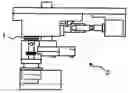
BACKGROUND ARTFIG. 1 illustrates a prior art tool for piercing nuts which is adapted to fasten piercing nuts to metal sheet. This requires great accuracy for the nut or metal sheet not to be damaged and for the nut to be safely permanently connected to the metal sheet. A condition for such accuracy is that the punch of the tool for piercing nuts bottoms with the correct pressure against the piercing nut, i. e. that the stroke of the punch is cor-rectly set for the used piercing nut and the metal sheet in question. To achieve this accuracy within some tenths of a millimetre, spacers, or shims, are currently used for adjustment in the shown prior art tool for piercing nuts. The shims are arranged between an adjusting plate and the tool for piercing nuts which thus is moved in its entirety by means of the shims. This mode of operation is time consuming and still does not provide exact information about the pressure to which the piercing nut and the metal sheet are subjected. A negative effect on, for instance, the strength of the piercing nut owing to a punch pressure which after all is incorrect, thus cannot be excluded. Moreover, it is necessary to completely stop the use of the tool for piercing nuts during the actual adjustment, which causes expensive production standstill when the tool is included as one of a plurality of tools in a long press line.
OBJECT OF THE INVENTIONTherefore, an object of the present invention is to eliminate the drawbacks of the prior art tool for piercing nuts.
SUMMARY OF INVENTIONAccording to the invention, this object is achieved by a tool for piercing nuts according to claim 1.
BRIEF DESCRIPTION OF THE DRAWINGSThe invention will now be described in more detail with reference to the accompanying drawings, in which
FIG. 1 illustrates a prior art tool for piercing nuts;
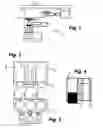
FIG. 2 is a side view of a gas spring;
FIG. 3 is a top plan view of the gas spring;
FIG. 4 is a sectional view of the gas spring;
FIG. 5 is a side view of the gas spring mounted in a tool for piercing nuts according to the invention; and
FIG. 6 is a top plan view of the tool for piercing nuts according to the invention.
DESCRIPTION OF A PREFERRED EMBODIMENTIn the tool for piercing nuts according to the in-vention, the shims 1, mentioned by way of introduction, of the prior art tool for piercing nuts 2 in FIG. 1 are replaced by a gas spring 3. The gas spring is shown in more detail in FIGS. 2-4 and in its position of operation in a tool for piercing nuts 4 according to the invention in FIGS. 5-6.
The gas spring 3 comprises, as will be seen, three pistons 5-7 which are movably arranged in a cylinder 8-10 each. The cylinders 8-10 are in a manner not illustrated in detail connected with each other (connected in series) to be able to be pressurised by a common source of com-pressed air (not shown). This source of compressed air makes it possible to set in the cylinders 8-10 a pressure acting on the pistons 5-7 with a force that is suitable for the case of operation in question.
The advantage of the gas spring 3 is that it makes it possible to exactly adjust the pressure exerted upon a piercing nut by the tool for piercing nuts 4. It will be appreciated that the pressure exerted by the gas spring 3 is dependent not only by the actual gas pressure but also by the surface area of the pistons 5-7. It will also be appreciated that the gas spring 3, when the tool for piercing nuts 4 bottoms when fastening a piercing nut, can perform a certain damping motion, the size of which greatly exceeds the damping motion which is allowed by the prior art shims (about 1.5 mm against about 0.1 mm).
Owing to the invention, just a single initial adjustment is therefore necessary, and subsequently appearing minor deviations will not be important since they can be com-pensated for by the gas spring 3.
The maximum stroke of the pistons 5-7 of the shown gas spring 3 is about 12 mm. This means in practice that not even a case where two piercing nuts inadvertently land on top of each other in the tool for piercing nuts 4 will cause damage that will require stoppage for repair or even, as in the prior art tool for piercing nuts 2 with the shims 1, exchange of the entire tool.
The above-mentioned connection in series of a plu-rality of cylinders 8-10 renders it possible to make the gas spring 3 elongate so that it well fits the tool for piercing nuts 4 as such and also a press line, in which the tool for piercing nuts 4 can be included as one among a large number of other tools and in which therefore the available space is extremely restricted.
A person skilled in the art understands that the above-described tool for piercing nuts 4 according to the invention can be modified in various ways within the scope of the claims and, for instance, that the number of cylinders 5-7 in the gas spring 3 can be different from the one shown.
Claims
1. A tool for piercing nuts, comprising a die part and a punch part and a piercing nut feeder incorporated into the punch part and adapted to feed piercing nuts into a piercing nut holder in the punch part so that said nuts, when the punch part is pressed against the die part by a press, are to punch holes in and be attached to a metal sheet inserted between the punch part and the die part, characterised in that a gas spring (3) is arranged between the press and the punch part, said gas spring (3) having at least one cylinder (5-7) and a piston (8-10) which is movably arranged in said cylinder (5-7) and which is aligned with the press, the pressure in the cylinder (5-7) being settable for adjusting the pressure exerted upon the piercing nut by the punch part.
2. A tool for piercing nuts as claimed in claim 1, in wherein that the gas spring (3) com-prises an odd number of, however at least three, cylinders (5-7) and associated pistons (8-10).
3. A tool for piercing nuts as claimed in claim 2, in wherein that the cylinders (5-7) are connected in series.
Images & Drawings included:

Sources:
- United States Patent and Trademark Office - verify current appl. status at the USPTO↗
Similar patent applications:
- » 20100306996
PIERCE NUT INSTALLATION TOOL - » 20120137496
Pierce nut insertion tool - » 20150026950
Method of using a pierce nut insertion tool
Recent applications in this class:
- » 20250256368 2025-08-14
Apparatus for Processing a Workpiece and Corresponding Method - » 20250100093 2025-03-27
Automated floating insertion tool for push-in fasteners - » 20240293900 2024-09-05
Two-stage device and methods for installing a self-clinching fastener - » 20240238922 2024-07-18
Joining tool and tool gripper - » 20240238921 2024-07-18
DEVICE AND METHOD FOR INSERTING AN AUXILIARY JOINING PART INTO A WORKPIECE, AND ARRANGEMENT - » 20240058907 2024-02-22
Setting device - » 20230173624 2023-06-08
Device and method for fixing nut to inner surface of pipe member - » 20230042240 2023-02-09
Joining head for fastening a fastening element to the surface of a component - » 20190160608 2019-05-30
Coupling member head - » 20180154488 2018-06-07
Device And Method For Positioning Connection Elements
Recent applications for this Assignee:
- » 20220106997 2022-04-07
Piston cylinder device with protection arrangement and method of protecting a piston cylinder device against overload or failure of the piston cylinder device - » 20210180661 2021-06-17
Gas spring and safety method for gas spring - » 20190331188 2019-10-31
Piston cylinder device with protection arrangement and method of protecting a piston cylinder device against overload or failure of the piston cylinder device - » 20170051807 2017-02-23
Gas spring and safety method for gas spring - » 20140232050 2014-08-21
Hydropneumatic suspension unit - » 20130038004 2013-02-14
Gas spring with temperature compensation - » 20100212305 2010-08-26
Counterbalancing arrangement - » 20090309278 2009-12-17
Hydropneumatic suspension unit - » 20090134588 2009-05-28
Suspension system, vehicle comprising such a suspension system and a method for controlling a suspension system - » 20090107784 2009-04-30
Hydropneumatic spring and damper system