Electrolyte additive
US20060141364A1
2006-06-29
10/543,411
2004-01-16
Abstract:
An electrolyte for use in a lithium ion cell that has a tin anode, the electrolyte comprising vinyl ethylene carbonate.
Interested in similar patents?
Get notified when new applications in this technology area are published.
Classification:
H01M10/0569 » CPC main
Secondary cells; Manufacture thereof; Accumulators with non-aqueous electrolyte characterised by the materials used as electrolytes, e.g. mixed inorganic/organic electrolytes the electrolyte being constituted of organic materials only; Liquid materials characterised by the solvents
H01M4/387 » CPC further
Electrodes; Electrodes composed of, or comprising, active material; Selection of substances as active materials, active masses, active liquids of elements or alloys Tin or alloys based on tin
H01M10/052 » CPC further
Secondary cells; Manufacture thereof; Accumulators with non-aqueous electrolyte Li-accumulators
H01M2300/004 » CPC further
Electrolytes; Non-aqueous electrolytes; Organic electrolyte characterised by the solvent; Mixture of solvents Three solvents
Y02E60/10 » CPC further
Enabling technologies; Technologies with a potential or indirect contribution to GHG emissions mitigation Energy storage using batteries
Y02E60/10 » CPC further
Enabling technologies; Technologies with a potential or indirect contribution to GHG emissions mitigation Energy storage using batteries
Description
This invention relates to an electrolyte for a lithium ion cell in which the anode comprises tin, and to lithium ion cells containing such an electrolyte.
For many years it has been known to make cells with lithium metal anodes, and cathodes of a material into which lithium ions can be intercalated or inserted. A wide variety of intercalation or insertion materials are known as cathode materials for rechargeable lithium cells, such as TiS2 or V6O13. To avoid the problems arising from dendrite growth at lithium metal anodes during cycling it has been proposed to use an intercalation material such as carbon as the anode material. In this case the cathode material will be generally an intercalation material that initially contains lithium ions, such as LixCoO2 where x is less than 1. Rechargeable cells of this type, in which both the anode and cathode contain intercalated lithium ions, are now available commercially, and may be referred to as lithium ion cells, or as swing or rocking-chair cells. Several different carbonaceous materials such as coke, graphite or carbon fibre have been suggested for use in anodes. Graphite is commonly used commercially, but the capacity of this material in commercial cells is close to the theoretical limit for LiC6 (372 mA h/g). Alternative anode materials have therefore been suggested in order to increase electrode capacity, and in this respect tin electrodes have the benefit of a markedly higher theoretical capacity: 994 mA h/g for Li4.4Sn. However, during insertion of lithium ions, very large volume changes occur, which lead to breakup of the electrode material and so poor cycle performance.
Annealing a tin electrode before use so as to form, for example, a tin-copper alloy has been found to improve the cycle performance of the cell. However, such electrodes still have lower cycle efficiencies than are required for long cycle life Li-ion cells.
The present invention aims to address this problem of poor cycle performance for cells with tin anodes.
Accordingly, the present invention provides an electrolyte for use in a lithium ion cell comprising a tin anode, the electrolyte comprising vinyl ethylene carbonate.
The present invention also provides a lithium ion cell with a tin anode wherein the electrolyte comprises vinyl ethylene carbonate.
Typically the electrolyte comprises from 0.5 to 20 volume % of vinyl ethylene carbonate, preferably from 1 to 10 volume % and most preferably about 5 volume %.
The electrolyte may also comprise ethylene carbonate, propylene carbonate, diethyl carbonate, dimethyl carbonate or mixtures thereof. In a preferred embodiment the electrolyte comprises ethylene carbonate and/or propylene carbonate.
The electrolyte must also contain lithium ions and so comprises a lithium salt such as LiPF6, LiBF4, lithium imide (LiN(CF3SO2)2 or lithium bis-(trifluoromethanesulphonyl) imide) or lithium methide (LiC(SO2CF3) 3, lithium tris-(trifluoromethanesulphonyl) methide.
In a preferred embodiment, the electrolyte comprises vinyl ethylene carbonate, ethylene carbonate, propylene carbonate and a lithium salt.
The invention also provides a process for making a lithium ion cell with a tin anode which process comprises: making an anode comprising a layer of tin; assembling a cell comprising the said anode, a cathode comprising lithium ions, and an electrolyte comprising lithium ions and vinyl ethylene carbonate.
The cathode is made of a material containing intercalated lithium ions. For example, a lithium cobalt oxide, a lithium nickel oxide, a lithium nickel cobalt oxide such as LiNi1-xCoxO2 or a lithium manganese oxide such as LiMn2O4.
The present invention also provides the use of an electrolyte comprising vinyl ethylene carbonate and a lithium salt in a lithium ion cell comprising a tin anode.
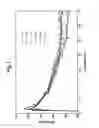
The invention will now be further described by way of example only, and with reference to the accompanying drawing which shows a graph of efficiency against cycle number for the test cells described in Example 1 and Comparative Example 1.
EXAMPLE 1Test cells containing a tin anode were made containing an electrolyte consisting of ethylene carbonate, propylene carbonate, 1 molar LiPF6 and vinyl ethylene carbonate. The ratio of ethylene carbonate to propylene carbonate was 2:1 by volume. The ethylene and propylene carbonates were mixed in a 2:1 ratio and then vinyl ethylene carbonate was added to form 5 volume % of the final mixture. LiPF6 was added to the mixture of liquids to form a 1 molar solution. The test cells contained three electrodes: a LiCoO2 counter electrode and a lithium reference electrode as well as the tin anode.
The tin electrode was cycled with respect to the lithium reference electrode between voltage limits of 0.01 V and 2.00 V at a constant current.
The cycle efficiencies of the three cells (D, E and F) are shown in FIG. 1.
COMPARATIVE EXAMPLE 1Test cells were made as described in Example 1 containing an electrolyte consisting of a 2:1 ratio of ethylene carbonate to propylene carbonate to which was added LiPF6 to form a 1 molar solution.
These test cells were cycled between voltage limits as described in Example 1 and the cycle efficiencies of the three cells (A, B and C) are shown in FIG. 1.
From FIG. 1 it can be seen that an increased cycle efficiency is shown by the cells where the electrolyte comprises vinyl ethylene carbonate. Thus a tin anode lithium ion cell where the electrolyte comprises vinyl ethylene carbonate will last for a greater number of cycles than a cell without vinyl ethylene carbonate.
Claims
1. An electrolyte for use in a lithium ion cell comprising a tin anode, the electrolyte comprising vinyl ethylene carbonate.
2. An electrolyte according to claim 1 wherein the electrolyte comprises from 0.5 to 20 volume % of vinyl ethylene carbonate.
3. An electrolyte according to claim 2 wherein the electrolyte comprises 5 volume % of vinyl ethylene carbonate.
4. An electrolyte according to claim 1 wherein the electrolyte further comprises ethylene carbonate and propylene carbonate.
5. A lithium ion cell with a tin anode wherein the electrolyte comprises vinyl ethylene carbonate.
6. A cell according to claim 5 wherein the electrolyte comprises from 0.5 to 20 volume % of vinyl ethylene carbonate.
Images & Drawings included:
Sources:
- United States Patent and Trademark Office - verify current appl. status at the USPTO↗
Similar patent applications:
- » 20190319322
Electrolytic additive, electrolyte including the electrolytic additive, cathode including the electrolyte, and lithium air battery including the cathode - » 20230178806
ELECTROLYTE ADDITIVE, ELECTROLYTE FOR BATTERIES INCLUDING ELECTROLYTE ADDITIVE, AND SECONDARY BATTERY INCLUDING ELECTROLYTE - » 20230246233
ELECTROLYTE ADDITIVE, ELECTROLYTE FOR BATTERIES INCLUDING ELECTROLYTE ADDITIVE, AND SECONDARY BATTERY INCLUDING ELECTROLYTE - » 20220376299
ELECTROLYTE ADDITIVE, BATTERY ELECTROLYTE INCLUDING ELECTROLYTE ADDITIVE, AND SECONDARY BATTERY INCLUDING BATTERY ELECTROLYTE - » 20220173435
LITHIUM BATTERY AND USE OF A UREA-BASED ELECTROLYTE ADDITIVE AS AN ELECTROLYTE ADDITIVE THEREIN - » 20220190331
Lithium battery and use of a germanium organyl-based electrolyte additive as an electrolyte additive therein - » 20140335406
NON-AQUEOUS ORGANIC ELECTROLYTE ADDITIVE, METHOD FOR PREPARING NON-AQUEOUS ORGANIC ELECTROLYTE ADDITIVE, NON-AQUEOUS ORGANIC ELECTROLYTE, AND LITHIUM-ION SECONDARY BATTERY - » 20160351963
Electrolyte additive for lithium battery, electrolyte for lithium battery, and lithium battery including the electrolyte additive - » 20200313239
Electrolyte additive, electrolyte and lithium ion secondary battery containing the same - » 20160111754
Electrolyte additive, electrolyte and lithium ion battery using the same
Recent applications in this class:
- » 20250174727 2025-05-29
LITHIUM-SULFUR BATTERIES AND ASSOCIATED ELECTROLYTES - » 20250174726 2025-05-29
ELECTROLYTIC SOLUTION, LITHIUM-SULFUR SECONDARY BATTERY, AND MODULE - » 20250174725 2025-05-29
SECONDARY BATTERY AND ELECTRONIC APPARATUS - » 20250158130 2025-05-15
ELECTROCHEMICAL APPARATUS AND ELECTRONIC APPARATUS CONTAINING SAME - » 20250158129 2025-05-15
ELECTROLYTE SOLUTION FOR RECHARGEABLE LITHIUM BATTERY AND RECHARGEABLE LITHIUM BATTERY INCLUDING THE SAME - » 20250149638 2025-05-08
MICROPOROUS MEMBRANES, BATTERY SEPARATORS, BATTERIES, AND DEVICES HAVING THE SAME - » 20250149637 2025-05-08
ELECTROLYTE FOR SODIUM SECONDARY BATTERY, SODIUM SECONDARY BATTERY, AND ELECTRIC APPARATUS - » 20250149636 2025-05-08
LITHIUM ION BATTERY - » 20250140931 2025-05-01
BATTERY ELECTROLYTE SOLUTION AND BATTERY - » 20250140930 2025-05-01
NONAQUEOUS ELECTROLYTIC SOLUTION SECONDARY BATTERY