Scan-assisted mobile telephone
US20060146359A1
2006-07-06
10/542,480
2003-10-30
✅ Patent granted
US 7,773,120 B2
2010-08-10
WO; PCT/EP03/12096; 20031030
WO; WO2004/064383; 20040729
John M Villecco
2026-05-25
Abstract:
The invention relates to a method for scanning, in particular documents with the aid of a camera (K). The inventive method consists in combining an image sequence or a sequence of partial images in order to obtain a final image, projecting a reference model (F) onto the camera vision field and in compensating representational differences of different images on the basis of geometrical information of the model (F).
Assignee:
- PALM, INC. 480 🇺🇸 Sunnyvale, CA, United States
Interested in similar patents?
Get notified when new applications in this technology area are published.
Classification:
H04N5/228 IPC
Details of television systems; Studio circuitry; Studio devices; Studio equipment ; Cameras comprising an electronic image sensor, e.g. digital cameras, video cameras, TV cameras, video cameras, camcorders, webcams, camera modules for embedding in other devices, e.g. mobile phones, computers or vehicles; Television cameras ; Cameras comprising an electronic image sensor, e.g. digital cameras, video cameras, camcorders, webcams, camera modules specially adapted for being embedded in other devices, e.g. mobile phones, computers or vehicles Circuit details for pick-up tubes
H04N1/00307 » CPC main
Scanning, transmission or reproduction of documents or the like, e.g. facsimile transmission; Details thereof; Connection or combination of a still picture apparatus with another apparatus, e.g. for storage, processing or transmission of still picture signals or of information associated with a still picture with a telecommunication apparatus, e.g. a switched network of teleprinters for the distribution of text-based information, a selective call terminal with a mobile telephone apparatus
H04N1/195 » CPC further
Scanning, transmission or reproduction of documents or the like, e.g. facsimile transmission; Details thereof; Scanning arrangements, i.e. arrangements for the displacement of active reading or reproducing elements relative to the original or reproducing medium, or using multi-element arrays the array comprising a two-dimensional array or a combination of two-dimensional arrays
H04N1/19594 » CPC further
Scanning, transmission or reproduction of documents or the like, e.g. facsimile transmission; Details thereof; Scanning arrangements, i.e. arrangements for the displacement of active reading or reproducing elements relative to the original or reproducing medium, or using multi-element arrays the array comprising a two-dimensional array or a combination of two-dimensional arrays using a television camera or a still video camera
G06F3/12 IPC
Input arrangements for transferring data to be processed into a form capable of being handled by the computer; Output arrangements for transferring data from processing unit to output unit, e.g. interface arrangements Digital output to print unit, e.g. line printer, chain printer
H04N9/47 IPC
Details of colour television systems; Colour synchronisation for sequential signals
H04N5/225 IPC
Details of television systems; Studio circuitry; Studio devices; Studio equipment ; Cameras comprising an electronic image sensor, e.g. digital cameras, video cameras, TV cameras, video cameras, camcorders, webcams, camera modules for embedding in other devices, e.g. mobile phones, computers or vehicles Television cameras ; Cameras comprising an electronic image sensor, e.g. digital cameras, video cameras, camcorders, webcams, camera modules specially adapted for being embedded in other devices, e.g. mobile phones, computers or vehicles
H04N5/222 IPC
Details of television systems Studio circuitry; Studio devices; Studio equipment ; Cameras comprising an electronic image sensor, e.g. digital cameras, video cameras, TV cameras, video cameras, camcorders, webcams, camera modules for embedding in other devices, e.g. mobile phones, computers or vehicles
G03B17/48 IPC
Details of cameras or camera bodies; Accessories therefor adapted for combination with other photographic or optical apparatus
Description
The invention relates to a method for scanning, in particular documents as well as to a mobile telephone according to the preamble of claim 2.
The use of a camera, typically with a low resolution, for scanning documents is known. This involves the camera and/or the mobile telephone being moved over the document at a short distance from it. A final image is generated from the images and/or partial images recorded in this way.
The images are recorded for example using a high scanning frequency of typically 15 or 30 Hertz. For this reason, adjacent images have an extremely high image overlap. A high resolution final image can be continuously established by adjoining narrow film strips from the respective image centre and allowing for the camera displacement.
Small variations in the distance between the camera and the document and a slight tilting of the camera which occurs with a hand-held camera nevertheless result in extremely troublesome changes in size in the document content displayed. The size changes must be adjusted to each other in a first processing step, so that the high resolution final image can be constructed without errors. The determination of the position of the camera sensor with respect to the document, particularly in terms of the distance and tilting, is a fundamental and important condition for fault compensation. The calculation of the relative position information from successive images is a known approach, which is extremely complex and provides results which are mostly very unstable. In general, tiltings of the camera in relation to the document can only be determined with great difficulty, on the basis of the recorded image information by means of image processing.
The object of the invention is to facilitate the scanning of documents using a scanning method and a mobile telephone.
This object is achieved according to the invention for a method by means of the features specified in claim 1 and for a mobile telephone by means of the features specified in claim 2.
The method and/or mobile telephone according to the invention allows for the rapid and robust determination of the relative position of the camera sensor in respect of the document.
In accordance with the invention, a reference model is projected onto the visual field of the camera. The evaluation of the geometry of the pattern in the images enables the compensation of the representational differences in the images.
A small reference model is permanently projected onto the same position within the visual field of the camera and is evaluated in the recorded image by means of an image processing algorithm. The position of the sensor in relation to the document is uniquely determined in a three-dimensional space from the geometric information of the reference model projected onto the document surface and the reference model represented in the sensor. The use of a reference model permits the extraction of the necessary geometric information for compensating the representational differences in images to be very robust and rapid using the methods of digital image processing and to be effected independently of the content of the scanned document.
A suitable reference model is for example a small reticule, which is permanently projected onto the same position within the visual field of the camera. The position of the sensor in relation to the document is distinctly determined in a three dimensional space from the information of the reticule parameter (distance) and the relative length of the reticule axis (tipping in x and y direction).
SUMMARY OF THE ADVANTAGES OF THE METHOD
-
- Rapidity and robustness in the determination of the relative position of the sensor to the document
- Extremely precise determination of the distance and the tilting of the sensor irrespective of the content of the scanned document
The invention is described below in more detail with reference to an exemplary embodiment shown in the drawing.
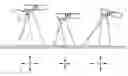
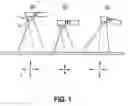
The method for the position determination of a camera K in relation to a document (not illustrated in more detail), as shown in FIG. 1, is realized for example on a mobile telephone or a mobile radio device which has the following features:
-
- Camera K for example on the rear side of the mobile telephone MT for recording images from the surroundings
- Processor for processing image information and for determining the relative sensor position
- Light-emitting diode L on the rear side of the mobile telephone MT for projecting a reticule F into the visual field of the camera (K).
The mobile telephone MT moves across the document at a slight distance therefrom in order to scan a document for example. The characteristic features of the projection of a reference model F for determining the relative sensor position are roughly sketched on an exemplary design.
Case a) in comparison with case b)
In cases a) and b) the camera is parallel to the document surface. The distance of the camera to the document is larger in case a) than in case b). The projected reticule F in the camera image is thus smaller in case b) than in case a). The reticule size is directly linked to the sensor distance and can be calculated in each instance from the detail screen of the camera.
Case c)
The camera K and/or the camera sensor is tilted in respect of the master document. The position of the sensor in a 3-dimensional space in relation to the document can be distinctly determined from the absolute size of the reticule in conjunction with the information about the relative length of the reticule axis.
Claims
1. Method for scanning, in particular documents, using a camera (K), an image sequence or a sequence of partial images being combined into a final image, in which a reference model (F) is projected onto the visual field of the camera, and
in which representational differences of different images are compensated on the basis of the geometrical information of the model (F).
2. Mobile telephone (MT) with a camera (K) and with an image processing device for generating a final image from the images or partial images obtained during a scanning process, characterized by
a projection device (L), by means of which a reference model (F) can be projected onto the visual field of the camera, and means of compensating for representational differences of the different images on the basis of the geometrical information of the model (F).
Images & Drawings included:
Sources:
- United States Patent and Trademark Office - verify current appl. status at the USPTO↗
Recent applications in this class:
- » 20240171688 2024-05-23
IMAGE FORMING DEVICE - » 20230421707 2023-12-28
IMAGE FORMING DEVICE, FACSIMILE PROCESSING SYSTEM, AND FACSIMILE PROCESSING METHOD - » 20230353690 2023-11-02
Image forming apparatus that notifies when a portable terminal can be moved from a predetermined position, at which it communicates with a first communication portion, after enablement of communication with a second communication portion - » 20230156129 2023-05-18
Image processing apparatus comprising processing device that acquires management information from terminal device and cancels restriction setting on transmission and reception of information, and processing method - » 20230109068 2023-04-06
INFORMATION PROCESSING SYSTEM AND CONTROL METHOD FOR CONTROLLING INFORMATION PROCESSING SYSTEM - » 20220247873 2022-08-04
Image forming apparatus capable of wireless communication with portable terminal and having a light emitting portion to indicate the wireless communication is enabled - » 20220191336 2022-06-16
Methods and systems for automatically transferring scanned documents from multi-function devices to personal devices - » 20220109762 2022-04-07
Image processing system includes at least an image processing device, mobile terminal and information processing device that has chatbot function to receive a question, and the image processing device generates activation data for activating the chatbot function - » 20210329134 2021-10-21
INFORMATION PROCESSING APPARATUS ENABLING COMMUNICATION SETTINGS TO BE MADE WITH EASE, METHOD OF CONTROLLING INFORMATION PROCESSING APPARATUS, AND STORAGE MEDIUM - » 20210152699 2021-05-20
Mobile terminal, storage medium and control method to remotely operate an information processing apparatus
Recent applications for this Assignee:
- » 20130106886 2013-05-02
Display of visual images by fractional color gradient increments - » 20130005400 2013-01-03
Integrated personal digital assistant device - » 20120321063 2012-12-20
Contact-centric user-interface for computing devices - » 20120302286 2012-11-29
Techniques for enhanced co-existence of co-located radios - » 20120238331 2012-09-20
Systems and techniques for reducing power consumption in a mobile computing device - » 20120207053 2012-08-16
Apparatus and methods for providing power savings on mobile devices - » 20120176249 2012-07-12
Proximity detection alarm for an inductively charged mobile computing device - » 20120169568 2012-07-05
MULTIBAND ANTENNA WITH GROUND RESONATOR AND TUNING ELEMENT - » 20120169547 2012-07-05
MULTIBAND ANTENNA WITH SURROUNDING CONDUCTIVE COSMETIC FEATURE - » 20120159034 2012-06-21
Communication port and connector