Multiply insole
US20060156582A1
2006-07-20
11/099,449
2005-04-06
✅ Patent granted
US 7,360,325 B2
2008-04-22
-
-
Ted Kavanaugh
2025-08-17
Abstract:
An insole includes a first layer made of a first slice foam material formed by a foamable polyurethane resin composition. A second layer is made of a second slice foam material formed by bonding together particles of comminuted previously formed foam material with a foamable polyurethane resin composition. The second layer is adhered to an upper surface of the first layer. The second layer has a thickness being greater than that of the first layer.
Inventors:
- Yi-Hsi Chen 1 🇹🇼 Miao Li Hsien, Taiwan
- Yi-Hsi Chen 1 🇹🇼 Miao Li City, Miao Li Hsien, Taiwan
Interested in similar patents?
Get notified when new applications in this technology area are published.
Classification:
A43B7/142 » CPC main
Footwear with health or hygienic arrangements with foot-supporting parts with pads or holes on one or more locations, or having an anatomical or curved form characterised by the location under the foot situated under the medial arch, i.e. under the navicular or cuneiform bones
A43B7/144 » CPC further
Footwear with health or hygienic arrangements with foot-supporting parts with pads or holes on one or more locations, or having an anatomical or curved form characterised by the location under the foot situated under the heel, i.e. the calcaneus bone
A43B13/386 » CPC further
Soles; Sole-and-heel integral units; Built-in insoles joined to uppers during the manufacturing process, e.g. structural insoles; Insoles glued to shoes during the manufacturing process multilayered
A43B17/006 » CPC further
Insoles for insertion, e.g. footbeds or inlays, for attachment to the shoe after the upper has been joined characterised by the material multilayered
A43B17/08 » CPC further
Insoles for insertion, e.g. footbeds or inlays, for attachment to the shoe after the upper has been joined ventilated
A43B13/38 IPC
Soles; Sole-and-heel integral units Built-in insoles joined to uppers during the manufacturing process, e.g. structural insoles; Insoles glued to shoes during the manufacturing process
Description
BACKGROUND OF THE INVENTION1. Field of the Invention
The present invention relates to an insole, and more particularly to an insole having a better resilience and air permeability than that of the prior art insole.
2. Description of the Background
The conventional insole is defective in that the resilience thereof would die out after wear. An improved insole intended to provide a solution to the problem described above was disclosed in a U.S. patent bearing U.S. Pat. No. 4,642,912. The insole is characterized in that it has three layers being made of the same flexible foam material but different in compressive strength thereof. As a result, the insole has good retention of its cushioning properties after wear. But according the fact, the three-layer insole of the invention only provided 15 percent better cushioning than the prior art insole. In other words, the drawback of the prior art can not resolve effectively. In addition, the air permeability of the three-layer insole reduced due to the fact that it is laminated by so many layers made of same foam material.
SUMMARY OF THE INVENTIONThe present invention has arisen to mitigate and/or obviate the disadvantage of the conventional insole.
In accordance with one aspect of the present invention, there is provided an improved insole having a heel area, an arch area, and a sole area, each defined on the top surface and corresponding to the respective areas of the foot and comprising a first layer made of a first slice foam material formed by a foamable polyurethane resin composition, a second layer made of a second slice foam material formed by bonding together particles of comminuted previously formed foam material with a foamable polyurethane resin composition, the second layer being adhered to an upper surface of said first layer; and the second layer having a thickness being greater than that of the first layer.
Further characteristics and advantages of the insole according to the present invention will become more apparent hereinafter from the following detailed disclosure of a preferred, though not exclusive, embodiment of the invention, which is illustrated, by way of an indicative, but not limitative, example, in the accompanying drawings, where:
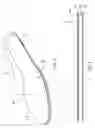
BRIEF DESCRIPTION OF THE DRAWINGSFIG. 1 is a perspective view of an insole according to an embodiment of the present invention;
FIG. 2 is a sectional view of the insole of FIG. 1 taken along section 2-2.
DETAILED DESCRIPTION OF THE INVENTIONPlease refer to the drawings, an insole 10 according to an embodiment of the present invention has a heel area 12, an arch area 14, and a sole area 16, is laminated by three elastic layers 20, 30, 40 and a fabric layer 50.
The basic layer 20 is sliced from a first foam material produced by bonding together particles of comminuted previously formed foam material with a foamable polyurethane resin composition. Such a foam material has a superior air permeability. In this embodiment, the thickness of the basic layer 20 is about 4 mm.
The upper layer 30 and the bottom layer 40 are adhered respectively to the basic layer 20 in a sandwich manner. These two layers are sliced from a second foam material made of a foamable polyurethane resin. Such a foam material did not mix with any other material and has a tensile strength being better than that of the first foam material. Before slicing to form the upper layer 30 and the bottom layer 40, the second foam material is modified by a crushing process to eliminate the beads existing therein. Such a crushing process can improve the air permeability of the second foam material. In this embodiment, the thickness of the upper and bottom layer 30,40 is about 0.5 mm.
The fabric layer 50 is adhered to the upper surface of the upper layer 30. In producing, the raw material to form the fabric layer 50 is first adhered to the second foam material and then sliced together to form the upper layer 30 and the fabric layer 50. The function of the fabric layer 50 is to increase the comfort and prevent sliding during wear.
Accordingly, in accordance with the present invention, the primary difference between the insole 10 and the insole disclosed in U.S. Pat. No. 4,642,912 is that the materials for forming the layers of the former are different. As a result, the tensile strength, the resilience and the air permeability of the insole according to the present invention are all better than the prior art insole. For example, the resilience of the insole 10 is 90% and that of the prior art insole is under 70%. The air permeability of the insole 10 is 500 l/m2 sec and that of the prior art insole is only 200˜300 l/m2 sec.
Claims
What is claimed is:1. An insole having a heel area, an arch area, and a sole area, each defined on the top surface and corresponding to the respective areas of the foot, said insole comprising:
a first layer made of a first slice foam material formed by a foamable polyurethane resin composition;
a second layer made of a second slice foam material formed by bonding together particles of comminuted previously formed foam material with a foamable polyurethane resin composition, said second layer being adhered to an upper surface of said first layer; and
said second layer having a thickness being greater than that of said first layer.
2. The insole according to claim 1 further comprising a third layer made of said first slice foam material said third layer being adhered to a upper surface of said second layer.
3. The insole according to claim 2 wherein said third layer having a thickness greater than that of said second layer.
4. The insole according to claim 1 further comprising a fabric layer being adhered to a bottom surface of said first layer.
5. The insole according to claim 2 further comprising a fabric layer being adhered to a bottom surface of said first layer.
6. The insole according to claim 1, wherein said first slice foam material before forming said first layer being modified by a crushing process.
7. The insole according to claim 2, wherein said first slice foam material before forming said first layer being modified by a crushing process.
Images & Drawings included:

Sources:
- United States Patent and Trademark Office - verify current appl. status at the USPTO↗
Recent applications in this class:
- » 20250280919 2025-09-11
CUSTOMIZABLE FOOTWEAR SYSTEM - » 20250221488 2025-07-10
Adjustable Footbed & System - » 20230346070 2023-11-02
Sole of shoe and shoe - » 20230255309 2023-08-17
SHOE ARTICLE WITH AN ARCH SPRING - » 20220256966 2022-08-18
PLANTAR ORTHOSIS - » 20220202131 2022-06-30
SHOE - » 20220175083 2022-06-09
ADJUSTABLE CLOSURE SYSTEM FOR AN ARTICLE - » 20220095739 2022-03-31
AN INSOLE FOR A FOOTWEAR - » 20220071341 2022-03-10
FOOTWEAR APPARATUS FOR IMPROVING GAIT BIOMECHANICS - » 20220061454 2022-03-03
SHOE