Closure assembly
US20060175282A1
2006-08-10
11/333,775
2006-01-17
Abstract:
A closure assembly is provided having a tamper detection ring fastenable to a nozzle of a container. The assembly also includes a cap fast with the detection ring to engage and close the nozzle, and a frangible connection means interposed between the ring and the cap to be broken when the cap is removed from the nozzle.
Interested in similar patents?
Get notified when new applications in this technology area are published.
Classification:
B65D41/3447 » CPC main
Caps, e.g. crown caps or crown seals, i.e. members having parts arranged for engagement with the external periphery of a neck or wall defining a pouring opening or discharge aperture; Protective cap-like covers for closure members, e.g. decorative covers of metal foil or paper; Caps or cap-like covers with lines of weakness, tearing-strips, tags, or like opening or removal devices, e.g. to facilitate formation of pouring openings; Threaded or like caps or cap-like covers provided with tamper elements formed in, or attached to, the closure skirt with rigid bead or projections formed on the tamper element and coacting with bead or projections on the container the tamper element being integrally connected to the closure by means of bridges
B65D51/242 » CPC further
Closures not otherwise provided for combined or co-operating with auxiliary devices for non-closing purposes provided with means for facilitating lifting or suspending of the container
B65D51/00 IPC
Closures not otherwise provided for
B65D41/00 IPC
Caps, e.g. crown caps or crown seals, i.e. members having parts arranged for engagement with the external periphery of a neck or wall defining a pouring opening or discharge aperture; Protective cap-like covers for closure members, e.g. decorative covers of metal foil or paper
B65D49/12 IPC
Arrangements or devices for preventing refilling of containers by destroying, in the act of opening the container, an integral portion thereof
B65D39/00 IPC
Closure members for rigid or semi-rigid containers or for flexible containers presenting similar closing problems ; Parts of containers co-operating with closure members or characterised by the form of closure member
B65D39/00 IPC
Closures arranged within necks or pouring openings or in discharge apertures, e.g. stoppers
Description
CROSS-REFERENCE TO RELATED APPLICATIONSThis application claims priority from Australian Provisional Appln. No. 2005-900-173 filed Jan. 17, 2005 and Australian Innovation Patent Appln. No. 2005-100-40 filed Jan. 17, 2005.
FEDERALLY SPONSORED RESEARCH OR DEVELOPMENTNot applicable.
TECHNICAL FIELDThis invention relates to a closure assembly. More particularly, this invention relates to a container and to a closure assembly for the container.
BACKGROUND OF THE INVENTIONContainers for fluent materials are available in a very large range of shapes and sizes. An important aspect of such containers relates to ease of use. To date, many different configurations have been applied to such containers in order to facilitate pouring of fluent materials from such containers.
Examples of such configurations include containers with gripping devices. These include handles which form an integral part of the container. Integrated handles are useful, but tend to cause packaging problems and space wastage, particularly with smaller containers.
In an attempt to address this, a handle is often connected to a nozzle of the container to be displaceable into and out of a position in which a minimal amount of space is taken up by the handle. Such handles include ring grips which allow users to hold the container with a finger inserted through a ring which is fastened to the container.
A disadvantage with such handles is that they are required to be manufactured in a separate step and also positioned on the container in another step. It will be appreciated that extra steps in production can increase costs greatly, particularly when the containers are manufactured on a large scale.
The present invention is provided to solve the problems discussed above and other problems, and to provide advantages and aspects not provided by prior inventions of this type. A full discussion of the features and advantages of the present invention is deferred to the following detailed description, which proceeds with reference to the accompanying drawings.
SUMMARY OF THE INVENTIONAccording to a first aspect of the invention, there is provided a closure assembly which includes
a tamper detection ring fastenable to a nozzle of a container;
a cap fast with the detection ring and engageable with the nozzle to close the nozzle;
a frangible connecting means interposed between the ring and the cap to be broken when the cap is removed from the nozzle; and
a handle fast with the ring.
The handle may be configured to permit a user to hold the container with at least one finger received through the handle. The handle may include a finger ring and a connector to connect the finger ring to the tamper detection ring.
The closure assembly may be a unitary one-piece plastics moulding.
According to a second aspect of the invention, there is provided a container which comprises
a vessel that defines a nozzle;
a tamper detection ring fastened to the nozzle;
a cap fast with the detection ring and engageable with the nozzle to close the nozzle;
a frangible connecting means interposed between the ring and the cap to be broken when the cap is removed from the nozzle; and
a handle fast with the ring.
The cap may form part of a drinking nozzle.
Other features and advantages of the invention will be apparent from the following specification taken in conjunction with the following drawings.
BRIEF DESCRIPTION OF THE DRAWINGSTo understand the present invention, it will now be described by way of example, with reference to the accompanying drawings in which:
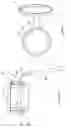
FIG. 1 is a side sectioned view of a nozzle of a container, in accordance with the invention, with a first embodiment of a closure assembly, also in accordance with the invention, on the nozzle.
FIG. 2 is a plan view of a tamper detection ring and handle of the first embodiment of the closure assembly.
FIG. 3 is a plan view of a tamper detection ring and handle of a second embodiment of the closure assembly.
DETAILED DESCRIPTIONWhile this invention is susceptible of embodiments in many different forms, there is shown in the drawings and will herein be described in detail preferred embodiments of the invention with the understanding that the present disclosure is to be considered as an exemplification of the principles of the invention and is not intended to limit the broad aspect of the invention to the embodiments illustrated.
In the drawings, reference numeral 10 generally indicates a first embodiment of a closure assembly, in accordance with the invention, for a nozzle 12 of a container, also in accordance with the invention.
Conventionally, the nozzle 12 has a circumferential channel 14 defined by a pair of radially extending lips 16. Such an arrangement can be found on many PET bottles. The nozzle 12 also has a threaded portion 18 above the channel 14.
The closure assembly 10 includes a tamper detection ring 20. A cap 22 is attached to the tamper detection ring 20 with a frangible connecting means in the form of a weakened zone 24 interposed between the cap 22 and the ring 20. The cap 22 is internally threaded to be screwed onto the nozzle 12 to seal the nozzle 12. The ring 20 has a retaining formation 26 that is configured to clip into the channel 14 in a non-removable manner, which is conventional. Thus when the cap 22 is unscrewed from the nozzle 12 the weakened zone 24 parts with the ring 20 remaining in the channel 14.
The cap 22 can be in the form of a drinking nozzle as used in, for example, purchased water bottles.
The closure assembly 10 includes a handle in the form of a finger ring 28. A connector 30 connects the finger ring 28 to the tamper detection ring 20. The connector 30 is shaped so that the finger ring 28 is angled towards the container to enhance storage of a number of the containers.
In FIG. 3, reference numeral 40 generally indicates a tamper detection ring 20, a connector 30 and a finger ring 42 of a second embodiment of a closure assembly, in accordance with the invention. With reference to FIGS. 1 and 2, like reference numerals refer to like parts, unless otherwise specified.
The finger ring 42 has split, overlapping portions 44. Thus, the ring 42 can be clipped into position at a convenient location.
The tamper detection ring 20, the cap 22, the finger ring 28, 42 and the connector 30 are in the form of a one-piece moulding of a plastics material. It will therefore be appreciated that the closure assembly 10, 40 can be fabricated in a single moulding operation with associated cost savings.
Presently available handles for containers are attached to the container in a separate assembly step. This means that the assembly line would require a further station and associated operation to attach presently available handles. This can prove to be costly, especially when the containers are mass-produced on a very large scale as is the case with, for example, beverage containers.
It will be appreciated that the present invention provides a means whereby a container can be provided with a handle during the capping process. This leads to a substantial saving in cost and fabrication time.
While the specific embodiments have been illustrated and described, numerous modifications come to mind without significantly departing from the spirit of the invention, and the scope of protection is only limited by the scope of the accompanying Claims.
Claims
What is claimed is:1. A closure assembly which includes
a tamper detection ring that is fastenable to a nozzle of a container;
a cap fast with the detection ring and engageable with the nozzle to close the nozzle;
a frangible connecting means interposed between the ring and the cap to be broken when the cap is removed from the nozzle; and
a handle fast with the ring.
2. A closure assembly as claimed in claim 1, in which the handle is configured to permit a user to hold the container with at least one finger received through the handle.
3. A closure assembly as claimed in claim 2, in which the handle includes a finger ring and a connector to connect the finger ring to the tamper detection ring.
4. A closure assembly as claimed in claim 1, which is a unitary one-piece moulding of a plastics material.
5. A container which comprises
a vessel that defines a nozzle;
a tamper detection ring fastened to the nozzle;
a cap fast with the detection ring and engageable with the nozzle to close the nozzle;
a frangible connecting means interposed between the ring and the cap to be broken when the cap is removed from the nozzle; and
a handle fast with the ring.
Images & Drawings included:


Sources:
- United States Patent and Trademark Office - verify current appl. status at the USPTO↗
Similar patent applications:
- » 20240336417
CLOSURE ASSEMBLY, CONTAINER PROVIDED WITH THE CLOSURE ASSEMBLY, AND METHOD FOR PRODUCING FILLED CONTAINERS PROVIDED WITH THE CLOSURE ASSEMBLY - » 20190144189
Closure assembly and container provided with said closure assembly - » 20190193899
Closure assembly and container provided with such a closure assembly - » 20220363447
Closure assembly for a container and container having a closure assembly - » 20230373690
CLOSURE ASSEMBLY FOR A CONTAINER AND CONTAINER HAVING A CLOSURE ASSEMBLY - » 20120042573
Closure assemblies for movable partitions, movable partition systems including closure assemblies and related methods - » 20230365311
CLOSURE ASSEMBLY FOR A CONTAINER AND CONTAINER HAVING A CLOSURE ASSEMBLY - » 20110088322
Closure assemblies for fire doors, fire doors including such closure assemblies and methods of locking fire doors - » 20140116633
Closure assemblies for movable partitions, movable partition systems including closure assemblies and related methods - » 20140010481
Closure assembly and a collapsible pouch container provided with a closure assembly
Recent applications in this class:
- » 20250011049 2025-01-09
CLOSURE - » 20250002230 2025-01-02
CAP FOR CLOSING A CONTAINER - » 20250002229 2025-01-02
CLOSURES WITH TAMPER EVIDENCE - » 20250002228 2025-01-02
CONTAINER CLOSURE - » 20240327073 2024-10-03
BOTTLE CLOSURE ASSEMBLY - » 20240317467 2024-09-26
CLOSURE DEVICE INTENDED TO BE FIXED TO THE NECK OF A CONTAINER - » 20240262574 2024-08-08
CLOSURE CAP - » 20240132256 2024-04-25
Tamper-evident housing - » 20240124197 2024-04-18
PLASTIC SCREW CAP WITH GOOD WASHABILITY - » 20240034519 2024-02-01
Screw Closure Having Captively Connected Screw Cap