Circuit security
US20060201701A1
2006-09-14
11/408,065
2006-04-21
Abstract:
A secure device (1) has a circuit board (2) with various exposed components such as an LCD (4) and keys (40). A secure circuit (10) is housed within an enclosure formed between the board (2) and a cover (11). The cover (11) has, on its inside surface, a security track (23) in a dense serpentine pattern. The board (2) has a security track (52), also in a dense serpentine pattern, is an inner layer. The track (52) is linked to covered surface-level tracks (27) by vias (64). The cover's security track (23) is connected to the board's security tracks (52, 27) via a deformable pad (25) whose conductivity increases with applied compression.
Interested in similar patents?
Get notified when new applications in this technology area are published.
Classification:
G06F21/86 » CPC main
Security arrangements for protecting computers, components thereof, programs or data against unauthorised activity; Protecting specific internal or peripheral components, in which the protection of a component leads to protection of the entire computer Secure or tamper-resistant housings
H05K1/0275 » CPC further
Printed circuits; Details Security details, e.g. tampering prevention or detection
H05K1/0275 » CPC further
Printed circuits; Details Security details, e.g. tampering prevention or detection
H05K1/144 » CPC further
Printed circuits; Details; Structural association of two or more printed circuits Stacked arrangements of planar printed circuit boards
H05K1/144 » CPC further
Printed circuits; Details; Structural association of two or more printed circuits Stacked arrangements of planar printed circuit boards
H05K2201/09263 » CPC further
Indexing scheme relating to printed circuits covered by; Shape and layout; Shape and layout details of conductors; Conductive traces Meander
H05K2201/09263 » CPC further
Indexing scheme relating to printed circuits covered by; Shape and layout; Shape and layout details of conductors; Conductive traces Meander
H05K2201/0999 » CPC further
Indexing scheme relating to printed circuits covered by; Shape and layout; Shape or layout details not covered by a single group of - Circuit printed on or in housing, e.g. housing as PCB; Circuit printed on the case of a component; PCB affixed to housing
H05K2201/0999 » CPC further
Indexing scheme relating to printed circuits covered by; Shape and layout; Shape or layout details not covered by a single group of - Circuit printed on or in housing, e.g. housing as PCB; Circuit printed on the case of a component; PCB affixed to housing
H05K2201/10151 » CPC further
Indexing scheme relating to printed circuits covered by; Details of components or other objects attached to or integrated in a printed circuit board; Types of components Sensor
H05K2201/10151 » CPC further
Indexing scheme relating to printed circuits covered by; Details of components or other objects attached to or integrated in a printed circuit board; Types of components Sensor
H05K1/00 IPC
Printed circuits
H05K1/00 IPC
Printed circuits
Description
FIELD OF THE INVENTIONThe invention relates to security of electronic circuits such as circuits for processing and storing security codes for transactions.
PRIOR ART DISCUSSIONIt is known from U.S. Pat. No. 6,355,316 to provide a secure device comprising an electronic circuit covered by a cover with a security track. If this track is broken an alarm is raised in the secure electronic circuit. The cover is of brittle material so that even the smallest damage causes it to break into a large number of small elements.
The invention is directed towards providing an improved secure circuit in which:
there is improved circuit security against tampering; and/or
the secure circuit has improved ability to withstand mechanical shock; and/or
the secure circuit can be non-destructively accessed by an authorised engineer for repair or upgrade.
STATEMENTS OF THE INVENTIONAccording to the invention, there is provided a secure circuit device comprising a circuit board, a secure circuit on the circuit board, a cover covering the secure circuit and being secured to the board, and security tracks on the cover and on the board arranged to be electrically connected together when the cover is in placed on the board, wherein a security track is in a dense pattern covering a substantial part of the area of the cover or the board.
In one embodiment, the cover comprises a security track with a dense pattern on an inner surface, facing the board.
In another embodiment, said security track has a serpentine pattern of a single continuous track.
In a further embodiment, the board has a multilayer structure and it comprises a security track having a dense pattern in an internal layer.
In one embodiment, said pattern is a serpentine pattern of a continuous single track.
In another embodiment, the secure circuit is electrically connected to said security track by blind vias in the board.
In a further embodiment, the board comprises through vias linking components on an exposed board surface with the secure circuit.
In one embodiment, said components include a keypad.
In another embodiment, the board comprises blind vias linking parts of the secure circuit.
In a further embodiment, both the cover and the board comprise inter-connecting ground rails.
In one embodiment, said ground rails extend around a periphery of the board area covered by the cover.
In another embodiment, the cover and board security tracks are connected via a seal disposed between the cover and the board.
In a further embodiment, said seal comprises a deformable conductive material pad.
In one embodiment, conductivity of the pad increases with increased compression of the pad.
In another embodiment, the pad comprises a deformable material with embedded conductors.
In a further embodiment, the conductors comprise threads of metal extending between the surfaces of the pad.
In one embodiment, the keypad comprises a security key linked with a security track.
In another embodiment, said security key comprises a ground guard rail surrounding the key.
In a further embodiment, said security track comprises a track in a serpentine pattern on a surface of the board covered by, and facing towards, the cover.
In one embodiment, said track connects with the security track of the cover.
In another embodiment, said security track is also connected to a security track of an internal layer of the board.
DETAILED DESCRIPTION OF THE INVENTION BRIEF DESCRIPTION OF THE DRAWINGSThe invention will be more clearly understood from the following description of some embodiments thereof, given by way of example only with reference to the accompanying drawings in which:
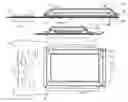
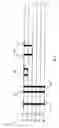
FIGS. 1(a), 1(b), and 1(c) are plan, and diagrammatic cross-sectional side and front views respectively of a security device containing a secure circuit;
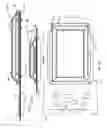
FIG. 2 is a diagrammatic cross-sectional diagram showing how a cover is secured in place on a circuit board of the device;
FIG. 3 is a plan view of the board;
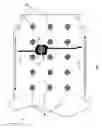
FIG. 4 is an underneath plan showing a keypad which includes a case switch key surrounded by a copper guard rail which is connected to ground potential;
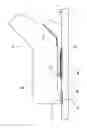
FIG. 5 is a diagrammatic cross-sectional diagram of the main board;
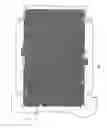
FIG. 6 is a view of security tracks embedded in an internal layer of the board; and
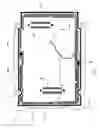
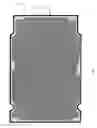
FIG. 7 is a view of a security track and a ground rail on the internal surface of the cover.
DESCRIPTION OF THE EMBODIMENTSReferring to FIGS. 1(a), 1(b), and 1(c) a secure device 1 comprises a main-circuit board 2 having non-secure components 3 and an LCD 4 on opposed sides of the main board 2 at an exposed end. The device 1 also comprises a secure circuit 10 mounted within an enclosure formed between the main board 2 and a security cover 11. The cover 11 is secured to the main board 2 by bolt fasteners 12. The security cover 11 has splayed-out side walls 13 terminating in a rim 20 contacting the main board 2. The secure circuit 10 is an ARM microprocessor and alarm components, and it is mounted on connectors on the main board 2. The device 1 also comprises keypad keys 40 on the exposed surface of the board 2 opposed to the cover 11.
Referring to FIG. 2, each splayed side wall of the cover 11 terminates in a rim 20. A cover ground rail 21 extends around the periphery of the hidden surface of the rim 20, and it contacts a ground rail 22 of the board 2. The ground rails 21 and 22 are 1 mm wide. The cover 11 has security tracks 23 in a serpentine pattern on its inside surface. These tracks have terminals 24 at two downwardly-projecting bosses on the rim 20. The corresponding locations on the board 2 have security track terminals 26. A security pad 25 lies between the two security track terminals 24 and 26 at these locations. The board security track terminals 26 are also shown in FIG. 3, as is a surface-level security track 27 extending around the periphery of the area covered by the cover 11, just inside the ground rail 22. This drawing also shows 80-way connectors 30 and 31 for supporting the secure circuit 10, which in this embodiment is an ARM CPU.
FIG. 4 shows the side of the board 2 opposed to the cover 11. This side includes conventional keys 40 and a case switch 41 key surrounded by protective copper 42 which is connected to ground potential.
Referring to FIG. 5, the internal structure of the main board 2 is shown. There are six layers (two external and four internal), with five insulation layers in-between. The layers are as follows:
-
- 50: On the internal surface. Conductors on the opposed external surface connect to this layer for ground, Vcc, keypad, LCD and non-secure signals. This layer connects to the secure circuit 10.
- 51: Routing conductors for secure and non-secure signals. Microvias are used to minimise the number of through holes in the board 2.
- 52: A security track layer with a serpentine pattern, shown in FIG. 6.
- 53: A ground plane.
- 54: Vcc, 3.3Vplane.
- 60: Conductors on the external surface connected to keypad keys 40. This layer also contains some non-secure signals and the case switch key 41.
The board 2 also has both through hole and blind vias including, from left to right in FIG. 5:
-
- (a) Through hole vias 60 for connecting keys and some non-secure signals to the secure circuit 10.
- (b) Through hole vias 61 for connecting the layer 53 ground plane to both the top and bottom layers 50 and 55.
- (c) Through hole vias 62 connecting the top and bottom layers 50 and 55 to the 3V3 conductor plane 54.
- (d) Blind vias 63 for routing sensitive and non-sensitive conductors between the top layer 50 and the second layer 51.
- (e) Blind vias connecting the secure circuit 10 to the security tracks of the layer 52.
Referring to FIG. 6 the internal security track 52 for conducting the mesh alarm signal and ground signal is illustrated. These signals are connected to the secure circuit 10 via the blind vias 64.
Referring to FIG. 7 the inside surface of the cover 11 has a security mesh track 23 on its surface. The track 23 includes terminals (shown by wide short lines at positions corresponding to those of the terminals 26 in FIG. 3). These are electrically connected to the two terminals 26 on the board 2, which in turn connect to the security tracks 27 and to the secure circuit 10—thus forming a security cage around the secure circuit 10 and electrically connected to an alarm circuit on the secure circuit 10. The external ground (guard) rail 21 is also shown. This connects to the ground rail 22 of the main board 2. Both the ground rail 22 and the mesh 27 are on the top layer 50 of the main board 2.
The secure circuit 10 is an ARM CPU and alarm components, and it is protected by a combination of the cover 11 on whose surface there is the single mesh track 23 and the board 2 containing an internal single wire mesh track 52.
All of the numeric keys 40 on the keypad are contained within the area opposed to the cover 11, including the case switch 41 which will activate the alarm if the keypad is removed from its housing. This alarm would also be activated if the area around the key is flooded with conductive ink to try and short circuit the key due to the presence of a ground potential guard rail 42 around the key. The serpentine mesh 27 of the board 2 is connected such that if this mesh is broken, connected to ground, or drilled then the alarm will be raised on the ARM CPU 10.
All of the electronics requiring security protection are contained on the ARM CPU 10.
The cover 11 is made from a very precise engineering plastics material. The walls 13 are splayed at 45° and the rim 20 has two raised land areas which connect the terminals 24 to the two larger terminals 26 on the board 2. The terminals 26 are protected from attack by the internal serpentine alarm track 27. The terminal sizes, the gap between the cover 11 and the board 2 and the track widths and spacing meet ZKA and VISA PED security requirements. The separation between ground and the terminals is 0.5 mm. If the ground area shorts to the mesh or either of the terminals then the alarm will be set.
The following summarises some of the main security features:
-
- The internal serpentine mesh layer 52 connected to the alarm circuit. This internal mesh is larger than the secure area of the cover 11.
- The case switch key 40 which will be a key contact on the back of the board 2. This key is constantly connected to a carbon PIL on the keypad membrane.
- If the keypad is removed from the outer plastic then the alarm will trigger.
- The ground potential guard rail 42 is present around the case switch key 41.
- If conductive ink is introduced to this pad area to try and bypass the key the ink will short the key to ground and raise the alarm condition.
- All PED (PIN Entry Device) keys are contained in the secure area (that opposed to the cover 11).
- The ground rail 22 on the top side of the board 2, which connects to the ground rail 21 of cover 11. If this ground rail is connected to the terminals or mesh then an alarm condition is raised.
- The miniature serpentine mesh 27 in the areas under the land area of the cover 11. If this mesh is broken the alarm condition is raised.
- The blind vias 63 which connect the layers 50 and 51 of the board 2. All secure signals on the board 2 will be routed on these layers. These signals are not visible on the key side of the board 2.
- The blind 64 which connects the layer 50 to the layer 52. These vias transfer the alarm mesh signal from the ARM CPU 10 to the layer 52 of board 2.
- These signals will not be visible on the key side of the board 2.
- All through hole vias enter the secure area of the PCB in the area under the land area of the cover 11. This prevents probes from being inserted into the secure area.
The alarm track 23 on the cover 11 is connected in series to the following:
-
- a) alarm track on the internal layer 52 of the board 2.
- b) alarm track on 27 on the top layer of the board 2.
- c) the case switch key 41 on the bottom layer 55 of the board 2.
The alarm signal is normally high. If it is broken (opened) or connected to ground then an alarm is raised on the ARM CPU 10, causing its RAM contents to be deleted.
Referring again to FIG. 2, each pad 25 is very small (only the dimensions of the terminals 26), however it forms an essential link between the security track 23 of the cover 11 and a terminal 26 of the security track 27 of the board 2. Each pad 25 comprises silicone rubber with dispersed brass fibres extending between the pad's faces. The surfaces of the pad 25 are gold plated. The arrangement of the brass fibres is such that electrical resistance between the two pad surfaces decreases with compression of the pad. Thus, as the screws are tightened to secure the cover 11 onto the board 2, the pads 25 are compressed, thus making them more conductive. This effectively links the cover's security mesh 23 to the board's security mesh 27 via the terminals 24 and 26. This arrangement provides many advantages. An attempt to tamper with the secure device 1 by separating the cover 11 from the board 2 results in an open circuit at the pad 25. However, an authorised engineer may non-destructively separate the cover 11 from the board 2 for repair or upgrade. The RAM contents are not lost, however the device may be repaired. Also, because the pad 25 is of resilient material it provides a degree of shock absorption, thus reducing risk of a fault if the device is dropped or knocked. Also, during manufacture, the pads 25 provide a large tolerance for tightening torque of the bolt fasteners.
If a hole is drilled through the cover 11 (or between the cover 11 and the board 2) an alarm will be raised on the ARM CPU 10 due to a track being broken. If a hole is drilled between the connection of the board 2 and the cover 11 the drill will cut security tracks on both the cover 11 and the board 2, thus raising an alarm condition.
Similarly if a hole is drilled through the board 2 the same alarm will be raised due to the single wire mesh track being broken or shorted to ground potential, causing the RAM contents on the secure circuit 10 to be deleted.
In an alternative embodiment, pads on the inner surface of the cover 11 are electrically connected to the board by a conductive polymer. The box is mechanically connected to the board by using a non-conductive epoxy and screws. In this embodiment, an attempt to forcibly separate the cover 11 from the board 2 would damage the security tracks.
The invention is not limited to the embodiments described but may be varied in construction and detail.
Claims
1-21. (canceled)
22. A secure circuit device comprising:
a circuit board,
a secure circuit on the circuit board,
a cover covering the secure circuit and being secured to the board,
security tracks on the cover and on the board arranged to be electrically connected together when the cover is in placed on the board, and
wherein a security track is in a dense pattern covering a substantial part of the area of the cover or the board.
23. The device as claimed in claim 22, wherein the cover comprises a security track with a dense pattern on an inner surface, facing the board.
24. The device as claimed in claim 22, wherein the cover comprises a security track with a dense pattern on an inner surface, facing the board; and wherein said security track has a serpentine pattern of a single continuous track.
25. The device as claimed in claim 22, wherein the board has a multilayer structure and it comprises a security track having a dense pattern in an internal layer.
26. The device as claimed in claim 22, wherein the board has a multilayer structure and it comprises a security track having a dense pattern in an internal layer; and wherein said pattern is a serpentine pattern of a continuous single track.
27. The device as claimed in claim 25, wherein the secure circuit is electrically connected to said security track by blind vias in the board.
28. The device as claimed in claim 25, wherein the board comprises through vias linking components on an exposed board surface with the secure circuit.
29. The device as claimed in claim 25, wherein the board comprises through vias linking components on an exposed board surface with the secure circuit; and wherein said components include a keypad.
30. The device as claimed in claim 25, wherein the board comprises blind vias linking parts of the secure circuit.
31. The device as claimed in claim 22, wherein both the cover and the board comprise inter-connecting ground rails.
32. The device as claimed in any of claim 31, wherein said ground rails extend around a periphery of the board area covered by the cover.
33. The device as claimed in claim 22, wherein the cover and board security tracks are connected via a seal disposed between the cover and the board.
34. The device as claimed in claim 22, wherein the cover and board security tracks are connected via a seal disposed between the cover and the board; and wherein said seal comprises a deformable conductive material pad.
35. The device as claimed in claim 34, wherein conductivity of the pad increases with increased compression of the pad.
36. The device as claimed in claim 34, wherein conductivity of the pad increases with increased compression of the pad; and wherein the pad comprises a deformable material with embedded conductors.
37. The device as claimed in claim 34, wherein conductivity of the pad increases with increased compression of the pad; and wherein the pad comprises a deformable material with embedded conductors; and wherein the conductors comprise threads of metal extending between the surfaces of the pad.
38. The device as claimed in claim 25, wherein the board comprises through vias linking components on an exposed board surface with the secure circuit; and wherein said components include a keypad; and wherein the keypad comprises a security key linked with a security track.
39. The device as claimed in claim 38, wherein said security key comprises a ground guard rail surrounding the key.
40. The device as claimed in claim 22, wherein said security track comprises a track in a serpentine pattern on a surface of the board covered by, and facing towards, the cover.
41. The device as claimed in claim 40, wherein said track connects with the security track of the cover.
42. The device as claimed in claim 40, wherein said track connects with the security track of the cover; and wherein said security track is also connected to a security track of an internal layer of the board.
Images & Drawings included:
Sources:
- United States Patent and Trademark Office - verify current appl. status at the USPTO↗
Similar patent applications:
- » 20210264061
Security circuit including dual encoder and endecryptor including the security circuit - » 20130207781
Security system for at least an integrated circuit, secure integrated circuit card, and method of secure wireless communications - » 20230289437
Electronic device with security circuit and security memory - » 20060196934
Security circuit and security cancellation method - » 20150161416
Security circuits and security systems including the same - » 20060128179
Display device structure with circuit board secured to display panel and method of securing circuit board to panel thereof - » 20110261953
Method for testing cryptographic circuits, secured cryptographic circuit capable of being tested, and method for wiring such circuit - » 20060184799
Security circuit and method to secure information in a device - » 20060122802
Data processing apparatus, program, and method for testing a secured circuit and maintaining confidentiality of the circuit - » 20050081040
In-circuit security system and methods for controlling access to and use of sensitive data
Recent applications in this class:
- » 20250173468 2025-05-29
INFORMATION PROCESSING DEVICE - » 20250139306 2025-05-01
FULL SYSTEM LOCKOUT - » 20250077718 2025-03-06
SECURE TAMPER RESISTANT DATA PROCESSING, STORAGE, AND TRANSMISSION GATEWAY AND CONTROLLER AND DATA ANOMALY DETECTION PROGRAM - » 20250077717 2025-03-06
RADIO FREQUENCY COVER REMOVAL DETECTION - » 20250045470 2025-02-06
PASSWORD ENCRYPTION FOR SERVICING HIGH SECURITY SYSTEMS - » 20250045469 2025-02-06
TAMPER DETECTION FOR AN ENCLOSURE OF AN ELECTRONIC DEVICE - » 20240427946 2024-12-26
IMPROVED EXECUTION OF AN OPERATION IN A SECURE ELEMENT - » 20240241995 2024-07-18
SECURITY LOCK SOLUTION USING THE USB-C OPENING - » 20240241994 2024-07-18
Detection of Short Resets of an Electronic Device - » 20240232444 2024-07-11
HYBRID THROUGH HOLE FOR SOLID STATE INTRUSION DETECTION