Fire protection : air escape vent
US20060211363A1
2006-09-21
11/356,852
2006-02-21
Abstract:
An air escape vent with a balanced louvre to allow air to escape rapidly after a minimum air pressure is reached.
Interested in similar patents?
Get notified when new applications in this technology area are published.
Classification:
A62C2/12 » CPC main
Fire prevention or containment; Physical fire-barriers Hinged dampers
A62C2/16 » CPC further
Fire prevention or containment; Physical fire-barriers; Hinged dampers with two or more blades multi-vane roll or fold-up type
A62C2/24 » CPC further
Fire prevention or containment; Physical fire-barriers Operating or controlling mechanisms
F16K17/12 » CPC further
Safety valves; Equalising valves, e.g. pressure relief valves opening on surplus pressure on one side; closing on insufficient pressure on one side weight-loaded
F16K17/363 » CPC further
Safety valves; Equalising valves, e.g. pressure relief valves actuated in consequence of extraneous circumstances, e.g. shock, change of position the closure members being rotatable or pivoting
F24F11/745 » CPC further
Control or safety arrangements; Control systems characterised by their outputs; Constructional details thereof for controlling the supply of treated air, e.g. its pressure for controlling air flow rate or air velocity the air flow rate increasing with an increase of air-current or wind pressure
F24F11/34 » CPC further
Control or safety arrangements for purposes related to the operation of the system, e.g. for safety or monitoring; Responding to malfunctions or emergencies to fire, excessive heat or smoke by opening air passages
E06B7/02 IPC
Special arrangements or measures in connection with doors or windows for providing ventilation, e.g. through double windows; Arrangement of ventilation roses
Description
When a fire breaks out in a house or factory, the normal procedure is to spray water on the fire. In the modern world the spraying of water has been superseded by using an inert gas to replace the water. To accomplish this it is necessary to replace more than half the volume of air in the house or factory space with the inert gas. Cylinders of inert gas or modified air must replace over half the volume of the room in which the fire is present. To accomplish this it is required to provide an escape valve for the existing air in the room to be exhausted and replaced. The present methods is to make an exhaust valve in the form of a panel of louvres hinged to allow the air to escape and weighted to close after the air has passed through. This method has the disadvantage, that the louvre will open very easily to start with, but will not open fully when the airflow increases. It would be advantageous if a louvred valve resisted opening until a minimum pressure was achieved, and then open easily until fully opened and the pressure drops.
According to the present invention, an escape valve in the form of one or more louvres set in a frame shall be caused to open when the minimum pressure is achieved. Thereafter the louvres will open to their maximum until the flow rate of air reduces below a minimum valve.
The invention will now be described in detail with the help of the enclosed sketches.
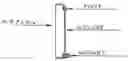
Sketch 1. Shows the present type of vent.
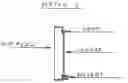
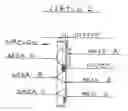
Sketch 2. Shows a single louvre closed.
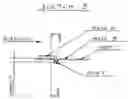
Sketch 3. Shows the louvre in the open condition.
When the pressure of air is applied to the louvre in sketch 2, the pressure of air is pushing the above area A, which is balanced against the area below B, and only area C pushes the louvre open due to the total mass or weight of the louvre being behind the pivot. The weight of the louvre exceeds the pressure of the combined area of the louvre until the pressure exceeds the opposing weight of the louvre. Once the pressure has exceeded the minimum opening pressure the louvre will open. When the louvre has started to open then the weight of mass A will rotate around the pivot and reduce the pressure required to fully open the louvre. When the louvre is fully open its pressure required for it to remain open is low. Once the airflow reduces below a certain rate the louvre will close and remain closed until the pressure increases above the minimum opening pressure.
Claims
1. A louvre vent with offset pivot in front of the louvre in the direction of the airflow.
2. A louvre vent with a heavy portion above the pivot line to balance most of the lower part of the louvre when open.
Images & Drawings included:
Sources:
- United States Patent and Trademark Office - verify current appl. status at the USPTO↗
Recent applications in this class:
- » 20230042007 2023-02-09
VENTILATION DUCT UNIT - » 20220118296 2022-04-21
Firestop device including an expandable fold-out collar - » 20200086150 2020-03-19
Explosion flap valve - » 20180185680 2018-07-05
Back pressure flap valve arrangement and the use thereof - » 20150238787 2015-08-27
Valve device and method for preventing explosion propagation - » 20130130613 2013-05-23
Fire damper for ventilating fan - » 20120164934 2012-06-28
Venting Device - » 20120108162 2012-05-03
Fire valve - » 20080264405 2008-10-30
Fire damper - » 20080254736 2008-10-16
Fire damper assembly