Hinge
US20060213030A1
2006-09-28
11/369,036
2006-03-06
Abstract:
A hinge has a shaft, a rotating bracket, a stationary bracket, a rotating positioning element and a stationary positioning element. The rotating bracket is mounted securely on the shaft and is attached to a cover of an electrical appliance. The stationary bracket is mounted around the shaft and is attached to a base of the electrical appliance. The rotating positioning element is mounted securely on the shaft and has two positioning protrusions. The stationary positioning element is mounted securely on the stationary bracket and has two positioning detents. The positioning detents selectively engage the positioning protrusions to keep the cover from bumping against the base.
Inventors:
- Chung-Yu Lee 18 🇹🇼 Shulin City, Taiwan
- Jia-Hao Hsu 24 🇹🇼 Shulin City, Taiwan
- Sheng-Nan Lu 46 🇹🇼 Shulin City, Taiwan
Assignee:
- SHIN ZU SHING CO., LTD. 60 🇹🇼 SHULIN CITY, Taiwan
Interested in similar patents?
Get notified when new applications in this technology area are published.
Classification:
G06F1/1681 » CPC main
Details not covered by groups - and; Constructional details or arrangements for portable computers; Constructional details or arrangements of portable computers not specific to the type of enclosures covered by groups - ; Miscellaneous details related to the relative movement between the different enclosures or enclosure parts Details related solely to hinges
G06F1/1616 » CPC further
Details not covered by groups - and; Constructional details or arrangements for portable computers with several enclosures having relative motions, each enclosure supporting at least one I/O or computing function with folding flat displays, e.g. laptop computers or notebooks having a clamshell configuration, with body parts pivoting to an open position around an axis parallel to the plane they define in closed position
E05D11/1078 » CPC further
Additional features or accessories of hinges; Devices for preventing movement between relatively-movable hinge parts for maintaining the hinge in two or more positions, e.g. intermediate or fully open the maintaining means acting parallel to the pivot
E05Y2900/606 » CPC further
Application of doors, windows, wings or fittings thereof for other use for electronic devices
Y10T16/52 » CPC further
Miscellaneous hardware [e.g., bushing, carpet fastener, caster, door closer, panel hanger, attachable or adjunct handle, hinge, window sash balance, etc.] Hinge
E05D7/00 IPC
Hinges or pivots of special construction
Description
BACKGROUND OF THE INVENTION1. Field of the Invention
The present invention relates to a hinge, especially to a hinge is mounted in an electrical appliance to allow a cover of the electrical appliance rotating in relative to a base of the electrical appliance.
2. Description of the Prior Arts
Electrical appliances such as notebook computers comprise a cover with a LCD, a base and a hinge. The hinge is mounted between the cover and the base to allow the cover rotating in relative to the base. However, the cover easily bumps against the base when the cover is closed, especially when the cover with a larger LCD. The bumping causes the LCD broken easily.
To overcome the shortcomings, the present invention provides a hinge with positioning function to mitigate or obviate the aforementioned problems.
SUMMARY OF THE INVENTIONThe main objective of the present invention is to provide a hinge with positioning function. The hinge has a shaft, a rotating bracket, a stationary bracket, a rotating positioning element and a stationary positioning element. The rotating bracket is mounted securely on the shaft and is attached to a cover of an electrical appliance. The stationary bracket is mounted around the shaft and is attached to a base of the electrical appliance. The rotating positioning element is mounted securely on the shaft and has two positioning protrusions. The stationary positioning element is mounted securely on the stationary bracket and has two positioning detents. The positioning detents selectively engage the positioning protrusions to keep the cover from bumping against the base.
Other objectives, advantages and novel features of the invention will become more apparent from the following detailed description when taken in conjunction with the accompanying drawings.
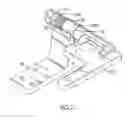
BRIEF DESCRIPTION OF THE DRAWINGSFIG. 1 is a perspective view of a hinge in accordance with the present invention;
FIG. 2 is an exploded perspective view of the hinge in FIG. 1;
FIG. 3 is a partial end view of the hinge in FIG. 1;
FIG. 4 is an operational end view of the hinge in FIG. 1 with a cover opened in relative to a base of an electrical appliance;
FIG. 5 is an operational end view of the hinge in FIG. 1 with the cover opened in relative to the base of the electrical appliance; and
FIG. 6 is an operational end view of the hinge in FIG. 1 with the cover opened in relative to the base of the electrical appliance.
DETAILED DESCRIPTION OF THE PREFERRED EMBODIMENTSWith reference to FIGS. 1 and 2, a hinge in accordance with the present invention comprises a shaft (10), a rotating bracket (20), a stationary bracket (30), a resilient sleeve (40), a rotating positioning element (50), a stationary positioning element (60), a biasing member (70), at least one washer (80) and a fastener (90).
The shaft (10) has a head (11), a fastening rod (12), an assembling rod (13), a mounting rod (131) and an optional thread (132). The head (11) has a first side and a second side. The fastening rod (12) is formed axially on the first side of the head (11) and is non-circular. The assembling rod (13) is formed axially on the second side of the head (11) and has a distal end. The mounting rod (131) is formed axially on the distal end of the assembling rod (13) and is non-circular. The thread (132) is formed on the mounting rod (131).
The rotating bracket (20) is mounted securely on fastening rod (12) of the shaft (10).
The stationary bracket (30) is L-shaped, is mounted around the assembling rod (13) of the shaft (10) and has a fastening wing (31), a mounting wing (32), a mounting sleeve (323), an optional recess (321) and an optional notch (322). The mounting wing (32) is perpendicular to the fastening wing (31) and has a top surface, a first side and a second side. The mounting sleeve (323) is formed on the top surface of the mounting wing (32) and is adjacent to the first side of the mounting wing (32). The recess (321) is formed in the top surface of the mounting wing (32), is adjacent to the first side of the mounting wing (32) and communicates with the mounting sleeve (323). The notch (322) is formed in the top surface of the mounting wing (32), is adjacent to the second side of the mounting wing (32) and communicates with and is wider than the recess (321).
The resilient sleeve (40) is mounted around the mounting rod (131) of the shaft (10), is mounted securely in the mounting sleeve (323) of the stationary bracket (30) and has a sleeve segment (42). The resilient sleeve (40) may be 9-shaped and may have a fastening protrusion (41). The sleeve segment (42) is mounted around the mounting rod (131) of the shaft (10) and corresponds to the mounting sleeve (323) of the stationary bracket (30). The fastening protrusion (41) is formed radially on the sleeve segment (42) and is mounted securely in the recess (321) of the stationary bracket (30).
The rotating positioning element (50) is mounted securely on the mounting rod (131) of the shaft (10) and has a first side, a non-circular through hole (51) and two positioning protrusion (52). The through hole (51) is formed through the rotating positioning element (50) and is mounted securely on the mounting rod (131) of the shaft (10). The positioning protrusions (52) are formed separately in the first side of the rotating positioning element (50) and may be opposite to each other.
The stationary positioning element (60) is mounted around the mounting rod (131) of the shaft (10), is mounted securely on the stationary bracket (30) and has a first side, a central circular hole (62), two positioning detents (63) and an optional fastening protrusion (61). The first side of the stationary positioning element (60) faces the first side of the rotating positioning element (50). The positioning detents (63) are formed in the first side of the stationary positioning element (60) and correspond respectively to and selectively engage the positioning protrusions (52) of the rotating positioning element (50). The fastening protrusion (61) is formed radially on the stationary positioning element (60) and is mounted securely in the notch (322) of the stationary bracket (30).
The biasing member (70) and the washer (80) are mounted around the shaft (10). The fastener (81) is mounted securely on the mounting rod (131) and may be a nut to screw on the thread (132) of the shaft (10).
With further reference to FIGS. 3 and 4, the hinge as described is mounted in an electrical appliance with a cover (90) and a base (91). The rotating bracket (20) is attached to the cover (90). The stationary bracket (30) is attached to the base (91). When the cover (90) rotates in relative to the base (91), the rotating bracket (20) rotates the shaft (10) and the rotating positioning element (50) is also rotated.
With further reference to FIG. 5, the cover (90) is closed. The positioning protrusions (52) of the rotating positioning element (50) respectively engage the positioning detents (63) of the stationary positioning element (60) to provide positioning function to keep the cover (90) from bumping against the base (91). Then a LCD on the cover (90) will not be broken easily.
With further reference to FIG. 6, the cover (90) is opened and is included 180 degrees with the base (91). Because the positioning protrusions (52) of the rotating positioning element (50) are oppositely to each other, the positioning protrusions (52) of the rotating positioning element (50) engage respectively to the positioning detents (63) of the stationary positioning element (60) when the cover (90) is opened and is included 180 degrees with the base (91). Therefore, the cover (90) will not be overturn when the cover (90) is opened.
Even though numerous characteristics and advantages of the present invention have been set forth in the foregoing description, together with details of the structure and features of the invention, the disclosure is illustrative only. Changes may be made in the details, especially in matters of shape, size, and arrangement of parts within the principles of the invention to the full extent indicated by the broad general meaning of the terms in which the appended claims are expressed.
Claims
What is claimed is:1. A hinge comprising:
a shaft having
a head having a first side and a second side;
a fastening rod formed axially on the first side of the head and being non-circular;
an assembling rod formed axially on the second side of the head and having a distal end; and
a mounting rod formed axially on the distal end of the assembling rod and being non-circular;
a rotating bracket mounted securely on fastening rod of the shaft;
a stationary bracket being L-shaped, mounted around the assembling rod of the shaft and having
a fastening wing;
a mounting wing being perpendicular to the fastening wing and having a top surface, a first side and a second side; and
a mounting sleeve formed on the top surface of the mounting wing and being adjacent to the first side of the mounting wing;
a resilient sleeve mounted around the mounting rod of the shaft, mounted securely in the mounting sleeve of the stationary bracket and having a sleeve segment mounted around the mounting rod of the shaft and corresponding to the mounting sleeve of the stationary bracket;
a rotating positioning element mounted securely on the mounting rod of the shaft and having
a first side;
a non-circular through hole formed through the rotating positioning element and mounted securely on the mounting rod of the shaft; and
two positioning protrusion formed separately in the first side of the rotating positioning element;
a stationary positioning element mounted around the mounting rod of the shaft, mounted securely on the stationary bracket and having
a first side facing the first side of the rotating positioning element;
a central circular hole; and
two positioning detents formed in the first side of the stationary positioning element and corresponding respectively to and selectively engaging the positioning protrusions of the rotating positioning element;
a biasing member mounted around the shaft;
at least one washer mounted around the shaft; and
a fastener mounted securely on the mounting rod of the shaft.
2. The hinge as claimed in claim 1, wherein the positioning protrusions of the rotating positioning element are oppositely to each other.
3. The hinge as claimed in claim 1, wherein
the stationary bracket has
a recess formed in the top surface of the mounting wing, being adjacent to the first side of the mounting wing and communicating with the mounting sleeve; and
a notch formed in the top surface of the mounting wing, being adjacent to the second side of the mounting wing and communicating with and being wider than the recess;
the resilient sleeve has a fastening protrusion formed radially on the sleeve segment and mounted securely in the recess of the stationary bracket; and
the stationary positioning element has a fastening protrusion formed radially on the stationary positioning element and mounted securely in the notch of the stationary bracket.
4. The hinge as claimed in claim 2, wherein
the stationary bracket has
a recess formed in the top surface of the mounting wing, being adjacent to the first side of the mounting wing and communicating with the mounting sleeve; and
a notch formed in the top surface of the mounting wing, being adjacent to the second side of the mounting wing and communicating with and being wider than the recess;
the resilient sleeve has a fastening protrusion formed radially on the sleeve segment and mounted securely in the recess of the stationary bracket; and
the stationary positioning element has a fastening protrusion formed radially on the stationary positioning element and mounted securely in the notch of the stationary bracket.
5. The hinge as claimed in claim 1, wherein
the shaft has a thread formed on the mounting rod; and
the fastener is a nut to screw on the thread of the shaft.
6. The hinge as claimed in claim 4, wherein
the shaft has a thread formed on the mounting rod; and
the fastener is a nut to screw on the thread of the shaft.
Images & Drawings included:



Sources:
- United States Patent and Trademark Office - verify current appl. status at the USPTO↗
Similar patent applications:
- » 20060032021
Hinge structure, hinge unit having the hinge structure, and container having cover attached thereto with the hinge structure - » 20120006169
Hinge connections and power miter saw with hinge linkage linear guide including such hinge connections - » 20070289092
METHOD FOR MANUFACTURING A HINGE MECHANISM FOR VEHICLE SEAT, HINGE MECHANISM MANUFACTURED ACCORDING TO SUCH A METHOD AND VEHICLE SEAT INCLUDING SUCH A HINGE MECHANISM - » 20080127455
Sliding Hinge Device, Personal Portable Device Having the Sliding Hinge Device and Method of Manufacturing the Sliding Hinge Device - » 20090279234
Sliding Hinge Device, Personal Portable Device Having the Sliding Hinge Device and Method of Manufacturing the Sliding Hinge Device - » 20110277273
HINGE PART FOR THE HINGE OF A FLAP, ENGINE BONNET OR BOOT LID OF A MOTOR VEHICLE, AND HINGE - » 20080209683
Sliding Hinge Device, Personal Portable Device Having The Sliding Hinge Device And Method Of Manufacturing The Sliding Hinge Device - » 20070277346
Method for manufacturing a hinge, hinge and hinge pin - » 20050115968
Method for providing a hinged guarantee closure, a hinged guarantee closure and container with a hinged guarantee closure - » 20120017396
Hinge for connecting a leaf to a frame so as to be hinged about a hinge axis
Recent applications in this class:
- » 20250172976 2025-05-29
Computing Device - » 20250172975 2025-05-29
Computing Device - » 20250165043 2025-05-22
FOLDABLE ELECTRONIC DEVICE - » 20250165042 2025-05-22
Hinge Mechanism and Electronic Device - » 20250165041 2025-05-22
Rotating Shaft Mechanism and Electronic Device - » 20250165040 2025-05-22
ROTATING MECHANISM AND FOLDABLE ELECTRONIC DEVICE - » 20250155939 2025-05-15
FOLDABLE APPARATUS AND ELECTRONIC DEVICE - » 20250155938 2025-05-15
Foldable Electronic Device and Hinge Mechanism Thereof - » 20250155937 2025-05-15
Hinge Mechanism and Electronic Device - » 20250155936 2025-05-15
LIFT-UP FOOT MECHANISM FOR HIDEAWAY COOLING FINS
Recent applications for this Assignee:
- » 20120120561 2012-05-17
Hinge device and electronic device using the same - » 20110309401 2011-12-22
Light emitting diode module - » 20110232034 2011-09-29
Hinge with spacers - » 20110232032 2011-09-29
Hinge with spacers - » 20110128731 2011-06-02
Light emitting diode substrate assembly - » 20110119867 2011-05-26
Hinge assembly - » 20110088219 2011-04-21
Hinge assembly - » 20110080082 2011-04-07
SLIDING RAIL - » 20110072616 2011-03-31
Transverse-positioning hinge - » 20110026195 2011-02-03
Inverted-type hinge and a portable electronic device