Knot knitten needle
US20060213232A1
2006-09-28
11/329,566
2006-03-03
Abstract:
The needle is 8 inches long, round body and has two raised guide holes near the bottom and a tapered tip with an oval hole in the end to thread the yarn through from bottom to the top. It is made of lightweight plastic and easy to handle with a finger rest midway through the body. The needle is inserted through the yarn to create a loop and then reinserted to form another loop. The knotted loops are linked together by inserting the needle to create various items.
Interested in similar patents?
Get notified when new applications in this technology area are published.
Classification:
D04B3/02 » CPC main
Hand tools or implements Needles
D04B3/00 IPC
Hand tools or implements
Description
The needle is an 8″ long cylinder, plastic needle with two holes at the end for the yarn to through and a finger rest midway to hold the needle. There is a hole at the tip of the needle for the yarn to go through.
The needle is inserted into a knot-loop in the yarn to create the first loop. It is then reinserted back into the loop-chain, creating more loops and one loop is connected to the other by inserting the needle and holding the loop between you thumb and forefinger, pulling the needle out of the yarn and creating a new loop.
This method of inserting and creating loops requires no twisting or turning of the arms or wrists. The basic stitch require no counting and can be used to make a various number of items. The needle can be used by anyone over 8 years old through adult, with limited movements.
BRIEF DESCRIPTIONFIG. 1. The needle head is 1″ from the body of the needle. There are no rough edges and the needle is smooth and blended into a one piece 8″ long needle. There is a finger rest indented 3/16″ midway on the body of the needle. The top hole is a beveled ¼″ oval at the end of the needle. There are two raised holes a the bottom of the needle for the yarn to go through, and they are 2″ apart.
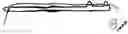
FIG. 2. The needle is shown lying down with the yarn going through the end of the needle though the second hole and passing over the finger rest and through the hole at the tip of the needle.
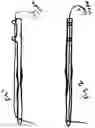
FIG. 3. The needle is shown from bottom to top, from the front view as well as a side view. Both views show the needle guide holes at the bottom and the needle tip with the hole in it for the yarn to go trough.
Claims
1. The knot needle makes loops by inserting the needle though yarn and creating more loops. The loops are connected by reinserting the knot needle back through the loops, linking them and forming the item you are creating.
Images & Drawings included:
Sources:
- United States Patent and Trademark Office - verify current appl. status at the USPTO↗
Recent applications in this class:
- » 20240328044 2024-10-03
MULTI-MEMBER KNITTING NEEDLES AND METHODS FOR MAKING THE SAME - » 20230416955 2023-12-28
MULTIFUNCTIONAL MARLIN SPIKE - » 20230287609 2023-09-14
KNITTING TOOL - » 20220349095 2022-11-03
Swivel connector assembly - » 20210230778 2021-07-29
Knitting needle - » 20210198820 2021-07-01
Knitting needle in particular for producing knitwear with cable patterns, and method for producing the knitting needle - » 20210087723 2021-03-25
Knitting needle with swivel joint - » 20210025090 2021-01-28
KNITTING NEEDLE - » 20200232131 2020-07-23
Connection structure connecting knitting needle body and cable and circular knitting needle having the same - » 20200071862 2020-03-05
Knitting needle in particular for producing knitwear with cable patterns, and method for producing the knitting needle