Method for connection acceptance control and optimal multi-media content delivery over networks
US20060224666A1
2006-10-05
11/445,579
2006-06-02
✅ Patent granted
US 7,827,301 B2
2010-11-02
-
-
Syed A. Zia
2029-05-28
Abstract:
A method for bandwidth allocation for delivery of multimedia data from at least one server to one or more clients over a network. The method includes the steps of: determining a maximum flow rate and a minimum flow rate for each client; determining a flow rate range for each client as given by the difference between the maximum flow rate and the minimum flow rate; sorting the one or more clients according to the flow rate range; initializing a current flow rate for each client as the minimum flow rate and summing the flow rate into total server flow rate; establishing remaining server bandwidth; and allocating the remaining server bandwidth to clients, based upon the sorted client's flow rate ranges.
Inventors:
- Arthur Douglas Allen 7 🇺🇸 Mountain View, CA, United States
- Arthur Allen 5 🇺🇸 Mountain View, CA, United States
Assignee:
- Burst.com 5 🇺🇸 Santa Rosa, CA, United States
- Democrasoft, Inc. 5 🇺🇸 Santa Rosa, CA, United States
Interested in similar patents?
Get notified when new applications in this technology area are published.
Classification:
H04L47/10 » CPC main
Traffic control in data switching networks Flow control; Congestion control
H04L47/15 » CPC further
Traffic control in data switching networks; Flow control; Congestion control in relation to multipoint traffic
H04L47/19 » CPC further
Traffic control in data switching networks; Flow control; Congestion control at layers above the network layer
H04L47/70 » CPC further
Traffic control in data switching networks Admission control; Resource allocation
H04L47/741 » CPC further
Traffic control in data switching networks; Admission control; Resource allocation measures in reaction to resource unavailability Holding a request until resources become available
H04L47/762 » CPC further
Traffic control in data switching networks; Admission control; Resource allocation using dynamic resource allocation, e.g. in-call renegotiation requested by the user or requested by the network in response to changing network conditions triggered by the network
H04L47/826 » CPC further
Traffic control in data switching networks; Admission control; Resource allocation; Miscellaneous aspects Involving periods of time
H04L65/80 » CPC further
Network arrangements, protocols or services for supporting real-time applications in data packet communication Responding to QoS
H04N21/2381 » CPC further
Selective content distribution, e.g. interactive television or video on demand [VOD]; Servers specifically adapted for the distribution of content, e.g. VOD servers; Operations thereof; Processing of content or additional data; Elementary server operations; Server middleware; Interfacing the downstream path of the transmission network, e.g. adapting the transmission rate of a video stream to network bandwidth; Processing of multiplex streams Adapting the multiplex stream to a specific network, e.g. an Internet Protocol [IP] network
H04N21/2385 » CPC further
Selective content distribution, e.g. interactive television or video on demand [VOD]; Servers specifically adapted for the distribution of content, e.g. VOD servers; Operations thereof; Processing of content or additional data; Elementary server operations; Server middleware; Interfacing the downstream path of the transmission network, e.g. adapting the transmission rate of a video stream to network bandwidth; Processing of multiplex streams Channel allocation ; Bandwidth allocation
H04N21/2396 » CPC further
Selective content distribution, e.g. interactive television or video on demand [VOD]; Servers specifically adapted for the distribution of content, e.g. VOD servers; Operations thereof; Processing of content or additional data; Elementary server operations; Server middleware; Interfacing the upstream path of the transmission network, e.g. prioritizing client content requests involving handling client requests characterized by admission policies
H04N21/2402 » CPC further
Selective content distribution, e.g. interactive television or video on demand [VOD]; Servers specifically adapted for the distribution of content, e.g. VOD servers; Operations thereof; Processing of content or additional data; Elementary server operations; Server middleware; Monitoring of processes or resources, e.g. monitoring of server load, available bandwidth, upstream requests Monitoring of the downstream path of the transmission network, e.g. bandwidth available
H04N21/26216 » CPC further
Selective content distribution, e.g. interactive television or video on demand [VOD]; Servers specifically adapted for the distribution of content, e.g. VOD servers; Operations thereof; Management operations performed by the server for facilitating the content distribution or administrating data related to end-users or client devices, e.g. end-user or client device authentication, learning user preferences for recommending movies; Content or additional data distribution scheduling, e.g. sending additional data at off-peak times, updating software modules, calculating the carousel transmission frequency, delaying a video stream transmission, generating play-lists the scheduling operation being performed under constraints involving the channel capacity, e.g. network bandwidth
H04N21/2662 » CPC further
Selective content distribution, e.g. interactive television or video on demand [VOD]; Servers specifically adapted for the distribution of content, e.g. VOD servers; Operations thereof; Management operations performed by the server for facilitating the content distribution or administrating data related to end-users or client devices, e.g. end-user or client device authentication, learning user preferences for recommending movies; Channel or content management, e.g. generation and management of keys and entitlement messages in a conditional access system, merging a VOD unicast channel into a multicast channel Controlling the complexity of the video stream, e.g. by scaling the resolution or bitrate of the video stream based on the client capabilities
H04N21/47202 » CPC further
Selective content distribution, e.g. interactive television or video on demand [VOD]; Client devices specifically adapted for the reception of or interaction with content, e.g. set-top-box [STB]; Operations thereof; End-user applications; End-user interface for requesting content, additional data or services; End-user interface for interacting with content, e.g. for content reservation or setting reminders, for requesting event notification, for manipulating displayed content for requesting content on demand, e.g. video on demand
H04N21/6377 » CPC further
Selective content distribution, e.g. interactive television or video on demand [VOD]; Network structure or processes for video distribution between server and client or between remote clients; Control signalling between clients, server and network components; Transmission of management data between server and client, e.g. sending from server to client commands for recording incoming content stream ; Communication details between server and client ; Control signaling related to video distribution between client, server and network components; Network processes for video distribution between server and clients or between remote clients , e.g. transmitting basic layer and enhancement layers over different transmission paths, setting up a peer-to-peer communication via Internet between remote STB's; Communication protocols; Addressing; Control signals issued by the client directed to the server or network components directed to server
H04N21/643 » CPC further
Selective content distribution, e.g. interactive television or video on demand [VOD]; Network structure or processes for video distribution between server and client or between remote clients; Control signalling between clients, server and network components; Transmission of management data between server and client, e.g. sending from server to client commands for recording incoming content stream ; Communication details between server and client ; Control signaling related to video distribution between client, server and network components; Network processes for video distribution between server and clients or between remote clients , e.g. transmitting basic layer and enhancement layers over different transmission paths, setting up a peer-to-peer communication via Internet between remote STB's; Communication protocols; Addressing Communication protocols
H04N21/658 » CPC further
Selective content distribution, e.g. interactive television or video on demand [VOD]; Network structure or processes for video distribution between server and client or between remote clients; Control signalling between clients, server and network components; Transmission of management data between server and client, e.g. sending from server to client commands for recording incoming content stream ; Communication details between server and client ; Transmission of management data between client and server Transmission by the client directed to the server
H04L69/329 » CPC further
Network arrangements, protocols or services independent of the application payload and not provided for in the other groups of this subclass; Definitions, standards or architectural aspects of layered protocol stacks; Architecture of open systems interconnection [OSI] 7-layer type protocol stacks, e.g. the interfaces between the data link level and the physical level; Intralayer communication protocols among peer entities or protocol data unit [PDU] definitions in the application layer [OSI layer 7]
G06F15/16 IPC
Digital computers in general ; Data processing equipment in general Combinations of two or more digital computers each having at least an arithmetic unit, a program unit and a register, e.g. for a simultaneous processing of several programs
Description
CROSS-REFERENCE TO RELATED APPLICATIONSThis application is a Continuation of U.S. patent application Ser. No. 09/344,688, filed Jun. 25, 1999, which claims priority to provisional application No. 60/108,777, filed Nov. 17, 1998, both of which are incorporated herein by reference.
BACKGROUND OF THE INVENTION1. Field of the Invention
The invention relates to the field of delivery of multimedia content over a variety of networks. More specifically, it pertains to multimedia servers which service many clients simultaneously for the delivery of multimedia content which is used and played back at each client. It addresses methods for determining optimal delivery rates to each client and methods for determining whether new clients may be accepted without diminishing the quality of service to existing clients.
2. Description of Related Art
In the history of multimedia program delivery, some in the industry have long advocated the use of large client-side buffers and faster-than-real-time content delivery over a network as offering the best of all worlds: a jitter-free viewing experience and a cost-effective utilization of the network resources at hand. Few systems, however, go very far in addressing how to schedule clients or a method for accepting new clients. Real-time systems, often known as streaming systems, can schedule new clients in a very simple manner—if sufficient bandwidth remains for the added real-time stream, then the client may be accepted. However, such systems do not maximize the number of simultaneous clients. On the other hand, faster than real-time delivery, sometimes known as store-and-forward systems, open up the possibility for more flexible scheduling procedures to control and optimize the number of simultaneous clients while ensuring a high level of quality of service.
The methods for such call acceptance and flow modulation that have been proposed in the prior art have been largely ad-hoc and also incomplete. These have been ad-hoc in the sense that there has been no guiding rationale for their selection from among many possible and potentially superior alternatives. The methods have also been incomplete insofar as they did not address the question of whether any given incoming request for service should be accepted or denied. Video-on-demand systems, or more generally, any system in which a multimedia server is designed to serve multiple clients over a network to deliver bounded content, can benefit from the use of such flow modulation techniques and call acceptance procedures.
BRIEF SUMMARY OF THE INVENTIONOptimal Content Flow Modulation
The present invention addresses multimedia content delivery optimization by re-casting the problem to be solved as an optimization problem in which one seeks to maximize a designated value function moment-by-moment, subject to a set of real-world operational constraints which will typically vary over time. Accordingly, given a set of clients and associated sessions, an optimal delivery procedure continuously establishes content flow rates from the content server to each of its clients so as to maximize aggregate value according to the governing value function.
This approach holds several advantages: 1) optimization problems are well understood, and are tractable by a large and diverse collection of computational methods; 2) if it exists, the global solution that is obtained is arguably optimal by construction, and thus superior or equal to all other.
The present invention teaches the method of optimizing two particular value functions:
1) total data delivered (maximize throughput).
2) total delivery charges (maximize charges).
The first value function does not distinguish one customer from another and will deliver as much data as possible from server to clients irrespective of the characteristics of the latter. The second value function favors the service of high paying customers. It can easily be seen that the first function is a special case of the second one whereby all clients are charged equally.
As will be seen in this disclosure, optimizing for these functions and identifying the necessary constraints requires a new and unique perspective that is specifically designed for the multimedia environment. Moreover, the disclosed methods are specifically designed to account for and accommodate real-world scenarios of today's networks. Consequently several variations of the method are presented to accommodate various scenarios.
The following briefly-defined concepts are useful in understanding the present invention:
Call/Connection Acceptance Control (CAC)
In accordance with the invention, a CAC procedure is responsible for deciding whether a candidate for service can be accommodated without jeopardizing sessions already in progress at the present time or at some time in the future; failing that, it must decide whether a service request should be queued for a time, or rejected.
Flow Modulation
Flow modulation methods are those portions of the system which manage the communication and data flow between the server and the clients. Collectively, these methods provide the multimedia data to the client and provide the server with the information about the state of the transmission, playback, user status and network status. These parameters are further used by the present invention in the CAC procedures. In fact, as will be shown, the proposed CAC procedures are tightly integrated with the flow modulation methods.
Adaptation to Variations in Network Capacity
Operational constraints may change overtime. For instance, one might elect to vary the total bandwidth available for multimedia content delivery according to the time of day. Alternatively, exogenous data flows on the network may cause unexpected disturbances by usurping available bandwidth and impeding the delivery of data along established session channels. The content delivery strategy of the present invention includes the ability to adapt to scheduled as well as unexpected disturbances so as to minimize unwanted disruptions of services.
Burst Transmissions Provide the Opportunity to Adapt
The present invention, due to it's faster-than-realtime transmissions (also know as burst transmissions), which are realized by use of high-bandwidth networks and large client cache or intermediate storage, provides an opportunity to adapt to changing network conditions. In contrast, real-time (streaming) systems of the prior art are essentially designed for worst-case scenarios: each client must be assumed to constantly use the complete real-time playback bandwidth. Such prior art systems are unable to adapt to any derivation from this scenario. For example, take the simple case where the total server bandwidth is 100% utilized by all clients playing back the streaming video. Should any network condition change, such as a temporary decrease in available bandwidth over the network, then one or more clients' playback is interrupted, and the system can not recover from such a condition until the bandwidth is regained. Even worse, if a single client presses pause either that unused bandwidth must remain reserved and no more clients can be accepted, or that paused client is pushed out in order to service the new client. In essence little or no CAC procedure may be implemented.
In contrast, the present invention burst transmits portions of a program and immediately ‘gets ahead of itself’, thus allowing headroom for a myriad of methods to intelligently handle new clients, client interactivity and possible network fluctuations.
In accordance with the invention, methods are disclosed for optimally determining the flow rate to each client. Methods are also disclosed for accepting or rejecting new clients; these call-acceptance methods are tightly coupled with said flow rate modulation methods. A series of constraint expressions are presented which govern the methods for determining the flow rates and acceptance of new clients. Linear programming techniques are used to optimally solve these expressions. Various embodiments are presented including scenarios for multiple-rate tariffs, and time-of-day bandwidth variations.
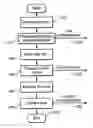
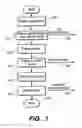
BRIEF DESCRIPTION OF THE DRAWINGSFIG. 1 depicts the flow of control and/or data between the different stations of a content delivery session;
FIG. 2 illustrates the Entity Data Model;
FIG. 3 geometrically illustrates the problem statements;
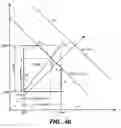
FIG. 4 geometrically illustrates an expansion of the problem statement;
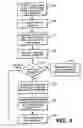
FIG. 5 illustrates a method for implementing flow modulation;
FIG. 6 illustrates a method for implementing flow modulation for maximized charges;
FIG. 7 illustrates typical content flow;
FIG. 8 illustrates typical server swing capacity;
FIG. 9 illustrates a method for call-acceptance and control (CAC);
FIG. 10 illustrates planned constraints on maximum flow;
FIG. 11 illustrates a method for call-acceptance and control (CAC) with scheduled flow changes;
FIG. 12 illustrates stratification of services; and
FIG. 13 illustrates a method for call-acceptance and control (CAC) for maximal charge.
DETAILED DESCRIPTION OF THE INVENTIONFIG. 1 depicts the flow of control and/or data between the different stations of a content delivery session in accordance with the invention. As shown, a client attempts a connection (100) and manifests itself to the Content Selection subsystem by means of a low bandwidth control channel (not shown). Next the client is authenticated and a selection is made (110), typically with the aid of a browser software such as Netscape™ or Microsoft Internet Explorer™. If the client is not authenticated, it is dismissed from the system (120). If the client has been authenticated and a program selected for viewing then the rate of service is set at this point (130), perhaps according to the selection that was made, or some contractual stipulation. The client is now placed on the service queue of the CAC subsystem (140). A client that is made to wait too long will eventually balk (150). Assuming this does not occur, the CAC subsystem will eventually allocate a channel to the client and open a session (160). Control now devolves upon the Content Flow Modulator (not shown) which starts the flow of content from server to client (170). Subsequent capacity changes, whether predictable or not, may force in abrupt termination of a session in progress (180). Otherwise the session runs to completion (190).
The entities entering into our discussion are depicted in FIG. 2. Client 200 maintains certain data associated with this entity; as shown but not labeled, which includes without limitation, status, id and costOfService. The other entities also each include unlabeled but depicted data. The diagram farther depicts the relationship between each entity. As shown, client 200 is assigned a session 240. Client 200 employs a channel 210. Client 200 selects contentSelection 230. Session 240 delivers content through channel 210. Server 220 modulates channel 210. Server 200 contains contentSelection 210. Server 220 accepts, defers or denies client 200. And contentSelection 230 is associated with session 240.
Furthermore FIG. 2 depicts the various one-to-many relationships. Each client 200 employs one channel 210. Client 200 may or may not receive one of channel 210, as depicted by the 0/1 notation. Similarly, client 200 may or may not receive a session 240. However, whenever client 200 does receive a session 240, it will always receive a channel 210 since channel 210 and session 240 are allocated as a pair. One or more (N) of client 200 may select one of contentSelection 230. And server 220 contains one or more (N) of contentSelection 230. Each one of contentSelection 230 is associated with 0-N of session 240. Each session 240 delivers content through one of channel 210. And server 220 modulates one or more (N) of channel 210.
A more detailed list of each entity of FIG. 2, and each one's associated description, data elements and function calls is listed below. This listing closely resembles that of object-oriented programming. As such, ‘methods’ represent the ability to obtain or modify data, while ‘attributes’ represent data which is directly associated with that particular entity. The listing also includes information relating to one embodiment wherein software programming specifics are disclosed, such as a variable type (double, int and so forth) and more. The present invention is not limited to such an embodiment and other implementations are possible without deviating from the scope and intent of the present invention. The listing, however detailed, is merely illustrative of the data and functions which are used in the equations and methods described herein.
Consequently, data and functions from this listing, associated with the various entities, will be used in forthcoming equations, flowcharts and methods. The reader is directed to this listing as reference when reading such equations and examining such drawings.
—Start of Entity Data Model Detailed Listing—
Model: Untitled 1 (Public)
Contains:
-
- client, session, channel, server, contentSelection.
Component: Client (Public Class/Interface)
Comment: - A client entity stands for a client presently requesting or receiving service.
Methods: - public static lookup (id: in int): client
- public GetId ( ): const int&
- public SetId (val: in int&)
- public GetCostOfService ( ): const double&
- public SetCostOfService (val : in double&)
Attributes: - private status: client<int>
- Specifies whether or not a client has been allocated a channel and session.
- private id: int
- Integer-valued identifier that is unique to the client (primary key). Can be obtained from a monotonically increasing counter.
- private costOfService: double
- Dollar charge per Mbyte. This value is the same for all customers under flow optimization. Under cost/charge optimization may be an integer value reflective of the rank; the higher the rank the higher the charge.
Has: - public selected: contentSelection
- public assigned a: session
- public employs: channel
Component: Session (Public Class/Interface)
Comment: - A session entity holds various state information about the service being received by an associated customer.
- public GetCurrentPosition ( ): const double&
- public SetCurrentPosition (val: in double&)
- public GetPayloadToGo ( ): const double&
- public SetPayloadToGo (val : in double&)
- public GetStatus ( ): const int&
- public SetStatus (val : in int&)
- public GetMinimumFlowRate ( ): const double&
- public SetMinimumFlowRate (val: in double&)
- public GetFlowRateRange ( ): const double&
- public SetFlowRateRange (val : in double&)
- public GetMaxFlowRate ( ): const double&
- public SetMaxFlowRate (val: in double&)
Attributes: - private playTimeToGo: double
- Indicates the minutes remaining in the viewing experience. Initialized to contentSelectiont.playTime (see below).
- private currentPosition: double
- Pointer into media content from which content is being delivered.
- private payloadToGo: double
- The amount of media content (in Mbytes) as yet undelivered by the server. Does not include any content presently stored in the client-side buffer.
- private status: int
- Indicates whether session is active or paused.
- private minimumFlowRate: double
- This is the minimum flow from server to client required to ensure uninterrupted service over the remaining playTime. Has a value of zero if playloadToGo is zero. Given by (payloadToGo*8)/(playTimeToGo*60)
- private flowRateRange: double
- Specifies the effective range over which the channel content flow serving a session is constrained without consideration for interactions with other flows. Equals maxFlowRate−minimumFlowRate
- private maxFlowRate: double
- Effective maximum bound on flow as expressed in formula (8) which must be re-evaluated periodically.
Has: - public delivers content through: channel
Component: Channel (Public Class/Interface)
Comment: - A channel represents the network resources from server to client associated with an ongoing session, encompassing the client-side buffer if any, and its level.
- public GetBufferLevel ( ): const double&
- public SetBufferLevel (val: in double&)
- public GetFlowRate ( ): const double&
- public SetFlowRate (val: in double&)
- public GetMaxFlowRate ( ): const double&
- public SetMaxFlowRate (val : in double&)
Attributes: - private bufferSize: double
- Capacity of the client-side buffer (or equivalent).
- private bufferLevel: double
- Current buffer level in MBytes of stored content.
- private flowRate: double
- Flow rate through channel specified by the relevant optimizing flow modulator.
- private maxFlowRate: double
- This value represents the maximum possible flow rate from the server to an individual client over its “channel”. This value reflects restrictions on flow that pertain to an individual client. It may be determined by factors such as the bandwidth of client's link to the network, or a limit imposed administratively to ensure balanced network utilization.
Component: Server (Public Class/Interface)
Comment: - Entity representing the media server and its CAC and flow modulation activities.
- public GetFlowRate ( ): const double&
- public SetFlowRate (val: in double&)
- public GetMaxMinFlowRate[ ]( ): const double& public SetMaxMinFlowRate[ ] (val: in double&)
Attributes: - private maxFlowRate: double
- Maximum possible content flow that is allocated to the server by the network.
- Private FlowRate: Double
- Aggregate content flow rate, summed over all sessions and their associated channels.
- private cac.flowSafetyMargin: double
- Tunable safety margin used by the CAC algorithm to protect sessions-in-progress from being affected by changes in available network bandwidth.
- private maxMinFlowRate[ ]: double
- Applies when N rate tariffs exist. This array holds the maximum floor level for each category of service. The value for the costliest category N is stored in maxMinFlowRate[N−1], and for the least costliest in maxMinFlowRate[0]. It is the relative magnitude of these ascending values that matters, not their absolute value. Thus the actual maximum floor flow rate for category k is given by server.maxFlowRate*(server.maxMinFlowRatc[k−1]/server.maxMinFlowRate[N−1]). Similarly, the maximum floor flow rate for category N is server.maxFlowRate.
Has: - public contains: contentSelection
- public modulates: channel
Component: contentSelection (Public Class/Interface)
Comment: - Entity represents a video/sound clip or other bounded unit of content. A continuous data feed does not qualify.
Attributes: - private averagePlayRate: double
- The average rate at which media content is consumed by the client, as computed by dividing the (payload*8) by the (playTime*60)
- private playTime: double
- Duration of play of the media content in minutes.
- private payLoad: double
- total size of the content in Mbytes.
Has: - public is associated with: session
—End of Entity Data Model Detailed Listing—
- client, session, channel, server, contentSelection.
The following table summarizes the highlights of the previous detailed description of each entity in FIG. 2.
| Entity | Description |
| client 200 | Each client is denoted by an associated unique integer indexId. |
| The set of active clients is denoted by SactiveClients. The set of | |
| deferred clients is denoted by SQdClients. Incoming clients are | |
| expected to select the content they wish to view prior to being | |
| queued for dispatch by the CAC sub-system, which requires | |
| knowledge of the client's bandwidth requirements, duration of play, | |
| and cost of service, all of which may vary according to the selection | |
| server 220 | Servers sit astride a network and can deliver media content through |
| the network to their clients up to a designated maximum flow | |
| rate. The server is responsible for accepting or rejecting clients, | |
| launching sessions and associated channels for the former, and | |
| modulates content flows over all channels in an optimal manner. | |
| channel 210 | A channel represents the data path between the server and the client. |
| The channel buffer is typically located near or within the client's | |
| viewing station. The flow of content through the channel is set by the | |
| flow modulator sub-system. | |
| contentSelection | A server will typically act as a repository for media content, |
| 230 | which it can deliver to clients upon demand. For purposes of |
| the invention, media content is characterized by its payload | |
| and the play duration, which together imply the | |
| averagePlayRate = (payload * 8)/(playTime * 60). The | |
| averagePlayRate is the streaming rate imposed by realtime | |
| just-in-time streaming algorithms. | |
| session 240 | Every session represents an instance of media content |
| delivery to an associated client over a designated channel. | |
| The playTimeToGo indicates the time remaining before the | |
| content is fully played out to the client. The payloadToGo is | |
| the amount of content data as yet undelivered to the | |
| channel. A session terminates when this value reaches | |
| zero, at which time playTimeToGo may still be large, | |
| according to the capacity, the level of the channel buffer, and | |
| the media play rate. | |
Below are presented some formulas and problem statements which are used in the methods which follow.
The flow of content between entities is subject to the following constraints at all times. Buffer levels are always expressed in Mbytes and data rates in Mbits/sec.
ΣiεSactiveClients(client.lookup(i).channel.flowRate)<=server.maxFlowRate (1)
-
- The sum of all channel flows cannot exceed the imposed maximum throughput capacity of the server.
client.lookup(i).channel.flowRate<=client.lookup(i).channel.maxFlowRate for all iεSactiveClients (2) - The data path from server to client is subject to its own constriction.
client.lookup(i).channel.flowRate<=(client.lookup(i).channel.bufferSize−client.lookup(i) channel.bufferLevel)*8/60+client.lookup(i).session.mediaContent.averagePlayRate, for all iεSactiveClients, (3) - The channel buffer is never allowed to overflow.
client.lookup(i).channel.flowRate<=client.lookup(i).session.payloadToGo*8/60 for all iεSactiveClients, (4) - Content that does not exist can not be delivered. (Constraint 1 will ordinarily prevail except at the very end of a session.)
- The sum of all channel flows cannot exceed the imposed maximum throughput capacity of the server.
The constraints listed above are straightforward applications relating to the flow of data through constricted channels, out of finite data sources, and into and out of bounded buffers. By contrast, the following constraint, which imposes a minimum channel flow rate instead of a maximum, is less obvious. The minimum value, termed the minFlowRate is set to the flow rate which, if sustained over the balance of the play time to go (playTimeToGo), ensures that all required content will be available when needed—and no sooner—until all content is played out. This floor value can be calculated for iεSactiveClients by the formula
client.lookup(i).session minFlowRate=(client.lookup(i).session.payloadToGo*8)/(client.lookup(i).session.playTimeToGo*60) (5)
Thus:
client.lookup(i).channel.flowRate>=client.lookup(i).session.minFlowRate for all iεSactiveClients (6)
The variable constraint bounds (i.e. the values to the right of the inequality symbol) of equations 1-4 and 6 are re-evaluated on a periodic basis (e.g. once per second) prior to the execution of the CAC procedure and optimizer. In particular, the minFlowRate value starts out at the beginning of a session equal to the streaming rate. By construction the minFlowRate rate never exceeds this initial value so long as constraint 6 is honored. In fact, constraint 5 implies that the minFlowRate value must be a diminishing function of time that may hold its value for a time but never rises. As seen from equation 6, the actual data rate of the channel, flowRate, is always greater than or equal to the minFlowRate. By design, and virtue of the fact the present invention uses faster-than-realtime transmissions, the system quickly gets ahead of itself and ensures that after initial conditions, the minFlowRate is always equal to or less than the real-time rate and that it continues to decrease. As we shall see the CAC procedure exploits this monotonic characteristic of the minimum flow rate over time.
Constraints 2, 3 and 4 are of like kind, each specifying an upper bound on individual channel flows. Whereas the bound for constraint 2 is typically a constant, the bounds on 3 and 4 will vary over time. Nevertheless, only one of the three bounds is effective at any given time, namely the one with the smallest bound value, given by:
client.lookup(i).session.maxFlowRate=minimum of 1) client.lookup(i).channel.maxFlowRate, 2) (client.lookup(i).channel.bufferSize−client.lookup(i).channel.bufferLevel)*8/60+client.lookup(i).session.mediaContent.averageplayRate, 3) client.lookup(i).session.payloadToGo*8/60 (7)
Consequently, formulas 2, 3, and 4 can be consolidated into a single constraint, the bound for which is computed at every scan to be the smallest bound of associated constraints 2, 3 and 4.
client.lookup(i).channel.flowRate<=client.lookup(i).session.maxFlowRate, whereby for all iεSactiveClients, maxflowRate is given by equation (7). (8)
At any one time, individual channel flows are constrained over a range, as follows:
client.lookup(i).session.flowRateRange=client.lookup(i).session.maxFlowRate−client.lookup(i).session.minimumFlowRate (9)
Value Functions
The value functions introduced in the Description of Related Art can now be expressed mathematically as linear functions of channel flows as follows:
Optimizing Throughput (Maximal Flow)
value=Σi ε SactiveClientsclient.lookup(i).channel.flowRate) (10)
Optimizing Charges (Maximal Charges)
value=Σi ε SactiveClients(client.lookup(i).channel.flowRate)*client.lookup(i).costOfService) (11)
Optimization Problem
The optimization problem, which in one embodiment is strictly throughput and in another case is charge, can be stated simply as follows:
Find values for
client.lookup(i).channel.flowRate for all iεSactiveClients constrained by inequalities 1 through 5, such that the value obtained by evaluating expression 10 or 11 assumes a maximum.
Both of these problem formulations are examples of Linear Programming for which a number of well-known and generally effective computational solutions exist. In linear programming one seeks to optimize a linear cost function of variable x
c*x=c1*x1+ . . . +cn*xn (12)
subject to a set of linear inequality constraints
A*x<=b (13)
where xT=(x1, xn), c=(c1, . . . ,cn) are the state variable & cost vectors, A is an n-by-m matrix, bT=(b1, . . . bm) is the constraint vector, and the operator ‘*’ stands for matrix or scalar multiplication.
FIG. 3 is introduced as illustrative of the problem statement and the general methods of the prior art, and is not incorporated as an element of the invention.
The linear programming problem as well as its solution can best be understood with the aid of geometry. FIG. 3, depicting a 2-dimensional Cartesian problem space, inequality constraints (13) define a convex hull H 310 over which a search for an optimum value of x=(x1,x2) is permitted to range. The cost vector c350 defines an infinite family of equal cost lines (hyperplanes) which lie orthogonal to c. Three examples of such lines are shown in L1 360, L2 365, and L3 370, each of progressively higher value. The supreme value of the cost function is obtained by sliding along c 350 till one can go no farther, in this instance toward vertex V4340 of hull H 310. Many well-known methods (e.g. the Simplex Method) work roughly in this fashion, exploiting the fact that at least one optimum point must be at a vertex. In particular, the Simplex method algorithm begins by finding a vertex (e.g. V2320), and then moves along a sequence of vertices (e.g. V3330, V4340) improving itself each time until no further improvement is possible & the summit is reached.
Let us suppose instead that V3330 were placed along L3370 along with V4340. According to prior art methods, V3330 and V4340 are the two possible solutions, but the equally valuable points in between them are not. As we shall soon see, the problem of throughput optimization (6) falls in this category.
While vertex V1300 does not factor into this description, it is depicted in FIG. 3 for completeness.
Flow Modulation
A Method for Maximal Flow
The following relates to one embodiment for optimizing the total data flow.
FIG. 4 depicts a scenario involving two flows. The convex hull is in this instance bounded by line segments L1, L2, L3, L4 and L5. L6 is a boundary used in a different embodiment, however the present embodiment uses L5 and not L6. Flow f2 can range over the interval separating line segments L1 from L3, namely f2MIN and f2MAX; the range is depicted as f2RANGE. Flow f1 can range over the interval between lines L2 and L4, namely f1MIN and f1MAX, and depicted as f1RANGE. Flow f1 can range over the interval between lines L2 and L4, namely f1MIN and f1MAX, as depicted as f1RANGE. The sum of flows f1 and f2 is constrained to lie inside of line segment L5 which, by construction, is always orthogonal to the cost vector Cf. Cost vector Ce is also illustrated but used in a distinct embodiment. In the present embodiment, only Cf is used. In the illustrated example of the present embodiment the constraint on total flow is set to 5, and is therefore low enough to cause L5 to intersect L3 and L4. This would not have been true had the value chosen had been 10 instead of 5. With L5 safely out of contention, the convex hull would instead be a simple rectangle bounded by L1 through L4, thereby permitting both flows to assume their respective maxima without interference. In practice operational constraints exist intrinsically or are imposed from the outside so as to ensure cost effective sharing of potentially costly network resources.
Supposing FIG. 4 to be correct, the well-known methods would select would vertex V3-5, which lies at the intersection of L3 and L5, or V4-5, which lies at the intersection of L4 and L5. These solutions, though optimal, are undesirable for the present invention as they fail to spread available bandwidth over all channels as fairly as would a centrally located interior point of L5. For this reason a simple optimization method is taught, which is adapted to the particular needs of this problem and ensures a fairer allocation of constrained bandwidth among all channels.
In order to optimize use of all available bandwidth, the following general method is used, with the details illustrated in FIG. 5. This method is a solution for the problem illustrated in FIG. 4, which geometrically illustrates the optimization problem in the limited case of two flows, f1 and f2. The following description expands the problem to an arbitrary number of clients (and therefore flows) and presents a method for solving this optimization problem.
Referring to FIG. 5, in step 500 values are calculated for the session maxFlowRate and session.minFlowRate for each client as per the minimum and maximum constraint bound expressions in 6 and 8, respectively.
The difference between these two yields the session.flowRateRange of each client. Thus
session.flowRateRange=session maxFlowRate-session.minimumFlowRate
In step 505, the active clients are sorted in an ascending fashion based upon their session.flowRateRange. As will be shown this critical step facilitates allocation of the remaining server bandwidth as evenly as possible among all active channels, thus maximizing the number of channels that benefit by use of the total server bandwidth. An arbitrary assignation of remaining bandwidth is likely to saturate the server before all channels have been assigned extra bandwidth, thereby favoring certain channels on an ad-hoc basis.
In step 510, each client's channel flow rate is set to the session mimimumFlowRate.
By doing so it is ensured that the minimum flow constraint is met for each session and that the minimum flow rate is a non-increasing function of time, which is critical to the proper functioning of the CAC procedure. All clients are marked as unprocessed.
In the next step, 520, server.flowRate is set to the sum of each active client's session.flowRate.
Next, the following is iterated over all clients in sorted sequence (during any given iteration the selected client is given by its id) by performing steps 530 through 570. In step 530 evaluating the following expressions test for possible server saturation:
delta=(server.maxFlowRate−server.flowRate)/(qty of un-processed clients)range=client.lookup(id).session.maxFlowRate-client.lookup(id).session.flowRate
If range is greater then delta, this implies that the server can be saturated in this iteration by allocating delta to all unprocessed clients (step 540).
On the other hand, the ‘no’ path for step 530 implies that the server is not saturated and that the present client (given by id) will saturate first. Accordingly, in 550 the delta variable is set as follows:
delta=range
Next, the flow rate is incremented for all unprocessed clients by delta, causing client id to saturate.
In step 560 the server flow rate is adjusted accordingly:
server.flowRate=server.flowRate+delta*(qty of unprocessed clients)
In step 570 the client given by id, now saturated, is marked as processed.
A Method for Maximal Charge
The following relates to one embodiment for optimizing the total monetary charges within the system.
Referring back to FIG. 4, cost vector Cc lies orthogonal to line L6, which intersects the convex hull at the vertex formed by the intersection of lines L4 and L5, namely V4-5. This cost vector, and the optimal point that it implies, favors flow f1 over flow f2. In this example, this is as it should be, as the cost of service for f1 equals 2, thus exceeding the cost of service of 1 set for f2. As the number of flows grows to exceed the number of distinct categories of service (and associated costs of service) the unique optimal solution, depicted in FIG. 4 for the case where every flow has a distinct cost of service, no longer applies. Once again a plurality of flows within a service category vie for bandwidth which a method should endeavor to distribute evenly. This method is derived from the previous one, and optimizes one cost category after another, starting with the most costly and ending with the least costly, or when all available capacity is allocated.
Let the service categories be denoted by k=l . . . N, where k also denotes the cost of service.
Let Cl . . . CN be the partition of SactiveClients that places all clients with cost of service k in set Ck. Partition sets Ck can be ordered to form sequence SeqC=CN . . . C1.
FIG. 6 depicts the method for implementing the method to maximize the cost of service (service charge) according to objective function 2 described above.
This method is nearly identical to the previous one. The principle difference stems from the partitioning of clients according to their category (cost) of service: clients charged most are allocated bandwidth preferentially. This is accomplished by adding another level of iteration around the method of FIG. 5. The inner iteration (steps 650 through 680) functions exactly as before, with the difference that its actions are limited to the clients belonging to the given service category k (i.e. Ck). This difference also holds true of step 640 which sorts category k clients according to their flow ranges prior to entry in the bandwidth-allocating inner Loop. The outer loop proceeds down a sorted sequence of service categories SeqC (generated in step 630), starting with the category generating the greatest revenue to the service provider. Given a fairly static set of service categories, this sort need be performed only when the categories undergo change. Steps 670, 675 and 680 are identical to their counterparts in the method of FIG. 5 (i.e. 570, 575 and 580).
The net effect of this method is preferential allocation of bandwidth according to category of service, and equitable treatment of clients within the same category of service.
Call Acceptance Control (CAC)
CAC for Maximal Flow
The CAC procedure applicable to this flow optimization relies on the step of accepting a new client if and only if the added load induced thereby does not compromise service to existing clients or the new one. This step could not be accomplished without the close integration with previously-described flow-modulation methods of FIGS. 5 and 6.
According to the previous discussion, the minimum flow rate is the minimum sustained flow rate that guarantees that the associated viewer will not be subject to interruptions in service due to a shortfall of content from the media server. It follows that whenever data is being delivered at a rate in excess of the minimum flow rate, a downward adjustment toward the minimum level could be accommodated as needed to surrender bandwidth to any newcomer.
FIG. 7 depicts content flow over a channel over the course of a typical session, and also how data is delivered under real-time streaming (D). The amount of content delivered is the same in either case, but the manner of delivery differs considerably. A session is launched at time 0 as the network is lightly loaded, and the optimizer sets an accordingly high flow rate. Another client emerges at the end of interval 700, causing a downward adjustment to the flow rate over interval B, as available bandwidth is shared between two sessions. During both of these intervals the minimum flow rate 720 drops quickly, as data accumulates in the client's media buffers. At the end of interval B a massive influx of clients necessitates that flow be dropped to the minimum flow rate, which now lies substantially below the streaming rate D and is held until all data is delivered at the end of interval C. Note that the minimum flow rate, graphed as element 720, diminishes monotonically over time.
The server swing capacity is defined as the difference between the maximum capacity of the server and the total minimum flow rates for all active clients. Therefore:
swingCapacity=server.maxFlowRate−Σi ε SactiveClients(client.lookup(i).session.minFlowRate)
Given the monotonic decreasing nature of session minimum flow rates, server swing capacity can readily be seen to be a monotonic increasing function of time over the intervals separating client admissions, at which points it undergoes a drop as a new load is taken on. This all-important characteristic implies the following:
-
- Any client admitted for service based on the present value of swing capacity is guaranteed to have sufficient bandwidth at its disposal over the entire future course of the session.
FIG. 8 depicts the server swing capacity 800 over the course of the sessions illustrated in FIG. 7. Swing capacity rises quickly over intervals A & B as data is delivered at high flow rates over the network. It holds steady over interval C when all channels flow at their minimum rate then jumps at the end of C before resuming its monotonic rise once again.
In this procedure FIG. 9, which executes on a periodic basis, queued clients awaiting bandwidth are scanned in FIFO order. For each one the required bandwidth is computed as per the client's prior content selection. If the available swing capacity reduced by a safety margin exceeds the amount required then the client is activated, and swing capacity is adjusted accordingly. Otherwise two possible cases are considered: 1) under the FirstFit embodiment the procedure continues scanning clients to the end of the queue, activating clients whose requirements can be met; 2) under the FIFO embodiment, the procedure ends with the first candidate client whose requirements cannot be met.
In step 900 available server swing capacity is evaluated according to the formula
swingCapacity=server.maxFlowRate−Σi ε SactiveClients(client.get(i).session.minimumFlowRate)
The bandwidth requirement for client id in Step 920 is obtained as follows:
required_bandwidth=client.lookup(id).contentSelection.averagePlayRate
The predicate evaluated in Step 940 is given by the expression
(required_bandwidth<=swingCapacity−server.cac_flowSafetyMargin)
In step 950, client activation entails allocation of a session and a channel, and insertion in the set of active clients eligible for bandwidth allocation by the optimal flow modulator.
In step 960 the swing capacity is diminished by the amount reserved for the activated client:
swingCapacity=swingCapacity−required_bandwidth;
Responding to Variations In Network Capacity (Maximal Flow)
In the CAC procedure for maximal flow, a safety margin was introduced, namely server.cac_flowSafetyMargin, to provide the means for ensuring that the server's swing capacity will never fall below a minimal threshold value.
According to this procedure, the following inequality always holds true:
swingCapacity>=server.cac_flowSafetyMargin (15)
In the previous discussion a server's swing capacity provided the basis for determining whether or not a prospective client should be allocated bandwidth. In another embodiment, server swing capacity can also be interpreted as specifying the maximum amount by which the server.maxFlowRate can be dropped without affecting service, should such an adjustment prove necessary due, for instance, to an influx of exogenous network traffic that diminishes the amount available for multi-media services. Parameter server.cac_flowSafetyMargin can thus be set so as to guarantee a minimum capacity to tighten the constraint on maximum server flow in response to unexpected load changes that affect the server's ability to service its existing clients as well as new ones.
Anticipating Scheduled Variations in Network Capacity (Maximal Flow)
FIG. 10 depicts how the constraint on maximum flow might be allowed to vary according to the time of day, day of the week, and so forth, in expectation of time-varying traffic flow levels extrapolated from past experience, traffic flow models, etc. Maximum flow rate 1000 can be seen to vary based upon the time of day. In practice, defining the right-hand-side of inequality constraint 1 as a time-dependent expression can impose such time-varying capacities. According to the previous description, the optimizer, which executes on a periodic basis, will automatically seek new flow levels for every active session as the constraint varies. There is, however, no guarantee that an acceptable operating point will be found for all sessions (i.e. one that respects the minimal and maximum constraints on session channel flow). One such example is the case where the server is loaded to the limit and total capacity is curtailed in excess of the aforementioned safety margin. Should such a situation arise the only recourse may well be the termination of a number of established sessions (i.e. load shedding).
The goal is to eliminate service disruptions of this sort by allowing the CAC procedure to look ahead into the future, and accept new clients only if these can be accommodated without any compromise in service in the midst of previously anticipated changes in available network capacity. The following CAC procedure generalizes the previous one: before accepting a client the test on swing capacity is repeated over a sequence of time segments that cover the proposed viewing period.
Definitions
Let
t_end(i)=client.lookup(i).session.playTimeToGo+t_now (16)
Let server.maxFlowRate(t) be server flow capacity as a function of time, as exemplified in FIG. 10.
Let SeqT(t_now)=advancing sequence of future times, lead by t_now, when server.maxFlowRate(t) undergoes a step change. For instance, at 9:15 in FIG. 10 this sequence reads as follows: 9:15, 9:30, 11:30, 13:30, 6:30, 7:30.
The server swing capacity at a future time t is computed according to the capacity and worst-case client flows at time t.
swingCapacity(t)=server.maxFlowRate(t)−Σt—end(i)>t(client.1ookup(i).session.minFlowRate) (17)
It is noteworthy that the worst-case client flows at time t are expressed in terms of the present minimum flow rates, which cannot increase over time, but might hold steady. Finally, a predicate is defined that tests whether a prospective customer will cause swing capacity to be exceeded at some time t, as follows:
boolean client_fits(i,t){if(client.lookup(i).contentSelection.averagePlayRate<=swingCapacity(t)−server.cac_flowSafetyMargin)return true; else return false;} (18)
This procedure (FIG. 11) is an adaptation of the first, which has been extended to consider swing capacity at times in the future when capacity undergoes scheduled changes. Before accepting a client, its minimal bandwidth requirement (which by construction of the flow modulator will never increase over time) is checked against projected swing capacity at points in time when total available capacity undergoes scheduled step changes, provided these times fall within the proposed content viewing period. A candidate is activated only if all tests succeed.
Step 1100 builds a sequence of time values (SeqT) at which step capacity changes are scheduled to occur. The first element of this sequence is t_now, representing the present.
Beyond step 1100 the queue of waiting clients is scanned in FIFO order, yielding a candidate designated by id at each iteration.
The bandwidth requirement for client id in Step 1120 is obtained as follows:
required_bandwidth=client.lookup(id).contentSelection.averagePlayRate
The worst-case end time for content flow to id is obtained according to the content selected, as follows:
t_end=t_now+client.lookup(id).selected.playTime
Steps 1130 through 1150 are executed within an iteration for each time point t in SeqT falling between t_now and t_end. This iteration is ended in step 1130 if t exceeds the time window of interest, or in step 1150 if the supply of scheduled capacity changes is exhausted.
For each time value step 1140 compares required bandwidth to projected swing capacity. Projected swing capacity at time t is:
swingCapacity(t)=server.maxFlowRate(t)−Σt—end(i)>t(client.get(i).session.minimumFlowRate)
Note that only active clients whose t_end times occur after t are considered in the sum of minimum flow rates.
The predicate expression used in step 1140 at time t is thus
(required_bandwidth<=swingCapacity(t)−server.cac_flowSafetyMargin)
Step 1160 performs the same actions as step 660 in the previous cac flowchart.
The first CAC process presented above is a special case of the prese[P]nt one, in which the set of step change times to server.maxFlowRate is empty (i.e. server.maxFlowRate is constant), and SeqT(t_now)=t_now.
In preparing SeqT(t_now), one need only consider future times that will pass before the longest possible content is played out if started at t_now. In order to sidestep problems associated with rollover (at midnight, year 2000, etc.), time is best expressed as a monotonically increasing value (e.g. seconds since Jan. 1, 1990).
CAC for Maximal Charges
The method for flow modulation presented above maximizes charges to clients with active sessions. The CAC embodiments presented previously may not be sufficient, as they do not consider the cost of service as a basis for connection acceptance. As a result they may turn away higher paying customers while granting service to lower paying ones, thereby defeating the purpose for this particular embodiment. Therefore, another embodiment is defined which offers the following features:
-
- 1. Awaiting clients are serviced in order of their respective service categories, higher paying clients first.
- 2. Once accepted, a client is guaranteed to receive acceptable service irrespective of its service category.
- 3. Under heavy load conditions higher paying customers are more likely to be accepted than lower paying ones.
- 4. Lower paying customers will not be starved for service when higher paying ones enjoy a surplus.
- 5. Available bandwidth is not thrown away needlessly while clients are being denied service.
The first objective is easily met by dividing the client queue into as many bands as there are service categories, resulting in a banded queue. Bands are ordered within the queue according to their service categories, with the costliest category in front. As prospective clients arrive and make their selection they are placed in their respective queue band according to their service category (which may be set contractually, according to content selection, etc.).
The second objective is met by employing a procedure patterned after those presented previously & offering the same guarantee. The 3rd and 4th objectives may be met by dividing total available bandwidth in as many strata as there are service categories, as depicted in FIG. 12. Two service categories are shown, Premium and Basic, each entailing an associated cost of service. A prospective client is accepted only if there is sufficient swing capacity available within its service category. The swing capacity for a given category is given by the smaller of 1) the difference between its maximum floor flow rate—corresponding to the top of the stratum for the service category—and the sum of the minimum rates of all active sessions in its category or below, and 2) available swing capacity overall. The fifth objective is met by allowing the flow optimizer to function freely subject to its operational constraints. The imposed ceilings on call acceptance by category relate to minimum flow rates, which merely impose a floor on actual flow rates. For example, basic clients might well consume all available bandwidth (300) in the absence of any premium customers, yet could be throttled back toward their floor flow rates (which together cannot exceed 200 in this example) at any time should any premium customer suddenly demand service. In contrast, premium customers could consume the entire 300 bandwidth. As lower paying customers appear these would be admitted to the degree that their quota on minimum flow is not exceeded (i.e. 200) and the availability of swing capacity on the system.
The procedure according to FIG. 13 requires a number of ancillary definitions, which follow:
Let the service categories be denoted by k=l . . . N, where k also denotes the cost of service.
Let server.maxMinFlowRate[k−1] be the top of the stratum for service category k. Note that server.maxMinFlowRate [N−l] server.maxFlowRate.
Let SK be the set of active client indices with a service category equal to or less than k. Note that S1 is contained in S2, S2 is contained in S3, and so forth, and that SN=SActiveClients.
Let swingCapacity(k) denote available swing capacity for service category k. By construction,
swingCapacity(k)=minimum of: (server.maxMinFlowRate(k−1]−Σis Sk(client.lookup(i).session,minFlowRate)),(server.maxFlowRate−Σis SactiveClients(client.lookup(i).session.minFlowRate))) (19)
Now, referring to FIG. 13:
This method is used for CAC when multiple rate tariffs are in effect, and there is a desire to maximize economic returns to the service provider while offering acceptable service to all.
All waiting clients are scanned in FIFO sequence. The actions taken in Steps 1320 and 1360 are identical to those described in connection with earlier CAC flowcharts.
Step 1340 evaluates a predicate expression that tests whether the required bandwidth can be accommodated without exceeding the lesser of 1) swing capacity available to the client's category of service, and 2) total available swing across all categories of service. The latter factor could be determinative if all available bandwidth were allocated to high paying customers, leaving lower paying ones such as the proposed client unable to draw from their unfilled quota.
Let us suppose that candidate client id belongs to rate category k.
We define the swing capacity available in rate category k as:
swingcapacity(k)=least of: (server.maxMinFlowRate[k−1]−Σisv Sk(client.lookup(i).session.minimumFlowRate))
and
(server.maxFlowRate−Σis SactveClients(client.lookup(i).session.minimumFlowRate))
The predicate expression invoked by step 1340 can now be written as follows:
(required_bandwidth<=swingCapacity(k)−server.cac_flowSafetyMargin)
This algorithm processes queued clients in band sequence, and within every band in FIFO if the predicate evaluates to true the client is activated. Otherwise two possible cases are considered:
1) under the FirstFit embodiment the procedure continues scanning clients to the end of the banded queue, activating clients whose requirements can be met; 2) under the FIFO embodiment, the procedure ends with the first candidate client whose requirements cannot be met. Many other variations on these two embodiments might also be considered.
Anticipating Scheduled Variations in Network Capacity (Maximal Charge)
The procedure applicable to optimization of delivery charges is obtained by blending elements of the CAC method depicted in FIG. 13 into the method depicted in FIG. 11, which applies without change. To understand how this might work it may be useful to visualize a version of FIG. 10 stratified along its length in the manner of FIG. 8. As the maximum flow level undergoes a step change so too do the widths of its constituent strata in equal proportion.
As previously mentioned, the method of CAC described above (FIG. 11) applies to this circumstance also, provided we alter the definition routines, (17) and (18), upon which that procedure relies, yielding (20) and (21), and adopt the banded queue organization outlined in the previous section.
The server swing capacity at a future time t is computed according to the capacity and worst-case client flows at time t.
swingCapacity(k,t)=minimum of((server.maxFlowRate(t)*(server.maxMinFlowRate[k−1]/server.maxMinFlowRate[N−1])−Σis Sk & (t—end(I)>t)(client.lookup(i).session.minFlowRate)),(server.maxFlowRate−Σis Sactive Clients&(t—end(i>t))(client.lookup(i).session.minFlowRate))) (20)
Finally, we define a predicate that tests whether a prospective customer will cause swing capacity to be exceeded at some time t, as follows:
boolean client_fits(i,t) {k=client.lookup(i).costOfService; if(client.lookup(i).contentSelection.averagePlayRate<=swingCapacity(k,t)−server.cac_flowSafetyMargin) return true else return false;} (21)
A method for call/connection acceptance and flow modulation for network delivery of video/audio programming is thus provided. Although several embodiments have been illustrated and described, it will be apparent to those skilled in the art that various changes and modifications may be made without departing from the spirit of the invention as set forth in the following claims.
Claims
What is claimed is:1. A method for bandwidth allocation for delivery of multimedia data from at least one server to one or more clients over a network comprising the steps of:
determining a maximum flow rate and a minimum flow rate for each client;
determining a flow rate range for each client as given by the difference between the maximum flow rate and the minimum flow rate;
sorting the one or more clients according to the flow rate range;
initializing a current flow rate for each client as the minimum flow rate and summing the flow rate into total server flow rate;
establishing remaining server bandwidth; and
allocating the remaining server bandwidth to clients, based upon the sorted client's flow rate ranges.
2. The method of claim 1, wherein the step of allocating remaining server bandwidth to clients comprises:
iterating in sorted sequence for each unprocessed client the steps of:
determining equally-allocated remaining server bandwidth if allocated evenly to all unprocessed clients;
determining the range of client bandwidth as given by the difference between the maximum flow rate and the minimum flow rate; and
determining saturation by comparing the equally allocated remaining bandwidth and the range of client bandwidth and allocating the lesser of these two to each client flow rate.
3. The method of claim 1, further comprising the steps of sorting the list of clients according to categories of service, which correspond to payment rates.
4. The method of claim 3, wherein the step of allocating remaining server bandwidth to clients comprises:
iterating in sorted sequence for each unprocessed client the steps of:
determining equally-allocated remaining server bandwidth if allocated evenly to all unprocessed clients;
determining the range of client bandwidth as given by the difference between the maximum flow rate and the minimum flow rate; and
determining saturation by comparing the equally allocated remaining bandwidth and the range of client bandwidth and allocating the lesser of these two to each client flow rate.
5. The method of claim 1, whereby allocating flow to remaining clients based upon the sorted client range flow rates and determining allocation of remaining server bandwidth is based upon a comparison of saturation of server versus saturation of each client, which maximizes allocation of total bandwidth for a maximal flow rate to a maximum number of clients.
6. The method of claim 1, wherein the step of allocating remaining server bandwidth comprises allocating remaining server bandwidth to remaining clients such that lower paying clients receive bandwidth only if higher paying ones are saturated.
7. The method of claim 1, wherein the step of allocating remaining server bandwidth to remaining clients comprises the steps of:
for each remaining unprocessed client:
determining equally-allocated remaining server bandwidth if allocated evenly to all remaining unprocessed clients;
determining the range of remaining client bandwidth as given by the difference between the maximum flow rate and the minimum flow rate;
determining saturation by comparing the equally-allocated remaining server bandwidth and the range of remaining client bandwidth, and allocating the lesser of these two amounts to each remaining client flow rate; and
whereby allocating flow to remaining clients based upon the sorted client range flow rates and determining allocation of remaining server bandwidth based upon a comparison of saturation of server versus saturation of each client maximizes allocation of total bandwidth for maximal flow rate to maximum number of clients.
8. The method of claim 1, wherein the minimum flow rate for each client is expressed as a non-increasing function of time.
9. The method of claim 8, wherein the minimum flow rate is obtained by dividing content not yet delivered by remaining play time.
10. A method for connection acceptance control for delivery of multimedia data from server to one or more clients over a network comprising the steps of:
determining a minimum flow rate for each client;
determining server swing capacity, wherein server swing capacity is the difference between total server bandwidth and a summation of the minimum flow rate of each processed client; and
allocating server bandwidth for each client who will fit without server bandwidth saturation, as determined by comparing an average data play rate of each client with the remaining bandwidth available to the server.
11. The method of claim 10, wherein said remaining bandwidth available to the server is given by the server swing capacity.
12. The method of claim 11, wherein the remaining bandwidth available to the server is given by the server swing capacity less a server flow safety margin.
13. The method of claim 12, wherein the step of allocating server bandwidth for each client, which will fit without server bandwidth saturation, is further comprised of:
allocating server bandwidth to each client sequentially until a client is located in which said average data play rate exceeds the server swing capacity.
14. The method of claim 13, wherein the step of allocating server bandwidth for each client, which will fit without server bandwidth, is further comprised of:
allocating server bandwidth to each client sequentially for each client, which can be activated without server bandwidth saturation.
15. The method of claim 14, further comprising the steps of:
storing a sequence of data representing scheduled bandwidth changes for the server.
16. The method of claim 10, wherein the one or more clients are distinguished by their cost of service and bandwidth is apportioned to clients iteratively, the amount apportioned to each client in a cost category is the amount remaining from prior allocations to clients in higher cost categories.
Images & Drawings included:






Sources:
- United States Patent and Trademark Office - verify current appl. status at the USPTO↗
Similar patent applications:
- » 9344688
Method for connection acceptance control and optimal multi-media content delivery over networks - » 20060265512
Method for connection acceptance control and optimal multi-media content delivery over networks - » 20050120131
Method for connection acceptance control and rapid determination of optimal multi-media content delivery over networks - » 20060218281
Method for connection acceptance control and rapid determination of optimal multi-media content delivery over networks - » 20060224768
Method for connection acceptance control and rapid determination of optimal multi-media content delivery over networks
Recent applications in this class:
- » 20250211529 2025-06-26
METHOD FOR IMPLEMENTING AND EVALUATING TSN TRAFFIC SCHEDULING - » 20250158925 2025-05-15
NETWORK VALIDATION WITH DYNAMIC TUNNELING - » 20250106158 2025-03-27
NETWORK VALIDATION WITH DYNAMIC TUNNELING - » 20250016097 2025-01-09
OVER-THE-NETWORK REAL-TIME DIGITAL SIGNAL PROCESSING USING GPUS - » 20250016096 2025-01-09
METHOD FOR TRANSMITTING DATA VIA A SERIAL, ASYNCHRONOUS INTERFACE, METHOD FOR RECEIVING DATA VIA A SERIAL, ASYNCHRONOUS INTERFACE, DEVICE AND SYSTEM - » 20240259313 2024-08-01
Call Admission Control and Preemption Control Over a Secure Tactical Network - » 20240236000 2024-07-11
CALCULATOR SYSTEM AND CONGESTION AVOIDANCE METHOD - » 20240223503 2024-07-04
DATA TRANSMISSION CONTROL METHOD AND APPARATUS, COMPUTER-READABLE STORAGE MEDIUM, COMPUTER DEVICE, AND COMPUTER PROGRAM PRODUCT - » 20240205154 2024-06-20
DATA TRANSMISSION METHOD AND RELATED DEVICES - » 20240163214 2024-05-16
INTERNET OF THINGS END-TO-END SERVICE LAYER QUALITY OF SERVICE MANAGEMENT
Recent applications for this Assignee:
- » 20120244505 2012-09-27
Collaborative and interactive learning - » 20120143914 2012-06-07
Real time and dynamic voting - » 20080228921 2008-09-18
Connection acceptance control - » 20060265512 2006-11-23
Method for connection acceptance control and optimal multi-media content delivery over networks - » 20060224768 2006-10-05
Method for connection acceptance control and rapid determination of optimal multi-media content delivery over networks - » 20060218281 2006-09-28
Method for connection acceptance control and rapid determination of optimal multi-media content delivery over networks - » 20050120131 2005-06-02
Method for connection acceptance control and rapid determination of optimal multi-media content delivery over networks - » 9344688 2008-02-19
Method for connection acceptance control and optimal multi-media content delivery over networks