Method of making secondary battery
US20060260120A1
2006-11-23
11/132,377
2005-05-19
Abstract:
A method of making a secondary battery includes the steps of a) providing a circuit board and a cell having a positive terminal and a negative terminal, b) bonding a first plate electrode and a second plate electrode to the circuit board, and c) connecting the cell to the circuit board by bonding the positive terminal to the first plate electrode and the negative terminal to the second plate electrode.
Assignee:
- Exa Energy Technology Co. Ltd. 3 🇹🇼 Taichung, Taiwan
Interested in similar patents?
Get notified when new applications in this technology area are published.
Classification:
H01M50/543 » CPC main
Constructional details or processes of manufacture of the non-active parts of electrochemical cells other than fuel cells, e.g. hybrid cells; Current conducting connections for cells or batteries Terminals
H01M10/0436 » CPC further
Secondary cells; Manufacture thereof; Construction or manufacture in general Small-sized flat cells or batteries for portable equipment
H01M10/42 » CPC further
Secondary cells; Manufacture thereof Methods or arrangements for servicing or maintenance of secondary cells or secondary half-cells
H01M10/425 » CPC further
Secondary cells; Manufacture thereof; Methods or arrangements for servicing or maintenance of secondary cells or secondary half-cells Structural combination with electronic components, e.g. electronic circuits integrated to the outside of the casing
H01M10/052 » CPC further
Secondary cells; Manufacture thereof; Accumulators with non-aqueous electrolyte Li-accumulators
H01M10/0565 » CPC further
Secondary cells; Manufacture thereof; Accumulators with non-aqueous electrolyte characterised by the materials used as electrolytes, e.g. mixed inorganic/organic electrolytes the electrolyte being constituted of organic materials only Polymeric materials, e.g. gel-type or solid-type
H01M50/572 » CPC further
Constructional details or processes of manufacture of the non-active parts of electrochemical cells other than fuel cells, e.g. hybrid cells; Current conducting connections for cells or batteries Means for preventing undesired use or discharge
Y02E60/10 » CPC further
Enabling technologies; Technologies with a potential or indirect contribution to GHG emissions mitigation Energy storage using batteries
Y02E60/10 » CPC further
Enabling technologies; Technologies with a potential or indirect contribution to GHG emissions mitigation Energy storage using batteries
Y02P70/50 » CPC further
Climate change mitigation technologies in the production process for final industrial or consumer products Manufacturing or production processes characterised by the final manufactured product
Y02P70/50 » CPC further
Climate change mitigation technologies in the production process for final industrial or consumer products Manufacturing or production processes characterised by the final manufactured product
Y10T29/49114 » CPC further
Metal working; Method of mechanical manufacture; Electrical device making; Electric battery cell making including adhesively bonding
H01M10/04 IPC
Secondary cells; Manufacture thereof Construction or manufacture in general
Description
BACKGROUND OF THE INVENTION1. Field of the Invention
The present invention relates to a secondary battery and more particularly, to the method of making a secondary battery.
2. Description of the Related Art
A regular Li-polymer secondary battery is known comprised of a cell and a circuit board. The cell comprises an aluminum positive-pole electrode and a nickel negative-pole electrode. The positive-pole electrode and the negative-pole electrode are respectively soldered to the circuit board, thereby forming a battery for use in an electronic product. Because the positive-pole electrode of the Li-polymer secondary battery is made of aluminum, the surface of the positive-pole electrode will be oxidized in air, thereby forming a protective layer. The presence of such a protective layer may hinder bonding of the electrode to the circuit board. Therefore, during fabrication of a Li-polymer secondary battery, a nickel stem is bonded to the positive-pole electrode of the cell through an ultrasonic welding process, and then the cell and the circuit board are bonded together.
However, during the fabrication of the aforesaid Li-polymer secondary battery, it is difficult to bond the nickel stem to the aluminum positive-pole electrode by means of ultrasonic welding. Therefore, this conventional L-polymer secondary battery fabrication method cannot achieves a high productivity. Further, welding the nickel stem to the circuit board requires a high temperature, which may affect the performance of the battery, thereby increasing the defective rate and the manufacturing cost.
SUMMARY OF THE INVENTIONThe present invention has been accomplished under the circumstances in view. It is the main object of the present invention to provide a secondary battery fabrication method, which greatly increases the manufacturing speed and the yield rate, and saves much manufacturing cost.
To achieve this object of the present invention, the method of making secondary battery comprises the steps of a) providing a circuit board and a cell having a positive terminal and a negative terminal, b) bonding a first plate electrode and a second plate electrode to the circuit board, and c) connecting the cell to the circuit board by bonding the positive terminal to the first plate electrode and the negative terminal to the second plate electrode.
In a preferred embodiment, the first plate electrode and the second plate electrode are respectively bonded to the circuit board by surface mounting technique in step b). In addition, the cell and the circuit board are bonded together in step (c) by a method selected from a group consisting of spot welding, ultrasonic welding and high frequency welding. Further, the first plate electrode is preferably prepared from nickel aluminum alloy and the second plate electrode is preferably prepared from nickel.
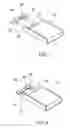
BRIEF DESCRIPTION OF THE DRAWINGSFIG. 1 is schematic drawing showing the structure of a cell and a circuit board for a secondary battery according to the present invention.
FIG. 2 corresponds to FIG. 1, showing the cell and the circuit board bonded together.
DETAILED DESCRIPTION OF THE INVENTIONReferring to FIGS. 1 and 2, a secondary battery fabrication method in accordance with the present invention is shown comprising:
Step I: preparing a cell 10 from Li-polymer, which has a positive terminal 12 and a negative terminal 14, and a circuit board 20, which has a protection circuit 26 for overcharge protection;
Step II: bonding a first plate electrode 22, which is prepared from nickel aluminum alloy, and a second plate electrode 24, which is prepared from nickel, to the circuit board 20 by means of surface mounting technique (SMT); and
Step III: connecting the cell 10 to the circuit board 20 by spot welding to bond the positive terminal 12 to the first plate electrode 22 and the negative terminal 14 to the second plate electrode 24 respectively.
According to the aforesaid procedure, the first plate electrode 22 and the second plate electrode 24 are bonded to the circuit board 20 before connection of the circuit board 20 to the cell 10, the first plate electrode 22 of nickel aluminum alloy and the second plate electrode 24 of nickel can respectively easily be bonded to the positive terminal 12 and negative terminal 14 of the cell 10. Because bonding between the cell 10 and the circuit board 20 does not affect the performance of the cell 10, the yield rate of the present invention is high. Further, because the plate electrodes 22 and 24 are bonded to the circuit board 20 by means of SMT, the bonding procedure can be done at a high speed with less labor, thereby increasing the productivity and lowering the product cost.
Therefore, the secondary battery fabrication method of the present invention achieves a high manufacturing speed, increases the yield rate, and saves the manufacturing cost.
Further, During Step III, instead of the spot welding a high-frequency sealing or ultrasonic welding process may be employed to bond the circuit board and the cell together, achieving the same effect.
Claims
What is claimed is:1. A method of making a secondary battery comprising the steps of:
(a) providing a circuit board and a cell having a positive terminal and a negative terminal;
(b) bonding a first plate electrode and a second plate electrode to said circuit board; and
(c) connecting said cell to said circuit board by bonding said positive terminal to said first plate electrode and said negative terminal to said second plate electrode respectively.
2. The method as claimed in claim 1, wherein said first plate electrode and said second plate electrode are respectively bonded to said circuit board by surface mounting technique in step (b).
3. The method as claimed in claim 1, wherein said cell and said circuit board are bonded together in step (c) by spot welding.
4. The method as claimed in claim 1, wherein said cell and said circuit board are bonded together in step (c) by ultrasonic welding.
5. The method as claimed in claim 1, wherein said cell and said circuit board are bonded together in step (c) by high frequency welding.
6. The method as claimed in claim 1, wherein said first plate electrode is prepared from nickel aluminum alloy.
7. The method as claimed in claim 1, wherein said second plate electrode is prepared from nickel.
Images & Drawings included:

Sources:
- United States Patent and Trademark Office - verify current appl. status at the USPTO↗
Similar patent applications:
- » 20100243951
NEGATIVE ELECTRODE MATERIAL FOR NONAQUEOUS ELECTROLYTE SECONDARY BATTERY, MAKING METHOD AND LITHIUM ION SECONDARY BATTERY - » 20100288970
NEGATIVE ELECTRODE MATERIAL FOR NONAQUEOUS ELECTROLYTE SECONDARY BATTERY, MAKING METHOD AND LITHIUM ION SECONDARY BATTERY - » 20080057385
Separator for non-aqueous secondary battery, making method, and non-aqueous electrolyte secondary battery - » 20120052192
Separator for non-aqueous secondary battery, making method, and non-aqueous electrolyte secondary battery - » 20110123839
Secondary battery and method of making secondary battery - » 20100291432
Secondary battery and method of making the secondary battery - » 20110008672
Secondary battery and method of making the secondary battery - » 20210359375
Separator structure for secondary battery, method for making the separator, and the secondary battery using the same - » 20080314482
Electrode active material, electrode, lithium-ion secondary battery, method of making electrode active material, and method of making lithium-ion secondary battery - » 20080199778
Electrode for secondary batteries and method for making same, and secondary batteries using the electrode
Recent applications in this class:
- » 20230335869 2023-10-19
Sealed battery - » 20230246310 2023-08-03
DESIGNS OF HIGH-POWER GEL-ASSISTED BIPOLAR SOLID-STATE BATTERY - » 20230155258 2023-05-18
BATTERY PACK - » 20230111837 2023-04-13
BATTERY CONNECTION APPARATUS FOR VEHICLE - » 20230083571 2023-03-16
BATTERY WITH AN ASYMMETRIC DESIGN AND ELECTRONIC DEVICES WITH AN ASYMMETRIC BATTERY DESIGN - » 20220352607 2022-11-03
DYNAMIC PORTABLE POWER PACK APPARATUS - » 20220271404 2022-08-25
Method for producing battery module - » 20220216576 2022-07-07
Electronic device - » 20220158312 2022-05-19
Battery - » 20220037749 2022-02-03
Electrochemical cells and methods of manufacturing the same
Recent applications for this Assignee:
- » 20060121356 2006-06-08
Electrolyte for rechargeable battery - » 20050274002 2005-12-15
Process for fabricating rechargeable polymer batteries