Access unit with variable size opening for construction application
US20060260217A1
2006-11-23
10/529,573
2003-10-17
✅ Patent granted
US 7,845,119 B2
2010-12-07
WO; PCT/GB03/04496; 20031017
WO; WO2004/035961; 20040429
Brian E Glessner | Omar Hijaz
2026-08-11
Abstract:
A constructional unit comprising: a support frame which is O-shaped in plan bounding an open central region, the support frame including first and second members which are each U-shaped in plan, each member being in the form of a base frame from which extend two side arms; the first and second members having their side arms telescopically engaged to define sides to the open central region of the O-shaped support frame; the telescopic engagement providing for—the spacing of the first base frame from the second base frame to be adjustable over a range of distance; and the temporary securing of the first member to the second member at a predetermined spacing; the base frame of the first member being adapted for location at a first level at a first working location; the second member being adapted, at a position remote from the first member, for location at a second level at a second working location by way of at least one leg pivotably attached at or near one end of the, or each, leg to the base frame of the second member or to a side arm thereof; the opposite end to the one end of the, or each, leg being adapted for location on the second working location; the second level being offset from and below the first level.
Inventors:
- Robert David Black 2 🇬🇧 Bicester, United Kingdom
- John Alexander Black 2 🇬🇧 Bicester, United Kingdom
- Robert David Black 1 🇬🇧 Bicester OX25 5LB, United Kingdom
- John Alexander Black 1 🇬🇧 Bicester, OX25 5LB, United Kingdom
Interested in similar patents?
Get notified when new applications in this technology area are published.
Classification:
E06C1/00 IPC
Ladders in general
E04G1/36 » CPC main
Scaffolds primarily resting on the ground Scaffolds for particular parts of buildings or buildings of particular shape, e.g. for stairs, cupolas, domes
E04G1/365 » CPC further
Scaffolds primarily resting on the ground; Scaffolds for particular parts of buildings or buildings of particular shape, e.g. for stairs, cupolas, domes specially adapted for staircases or stairs
E04G21/3204 » CPC further
Preparing, conveying, or working-up building materials or building elements ; Other devices or measures for constructional work; Safety or protective measures for persons during the construction of buildings against falling down
E04G2001/157 » CPC further
Scaffolds primarily resting on the ground essentially comprising special means for supporting or forming platforms ; Platforms Extensible platforms, e.g. telescopic platforms
E04G21/26 IPC
Preparing, conveying, or working-up building materials or building elements ; Other devices or measures for constructional work; Safety or protective measures preventing damage to building parts or finishing work during construction Strutting means for wall parts; Supports or the like, e.g. for holding in position prefabricated walls
E04G21/04 IPC
Preparing, conveying, or working-up building materials or building elements ; Other devices or measures for constructional work; Conveying or working-up concrete or similar masses able to be heaped or cast Devices for both conveying and distributing
E04H12/00 IPC
Towers; Masts or poles; Chimney stacks; Water-towers; Methods of erecting such structures
A62B1/22 IPC
Devices for lowering persons from buildings or the like by making use of jumping devices, e.g. jumping-sheets, jumping-mattresses
Description
TECHNICAL FIELDThis invention relates to a constructional unit.
BACKGROUND ARTIn erecting a building having more than one floor level there usually arises a need for a space to be left in a floor typically to install stairs between that and another floor. Such an opening needs to be protected in some way to prevent accidents arising from people or articles inadvertently dropping through the space. However the form of protection used should preferably not lead to access problems for acceptable use. A number of proposals have been made to enable such a space to be protected. However these do result in limitation, if not prevention, of the use of the space for passage of people or transfer of articles.
DISCLOSURE OF INVENTIONAccording to the present invention there is provided a constructional unit comprising:
-
- a support frame which is O-shaped in plan bounding an open central region, the support frame including first and second members which are each U-shaped in plan, each member being in the form of a base frame from which extend two side arms; the first and second members having their side arms telescopically engaged to define sides to the open central region of the O-shaped support frame; the telescopic engagement providing for—
- the spacing of the first base frame from the and second base frame to be adjustable over a range of distances; and
- the temporary securing of the first member to the second member at a predetermined spacing;
- the base frame of the first member being adapted for location at a first level at a first working location;
- the second member being adapted, at a position remote from the first member, for location at a second level at a second working location by means of at least one leg pivotably attached at or near one end of the, or each, leg to the base frame of the second member or to a side arm thereof; the opposite end to the one end of the, or each, leg being adapted for location on the second working location; the second level being offset from and below the first level.
According to a first preferred version of the present invention the, or each, leg can be varied in length to provide for the support frame to be maintained horizontal or at a predetermined angle to the horizontal.
According to a second preferred version of the present invention or of the first preferred version thereof a platform member is provided to which, in a first working position, serves to fill the open central region of the support frame so as to prevent the inadvertent passage of an article or person from above the support unit through the otherwise open central region and a second working position where the platform member is withdrawn to allow access through the open central region. Typically the platform member is, at least in part, of openwork construction to enable a view to be obtained through the open central region, when the platform member is in the first working position.
BRIEF DESCRIFION OF DRAWINGSAn exemplary embodiment of the present invention will now be described with reference to the accompanying drawings of a constructional unit of which:
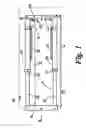
FIG. 1 is a plan view;
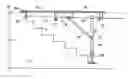
FIG. 2 is a side view in direction of arrow II of FIG. 1; and
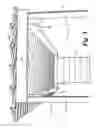
FIG. 3 is a pictorial end view of a mock up of significant parts of the unit of FIGS. 1 and 2 being used in combination with a movable platform.
MODE FOR CARRYING OUT THE INVENTIONThe figures variously show a constructional unit 11.
The unit 11 includes a support frame made up of first member 13 and a second member 14 which are each U-shaped in plan. First member 13 comprises a base frame 15 from which extend side arms 16, 17. Second member 14 is in the form of a base frame 18 from which extend side arms 19, 20.
Side arm 16 is telescoped with side arm 20 and side arm 17 is telescoped with side arm 19 to provide an O-shaped support frame around a clear central region 12. The telescopic engagement provides for the spacing S of the first base frame 15 from the second base frame 18 to be varied over a range of distances depending on the gap to be filled. Clamps C1, C2 on, respectively, ends 19A, 20A provide for the securing of the telescoped side arms of the first member 13 and the second member 14 at a predetermined value of spacing S.
The base frame 15 of the first member 13 includes a flange 15A by means of which the unit 11 is located in an opening 20 in floor F2 at a height L1, above a lower floor F1. The opening 20 forms the top of a stair well for stair S.
Side arm 19 has pivotably attached to it end 30 of a telescopic prop 31 with upper tube 31A and lower adjustable foot 31B. Brace 32 enables the prop 31 to be fixed in the extended position shown in FIG. 2. When the unit 11 is not in use the prop 31 can be folded to lie beneath side arm 19.
Side arm 20 has pivotably attached to it end 34 of a telescopic prop 35 with upper tube 35A and lower adjustable foot 35B. Brace 36 enables the prop 35 to be fixed in the extended position comparable to that of shown to that of prop 31 in FIG. 2. When the unit 11 is not in use the prop 35 can be folded to lie beneath side arm 20.
In use the props 31,35 are extended as shown in FIG. 2 with the braces 32, 36 secured and the feet 31B, 35B are extended and clamped to ensure that the second base frame 18 is positioned in the opening 20 with the side arms 16, 17, 19, 20 are substantially horizontal. This configuration of the unit 11 while providing a secure structure does not intrude into the stair S and leaves a clear space A between the props (see FIG. 3) so that access is readily available to the foot of the stair S for individuals or equipment to pass between floors F1, F2.
INDUSTRIAL APPLICABILITYThe constructional unit 11 provides for a secure mounting to lie within opening 20. It is further provided with a closure member 40 in the form of a folding lattice (FIG. 3) of aluminium alloy which while being light is of substantial strength. A suitable closure member for this purpose is the safety unit the subject of our UK Application 2,339,824. This member 40 is readily slid into place to close, or out of position to give access to, opening 20. Being of openwork construction it is possible for somebody wishing to use the stairs S (whether to ascend or descend) to view the region they wish to enter to establish whether or not it is safe to move the closure member 40. When in pace the closure member 40 serves to prevent people or objects cannot inadvertently fall through opening 20.
Second base frame 18 lies within space 20 and is supported there by telescopic props 31, 35. To ensure that the frame 18 is laterally supported when space 20 is otherwise clear of the frame 18 a pair of lateral props 41, 42 are provided which can be driven outwardly to seat against the side of the space 20 and be locked their to limit lateral movement of frame 18 and so stabilise unit 11.
Claims
1. A constructional unit characterised by:
a support frame which is O-shaped in plan bounding an open central region, the support frame including first and second members which are each U-shaped in plan, each member being in the form of a base frame from which extend two side arms; the first and second members having their side arms telescopically engaged to define sides to the open central region of the O-shaped support frame; the telescopic engagement providing for—
the spacing of the first base frame from the and second base frame to be adjustable over a range of distances; and
the temporary securing of the first member to the second member at a predetermined spacing;
the base frame of the first member being adapted for location at a first level at a first working location;
the second member being adapted, at a position remote from the first member, for location at a second level at a second working location by means of at least one leg pivotably attached at or near one end of the, or each, leg to the base frame of the second member or to a side arm thereof; the opposite end to the one end of the, or each, leg being adapted for location on the second working location; the second level being offset from and below the first level.
2. A constructional unit as claimed in claim 1 characterised in that the, or each, leg can be varied in length to provide for the support frame to be maintained horizontal or at a predetermined angle to the horizontal.
3. A constructional unit as claimed in any preceding claim characterised by a platform member which, in a first working position, serves to fill the open central region of the support frame so as to prevent the inadvertent passage of an article or person from above the support unit through the otherwise open central region and a second working position where the platform member is withdrawn to allow access through the open central region.
4. A constructional unit as claimed in claim 3 characterised by a platform member which is, at least in part, of openwork construction to enable a view to be obtained through the open central region, when the platform member is in the first working position.
5. A constructional unit characterized by:
a support frame which is O-shaped in plan bounding an open central region, the support frame including first and second members which are each U-shaped in plan, each member being in the form of a base frame from which extend two side arms; the first and second members having their side arms telescopically engaged to define sides to the open central region of the O-shaped support frame; the telescopic engagement providing for:
the spacing of the first base frame from the second base frame to be adjustable over a range of distances; and
the temporary securing of the first member to the second member at a predetermined spacing;
the base frame of the first member being adapted for location at a first level at a first working location;
the second member being adapted, at a position remote from the first member, for location at a second level at a second working location by means of at least one leg pivotably attached at or near one end of the, or each, leg to the base frame of the second member or to a side arm thereof; the opposite end to the one end of the, or each, leg being adapted for location on the second working location; the second level being offset from the below the first level.
6. The constructional unit as claimed in claim 5, wherein the, or each, leg can be varied in length to provide for the support frame to be maintained horizontal or at a predetermined angle to the horizontal.
7. The constructional unit as claimed in claim 5, wherein a platform member which, in a first working position, serves to fill the open central region of the support frame so as to prevent the inadvertent passage of an article or person from above the support unit through the otherwise open central region and a second working position where the platform member is withdrawn to allow access through the open central region.
8. The constructional unit as claimed in claim 7, wherein a platform member which is, at least in part, of openwork construction to enable a view to be obtained through the open central region, when the platform member is in the first working position.
Images & Drawings included:

Sources:
- United States Patent and Trademark Office - verify current appl. status at the USPTO↗
Recent applications in this class:
- » 20200149299 2020-05-14
ACCESSIBLE WORK OVER PLATFORM WITH OUTRIGGER SYSTEM, APPARATUS, AND METHOD - » 20190309532 2019-10-10
SUPPLY SCAFFOLD FOR ARRANGING IN THE INTERIOR OF A TOWER, SCAFFOLD MODULE, TOWER, WIND TURBINE AND METHOD FOR ERECTING AND/OR OPERATING A SUPPLY SCAFFOLD AND FOR ERECTING A TOWER - » 20190017281 2019-01-17
Aircraft Access / Safety Units - » 20180230701 2018-08-16
Founding System - » 20170292279 2017-10-12
SCAFFOLDING ARRANGEMENT - » 20150152653 2015-06-04
PLATFORM - » 20150068840 2015-03-12
Platform for accessing a hydraulic machine and methods for installing and disassembling such a platform in a suction tube - » 20090236180 2009-09-24
Manhole construction safety and work platform device - » 20090173577 2009-07-09
WORKING PLATFORM - » 20050247008 2005-11-10
Scaffolding device for work on inner wall face of tower vessel body, and method of work on inner wall face using the scaffolding device