Peak Velocity Detector
US20060260396A1
2006-11-23
11/308,836
2006-05-12
Abstract:
A device that provides an output at the instant that peak velocity is reached. It is comprised of two main components, namely an acceleration detection switch connected in series with another acceleration detection switch.
Interested in similar patents?
Get notified when new applications in this technology area are published.
Classification:
A63B69/3632 » CPC main
Training appliances or apparatus for special sports for golf for driving Clubs or attachments on clubs, e.g. for measuring, aligning
A63B15/00 » CPC further
Clubs for gymnastics or the like, e.g. for swinging exercises
G01P3/22 » CPC further
Measuring linear or angular speed; Measuring differences of linear or angular speeds; Devices characterised by the use of mechanical means by using centrifugal forces of solid masses transferred to the indicator by electric or magnetic means
G01P15/135 » CPC further
Measuring acceleration; Measuring deceleration; Measuring shock, i.e. sudden change of acceleration by making use of inertia forces using solid seismic masses with conversion into electric or magnetic values by making use of contacts which are actuated by a movable inertial mass
A63B2220/40 » CPC further
Measuring of physical parameters relating to sporting activity Acceleration
G01P15/00 IPC
Measuring acceleration; Measuring deceleration; Measuring shock, i.e. sudden change of acceleration
Description
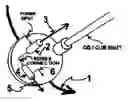
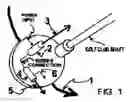
FIG. 1 depicts the peak velocity detector mounted on a golf club shaft. It can be mounted on any item that will move along a curved path 1. Switch A 2, is mounted so that its acceleration sensing axis is in alignment with the centripetal acceleration 3 experienced from motion along a curved path 1. Switch B 4, which is in series with switch A 2, is oriented such that it will sense the reversal of the tangential acceleration 5 which occurs at the instant that peak velocity occurs. The output 6 from switch B 4 at peak velocity can be used as an input to a computer for processing purposes or to a visual indicator.
Using the golf swing as an example, during the downswing, prior to peak velocity, switch A 2 is “on” and provides an output continuously to switch B 4 due to the centripetal acceleration 3 that is above a predetermined magnitude acting on switch A 2 due to motion along the curved path 1. As peak velocity is approached, switch A 2 continues to provide an output to switch B 4 which, up to this time, is “off” and provides no output due to the tangential acceleration 5 acting on its acceleration sensing axis. At peak velocity, switch A 2 continues to provide an output to switch B 4 which is “on” and now provides an output 6 because the tangential acceleration 5 reversed direction. The series circuit is now complete at peak velocity, thereby causing the output 6 from the peak velocity detector at switch B 4.
Claims
What is claimed is:1. A peak velocity detector, comprising:
an acceleration sensing switch, hereby designated as (switch A), that is “off” while an acceleration below a predetermined magnitude is sensed along its acceleration sensing axis or “on” while an acceleration at or above the predetermined magnitude is sensed along its acceleration sensing axis and
a second acceleration sensing switch, hereby designated as (switch B), that switches from “off” to “on” at the instant when an acceleration sensed along its acceleration sensing axis reverses direction.
2. A peak velocity detector as recited in claim 1, wherein said (switch A) is functionally connected in series to said (switch B).
3. A peak velocity detector as recited in claim 2, wherein the said (switch A) acceleration sensing axis is oriented orthogonal to the said (switch B) acceleration sensing axis.
4. A peak velocity detector as recited in claim 3, wherein said (switch B) provides an output from the instant that peak velocity occurs.
Images & Drawings included:
Sources:
- United States Patent and Trademark Office - verify current appl. status at the USPTO↗
Recent applications in this class:
- » 20250135314 2025-05-01
Swing Speed Training Device - » 20250128135 2025-04-24
SYSTEM AND METHOD FOR GOLF SUPER TAG MULTIFUNCTION GOLF SWING CAPTURE AND ANALYSIS DEVICE - » 20250065211 2025-02-27
APPARATUS AND METHOD FOR GOLF ALIGNMENT TRAINING - » 20240382819 2024-11-21
GOLF LESSON SYSTEM USING TACTILE STIMULATION AND GOLF LESSON METHOD USING THE SAME - » 20240350886 2024-10-24
GOLF SWING TRAINING DEVICE AND METHODS OF USE - » 20240299823 2024-09-12
Counterweighted Golf Club Swing Training Apparatus - » 20240226692 2024-07-11
GOLF SHOT TRACKING SYSTEM - » 20240189693 2024-06-13
Apparatus and method for golf alignment training - » 20240173604 2024-05-30
Swing motion trainer - » 20240001212 2024-01-04
GOLF TRAINER DEVICE